Key Takeaway
- 🏭 Why the big buyers build their own: custom AI chips are how OpenAI, Google, Amazon, Meta, Microsoft and Anthropic escape the two costs of the NVIDIA path — price and queue. NVIDIA’s GPUs remain the fastest general route (and the CUDA moat still anchors it), but a hyperscaler training thousands of identical models sees the GPU bill before it sees the benchmark.
- 📅 The record, dated: OpenAI-Broadcom announced a 10-gigawatt collaboration on October 13, 2025, with rack deployments starting H2 2026 and completing by end-2029; the first chip, “Jalapeño,” was unveiled June 24, 2026 (initial deployment targeted by end-2026, “really ramp up in ’27 and really going full tilt in first half ’28” per Broadcom’s CEO); Broadcom also supplies Google TPUs through 2031 and runs Meta’s expanded custom-chip partnership (announced April 14, 2026, 1+ GW initially) and an Anthropic compute arrangement.
- ⚔️ NVIDIA’s counters remain real: the CUDA software moat, the fastest general-purpose silicon, a deployment ecosystem measured in months rather than years — and the cautionary tales Microsoft (Maia) and Meta (MTIA) prove design programs can slip years behind schedule.
- 🧮 What custom actually wins: predictable supply (own fab commitments), workload fit (inference-first designs like Google’s TPU line), margin recapture at scale, and the power-to-intelligence ratio — not headline benchmark wins.
- 🔭 The honest verdict: the GPU remains the default for everything exploratory and the custom lines serve the known workloads at scale — the market is splitting by task certainty, and Broadcom sits at the center of the shift as the merchant forge for everyone’s custom chip.
Custom AI chips vs NVIDIA is the infrastructure question of the 2026 build cycle — and the answer is arriving one dated announcement at a time. On October 13, 2025, OpenAI and Broadcom announced a 10-gigawatt collaboration to design and deploy OpenAI’s own accelerators, racks starting in the second half of 2026 and completing by end-2029; on June 24, 2026, the partnership unveiled its first chip — codenamed Jalapeño, an “Intelligence Processor” — with a physical sample delivered to OpenAI that day and Broadcom’s CEO Hock Tan telling CNBC the program will “really ramp up in ’27 and really going full tilt in first half ’28.” Broadcom’s custom-chip book carries Google (TPU supply through 2031), Meta (an expanded partnership announced April 14, 2026) and Anthropic. NVIDIA still sells the fastest general-purpose path — and the CUDA moat holds. This guide dates the whole roster, explains the four real reasons big buyers go custom, weighs NVIDIA’s counters, and reads the cautionary tales that keep the honest scoreboard.
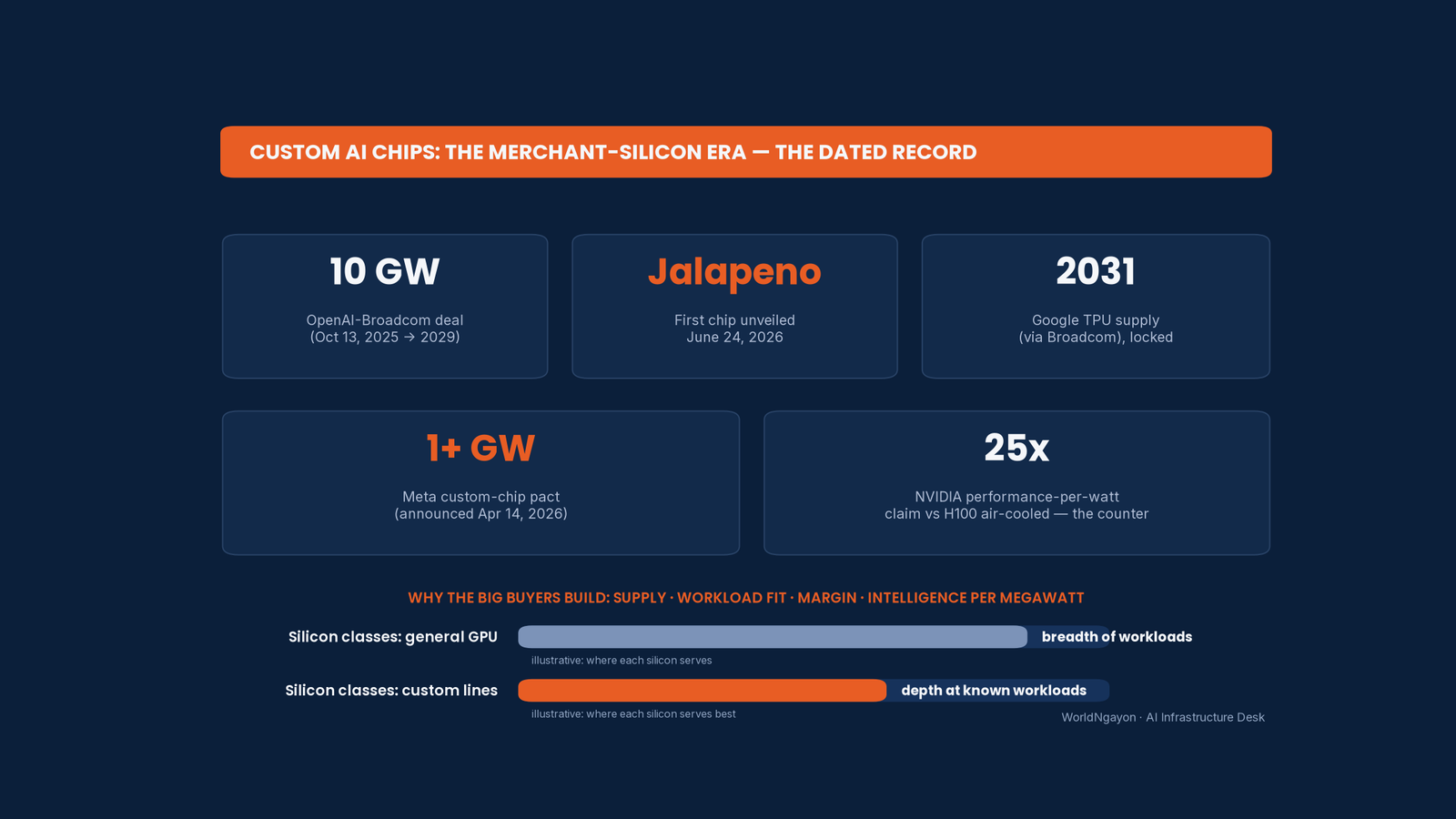
Table of Contents
Custom AI Chips vs NVIDIA: the question decoded
The comparison, decoded into its real questions: when buyers weigh custom AI chips vs NVIDIA GPUs, five things trade off — peak performance (NVIDIA leads the general case), workload fit (a custom silicon designed for your exact inference load beats a general chip on the metrics that workload cares about), unit economics at scale (the GPU carries NVIDIA’s margin), supply predictability (own-designed chips ride your own fab commitments), and software (CUDA’s decade of tooling vs each custom line’s stack). A custom chip is a bet that your workload is known enough, large enough and stable enough for the fit-and-economics columns to pay for giving up the benchmark and the ecosystem. The buyers making that bet in 2026 are the ones whose workloads meet all three conditions — which is why the roster is not a rebellion against NVIDIA but a maturity statement.
WorldNgayon Analysis: the honest framing avoids the binary the headlines sell. NVIDIA is not being displaced; it is being ROUTED AROUND at the edges where volume concentrates. The general GPU serves exploration, development, fast-changing workloads and everyone without ten gigawatts of certainty — a far larger number of customers than the hyperscalers. The custom lines carve the steady-state core. Both layers grow if AI demand grows; the share of the middle is the market’s real question (the capex-economics pieces carry the spend side).
Bottom Line: custom AI chips vs NVIDIA is not a winner-take-all fight — it is a routing of workloads by certainty, with margins as the scoreboard.
Who builds what: the custom chips roster, dated
| Player | Custom line | Dated status (as reported) |
| TPUs | The template: TPU generations scaling for years; Broadcom supplies parts of the line through 2031; October 2026 — TPUs opened to a NEW customer class (OpenAI announced buying them — the merchant flip) | |
| OpenAI + Broadcom | Jalapeño (“Intelligence Processor”) | 10-GW collaboration announced Oct 13, 2025; first chip unveiled June 24, 2026; prototype in late 2026; ramp 2027; full tilt 1H-2028; deployment completing by end-2029 |
| Amazon | Trainium | Shipped generations powering AWS AI services; the established merchant-hyperscaler split (own chips for steady loads, NVIDIA for the rest) |
| Meta | MTIA + the Broadcom line | Expanded custom-chip partnership with Broadcom announced April 14, 2026 through 2029 — 1+ GW initial compute; the MTIA design program continues in parallel |
| Microsoft | Maia | The cautionary tale: reported delays and underdelivery vs plan — custom programs can slip years |
| Anthropic | Broadcom compute arrangement | Compute-backed arrangement in Broadcom’s 2026 book (the lab buying capacity rather than designing silicon) |
The merchant flip that changed the game (October 2026): OpenAI — the buyer behind the biggest custom-chip build — also announced buying Google’s TPUs, the merchant custom line. The same buyer on BOTH sides (designing with Broadcom, buying from Google) is the cycle’s clearest signal that custom and merchant silicon are now complementary layers, not substitutes: you design for your signature load and rent for everything else (our AI World This Week coverage dates that story).
WorldNgayon Analysis: Broadcom’s book is the roster’s quiet center: one merchant forge now carries OpenAI’s design program, parts of Google’s TPU line through 2031, Meta’s expanded 1-GW commitment and an Anthropic arrangement — the “Silent Winner of the AI Chip Race” framing the April coverage sold. The forge position is structurally brilliant: every custom program’s silicon still flows through one vendor — concentration risk worth naming in any infrastructure investment read (the money-trail pieces track that exposure).
Bottom Line: five builders, one forge — and the October TPU flip made custom and merchant silicon colleagues, not rivals.
Why the big buyers go custom: the four real reasons
1 — Supply predictability: the GPU market’s allocations, lead times and price pressure become the buyer’s own problem; a designed chip rides fab commitments you control. In a build cycle measured in gigawatts, supply certainty is strategy — the reason the deals are quoted in gigawatts and years (10 GW for OpenAI-Broadcom; 1+ GW for Meta’s first phase; multi-year horizons for Google’s line).
2 — Workload fit: a chip designed for YOUR inference pattern (batch sizes, sequence lengths, quantization choices) strips the generality tax. Google’s TPU line proves the thesis at scale: purpose-built for tensor workloads, delivering competitive throughput per dollar at hyperscale for years. The custom win is efficiency at the WORKLOAD level — measured where the bills are, not on launch-day benchmarks (the serving-economics pieces carry the workload-fit frame).
3 — Margin recapture: every GPU premium avoided at trillion-scale sums to budget-defining amounts; the hyperscalers’ custom lines are partly a negotiation posture, and the posture works — NVIDIA’s pricing visibly flexed as the custom programs matured. The who-pays analysis carries how that margin story reaches the infrastructure layer.
4 — The power-to-intelligence ratio: the binding constraint of the 2026 cycle is power (the grid-side pieces carry it) — and a workload-fit chip converts a given gigawatt into more tokens per second. At hyperscale, intelligence-per-megawatt is the metric; custom silicon is its lever.
Bottom Line: supply, fit, margin, megawatts — the four reasons all reduce to owning your curve instead of renting it.
NVIDIA’s counters: why the GPU persists
Counter 1 — the CUDA moat against custom AI chips: a decade of models, kernels, libraries and trained engineers make the general GPU the fastest route from idea to production for most teams; custom lines carry their own stacks that must be re-learned per program. Counter 2 — the general path is simply the best at what it does: frontier training, exploratory workloads, fast-changing research — the places where flexibility outranks efficiency. Counter 3 — deployment speed: NVIDIA silicon deploys in months; a custom program needs years (OpenAI’s Jalapeño: announced October 2025, full tilt 2028 — a three-year arc even with the industry’s best forge). Counter 4 — the ecosystem flywheel: every framework release lands on the general GPU first, and the custom lines must port to keep up. The honest scoreboard read: NVIDIA persists everywhere certainty is LOW and pace is HIGH — which is most of the market most of the time.
WorldNgayon Analysis: the persistence point cuts against the easy dismissal of NVIDIA’s dominance and against its perpetuity. The custom-share grows with every confirmed deployment date; the general-share grows with every new model family. The GPU-rental market analysis carries the price side of the same balance — and the rental layer is where both silicon classes meet the buyer without a three-year commitment.
Bottom Line: the GPU persists wherever the workload changes faster than silicon can — and that describes research, not production scale.
The cautionary tales: Microsoft and Meta’s custom slips
Microsoft’s Maia program: the reported delays and underdelivery of the first Maia generations — the design launched, the deployment slipped well past plan — became the cycle’s canonical example that design programs do not run on announcement clocks. Meta’s MTIA: the in-house line kept improving while the company ALSO expanded its Broadcom partnership to 1+ gigawatt (April 2026) — the same buyer hedging its custom bet with merchant custom. Both tales teach the same lesson in opposite directions: Maia proves the RISK (programs slip); Meta proves the HEDGE (buy both). The honest custom-vs-NVIDIA read carries both: custom is a capability a hyperscaler grows over years, not a purchase it makes over quarters.
WorldNgayon Analysis: the tales also discipline the investment reads: each “X is abandoning NVIDIA” headline should be checked against the roster table’s dates — the April Meta announcement and the June Jalapeño unveiling both carried “expanded,” “ramp,” “scale” language, the vocabulary of complements rather than of exits. The claims discipline (the dated-claims ledger) applies verbatim to the silicon narrative.
Bottom Line: one slip, one hedge — the cautionary tales say custom is a decade competency, not a quarter’s decision.
What this means for work, money and the Philippines
For careers: the custom-chip era multiplies roles outside GPU-land — silicon-adjacent work (compiler toolchains for custom accelerators, kernel engineering for TPU-class lines, cluster operations for mixed fleets) grows with each deployment date on the roster; the AI-jobs analyses carry the demand map.
For investors: the custom AI chips forge position concentrates both the upside and the single-vendor risk — Broadcom’s book carries OpenAI’s 10-GW program, Google’s line through 2031, Meta’s 2029 horizon and the Anthropic arrangement; the watchlist discipline applies to the concentration read.
For Filipino professionals and OFWs: the practical angle rides the price layer: merchant TPUs rented by the hour lower the barrier for the region’s builders — the automation and services offers this site tracks (the agent-tools ledger) can price against rented TPU-class compute instead of premium GPUs. The open-source tools list and the regional jobs map carry the complementary lanes. And the infrastructure buildout’s energy story connects to the region directly: the SEA buildout analysis carries where the gigawatts land near home.
For builders: mixed fleets are the 2026 architecture — rent the general GPU for development, route steady inference to the cheapest fit, and let the custom lines absorb the volume; the tier-routing discipline applies to silicon exactly as it applies to model tiers.
Verdict: the split by task certainty
Custom AI chips vs NVIDIA, settled as a routing verdict: the buyers with known workloads at trillion-scale are building (OpenAI-Broadcom’s 10-GW Jalapeño program, dated step by step; Google’s TPU line, now merchant; Meta’s 1-GW-plus Broadcom commitment; Amazon’s Trainium fleets) while hedging with merchant purchases — and NVIDIA keeps everything else: exploration, research, the ecosystem, the speed of deployment, the CUDA moat. The four real reasons to go custom (supply, fit, margin, intelligence-per-megawatt) all reduce to owning your curve; the cautionary tales (Microsoft’s Maia slip) price the risk; and Broadcom sits at the center of the shift as the merchant forge. The market splits by task certainty — and the dates say the split just became an industry.
Sources on the record: the Broadcom investor release · the CNBC Jalapeno report.
Financial Disclaimer
This article is editorial analysis of publicly reported information, not investment or financial advice, and no outcome is promised. Figures are as reported by the named sources at the stated dates; verify before acting. Markets and infrastructure projects carry substantial risk.
The reading rule for custom AI chips coverage: grade every claim its date. The custom AI chips story now has anchors – the 10-GW OpenAI-Broadcom record from October 2025, Jalapeno’s June 2026 unveiling, Meta’s April 14 commitment, the TPU-supply lock through 2031 – and any custom AI chips headline that carries no date beside its claim is commentary, not record. Match the date before matching the conclusion.
- investors.broadcom.com/news-releases/news-release-details/openai-and-… — the Broadcom investor release
- cnbc.com/2026/06/24/openai-and-broadcom-reveal-jalapeno-first-ai-chip… — the CNBC Jalapeno report
External sources linked in this article, in order of first mention. Spotted an error or a broken link? Tell us.
Cite this pagePublished Nov 2, 2026
Agron, E. (2026, November 2). Custom AI Chips vs NVIDIA: Why the Big Buyers Are Building Their Own. WorldNgayon. https://worldngayon.com/custom-ai-chips/
Agron, Edmon. “Custom AI Chips vs NVIDIA: Why the Big Buyers Are Building Their Own.” WorldNgayon, 2 Nov. 2026, worldngayon.com/custom-ai-chips/.
Agron, Edmon. “Custom AI Chips vs NVIDIA: Why the Big Buyers Are Building Their Own.” WorldNgayon, November 2, 2026. https://worldngayon.com/custom-ai-chips/.
Agron, E. (2026) ‘Custom AI Chips vs NVIDIA: Why the Big Buyers Are Building Their Own’, WorldNgayon, 2 November. Available at: https://worldngayon.com/custom-ai-chips/.
E. Agron, “Custom AI Chips vs NVIDIA: Why the Big Buyers Are Building Their Own,” WorldNgayon, Nov. 2, 2026. [Online]. Available: https://worldngayon.com/custom-ai-chips/
@online{agron2026customai,
  author       = {Agron, Edmon},
  title        = {{Custom AI Chips vs NVIDIA: Why the Big Buyers Are Building Their Own}},
  year         = {2026},
  date         = {2026-11-02},
  organization = {WorldNgayon},
  url          = {https://worldngayon.com/custom-ai-chips/},
  urldate      = {}
}TY - ELEC AU - Agron, Edmon TI - Custom AI Chips vs NVIDIA: Why the Big Buyers Are Building Their Own T2 - WorldNgayon PY - 2026 DA - 2026/11/02/ UR - https://worldngayon.com/custom-ai-chips/ Y2 - ER -
Cite the version you read; the page may be updated. Zotero and Mendeley can also import this page directly.