OpenAI will buy Google TPUs — the supply flip that ended a decade of one-vendor dependence arrived this week, when reports on October 28 surfaced that OpenAI plans to purchase Google TPUs after making its frontier models available through Google Cloud the week before. It is the headline of a week where the AI economy’s money plumbing got louder on every channel: SK hynix posted the first quarter above 100 trillion won in company history on October 28 (operating profit +632% year-on-year), Binance confirmed the largest crypto hack ever reported and halted withdrawals on October 30, the peso hit a record low at 64.17 to the dollar, the Federal Reserve held rates, and the AI crash question — the one this site mapped in a five-piece series this week — moved from corner-of-the-internet to institutional monitoring, with the IMF naming an AI market correction a salient financial-stability risk. This is AI World This Week #016, the WorldNgayon Intelligence Brief covering October 25-31, 2026 — the issue where the Google TPUs question stopped being hypothetical — the week the AI money story became the AI risk story.
Table of Contents
Executive Brief
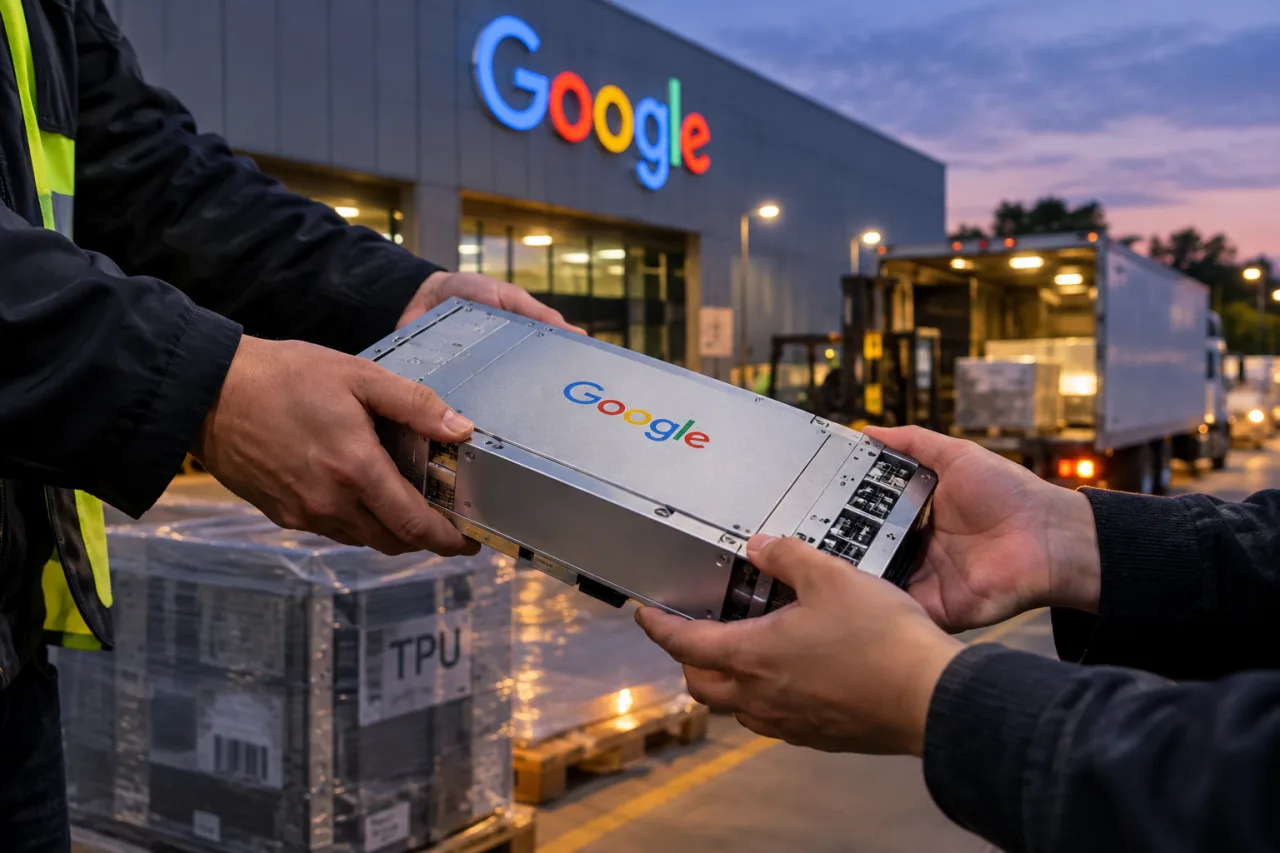
1. The supply flip: Reuters carried a report on October 28 that OpenAI plans to buy Google TPUs — the plan that deepens commercial ties between the two rivals and puts Google TPUs inside the biggest AI buyer’s procurement list for the first time, following OpenAI’s expansion to Google Cloud (frontier models through Model Garden and Marketplace) and its deals with AMD — making OpenAI the first AI lab with live purchasing relationships across all three US clouds and two chip vendors. Alphabet expects to begin recognizing a small share of TPU-sales-agreement revenue by end-2026, with the majority in 2027 (CFO Anat Ashkenazi’s prior guidance).
2. The memory maker’s ₩100-trillion quarter: SK hynix’s official Q3 2026 release (published the same day the Google TPUs plan surfaced) (published October 28) showed revenue of 104.62 trillion won (+32% QoQ, +328% YoY — the first quarter above 100 trillion won in company history) and operating profit of 83.33 trillion won (+38% QoQ, +632% YoY) at an 80% operating margin. Management said long-term agreements now cover more than half of production capacity for the next two years — DRAM and HBM volumes effectively sold out through 2029 — and expects HBM4 to overtake HBM3E in quarterly share this quarter.
3. The risk week: the Open Markets Institute’s October report documented OpenAI’s annualized revenue coming in $20 billion below a widely-reported figure and Nvidia- and Blackstone-backed Firmus Technologies abandoning its planned IPO after investors balked; Fitch warned a sharp AI-stock correction could plunge the US into recession; the IMF named an AI-driven market correction as a salient financial-stability risk; crypto’s largest hack (Binance, October 30) hit the same asset-complexity culture. The overall week reads as ★★★★☆ (4/5) for AI — enormous real-economy momentum with the risk layer now institutionally priced.
AI World This Week — Weekly Brief
| Field | This Week |
| Issue | #016 (October 25-31, 2026) |
| Top Story | OpenAI plans to buy Google’s TPUs (reported October 28); SK hynix’s record ₩104-trillion quarter the same day |
| Key Themes | Supply diversification; the memory supercycle; the AI crash question going institutional; crypto-market damage; PH currency pressure |
| Models in Play | GPT-6.1 Terra (reported late October), Gemini 4 Argon, Claude 5.5 family, MiniMax M3.1 Flash, Mistral Large 4, Nano Banana 2.1 |
| Market Signal | Chips up (SK hynix +632% profit); fear priced (IMF/Fitch language); peso at 64.17 record low; Binance withdrawals halted |
Quick Facts
The Google TPUs flip, in quick-facts form
The top story: the OpenAI-Google chip flip (reported October 28, 2026)
| Fact | Detail |
| Reported | October 28, 2026 (The Information, carried by Reuters) |
| What | OpenAI plans to buy Google TPUs — the same TPUs that power Google’s own AI supercomputers |
| Context | Follows OpenAI frontier models arriving on Google Cloud (Model Garden, Marketplace) — reported the week before. Buying Google TPUs completes a map that already holds Nvidia systems and AMD purchases |
| Buyer’s vendor map | Nvidia, AMD, and now Google chips — across Microsoft Azure, AWS, and Google Cloud |
| Seller-side signal | Alphabet CFO Anat Ashkenazi previously guided: small share of TPU-sales-agreement revenue recognized in 2026, the vast majority in 2027 — the machinery for selling Google TPUs externally is installed |
| Why it matters | The chip supply relationship — the AI race’s deepest structural layer — is being repriced from rivalry to commerce |
AI This Week by the Numbers
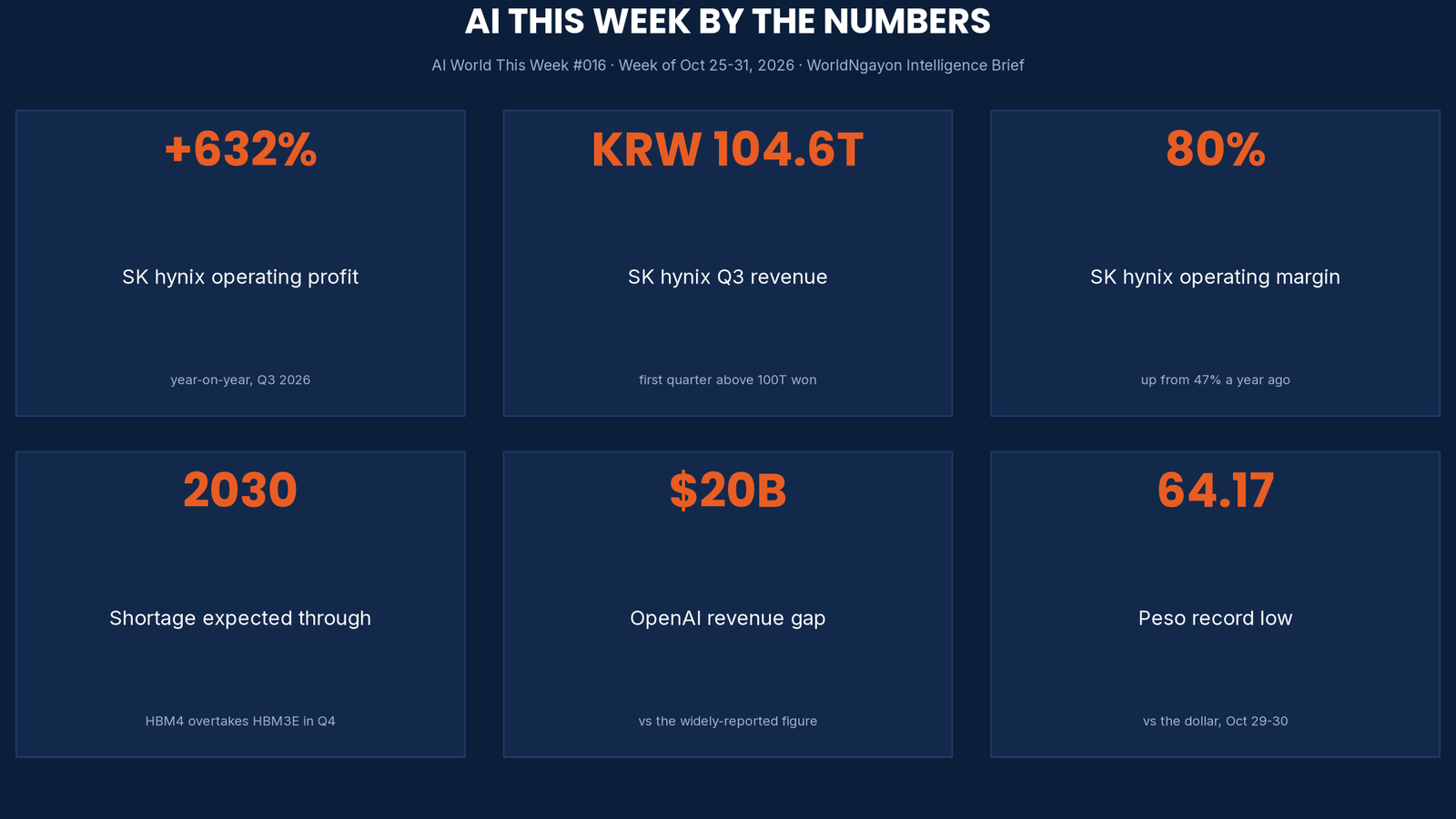
| Number | What It Is |
| +632% | SK hynix operating profit, year-on-year (Q3 2026) |
| ₩104.6T | SK hynix Q3 revenue — first quarter above ₩100 trillion in company history |
| 80% | SK hynix operating margin (up from 76% in Q2, 47% in Q3 2025) |
| 2030 | Year through which SK hynix expects memory demand to exceed supply |
| $100B | Nvidia’s existing OpenAI investment — the circular-deal web’s founding strand |
| $20B | OpenAI’s annualized-revenue gap versus the widely-reported figure (Open Markets, October 2026) |
| 64.17 | The peso’s record low against the US dollar (October 29-30) |
| $6.3B | The reported scale of the Binance hack (October 30) — the largest crypto theft in history |
WorldNgayon Analysis: the week’s numbers form a single diagram: the supply chain prints records (the +632% quarter), the customers borrow to keep buying (the circular web), the institutions write the risk language (IMF/Fitch/BoE), and the peso pays the spillover bill. Sixteen issues into this series, this is the first week where all four layers moved in the same reporting cycle.
Bottom Line: the AI boom’s money week ran at full volume — and for the first time, the institutional risk layer moved at the same volume.
AI Impact Meter
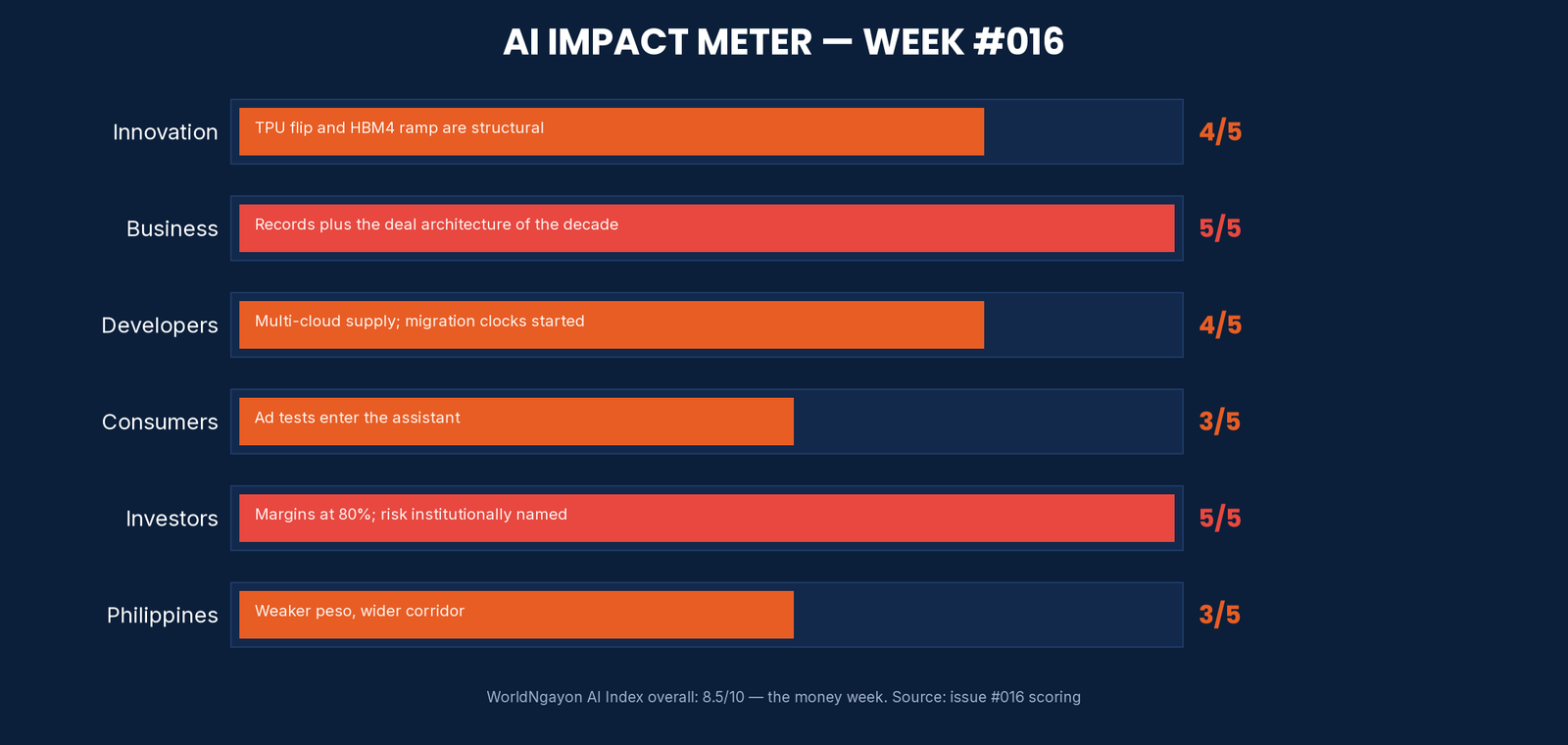
| Audience | This Week | Why |
| Innovation | ★★★★☆ | The TPU flip and HBM4 ramp are structural, not cosmetic |
| Business | ★★★★★ | A ₩100-trillion quarter plus multi-cloud supply — the deal architecture of the decade |
| Developers | ★★★★☆ | OpenAI models available via Google Cloud; the Custom-GPTs retirement deadline forcing workflow migrations; the Custom-GPTs retirement clock is the week’s only other dated event |
| Consumers | ★★★☆☆ | Google’s AI-Mode ad tests begin reshaping the assistant experience |
| Investors | ★★★★★ | Margins at 80%, concentration risk institutionally named, a $6.3B hack, and a currency at record lows |
| Philippines | ★★★☆☆ | The peso’s record-low week cuts both ways for OFW remittances; QRPh goes international |
The Week in Timeline
| Date | Event |
| Oct 25 (Sun) | Week opens with the Gemini 4 Argon family holding its arena positions; Claude 5.5 family’s price cuts from the prior week still repricing the per-token market |
| Oct 26 (Mon) | The Custom-GPTs retirement’s first deadline lands: new GPT creation ends for affected Enterprise workspaces (except FedRAMP) — the December 11 platform retirement now 46 days out |
| Oct 27 (Tue) | AI model trackers log the late-October release cycle (GPT-6.1 Terra reported in the cycle); the Open Markets Institute’s crash-risk report circulates with its OpenAI revenue-revision and Firmus findings |
| Oct 28 (Wed) | The week’s double-header: SK hynix posts the ₩104.6-trillion quarter; Reuters reports OpenAI plans to buy Google’s TPUs; Alphabet reports quarterly results with TPU-revenue recognition guidance |
| Oct 29 (Thu) | The Fed holds rates; the peso touches its record low at 64.17; terminal builder Ghostty ships version 1.4 and tops Hacker News; GM’s Nasdaq-100 ETF filing lands |
| Oct 30 (Fri) | Binance confirms the largest crypto hack in history and halts withdrawals; the peso closes the week in record-low territory |
| Oct 31 (Sat) | QRPh’s cross-border QR rollout widens the OFW payment map; this site publishes the five-piece AI-crash series and the week’s explainers |
Key Takeaway
- The supply flip is real: OpenAI’s reported plan to buy Google’s TPUs — on top of Google Cloud distribution of OpenAI models — ends the single-vendor era; OpenAI now has live relationships across three clouds and three chip sources, and Alphabet guided TPU-revenue recognition into 2027.
- The memory supercycle has a number now: SK hynix’s ₩104.6-trillion quarter with an 80% operating margin, HBM4 overtaking HBM3E this quarter, and a shortage expected through 2030 is the strongest demand confirmation in the entire supply chain.
- The risk moved institutions first: the IMF (salient stability risk), Fitch (recession warning), the Bank of England (valuation caution) and the Open Markets Institute ($20B revenue gap; a first IPO walk-away) put the AI-crash question on the official record this week — the label debate is now a monitoring exercise.
- Crypto joined the risk week: Binance’s reported $6.3B hack — the largest in crypto history — and halted withdrawals reminded every market that infrastructure risk is financial risk.
- The Philippines’ map widened and its currency weakened: QRPh’s cross-border rollout landed in the same week the peso hit 64.17 — the remittance corridor gets cheaper infrastructure in a more expensive dollar world.
1. 🤖 Models & Releases
The week’s model layer ran quieter than its money layer, but the standings moved: the late-October release cycle put GPT-6.1 Terra (reported in the cycle, accessed October 27) into the tracker conversation, the Gemini 4 Argon family held its arena positions ahead of the Gemini 3.8 Flash tier, Anthropic’s Claude 5.5 family (Haiku 5.5, Sonnet 5.5, Opus 5.5) carried its price cuts into a second week of per-token repricing, and the smaller labs — MiniMax’s M3.1 Flash, Mistral’s Large 4, Google’s Nano Banana 2.1 image model — kept the multi-front pressure on. More consequential than any single launch: the Custom-GPTs retirement’s first deadline landed Monday (October 26) — new GPT creation ends for affected Enterprise workspaces — and Anthropic’s agent-skills donation to the Agentic AI Foundation (October 22, last week’s boundary) kept the open-agent-ecosystem play running.
WorldNgayon Analysis: the model layer’s story this week is COMMODITIZATION PRESSURE — Claude’s 5.5 price cuts and the small labs’ rapid-fire releases pushed the intelligence layer toward feature competition (memory, agents, integration) while the money layer consolidated (the chip deals, the memory contracts). That inversion — expensive infrastructure, cheap intelligence — is the cleanest read of the week, and it is exactly the dynamic the crash-question series measures (the token-price trend is warning-number five on the watchlist). For builders: the intelligence you procure gets cheaper monthly; the differentiation budget belongs in workflow, evaluation and verification skills — the model field guide and the hallucination-defense discipline are the practical layers.
Bottom Line: intelligence got cheaper while the machines got more expensive — and that gap is the week’s business model in one sentence.
2. 💼 Industry & Business
The industry layer ran the week’s heaviest tape. The partnership architecture: Reuters carried the report (October 28) that OpenAI plans to buy Google TPUs — deepening ties between the search rival and the frontier lab that had just expanded onto Google Cloud, where customers can buy OpenAI frontier models through Model Garden and Marketplace under existing Google spending commitments. Add the AMD warrants and the Nvidia investment and OpenAI now sits at the center of the circular-deal web with FIVE procurement relationships — the structure this site’s circular-deals explainer maps strand by strand. The memory supercycle: SK hynix’s October 28 release — 104.62 trillion won of revenue on a first-ever 100-trillion quarter, 83.33 trillion won of operating profit (+632%), an 80% margin, DRAM and HBM sold out through 2029 on multi-year agreements covering more than half of capacity, ~100 trillion won in planned shareholder returns, and a shortage expectation running to 2030. The risk layer: the Open Markets report’s two findings (the $20B revenue gap; the Firmus IPO walk-away) moved from research blogs to the same wire cycle as the deals themselves.
The flip, unpacked: why would the largest AI buyer adopt Google TPUs in volume? Three reasons the reporting supports. 1 — bargaining power: with Nvidia bookings guaranteed and AMD warrants signed, adding Google TPUs makes every future negotiation cheaper — the buyer with three suppliers sets the terms the fourth supplier must meet. 2 — the TPU line is real capacity: Google has been operating TPUs inside its own AI supercomputers for a decade (the generational lineage this site’s TPU series covers), and its CFO has already guided external TPU-revenue recognition — small share in 2026, the vast majority in 2027 — meaning the capacity exists and the commercial machinery is installed. 3 — the inference era wants specialized silicon: inference-first designs (the Ironwood-class pods this site’s TPU architecture explainer documents) price better per delivered token than general-purpose GPUs for serving workloads — and OpenAI’s customers are serving workloads. Buying Google TPUs is not a hedge against Nvidia; it is the inference era’s procurement logic arriving at the frontier lab. The open questions stay open (volume, pricing, exclusivity terms), but the direction — Google TPUs as a merchant product at scale — is now the market’s working assumption, and every 2027 capacity projection built this week should carry that assumption.
WorldNgayon Analysis: read the three threads together and the week shows the AI economy’s real shape: the SUPPLIERS have pricing power that converts directly to profit (80% margins are oil-monopoly numbers); the CUSTOMERS are financing their purchases with each other’s capital (the web); and the MARKETS are pricing both — the concentration risk with the demand risk — simultaneously. The TPU flip is the structural tell: when the fastest-growing buyer starts buying from its rival, procurement has entered its efficiency phase, where every watt and every token gets shopped across vendors. That competition is good for prices and bad for margins somewhere — the somewhere to watch is the infrastructure financiers, not the chipmakers. This is the same architecture the crash series watches; this week it moved.
Bottom Line: the week proved the AI economy’s pricing power sits with the suppliers — and its leverage sits with the buyers.
3. 🏛 Policy & Regulation
The policy layer turned market-safety this week. The institutional risk language: the IMF named an AI-driven market correction a salient financial-stability risk; Fitch Ratings warned a sharp AI-stock correction could plunge the US into recession; the Bank of England’s standing warning (valuations could fall if infrastructure costs prove too high; investors not properly cautioned) carried into the same cycle; and the Open Markets Institute/Americans for Financial Reform report called for policymakers to commit to NOT bailing out AI companies and their banks. Consumer-side movement: Google began testing advertising in AI Mode for users who opt into Personal Intelligence by connecting Google apps — ending the assistant’s ad-free era and starting the data-governance debate about what connected-app insights may inform ads ( advertisers cannot access the connected-app data, per Google’s language).
WorldNgayon Analysis: watch how the policy layer’s verb changed: from “is it a bubble?” (2025’s debate) to “what contains it?” (2026’s preparation) — bail-out commitments, liquidity pre-positioning, disclosure pushes. For the Philippines and every emerging market, the ECB’s transmission analysis is the one to copy: the risk arrives through TRACKERS (your index funds hold the five names) before it arrives through anything local. The ad-in-AI-Mode test is worth the same market attention: when the assistant layer starts carrying the ad load, the web’s economics migrate — and the questions regulators ask next (what data feeds the ad? can the user see the boundary?) become the consumer-protection agenda of 2027. The site’s memory-and-privacy guide carries the user-side version of this exact question.
Bottom Line: the regulators stopped debating the label and started building the firebreaks — the mark of a risk that has been accepted, not dismissed.
4. 🖥 Infrastructure
Infrastructure was the week’s profit engine and its strategy layer. Memory: SK hynix’s quarter says the HBM era’s demand curve outruns capacity through 2030 — HBM4 mass production began in Q3 with HBM4 expected to overtake HBM3E in shipment and revenue share in Q4, the M15X fab ramps to maximum capacity by year-end, Yongin Phase 1 enters full operation next year, and DRAM bit shipments rose ~10% QoQ with server DDR5 up over 40% and DRAM ASPs up high-20s percent. Compute supply: the OpenAI-Google TPU report lands on the same architecture this site’s TPU series covers — Google’s inference-first TPUs (Ironwood-class) gaining the largest AI buyer — and Google TPUs entering merchant supply reframes every capacity projection (the test-time-compute demand layer and the capex structure both carry the math). If Google TPUs ship to OpenAI at scale in 2027, the inference-capacity map widens by an entire vendor family — the pods, the optical switches, the liquid cooling — exactly when memory is sold out. The Philippine Connection: the peso’s record-low week (64.17) is the remittance math story (our OFW playbook carries the plan); QRPh’s cross-border rollout (October 31) widens the payment map exactly as the currency weakens; and the region’s data-center buildout — Malaysia’s share trajectory, the Philippine corridors — reads the same TPU-and-HBM supply news as every other market, just later and smaller (the SEA race analysis carries the regional frame).
The peso week, unpacked for remitters: the 64.17 record low (October 29-30) is the exchange-rate side of the same global money story — the dollar’s strength against regional currencies (the WEF’s burst model even predicts an unusual, weaker-than-traditional dollar in a full AI-crisis scenario; what happened this week was the normal risk-off before that scenario). For the remittance corridor the arithmetic is concrete: a $500 remittance bought about ₱1,000 more at the week’s floor than at last month’s average; QRPh’s cross-border rollout cuts fee friction on the same corridor; and the BSP’s next meeting is the market’s next rate-event. The family-finance moves (reserve diversification, corridor timing) sit in the playbook — the point for this issue: currency weeks reward the prepared exactly as market weeks do.
WorldNgayon Analysis: the infrastructure layer is where the week’s bull and bear cases MEET PHYSICALLY: a memory maker with an 80% margin and a two-year sold-out book cannot be called a mirage — the demand is signed, contractual, and priced. Equally real: the buyer of that memory is financing purchases through capital markets that the risk layer is repricing. The TPU flip accelerates the diversification that keeps the supply honest. For the Philippine reader, the infrastructure week’s practical takeaway is the peso-plus-power pairing: the currency’s record low raises the value of dollar-denominated remittances while raising the cost of the country’s own AI imports — the same event prices as income and expense depending on which side of the corridor you stand.
Bottom Line: the week’s infrastructure story is a sold-out memory book, a diversified compute supply, and a peso at 64.17 — three numbers that describe both the boom and its bill.
5. 🔬 Research
The research layer’s week: HBM4’s production ramp is the applied-research headline — a memory generation moving from qualification to share leadership inside two quarters, with yield “already exceeding targets” per the earnings call — the engineering behind the 80% margin. The agentic-ecosystem research layer moved through Anthropic’s donation of Agent Skills to the Agentic AI Foundation — the open-standards play for portable agent tooling, the pattern this site’s agent-tooling pieces track. On the modeling side, the tracker cycle logged GPT-6.1 Terra (OpenAI, reported late October) joining a tier that already carries Gemini 4 Argon and the Claude 5.5 family — with the evaluation conversation (TrueSkill-style arena ratings, per the tracking infrastructure) now running as continuously as the releases. The MoE-inference engineering pieces document why serving economics and not just capability drive this tier.
WorldNgayon Analysis: the research week’s honest read is that PRODUCTION RESEARCH — memory yield curves, serving optimization, agent-skill portability — outgrew the novelty-research layer. The AI economy’s research money now flows to whatever shortens the gap between a signed contract and delivered compute: HBM4 engineering, TPU pod scale-up, inference-cost reduction. That is the research profile of a maturing industry — less wonder, more throughput — and it is the profile the impact-meter’s Business row (★★★★★) is actually scoring. For students and career-switchers: the hiring signal this week (the sold-out memory book, the chip deal) points at materials science, memory architecture, power engineering and serving optimization — the infrastructure-jobs map carries the roles.
Bottom Line: the week’s research money bought throughput — and throughput is the job market.
6. 📈 AI Market Watch
| Company / Asset | Context | Signal |
| SK hynix | Q3 records; HBM4 ramp; sold out through 2029 | The AI supply chain’s profit ceiling keeps RISING (+632% YoY) |
| Nvidia / AMD / Google | OpenAI plans to buy Google TPUs (reported Oct 28) alongside AMD and Nvidia commitments | Buyer power returns to the chip market with Google TPUs in the basket; Google TPUs become merchant infrastructure priced against GPU lines — the margin story shifts |
| Oracle / neoclouds | Commitment-dependent revenue; the risk reports name them | The credit-sensitive tier — watch spreads, not headlines |
| OpenAI (private) | $20B annualized-revenue revision (Open Markets, Oct) | The end-user-dollar instrument’s first divergence |
| Binance / crypto | $6.3B hack (Oct 30); withdrawals halted; largest in history | Infrastructure risk is market risk — the same lesson, new venue |
| USD/PHP | Record low 64.17 (Oct 29-30) | Remittances buy more; AI imports cost more |
Filipino Investor Angle: the week offers the cleanest concentration-arithmetic lesson of any cycle: your tracker holds the five (about 30% of the S&P 500), the five anchor the circular web, the web’s stress transmits first through credit — so the watchable series (the end-user dollar, the spreads, the financing window, the token prices) matters more than any single headline. The both-ways positioning from the watchlist piece — profitable suppliers, application tier, yield names, unexposed reserve — is the structure that answers both scenarios. And the region’s dividend tier (the PSE yield map) keeps its low-AI-correlation cushion.
The crypto-market layer, honestly placed: the Binance hack belongs in this week’s record because the AI infrastructure economy and the crypto infrastructure economy share the same plumbing lesson — assets that exist as code behind systems defended by human process (keys, signatures, operational discipline) carry infrastructure risk that markets cannot diversify away. The 50-signature architecture the site’s explainer covers is exactly the multi-layer security thinking the AI compute layer runs on; the $6.3B loss is the reminder that even mature multi-signature systems price tail risk in single days. The AI buildout’s data-center debt, GPU collateral arrangements and circular capital structures live with the same property — and the week’s institutional risk language (IMF, Fitch) reads the same tail in the AI ledger.
WorldNgayon Analysis: the market week confirmed the watchlist architecture: the profitable core printed records (SK hynix), the credit-sensitive tier got named by the risk reports, the private-market window showed its first walk-away, and the end-user dollar showed its first public divergence. None of that is a crash signal alone; together they are exactly what an early-warning board looks like when the boom is real AND the leverage is real. The reading rule stays: same numbers, monthly, without mood.
Bottom Line: a week that prints an 80%-margin quarter while the IMF writes stability language is a week for exposure arithmetic — not for predictions.
7. 🛠 Tool of the Week
Ghostty 1.4 — the terminal’s open-source release that topped Hacker News on October 29-31 (this site’s Ghostty 1.4 analysis carries the read). What it does: a fast, native terminal emulator with GPU-accelerated rendering and serious macOS integration. Who it’s for: developers and AI-workflow operators — the terminal is where agents, tunnels and CI live. Cost: free, open source. Quick use case: run your local-LLM stack (the local-LLM guide’s runners) in a terminal that renders cleanly across split sessions without the thermal tax of heavier environments.
WorldNgayon Analysis: the practical pick matters for a simple reason: the AI-native workweek increasingly lives in terminal sessions — model runners, agent harnesses, deploy tunnels — and the tooling that makes those minutes pleasant compounds all week. Ghostty’s rise through a non-AI headline cycle (a terminal, trending) is also the healthy signal: the developer layer keeps building real software regardless of the market’s mood.
Bottom Line: a terminal release topping the AI discourse is the week’s quietest good omen.
8. 🎯 Why It Matters
For Professionals: the procurement week changes vendor strategy — multi-vendor compute (three clouds, three chips) means your skills should be too: the multi-cloud, multi-model workflow — the pattern the Google TPUs week made standard — is the employable pattern (the jobs pieces carry the demand map).
For Businesses: the memory shortage through 2030 and the Google TPUs merchant flip — both say buy capacity terms early; price commitments against delivered compute, not quoted futures and the sold-out book say CAPACITY IS THE CONSTRAINT — buyers who lock terms early (the memory playbook) win the next two years; price your AI commitments against actual delivered compute, not quoted futures.
For Students: the sold-out memory book and HBM4 ramp name the careers: memory architecture, materials, power engineering, packaging — the infrastructure-hiring band the week’s numbers all point through.
For Developers: the Custom-GPTs retirement clock (December 11) and the agent-skills donation both point the same way: portable, written-down workflows beat platform-tied ones — export your instructions, files and starters (the migration checklist), and treat the open-agent standards as your hedge.
WorldNgayon Analysis: the four audiences’ layers converge on one sentence: the week repriced CAPACITY (memory, compute, power) upward and PORTABILITY upward — the two assets that survive every scenario in the crash literature. That is the allocation signal hiding under the market noise.
Bottom Line: capacity and portability — buy both, borrow neither.
WorldNgayon Insight
Step back from the week and the diagram is complete for the first time in this series’ sixteen issues. The supply layer printed the strongest profit number in AI history (+632% at 80% margins, two years sold out). The buyer layer responded by diversifying its supply chain — Google TPUs entering the merchant market is the week’s structural sentence — competition returning to the chip market. The institutions layer published the risk language in institutional grade (IMF’s salient risk; Fitch’s recession line; the BoE’s caution; the $20B revenue revision). The consumers layer got its first ad tests in the assistant. The crypto layer suffered its largest hack. And the currency layer paid the spillover bill (64.17). SIXTEEN issues into the weekly format, this is the first week where every layer of the stack moved on the same theme simultaneously: the AI economy is transitioning from narrative pricing to cash-flow accounting — and the accounting is arriving at every layer in the same week. The honest read is neither the bulls’ nor the bears’: it is the maturating read — an industry whose money story is finally getting audited by its own participants. The Filipino-led angle here is not ornamental: the peso’s record low and QRPh’s cross-border rollout are the same global repricing arriving at the family budget, and the family that understands which parts of the AI buildout are real (the sold-out memory) versus which are financed (the circular web) reads the exchange-rate weeks correctly.
WorldNgayon AI Index
| Dimension | Score | Notes |
| Innovation | 7.5/10 | HBM4’s ramp and the Google TPUs merchant flip outran the model releases this week — two supply stories, one week |
| Business | 9/10 | A ₩100-trillion quarter, Google TPUs entering merchant supply, and the first IPO walk-away — the full spectrum in seven days |
| Research | 6.5/10 | Production research outgrew novelty research; the agent-standards layer kept building |
| Policy | 8/10 | IMF salient-risk language, Fitch’s recession warning, bail-out commitments — the institutional turn happened live |
| Infrastructure | 9/10 | Sold out through 2029; shortage through 2030; the strongest infrastructure week of the year |
| Overall Week | 8.5/10 | The money week — real profit, real leverage, and the audit arriving |
Looking Ahead
- The Custom-GPTs retirement: December 11 remains the standard-retirement date (FedRAMP workspaces: February 11) — the only other near-term hardware-clock in the calendar — the migration window is 42 days at publish; the checklist applies.
- HBM4 vs HBM3E share flip: SK hynix guided the crossover inside Q4 — the memory-supply read continues weekly.
- The OpenAI-Google TPUs commerce: watch for deal-structure clarification (reported plan; details pending), the first Google TPUs shipment evidence, and the 2027 revenue-recognition cadence — instrument four on the watchlist.
- The credit board: neocloud and data-center spreads, the first refinancing outcomes, and any second IPO walk-away — the financing window is the watchlist’s instrument #4.
- The peso at 64.17: BSP’s next meeting and the remittance-corridor response — the OFW finance pieces track the corridor monthly.
- Next model cycle: the tracker tiers (GPT-6.1 Terra, Gemini 4 Argon’s successors, the Claude 5.5 price effects) — the per-token market reprices with each release.
Stay tuned for AI World This Week #017 — and the complete series archive lives at the AI World This Week hub, updated weekly.
Frequently Asked Questions
What is AI World This Week?
The WorldNgayon Intelligence Brief — a weekly briefing that turns the past seven days of global AI news into practical digital intelligence for professionals, freelancers, businesses, students, developers and global Filipinos. Every issue follows the same 14-part structure: executive brief, the numbers, the impact meter, the timeline, eight analysis sections, the editorial insight, the AI index and the look-ahead — published on the series hub, updated weekly.
What is the WorldNgayon AI Index?
The issue’s editorial scoring of HOW consequential the week was, across five dimensions — Innovation, Business, Research, Policy and Infrastructure — plus an overall week score. It is not a model benchmark; it is a measurement of consequence intensity. This week scored 8.5/10 overall: the first week where every layer of the AI economy moved on the same theme.
Is OpenAI really buying Google TPUs?
The plan was reported October 28 by The Information and carried by Reuters: OpenAI plans to buy Google TPUs — the first move toward Google TPUs as merchant supply at frontier scale. It follows OpenAI’s frontier models becoming available through Google Cloud and completes OpenAI’s multi-vendor supply map (Nvidia, AMD, Google — across Azure, AWS and Google Cloud). Deal details were pending at publication; the direction — supply diversification across rivals — is the structural story.
Why does SK hynix’s quarter matter if I don’t own the stock?
Because it is the demand evidence the entire AI debate runs on: an 80% operating margin on memory sold out through 2029 is contractual, not narrative — the cleanest possible proof that real end-user compute demand exists. It is also the bull case in its strongest published form for this week — the anchor number against which the risk stories are read.
What should Filipinos and OFWs do about the peso at 64.17?
The playbook piece (linked in this issue) carries the practical layer: remittance timing, the corridor’s cross-border QR option, and the exposure math for peso- versus dollar-denominated reserves. The week’s record-low print raises the value of dollar earnings and raises the cost of AI imports — the strategy is corridor-aware reserves, not panic.
How should I read the crash-risk language (IMF, Fitch, the revenue gap) this week?
As monitoring language, not prediction: the institutions named the risk, published the transmission channels, and proposed preparation (the bail-out commitments debate). This site’s crash series carries the framework — the four red flags, the watchlist of warning numbers, the burst timeline — and the operating rule stands: track the numbers monthly, size exposure for both scenarios, and let the series decide nothing by mood.
Sources on the record: the Bangko Sentral ng Pilipinas · the IMF · Fitch Ratings.
Financial Disclaimer
AI World This Week is editorial intelligence drawn from publicly reported information, not investment or financial advice, and no outcome is promised. Figures are as reported by the named sources at the stated dates and change frequently; verify before acting. Markets carry substantial risk, including loss of capital.
- Official bsp.gov.ph/SitePages/Default.aspx — the Bangko Sentral ng Pilipinas
- imf.org/en/Home — the IMF
- fitchratings.com — Fitch Ratings
External sources linked in this article, in order of first mention. Spotted an error or a broken link? Tell us.
Cite this pagePublished Nov 1, 2026
Agron, E. (2026, November 1). AI World This Week #016: OpenAI Will Buy Google TPUs While the Memory Makers Print Records. WorldNgayon. https://worldngayon.com/google-tpus-ai-world-this-week/
Agron, Edmon. “AI World This Week #016: OpenAI Will Buy Google TPUs While the Memory Makers Print Records.” WorldNgayon, 1 Nov. 2026, worldngayon.com/google-tpus-ai-world-this-week/.
Agron, Edmon. “AI World This Week #016: OpenAI Will Buy Google TPUs While the Memory Makers Print Records.” WorldNgayon, November 1, 2026. https://worldngayon.com/google-tpus-ai-world-this-week/.
Agron, E. (2026) ‘AI World This Week #016: OpenAI Will Buy Google TPUs While the Memory Makers Print Records’, WorldNgayon, 1 November. Available at: https://worldngayon.com/google-tpus-ai-world-this-week/.
E. Agron, “AI World This Week #016: OpenAI Will Buy Google TPUs While the Memory Makers Print Records,” WorldNgayon, Nov. 1, 2026. [Online]. Available: https://worldngayon.com/google-tpus-ai-world-this-week/
@online{agron2026googletpus,
  author       = {Agron, Edmon},
  title        = {{AI World This Week \#016: OpenAI Will Buy Google TPUs While the Memory Makers Print Records}},
  year         = {2026},
  date         = {2026-11-01},
  organization = {WorldNgayon},
  url          = {https://worldngayon.com/google-tpus-ai-world-this-week/},
  urldate      = {}
}TY - ELEC AU - Agron, Edmon TI - AI World This Week #016: OpenAI Will Buy Google TPUs While the Memory Makers Print Records T2 - WorldNgayon PY - 2026 DA - 2026/11/01/ UR - https://worldngayon.com/google-tpus-ai-world-this-week/ Y2 - ER -
Cite the version you read; the page may be updated. Zotero and Mendeley can also import this page directly.