Key Takeaway
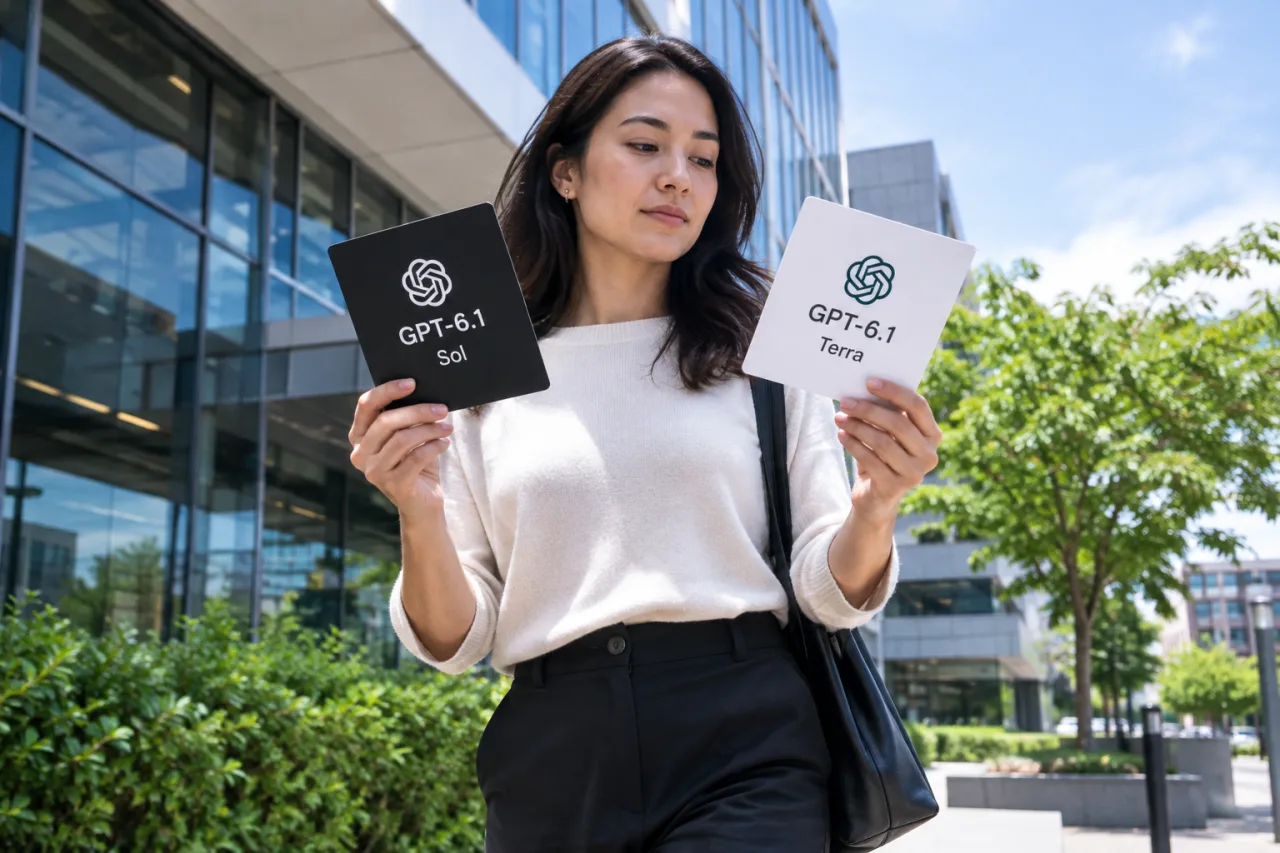
- ⚖️ Two models, two jobs: GPT-6.1 Sol is the established higher-tier model in OpenAI’s 6.1 line; GPT-6.1 Terra — released October 26, 2026 at $1/$5 per million tokens — is the new mid-tier built for faster computer use at a lower price. The question is not “which is smarter” but “which task am I paying for.”
- 💵 The price anchor moved: Terra sits at $1 input and $5 output per million tokens, available in ChatGPT Work, Codex and the API — the same tier band that made the October race a pricing story, with a lower-priced next Terra-family model reported in preparation.
- 🖱️ The capability delta is structural: Terra’s edge lies in computer use (driving applications and agents) and speed; Sol keeps the headroom for long-context, high-complexity reasoning where the flagship line’s ceiling still matters.
- 🧪 The work-type test decides it: map your recurring tasks to the tier — batch classification, form driving, summarization, and agent loops fit Terra’s economics; deep reasoning, dense documents, and the highest-stakes drafting stay Sol-class work.
- 📉 The budget math is the verdict: teams re-price monthly bills per task type; the hybrid lineup (Sol for the hard 20%, Terra for the routine 80%) is the cost structure OpenAI’s own tier strategy encourages — and the one this piece’s worksheet prices.
GPT-6.1 Sol vs Terra is the practical comparison of the October 2026 cycle — not which model is smarter, but which model your recurring tasks should rent. GPT-6.1 Sol is the established higher-tier model of the 6.1 line; GPT-6.1 Terra shipped October 26, 2026 at $1/$5 per million tokens, built for faster computer use at a lower price and available in ChatGPT Work, Codex and the API. This guide carries the verified, dated facts on both, the capability map by work type, the routing worksheet that prices your own bill, and the tier-war context that explains why OpenAI stacked a mid-tier this month.
Table of Contents
GPT-6.1 Sol vs Terra: the comparison that pays the bill
The comparison reframed: model comparisons usually ask a capability question; the Sol-vs-Terra question is an ECONOMICS question, because OpenAI built the pair as a tier structure. Sol exists to carry the hardest work at flagship-adjacent quality; Terra exists to carry the routine volume at a price that makes the routine work pencil out. The comparison’s honest output is not a winner — it is a ROUTING: which share of your workload belongs on Sol, which on Terra, and what the split saves. The reporting context makes the intent explicit: OpenAI’s strategy competes with Anthropic on pricing while expanding its lineup across performance tiers, with the next Terra-family model reported in preparation at an even lower price than GPT-6.1 Sol.
Why this comparison matters more than most model posts: tier pricing is where AI budgets actually change. The flagship increments add capability; the mid-tier additions re-price existing workloads. A $1/$5 token price point converts large classes of tasks — the ones that were marginal at flagship rates — into automatable line items. That is why the Sol-vs-Terra split is a budget document, not a leaderboard (the inference-cost pieces carry the broader pricing map).
WorldNgayon Analysis: the GPT-6.1 Sol vs Terra shift mirrors what markets have done in every technology commodity cycle: once the capability saturates the median use case, competition moves to per-unit price — and the buyer’s skill moves from benchmark-reading to workload-routing. This piece is the routing manual; the capability map below is its instrument.
Bottom Line: Sol vs Terra is a routing decision — the winner is the split that prices your bill down without touching your quality floors.
The two models, verified and dated
| Fact | GPT-6.1 Sol | GPT-6.1 Terra |
| Status | Shipped (the 6.1 line’s higher tier) | Released October 26, 2026 |
| Price class | Mid-tier-plus (the pre-Terra 6.1 anchor) | $1 input / $5 output per million tokens |
| Availability | ChatGPT, API | ChatGPT Work, Codex, API |
| Positioning edge | Long-context, high-complexity reasoning headroom | Faster computer use; agent-driving; speed-per-token |
| Family roadmap | The 6.1 line’s established tier | A next Terra-family model reported in preparation at a lower price than Sol |
What the dates verify: Terra’s October 26 release carried three checkable facts — the $1/$5 pricing, the ChatGPT Work/Codex/API availability, and the computer-use positioning — and the family roadmap (a lower-priced Terra successor in preparation) is The Information’s report, which is a named-secondary source: usable with attribution, not vendor-confirmed (the claims-tier discipline applies to every fact in this table).
WorldNgayon Analysis: the tier table is also a strategy disclosure: OpenAI saying “a Terra successor cheaper than Sol is coming” prices Sol’s future — mid-tier expansion compresses the tier above it. Teams signing annual contracts against Sol-class pricing should read that line twice; the cadence of the October model race shows why annual assumptions now decay quarterly.
Bottom Line: the table is dated because the tier game re-prices monthly — facts, not vibes, route bills.
The capability map: what each model is built for
Terra’s design center — computer use and speed: the reporting and OpenAI’s positioning put Terra’s edge in driving applications: clicking, filling, navigating, and looping through software like an operator — the agent-driving workload that batch processes, form automation, and UI-automation products consume at volume. Speed-per-token at $1/$5 makes the agent LOOP affordable: an agent that takes forty model calls per completed task was uneconomical at flagship rates and routine at Terra rates. That structural difference — call count × price — is precisely why “faster computer use at lower cost” is one sentence and not two marketing claims (the compute-economics pieces carry the loop-cost math).
Sol’s design center — the ceiling cases: the tasks where model headroom still matters: long documents with dense cross-references, high-stakes drafting where nuance is the deliverable, multi-step reasoning where an error’s cost exceeds the token bill, and ambiguous instructions where inference quality shows. Sol is the tier you keep for the work that would embarrass the cheaper model — the audit responses, the legal summaries, the client-facing strategy drafts.
Where they genuinely tie: everyday chat and drafting, translation-class tasks, well-scoped Q&A, and summarization below the complexity ceiling — work any 6.1-class model does well, where the price should decide. The field-guide rule applies: test YOUR tasks at both tiers before routing (the model-evaluation method) — a two-hour A/B on your twenty most common prompts beats every leaderboard.
WorldNgayon Analysis: the capability map is also a skill map: the professionals who can specify WHICH tasks belong to WHICH tier (the routing skill) are the ones who turn the tier war into savings; the ones who default everything to the flagship pay the flagship tax. The routing worksheet below is that skill, made mechanical.
Bottom Line: Terra loops, Sol reasons, and the tie-zone is bigger than most buyers assume — the worksheet finds yours.
The task-type worksheet: route your bill
The five-column worksheet (fill it in one sitting): 1 — task; 2 — monthly volume (calls, docs, loops); 3 — tokens per task; 4 — quality sensitivity (does a subpar output cost money or embarrassment?); 5 — tier assigned. The routing rules the industry converged on: computer-use and agent loops → Terra (call-count math dominates); bulk summarization and classification → Terra (volume work, bounded risk); dense reasoning, long-context, high-stakes drafting → Sol (quality floor over token bill); everything ambiguous → Sol first, downgrade after testing (the cheap route is earned by evidence, not assumed). Teams that ran the worksheet on real volumes commonly find the 80/20 split: the routine majority moves to Terra and the hard minority justifies Sol — the split the verdict line names.
WorldNgayon Analysis: the worksheet’s deeper value is INSTRUMENTATION: once tasks are tiered and logged, every future price move (the promised lower Terra successor; the competitors’ October moves) becomes a one-line re-route instead of a crisis. The routing spreadsheet is the buyer’s answer to vendor-tier strategy — and it is the discipline this site documents across the build lane: the model is rented; the routing logic is owned.
Bottom Line: five columns, one sitting — the worksheet converts the tier war into your line-item savings.
The October context: why the tier war happened now
The war, dated: Terra shipped October 26 at $1/$5; Google announced Gemini 4 Carbon (the Argon upgrade) on October 28; Anthropic is reported preparing an intent-reading model — three labs, three weeks, each move tier-shaped. The reporting names the strategy openly: OpenAI’s push competes with Anthropic on pricing while expanding the lineup across tiers, with the next flagship still in its safety-review window. The tier war is what happens when three labs can each ship weekly: the frontier is too expensive to differentiate there, so the differentiation moved to the tiers where bills live — the mid-band OpenAI just armed at $1/$5.
What the war predicts: continued mid-tier price decay (the next Terra successor at a lower price than Sol — per the report), more tier names per family (Argon-to-Carbon cadence on the Google side), and evaluation fatigue as the meta-skill — which is why the worksheet-and-matrix discipline (the one-page model matrix) is becoming a real office skill. The buyer’s market in the assistant tier is the buyer’s opportunity; the routing logic is how it is claimed.
WorldNgayon Analysis: the tier war also marks a maturation: the AI market’s center of gravity moved from capability announcements to unit economics — the same transition the crash-series instruments track. Teams that industrialized their routing early are the ones the coming price cuts compound for.
Bottom Line: the October war was fought in the tiers, and the winner was whoever had priced their own workload first.
What this means for work, money and the Philippines
For teams and freelancers: the $1/$5 price converts the client-automation offers — the form-driving agents, the backlog summarizers, the report pipelines — into flat-fee services with margin, and the Sol-Terra split gives the proposal a cost story a client can read. The agent-tools ledger carries the build half of those offers.
For Filipino professionals and OFWs: the tier war lowers the exact bill the diaspora pays for daily AI work — assistants, drafting, translation-class tasks — and the routing worksheet works in peso terms identically: price your monthly token bill per task, split it at the 80/20 line, and let the difference compound (the money-minute discipline applied to the AI budget itself). The peso playbook carries the FX layer of the same bill.
For students and career-switchers: the tier-management skill (cost routing, evaluation hygiene, the model matrix) is the new “Excel proficiency” — invisible until missing, and increasingly listed in job posts that route AI spend. Five hours of worksheet-building is the certification.
Verdict: Sol for the hard 20%, Terra for the routine 80%
GPT-6.1 Sol vs Terra, settled as a routing decision rather than a ranking: Sol is the tier for the ceiling — long-context reasoning, high-stakes drafting, the work where an error costs more than the tokens; Terra is the tier for the loops — computer use, agent driving, bulk volume — at $1/$5 per million tokens, shipped and usable since October 26, 2026. The tier war that produced them will keep repricing both; the routing worksheet keeps your bill correct through every move. Sol for the hard twenty percent, Terra for the routine eighty — and the worksheet is how you prove your own numbers.
Sources on the record: the Yahoo Finance model-race report · the Google blog.
Financial Disclaimer
This article is editorial analysis of publicly reported information, not investment or financial advice, and no outcome is promised. Statements are as reported by the named sources at the stated dates; verify before acting. Markets carry substantial risk.
The reading rule for GPT-6.1 Sol coverage mirrors the tier logic: GPT-6.1 Sol remains the quality-floor tier for ceiling work, and every GPT-6.1 Sol comparison should say which workload it is judging — a GPT-6.1 Sol recommendation for agent loops would be wrong-priced the same way a Terra recommendation for dense documents would be wrong-qualitied. Name the task, and the tier names itself.
A closing note on the comparison habit itself: the GPT-6.1 Sol vs Terra question will reappear with every tier move – the promised Terra successor, the next Sol-class bump, the competitors’ matching moves – and the teams that route well are the ones who re-run the worksheet on each move rather than re-arguing the leaderboard. The routing artifact costs one spreadsheet column and survives every model generation; the leaderboard costs an afternoon and decays by the next announcement. That asymmetry is the whole buying lesson of the October cycle.
- au.finance.yahoo.com/news/anthropic-google-openai-prepare-ai-14421201… — the Yahoo Finance model-race report
- blog.google/innovation-and-ai/technology/ai/google-io-2026-all-our-an… — the Google blog
External sources linked in this article, in order of first mention. Spotted an error or a broken link? Tell us.
Cite this pagePublished Nov 1, 2026
Agron, E. (2026, November 1). GPT-6.1 Sol vs Terra: Which One for Your Work? WorldNgayon. https://worldngayon.com/gpt-6-1-sol-vs-terra/
Agron, Edmon. “GPT-6.1 Sol vs Terra: Which One for Your Work?” WorldNgayon, 1 Nov. 2026, worldngayon.com/gpt-6-1-sol-vs-terra/.
Agron, Edmon. “GPT-6.1 Sol vs Terra: Which One for Your Work?” WorldNgayon, November 1, 2026. https://worldngayon.com/gpt-6-1-sol-vs-terra/.
Agron, E. (2026) ‘GPT-6.1 Sol vs Terra: Which One for Your Work?’, WorldNgayon, 1 November. Available at: https://worldngayon.com/gpt-6-1-sol-vs-terra/.
E. Agron, “GPT-6.1 Sol vs Terra: Which One for Your Work?” WorldNgayon, Nov. 1, 2026. [Online]. Available: https://worldngayon.com/gpt-6-1-sol-vs-terra/
@online{agron2026gpt6,
  author       = {Agron, Edmon},
  title        = {{GPT-6.1 Sol vs Terra: Which One for Your Work?}},
  year         = {2026},
  date         = {2026-11-01},
  organization = {WorldNgayon},
  url          = {https://worldngayon.com/gpt-6-1-sol-vs-terra/},
  urldate      = {}
}TY - ELEC AU - Agron, Edmon TI - GPT-6.1 Sol vs Terra: Which One for Your Work? T2 - WorldNgayon PY - 2026 DA - 2026/11/01/ UR - https://worldngayon.com/gpt-6-1-sol-vs-terra/ Y2 - ER -
Cite the version you read; the page may be updated. Zotero and Mendeley can also import this page directly.