Key Takeaway
- 🔋 The AI energy storage problem, in one sentence: AI training loads flip off and on in milliseconds — hundreds of thousands of GPUs switching between compute bursts and communication pauses — and those swings crash through the grid’s stability rules that no traditional data-center was ever built to violate.
- 🧱 The fix has four layers: chip-level buffering (batteries on GPU boards and racks), rack and server-level systems, facility-level UPS (now moving to medium-voltage), and grid-scale battery parks — the coordinated stack that makes a jittery AI training site look like a calm, predictable load to the power grid.
- 📈 The demand math: data-center battery demand is projected from roughly 20 GWh today to over 70 GWh by 2030 (~26% annual growth — among the fastest of any battery segment), with AI-linked storage demand reaching ~300 GWh by 2030 per market forecasts; LFP chemistry is expected to hold ~80% of ESS shipments into the mid-2030s.
- 🔌 The commercial signal: data-center operators signed ~45 TWh of power-purchase agreements in just the first half of 2026 — nearly 20% up year-on-year — and storage is now a named procurement category alongside geothermal and small modular reactors.
- ⚖️ The honest read: AI energy storage is not one product but an architectural response to the worst power profile the grid has ever been asked to serve — the operators who master it turn a reliability liability into a dispatch schedule that markets money.
Table of Contents
AI energy storage is the quiet infrastructure layer that makes the AI buildout possible — a set of battery systems at every scale from chip to grid, deployed for one purpose: to turn the jumpy, violent power profile of AI training into something an electricity grid can tolerate – AI energy storage exists for exactly this conversion. The problem is genuinely novel. Traditional data centers drew steady loads for decades; AI training sites switch megawatt-scale loads on and off in milliseconds, creating electrical events grids were never designed to absorb. This piece explains the mechanism honestly, maps the four-layer storage architecture answering it, sizes the market with verified numbers, and places the technology in the money decisions now reshaping AI infrastructure.
Why this guide belongs on your reading list: the AI-power story usually gets told as “data centers need lots of electricity.” The sharper story — the one investors, site planners and grid engineers argue about — is that the SHAPE of AI’s electricity demand breaks assumptions, and storage is the fix the industry converged on. Every battery decision in the AI buildout flows from the millisecond problem explained first below.
AI energy storage and the millisecond load problem
The AI energy storage problem, precisely: large-model training runs as synchronized waves — GPUs compute in unison for a stretch, then all pause together to combine results (all-reduce communication steps), then compute again. The result is a load profile that can swing by hundreds of megawatts in milliseconds as entire GPU fleets flip between phases. Grid-scale equipment is engineered for ramping on the seconds-to-minutes scale, not the millisecond one; the synchronized flips also introduce harmonic frequencies that can resonate at the natural frequencies of generators and turbines, accelerating mechanical fatigue and challenging voltage and frequency regulation — real equipment damage, not just paperwork-level nuisance.
Why this is structural, not a bug to patch: the flip behavior IS the architecture — synchronous training is how the fastest models train. Software mitigations (staggering workloads, secondary loads, controlled ramp rates) help but trade efficiency or hardware stress; the comprehensive answer the industry converged on is energy storage that absorbs the swings before they reach the grid. That is the strategic role of AI energy storage — not backup power, but load smoothing: making a violent load look like polite baseload.
The scale context that makes it urgent: data centers consumed about 415 TWh of electricity in 2024 (~1.5% of world demand), the fastest-growing slice of industrialized-world electricity, concentrated geographically; AI training pushes facilities toward gigawatt-scale campuses where the local grid may be thinner than the load. The IEA’s AI-power analysis documents operators signing ~45 TWh of PPAs in H1-2026 alone (~20% growth), with storage entering the procurement mix alongside geothermal and SMR-class technologies.
The four layers of AI energy storage
The architecture, mapped (the classification follows the recent engineering literature):
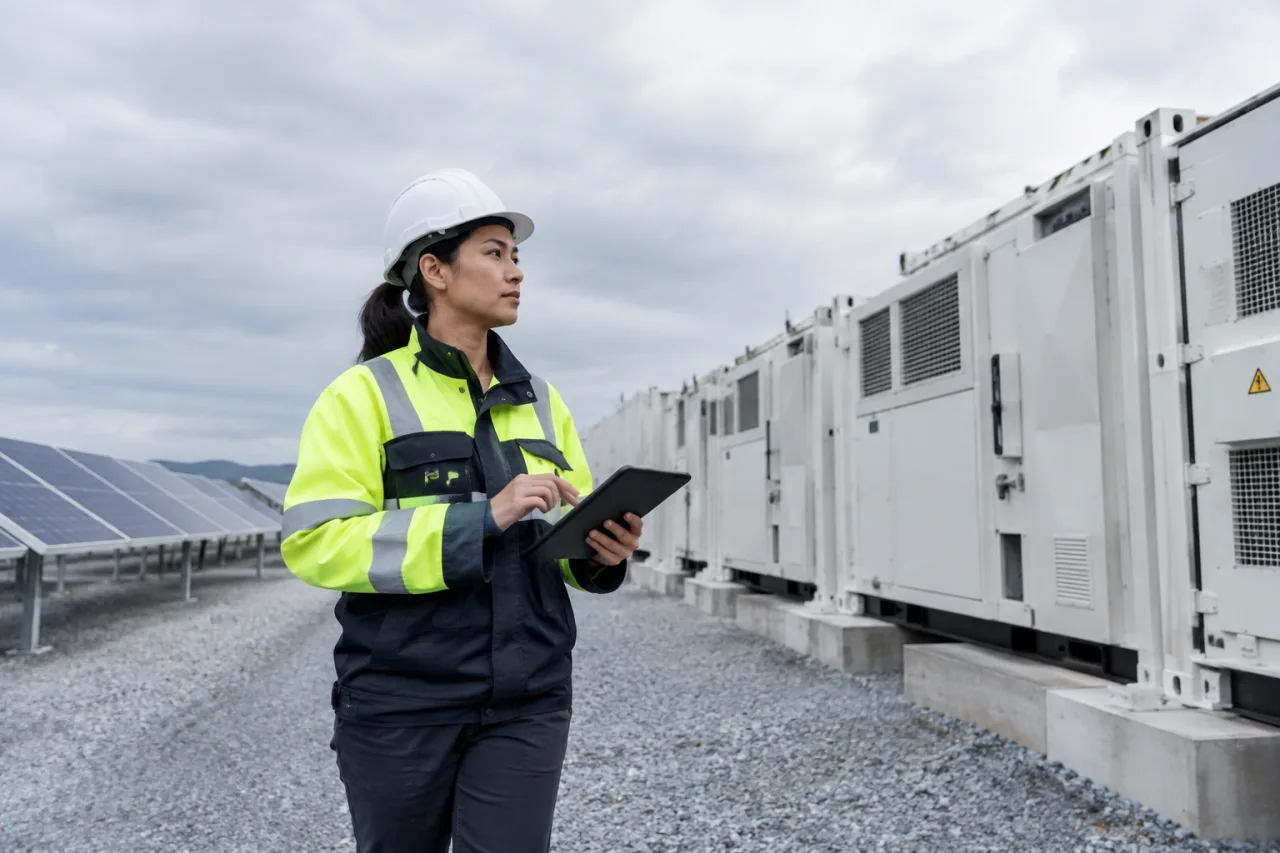
Layer 1 — chip-level buffering: small battery units integrated at the GPU-board or accelerator level (battery backup units, BBUs) sized to absorb the fastest swings — microsecond-to-second smoothing with minimal degradation per cycle. Layer 2 — rack/server-level storage: batteries sized per rack or per node group, buffering intra-rack dynamics and bridging to the facility layer. Layer 3 — facility UPS: the established uninterruptible-power layer, now transformed by medium-voltage UPS systems that both protect loads and — the new role — interact with the grid for frequency regulation and peak shaving; this is the layer where AI energy storage systems evolved from grid-isolated islands into grid participants. Layer 4 — grid-scale BESS: co-located battery parks (tens to hundreds of MW-hours) that absorb training swings before they stress the wider grid, often paired with on-site generation.
The AI energy storage coordination principle: no single layer suffices — each covers a different timescale (milliseconds to hours), and the academic review literature is explicit that coordinated hierarchical deployment across all four layers is necessary for load smoothing, grid support and battery-life management. The layered view also explains the supply chain: every layer draws lithium-ion cells, which is why the data-center buildout is now measured in battery-GWh – and AI energy storage is the name of that procurement line and why LFP supply matters as much as HBM supply for AI growth.
The chemistries: LFP, LTO and the hybrids
The chemistry ledger by layer: lithium iron phosphate (LFP) dominates capacity and is forecast at ~80% of ESS cell shipments through 2036 — the bulk-storage standard for facility and grid layers, chosen for cycle life and safety. Lithium titanate oxide (LTO) wins the fast-cycle roles — fast response, long cycle life, and low degradation under frequent micro-cycling — the millisecond-to-second layer, at higher cost. Non-battery complements: supercapacitors (the fastest bursts, milliseconds — paired in hybrid energy storage systems, HESSs, with batteries), flywheels (seconds-level bursts, mechanical), and superconducting magnetic storage (SMES) for exotic requirements; thermal storage and fuel cells round out the menu for campus-scale roles.
The hybrid principle, plainly: no single electrochemistry holds both “fast bursts” and “deep energy” optimally — so engineered hybrid systems pair a fast device (supercapacitor, LTO) to absorb micro-swings with a slow, dense device (LFP) to carry sustained loads. Review literature on AI data centers identifies LTO+LFP paired with supercapacitors or flywheels as the suitable hybrid configurations — the four-layer architecture is, chemically, a division of labor across those pairs. The EV-winter commercial angle matters too: as electric-vehicle growth slowed, battery makers redirected capacity toward stationary ESS — data centers emerged as the second-largest stationary battery market, the growth vector battery value-chains now price into their strategies.
The market projection: GWh, growth and who pays
The verified numbers (three sources, consistent direction): data-center battery demand grows from roughly 20 GWh today to over 70 GWh by 2030 (Roland Berger — ~26% annual growth, among the highest of any battery segment); AI-linked ESS demand reaches ~300 GWh by 2030 in market forecasts (Fastmarkets); US data centers may account for as much as 12% of total US electricity by 2028 (Fastmarkets outlook citing electricity-consumption projections), with US power consumption rising ~5% in 2026. The demand concentration: medium-voltage UPS deployment at AI data centers is the fast-growing BESS demand source that upstream lithium estimates have not yet captured — a forecasting gap market analysts flag by name.
Who pays, structured: the storage bill lands on operators’ capex (as infrastructure, layered with the generators and land buys tracked in this site’s who-pays-for-AI-power analysis), on utilities’ grid accounts (frequency-regulation mandates), and — the newest line — on AI consumers’ inference bills through the sites’ power-budget pass-through. The market risk, honestly: battery prices move; the LFP supply chain consolidates in specific geographies; and grid-rule shifts can strand storage configurations built for yesterday’s interconnection standards — the disclaimer at this piece’s end exists for exactly these reasons, and every GWh projection here carries the market-analysis caveat, not the promise.
The long-duration wave: beyond the four-hour lithium
The second storage market AI created: lithium’s dominance covers short bursts (two-to-four-hour batteries dominate today’s installations — over 57.6 GWh of new capacity was added in the US in 2025 alone, +30% year-on-year, most of it two-four-hour duration). AI’s demand for 24/7 clean baseload pulled a different technology class into the frame: long-duration energy storage (LDES) — systems that bank and dispatch 8+ hours up to multi-day supply — now advancing from pilot to commercial scale (thermal, gravity, flow-battery and iron-air designs) specifically because data-center buyers want renewable-backed reliability without gas backup.
The Fluence co-founder’s framing (Marek Kubik, on record at a Las Vegas industry event): “AI data centers need two different types of BESS, not one – long-duration storage for round-the-clock baseload and, separately, power quality management” — the market’s two distinct product lanes in one quotable line. The AI procurement mix already stretches to the exotic: geothermal PPAs, small modular reactor agreements, virtual-power-plant arrangements and storage-heavy contracts appear in the IEA’s 2026 procurement summary — storage is no longer a backup footnote, it is an infrastructure pillar the largest operators now buy by name.
AI energy storage as a procurement asset
The deal structures, honestly sorted: 1 — behind-the-meter ownership: the operator buys and runs storage inside the campus fence (capex-heavy, full control of the response layer). 2 — the PPA-plus-storage hybrid: the power-purchase agreements (~45 TWh in H1-2026 across the industry) increasingly bundle storage deliverables — the seller guarantees a smoothed profile, shifting the risk. 3 — the service contract: third-party storage operators (the Fluence-class market) sell frequency response and peak-shaving as a service — the opex-light entry. 4 — the grid-services revenue stack: a well-tuned facility storage layer earns back capex by selling regulation services into wholesale markets — the line where AI infrastructure becomes a grid asset rather than a grid burden. Each shape carries different balance-sheet treatment — the reason procurement teams, not just engineers, now own storage decisions. The market-research layer carries the usual caveat: analyst forecasts disagree, the honest read is direction (strong growth) rather than the point number.
WorldNgayon Insight: storage is the new transmission
The infrastructure pattern repeating: when a load outgrows the network built for it, a bridging asset gets built — and eventually defines the market. The 2020s’ version is battery storage around AI campuses: the grid-extension queues are too slow and the training flips too violent, so storage sits between the two — absorbing the swings, letting operators connect to weaker grids than they otherwise could, and (as the IEA’s procurement data shows) graduating from compliance device to dispatchable asset. The strategic read for 2027-2030: the operators who treat storage as architecture — four layers, chemistries assigned by timescale, grid-services revenue attached — will site AI campuses where pure-grid connections cannot reach; the ones who treat it as UPS-line-item will pay the millisecond problem as equipment damage. The bridging asset never stays supplementary for long.
What this means for work, money and the Philippines
Budgets: the storage layer is now part of every serious AI-infrastructure quote — enterprise buyers collocating AI workloads should ask where their site sits across the four layers (the question that separates 2026-grade facilities from legacy UPS rooms). Careers: the four-layer stack creates a hybrid professional — electrical-engineer-plus-data-center-plus-battery-markets — one of the highest-leverage skill crossings in AI infrastructure hiring; the AI infrastructure jobs analysis tracks where that demand concentrates. For Filipino professionals and OFWs: the regional buildout (Malaysia’s 42%-share trajectory, Philippine campuses, the SEA corridor) happens in tropical grids where every stability problem is amplified — the engineers and technicians who master storage-layer design now will be consulted for every new Southeast Asian AI site; the same expertise is portable to the gulf’s own AI-power programs. The battery layer is where grids, AI and careers meet — learn its grammar once and you read every campus story after.
Verdict: the load that learned to behave
AI energy storage, settled: the technology answering the most radical power-profile problem grids have faced — millisecond-scale training swings smoothed through a four-layer battery architecture, LFP carrying the bulk, LTO and supercapacitors riding the fast edge, hybrids doing what neither can alone, and a separate LDES lane growing for the 24/7-clean-baseload goal. The market math is strong (20→70+ GWh data-center demand by 2030; ~300 GWh AI-linked forecasts; LFP at ~80% share) but every figure is a forecast, not a contract — treat it as direction. The strategic takeaway stands regardless of whose forecast lands: the AI buildout is now a battery market, and the sites that master the millisecond problem will grow where others stall.
Financial Disclaimer
This article is editorial analysis of publicly reported market and technical information, not investment or financial advice, and no outcome is promised. Storage forecasts, chemistry shares and market projections vary by analyst and change frequently; verify with the named sources. Technology and energy markets carry substantial risk.
Sources on the record: the Roland Berger power-volatility analysis · the IEA Powering-AI executive summary.
>
- rolandberger.com/en/Insights/Publications/Managing-power-volatility-i… — the Roland Berger power-volatility analysis
- iea.org/reports/powering-artificial-intelligence/executive-summary — the IEA Powering-AI executive summary
External sources linked in this article, in order of first mention. Spotted an error or a broken link? Tell us.
Cite this pagePublished Oct 31, 2026
Agron, E. (2026, October 31). AI Energy Storage Explained: the Batteries Behind the Buildout. WorldNgayon. https://worldngayon.com/ai-energy-storage/
Agron, Edmon. “AI Energy Storage Explained: the Batteries Behind the Buildout.” WorldNgayon, 31 Oct. 2026, worldngayon.com/ai-energy-storage/.
Agron, Edmon. “AI Energy Storage Explained: the Batteries Behind the Buildout.” WorldNgayon, October 31, 2026. https://worldngayon.com/ai-energy-storage/.
Agron, E. (2026) ‘AI Energy Storage Explained: the Batteries Behind the Buildout’, WorldNgayon, 31 October. Available at: https://worldngayon.com/ai-energy-storage/.
E. Agron, “AI Energy Storage Explained: the Batteries Behind the Buildout,” WorldNgayon, Oct. 31, 2026. [Online]. Available: https://worldngayon.com/ai-energy-storage/
@online{agron2026aienergy,
  author       = {Agron, Edmon},
  title        = {{AI Energy Storage Explained: the Batteries Behind the Buildout}},
  year         = {2026},
  date         = {2026-10-31},
  organization = {WorldNgayon},
  url          = {https://worldngayon.com/ai-energy-storage/},
  urldate      = {}
}TY - ELEC AU - Agron, Edmon TI - AI Energy Storage Explained: the Batteries Behind the Buildout T2 - WorldNgayon PY - 2026 DA - 2026/10/31/ UR - https://worldngayon.com/ai-energy-storage/ Y2 - ER -
Cite the version you read; the page may be updated. Zotero and Mendeley can also import this page directly.