Key Takeaway
- 🛂 Naia offloading is the street name for it: the Bureau of Immigration states it has no offloading policy — officers allow or deny boarding, the formal term is deferred departure, and the decision runs on the totality of your circumstances, not one missing paper.
- 📄 The document pack beats the memorized story — naia offloading rewards preparation, not performance: passport with 6+ months validity, visa where required, return ticket, eTravel QR, proof of ties (certificate of employment, ITR, business registration) and of funds — prepared BEFORE the counter, not argued at it.
- ⏱️ Secondary inspection is normal, not a conviction — most naia offloading fear dies at the questionnaire: the Border Control Questionnaire, a short interview (around 10-15 minutes under the guidelines), document checks — and a deferral still comes with a stated reason and a path to rebook.
- 🚩 The red flags that trigger scrutiny: first-time travel to transit-point destinations, no steady income or benefactor, inconsistent answers, and sponsor relationships outside the 4th-civil-degree rule — the anti-trafficking screen the pastillas-scam case showed being bypassed.
- ⚖️ Your rights are real: the constitutional right to travel is regulated, not abolished — ask for the specific concern in writing, fix exactly that gap, and never lie, because a false statement converts an inspection into a deferral with a record.
Table of Contents
Naia offloading is what travelers call it; the Bureau of Immigration answers the question with an official denial — there is no offloading policy, its officers say, only departure formalities applied per the IACAT guidelines — while naia offloading numbers ran to roughly 40 travelers a day denied boarding at a single NAIA terminal, per statements the Bureau made to news outlets. Naia offloading sits exactly in that gap between “policy” and “experience”: the legal basis (the constitutional right to travel, regulated for national security, public safety, and health), the actual inspection flow for 2026 (primary interview, eTravel QR, secondary inspection via the Travel Control and Enforcement Unit), the red flags officers weigh, and — the practical core — the document pack that makes the whole encounter boring. The naia offloading conversation on Philippine social media runs on second-hand horror, and the boring truth underneath is calmer and more useful: the guidelines are public, the red flags are readable in advance, and the travelers who assemble their papers as a routine clear counters the way they clear baggage claims. Because the checks exist to catch trafficking and illegal recruitment: the same airport pipeline the pastillas-scam prosecutions showed being sold as a service.
Why Naia Offloading Happens: What the Guidelines Actually Weigh
Immigration officers assess the totality of circumstances — the IACAT guidelines on departure formalities list the factors: age, educational attainment, financial capability consistent with the declared purpose, travel history, duration of stay abroad, the destination, and relationships with travel companions. No single factor decides; patterns do — which is why beating naia offloading means understanding the pattern, not gaming one question. The documented red flags: first-time travelers bound for destinations not known for tourism; travelers with no steady income in the Philippines and no benefactor; trips to transit points associated with trafficking (Dubai, Hong Kong, Malaysia, Singapore, Bangkok in the Bureau’s own examples); inconsistent answers about the trip’s purpose; and anyone whose story shifts between the airline counter and the immigration booth. Naia offloading assessments in the documented cases weigh these together — a single flag with a strong document pack clears, while two flags with an empty folder is the combination that defers. Each flag traces to the same underlying question — is the purpose of travel what the papers say — and the naia offloading cases that make the news are almost always the extreme end: travelers escorted off planes because the answers unraveled. The Bureau has also said financial capacity is not a standalone requirement — a person is asked for further proof only when the declared purpose looks different from the facts presented.
The Document Pack: What to Have Before the Counter
Beating naia offloading starts with the pack — carry tier one always, and tier two the moment any red flag could apply to you:
- Tier 1 — the basics every passenger presents before any naia offloading question starts: a passport valid at least six months beyond departure; the visa the destination requires; a return or onward ticket; the eTravel QR code (mandatory free registration at etravel.gov.ph within 72 hours before departure); and the boarding pass. Tier one sounds trivial until the morning it matters: a passport with five months and three weeks of validity fails the six-month rule outright — the naia offloading story that begins at check-in, not immigration — and the eTravel QR left unregistered cannot be created at the counter because the system requires the 72-hour window.
- Tier 2 — proof of ties and means: a company ID or certificate of employment stating position, salary, and tenure (best addressed to the immigration officer); latest ITR; business registration with a DTI/SEC certificate for the self-employed; school ID and enrollment proof for students; bank statements as funds evidence. Print the employment letter fresh-dated — officers look at recency — and keep the ITR’s latest page, not the whole bundle, because the point gets made faster with the receipt of income than with a folder the counter cannot skim in forty-five seconds. Tier two is where most naia offloading outcomes get decided, because the officer needs the ties to the Philippines to be visible, not narrated — a certificate of employment beats a confident story every single time.
- Tier 3 — the special-case documents that answer naia offloading’s hardest flags: the DSWD travel clearance for minors traveling without parents; the CFO Guidance and Counseling Certificate for spouses and partners of foreign nationals on a first departure to join them; the OEC and OWWA e-card papers for OFWs under their deployment lane; an affidavit of support — where a non-relative sponsor is allowed only when everything else checks out, since support is normally limited to relatives within the 4th civil degree.
- The digital layer: one phone folder with scans of everything above plus printed copies of the critical pages — dead batteries and airport Wi-Fi are the two cheapest reasons a good trip goes bad at the counter.
Secondary Inspection: What Actually Happens There
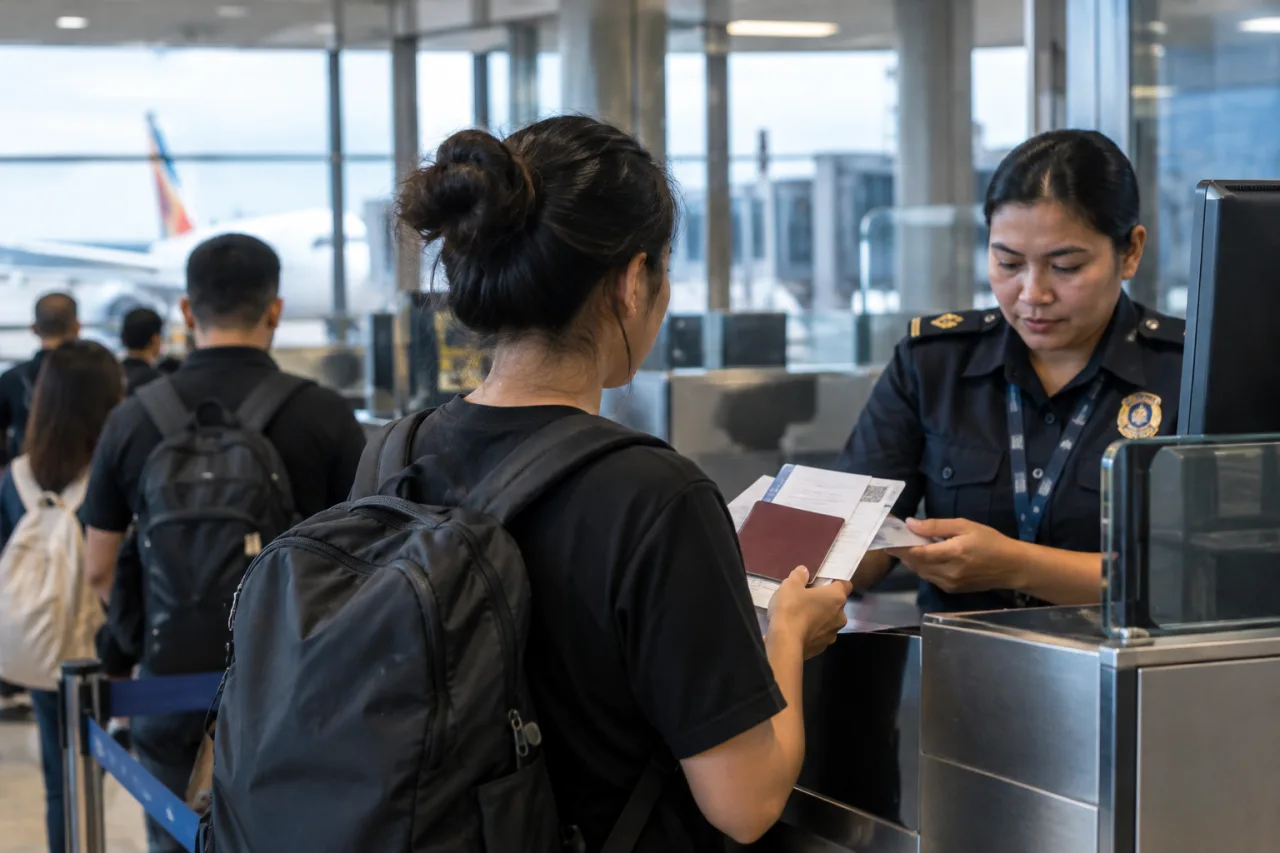
Naia offloading fears peak at secondary inspection, but referral is not offloading — it is the extended look. Under the guidelines, the traveler completes the Border Control Questionnaire, the primary officer’s initial assessment is documented, and a designated unit (the Travel Control and Enforcement Unit at NAIA) conducts the interview and document review — around 10 to 15 minutes when circumstances are ordinary. The room is different from the main counters, the officers ask their questions in writing first (the BCQ), and the naia offloading outcome inside this room depends overwhelmingly on consistency: the answers you give here match the ticket in your hand or they do not, and the documentation either exists or it doesn’t. Outcomes: cleared with a stamp; asked to complete a requirement and rebook (a deferral with reasons stated); or — where facts suggest trafficking or illegal recruitment — referred to the IACAT Anti-Trafficking Task Force, which is protection-first, with an affidavit of deferred departure documenting the case. The task-force lane exists because naia offloading in its protective form is the system working: the passenger walked off a plane was walking into a compound, and the affidavit starts the protection file. The rules that decide which naia offloading outcome you get: answer consistently (the interview cross-checks your airline data, your stated purpose, and your documents), volunteer the pack rather than waiting to be asked, and never invent details — a lie is the one variable that converts a secondary inspection into the worst naia offloading outcome with a record attached. The rights worth knowing as preparation, not as ammunition: you can ask what specific requirement failed, you can request the written explanation, and you can re-book once the gap is closed — travelers who argue the constitution at the counter without documents achieve nothing the guidelines recognize, while travelers who fix the stated gap travel the next week. The naia offloading records also show the deferral reason is usually specific — an unverifiable sponsor, a funds question, a purpose mismatch — and a specific reason is a solvable one, which is why the written explanation matters more than the argument.
Why Travelers Get Offloaded When Everything Feels “Legal”
Three recurring self-inflicted patterns appear across every deferral account: the tourist-declared trip that talks like a job hunt (the classic illegal-recruitment screen the overseas job scams guide documents end to end); the sponsor paper that fails the relationship test (a boyfriend’s guarantee letter outranks nothing under the 4th-degree rule); and the destination-and-duration mismatch (a two-week holiday declared, a six-month one-way packing list presented). Each is fixable in advance — by matching the declared purpose to the documents, not by scripting better answers — and each ties directly to the anti-trafficking mandate that the pastillas prosecutions showed being rented out: the Bureau’s screening exists because the offloading-and-routing pipeline fed the scam-compound economy the scam-hub takedown coverage tracks.
The Departure Desk Checklist: eTravel, Travel Tax, and the ECC Lane
Three departure-side requirements sit outside immigration proper but feed the same inspection. The eTravel registration: free, mandatory for departing Filipinos, filed within 72 hours but not less than 3 hours before departure at etravel.gov.ph — the QR is presented during inspection, and naia offloading advisories start with travelers who confuse the paid lookalike sites with the official portal. Travel tax: Filipinos on non-OFW travel pay the travel-tax rate that matches their ticket class, usually collected by the airline at check-in — OFWs with valid OEC travel exempt or at reduced rates, which is one more reason the OFW papers belong in the pack. The Emigration Clearance Certificate lane applies to foreigners leaving after long stays: ECC-A for temporary visitors who accumulated six months or more in the country, ECC-B for immigrant and resident holders with ACR cards — processed at the BI main office before departure day, with fees that range by type and urgency. None of these three replaces immigration inspection; all three arriving unprepared turn a clean inspection into a counter-side failure that looks identical to one.
The Rights Walkthrough: What To Ask For, In Order
If a secondary inspection ends in deferral, the sequence the guidelines support: listen to the stated reason without rehearsing rebuttals, ask what document or requirement closes the gap, request the written explanation (the deferral form names the basis), and fix the gap before rebooking — the naia offloading files that resolve are the ones that treat the stated reason as the work order. Escalation exists for genuinely arbitrary treatment: the Bureau’s public channels and the IACAT structure receive complaints, and a deferral believed to involve the corrupt payments the pastillas prosecutions documented is itself reportable — the Ombudsman case list in this guide’s sibling pieces shows exactly where those reports land. What the rights do not include: same-day argument, self-directed negotiation, or payment — each of those converts an administrative queue into the problem the prosecutions are literally in court to punish.
Frequently Asked Questions
Why Travelers Get Offloaded at NAIA — Is There an Actual Policy?
No — the Bureau of Immigration states it has no offloading policy; the formal term is deferred departure, and it happens when an officer finds the declared purpose inconsistent with the facts under the IACAT departure guidelines. The distinction matters: naia offloading as travelers use the word covers both the honest screening that catches trafficking and the corrupted screening the pastillas prosecutions exposed — two very different events wearing one nickname. The screening exists to intercept trafficking and illegal recruitment, and “offloading” is the umbrella word travelers use for being denied boarding at inspection.
What documents do I need to avoid getting offloaded at NAIA?
The tier-one pack: passport valid 6+ months, visa where required, return or onward ticket, and the eTravel QR. Add tier two whenever a naia offloading risk factor could apply to you — certificate of employment with tenure and salary, latest ITR, business registration for the self-employed, proof of funds, and school records for students. Special cases add DSWD clearance (unaccompanied minors), the CFO certificate (spouses/partners of foreign nationals), and OEC papers for OFWs. The naia offloading cases that end badly almost always trace to a tier the traveler never assembled — so build the pack the night before, print the four most-asked pages, and keep the folder on the phone plus the cloud.
How long does secondary inspection at NAIA take?
Minutes, ordinarily — the guidelines cap the secondary interview around 10 to 15 minutes unless documents need deeper verification. You’ll complete the Border Control Questionnaire, answer the interview, and either clear, receive a stated requirement and rebook, or — in trafficking-indicator cases — be referred to the IACAT task force with protection attached.
Can my boyfriend or girlfriend sponsor my trip to pass immigration?
Only within limits: support affidavits normally count from relatives within the 4th civil degree of consanguinity or affinity, and the Bureau sometimes accepts a non-relative affidavit when everything else in the trip is consistent — “sometimes” being the operative word. The stronger play is self-funding documentation, and couples headed for marriage abroad should complete the CFO certificate before the airport, not at it.
I was offloaded once — does it permanently affect my travel?
No permanent ban, but deferrals are recorded and can invite closer scrutiny next trip — which makes the document pack MORE important the second time. Ask for the specific concern at deferral, complete exactly that requirement, and rebook; travelers who fix the stated gap travel normally afterward, while travelers who change nothing repeat the experience. One more nuance the record-keeping creates: a deferral is not a conviction and travels nowhere — no immigration officer in another country sees it — but the file it starts means the naia offloading question follows YOU, which is precisely why the second trip’s pack should be stronger, not identical.
Financial Disclaimer
This article provides general consumer-protection and travel guidance and does not constitute legal advice. Naia offloading rules evolve with every guideline revision and vary by traveler category; verify every step against the Bureau of Immigration, IACAT, and eTravel official pages before acting. The author and publisher disclaim any liability for actions taken based on this information.
Cite this pagePublished Oct 28, 2026
Agron, E. (2026, October 28). Why Travelers Get Offloaded at NAIA — and the Document Pack That Prevents It. WorldNgayon. https://worldngayon.com/naia-offloading/
Agron, Edmon. “Why Travelers Get Offloaded at NAIA — and the Document Pack That Prevents It.” WorldNgayon, 28 Oct. 2026, worldngayon.com/naia-offloading/.
Agron, Edmon. “Why Travelers Get Offloaded at NAIA — and the Document Pack That Prevents It.” WorldNgayon, October 28, 2026. https://worldngayon.com/naia-offloading/.
Agron, E. (2026) ‘Why Travelers Get Offloaded at NAIA — and the Document Pack That Prevents It’, WorldNgayon, 28 October. Available at: https://worldngayon.com/naia-offloading/.
E. Agron, “Why Travelers Get Offloaded at NAIA — and the Document Pack That Prevents It,” WorldNgayon, Oct. 28, 2026. [Online]. Available: https://worldngayon.com/naia-offloading/
@online{agron2026naiaoffloading,
  author       = {Agron, Edmon},
  title        = {{Why Travelers Get Offloaded at NAIA — and the Document Pack That Prevents It}},
  year         = {2026},
  date         = {2026-10-28},
  organization = {WorldNgayon},
  url          = {https://worldngayon.com/naia-offloading/},
  urldate      = {}
}TY - ELEC AU - Agron, Edmon TI - Why Travelers Get Offloaded at NAIA — and the Document Pack That Prevents It T2 - WorldNgayon PY - 2026 DA - 2026/10/28/ UR - https://worldngayon.com/naia-offloading/ Y2 - ER -
Cite the version you read; the page may be updated. Zotero and Mendeley can also import this page directly.