

Table of Contents
Key Takeaway
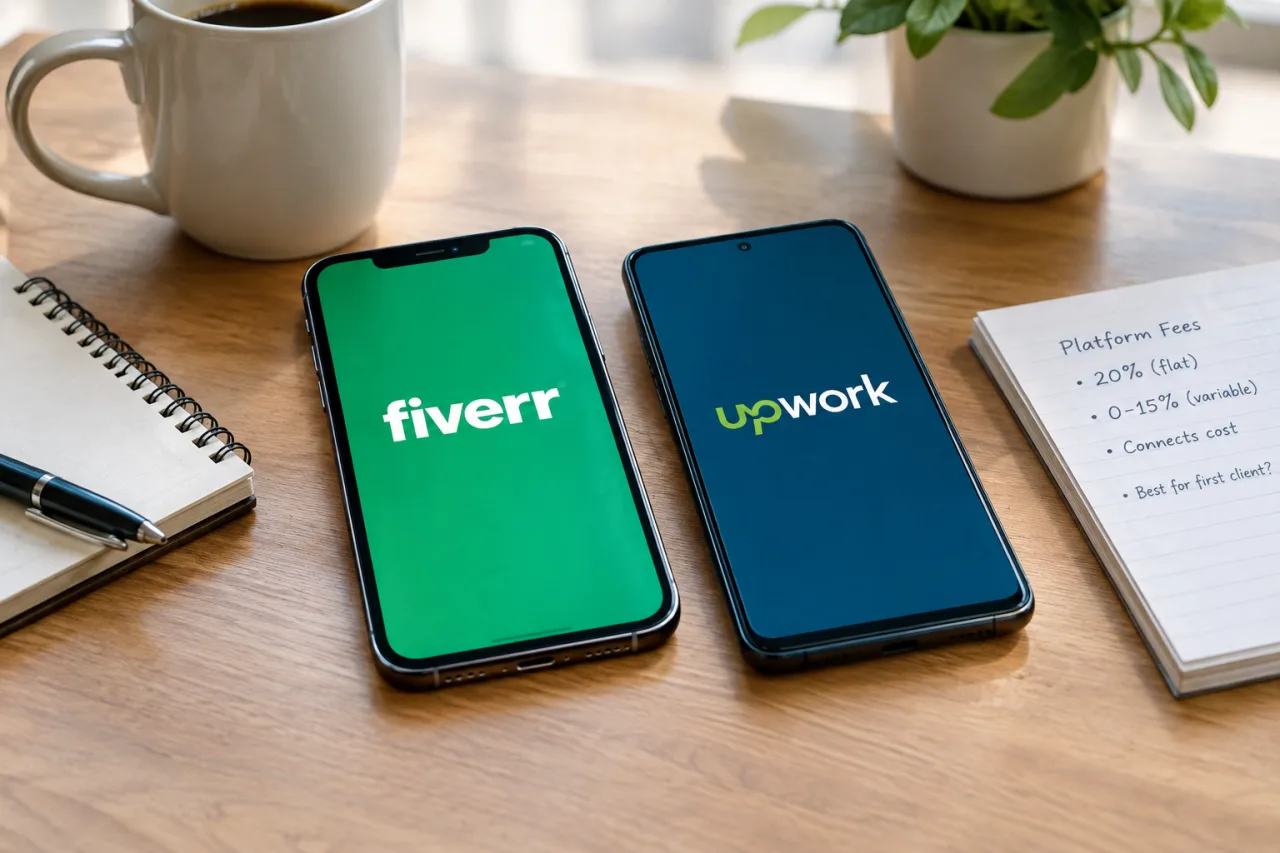
- ⚖️ Fiverr vs Upwork comes down to one honest fee fact: Fiverr keeps a flat 20 percent of every completed order, while Upwork’s service fee varies per contract from 0 to 15 percent and shows before you bid.
- 🎫 Proposals cost money on Upwork only: bidding runs on Connects, with extra credits at $0.15 each, so Fiverr asks for setup and Upwork asks for every proposal’s worth of attention.
- 📦 Fiverr fits productized services: if your work fits a package with a fixed price, the gig page does the selling while you sleep.
- 📝 Upwork fits custom work: writing, development, and consulting jobs that need scope negotiation start here, and the 0 percent Direct Contracts route rewards clients you bring yourself.
- 🧾 Price for the fee from day one: on Fiverr, divide your target income by 0.8; on Upwork, fold the shown percentage into your rate before the proposal leaves.
Every new freelancer meets the same Fiverr vs Upwork fork in the first week, and the choice changes what arrives next: an order notification, or a proposal you had to write and pay to send. The practical Fiverr vs Upwork answer is not a ranking, because the two platforms sell different products. One sells packages: the Fiverr vs Upwork fork is really a packages-versus-proposals fork. What decides your first client is which of those two products you can actually deliver on schedule, and the numbers below line up behind that decision.
What Each Marketplace Is Built For
Fiverr sells catalog listings. You package a service with a fixed scope and a fixed price, buyers find the gig through search, and the platform handles the transaction. Upwork sells proposals. Clients post jobs with real scoping questions, freelancers answer with tailored bids funded by Connects, and the contract price tends to be bigger and negotiated case by case.
In any practical Fiverr vs Upwork comparison, that difference shapes everything else: how you spend your first hour (building a gig versus writing a profile-bid system), how income arrives (order-based versus contract-based), and which mistakes cost money (Underpricing a package versus burning Connects on weak proposals).
Fiverr vs Upwork Fees, With the Published Numbers
The two fee systems are structured differently, and both platforms document them clearly. The side-by-side, using each platform’s published terms:
| Fee element | Fiverr | Upwork |
|---|---|---|
| Share kept by the platform | Flat 20 percent (you earn the 80 percent the payment terms grant, including extras and tips) | Variable 0 to 15 percent freelance service fee, shown in each proposal and locked at contract |
| How the fee is set | Same 20 percent for every order, every level | Per contract; the enterprise tier typically lands at 10 percent |
| Special case | Early payout at 1 percent for eligible members | Direct Contracts at 5 percent on Basic, 0 percent on Freelancer Plus |
| Proposal or listing cost | No proposal system; gig setup is free | Connects fund every bid; additional Connects cost $0.15 |
| Client-side fee | 5.5 percent service fee plus $3.50 on orders under $200 | Built into the rate the client already sees |
| Payout hold | 14-day clearance (7 days at higher seller levels) | Weekly billing cycles with payments as frequent as weekly |
Two details in this Fiverr vs Upwork fee table deserve attention. The Fiverr buyer fee raises the real cost of your gig for the client, which matters when a $50 package becomes a $59.25 checkout, and payment terms for the Philippines now ask buyers for a PSN (Philippine Identification System) number at checkout, one of several country-specific ID requirements. On Upwork, the variable fee means you always know your exact percentage before a contract starts, but two contracts for the same work can carry different fees, so the rate you quote has to absorb whichever number appears in that proposal screen.
The Price You Quote Is Not the Price You Get
Both platforms insert a layer between your listed rate and your payout, and the arithmetic has to be done forward. Work each quote from the net target:
- Fiverr gross-up: you keep 80 percent, so a target payout of $400 needs a $500 package price. The client, meanwhile, sees the checkout add the buyer fee: a $50 package costs the client $59.25 at the current 5.5 percent plus the $3.50 small-order charge under $200.
- Upwork gross-up: the service article’s own worked example shows the method. To net $20 per hour at a 10 percent fee, you bill $22.22; the client pays $266.64 over 12 hours, the fee takes $26.66, and your net lands at $239.98 against the $240 target. Read the shown percentage in every offer and fold it into the rate before you submit.
- Connects arithmetic: a proposal spends Connects, and buying extra runs $0.15 each. Ten carefully chosen bids cost $1.50 in credits plus the writing time; fifty sprayed bids cost $7.50 and a response rate that teaches the wrong lesson.
Where Each Marketplace Hides Extra Costs
Beyond the headline shares, three smaller charges decide the real monthly ledger:
- Fiverr clearance timing. Earnings clear 14 days after completion, 7 days at higher levels, and early payout for eligible members costs 1 percent of the clearing amount. A 1 percent early payout used once on a tight bill is a tool; used on every order it is a permanent pay cut.
- Fiverr withdrawal fees. The provider set charges $0 to $3 per withdrawal depending on method, before any currency conversion your provider adds.
- Upwork membership. Freelancer Plus runs $19.99 per month and buys the 0 percent Direct Contracts rate plus visibility boosts; the Basic plan is $0. The upgrade pays for itself only if you bring clients or need the visibility, so decide by your lane, not by the demo.
How Clients Actually Arrive on Each
On Fiverr, the work is positioning. Buyers search, compare gig thumbnails, reviews and response time. Your first client usually arrives because your gig priced and packaged well inside its category, not because you wrote to anyone. The walkthrough for that side of the market, including the OFW-specific setup steps, lives in our Fiverr starter guide for OFWs.
On Upwork, the work is proposal craft. You read the job post, answer it with a short tailored bid, and the Connect system meters your effort. Fresh profiles earn a small monthly Connect balance and top up at $0.15 per Connect; every bid spends them. The platform rewards specificity: one well-matched proposal beats ten sprayed ones, and the rate calculator on the pricing page exists precisely because your gross rate has to absorb the service fee.
Where that effort converts differently matters too. The pay evidence for the wider freelance market, the split between rising and falling categories, is what our AI-era freelance pay analysis covers, and it pairs with the rate-setting framework in our freelance rates guide.
Fiverr vs Upwork for Non-US Freelancers
Both platforms withdraw internationally, but the rails differ in cost and reach, and that difference lands hardest on freelancers outside the US. Fiverr credits your balance after clearance and pays out through the standard provider set; Upwork credits weekly and carries a similar provider list plus its own wire routes. Either way your platform fee is only the first layer; the conversion and transfer fee on the way home is the second, and our PayPal vs Payoneer vs Wise comparison prices that second layer corridor by corridor.
The same logic applies a lane away, in the content business, where our UGC creator rates guide shows brands paying production fees through those identical rails.
The First Seven Days, Day by Day
Plans beat intentions, so here is the seven-day route each path actually takes a new freelancer through:
- Day one: pick the shape. List the three services you can deliver today with a fixed scope. If all three fit a one-line package, the Fiverr vs Upwork decision leans Fiverr; if any needs a scoping call, it leans Upwork. Most skill sets contain both kinds, and this single test sorts them honestly.
- Day two: build the presence. Fiverr path: write two gigs, each with a keyworded title, three tiered packages and a 30-second video or clean gallery. Upwork path: complete the profile with the skills tests omitted (they are retired clutter) and publish three portfolio pieces that match your intended jobs.
- Day three: price and prepare. Run the gross-up arithmetic from the fee section on every listing or rate card. Decide your review-first strategy deliberately: beginner pricing buys the first three reviews, and the rate framework in our freelance rates guide stops that pricing from sinking the floor permanently.
- Day four: first exposure. Fiverr path: submit the gigs and read the category’s current first page to see what wins. Upwork path: spend the starter Connects on two high-match jobs, writing bids that answer the post’s actual questions in the first two lines.
- Days five to seven: respond and iterate. Fiverr path: answer every buyer question inside the platform’s response-time window, because the number is public. Upwork path: follow up once, refine bid text that got zero response, and check the job history of every client before spending the next Connect.
Both Fiverr vs Upwork paths reward the same underlying behavior: a scoped, scheduled, priced offer that ships on time. The platforms differ in packaging, and the freelancer who handles that first week on either one can port the same discipline across. That is also why the practical Fiverr vs Upwork answer for many is sequence rather than choice: one platform first, the second when the first can run on its own for a month.
Which One Should You Start On
In the Fiverr vs Upwork decision, match the platform to the job shape you can commit to in your first month:
- Start on Fiverr if your skill compresses into packages: thumbnails, short translations, voiceover minutes, quick site fixes, data-cleanup batches. You can ship standard scopes on schedule, and the catalog does your selling.
- Start on Upwork if your work needs scoping calls and written proposals: full builds, ongoing marketing retainers, consulting, complex writing. Your first client will pay more than a catalog price, and you will pay for the privilege of bidding.
- Run both if you can price the two lanes separately, which is what most working freelancers settle into after a quarter: Fiverr for steady order flow, Upwork for the bigger custom contracts.
For the pricing itself, one rule keeps both Fiverr vs Upwork lanes honest: quote your net, then gross it up for the platform. On Fiverr, a target of $400 take-home means a $500 package price (400 divided by 0.8). On Upwork, read the shown fee percentage in every proposal and adjust before you send. Freelancers who skip that step meet the fee twice, once at quote and once at payout.
Frequently Asked Questions
What does Fiverr charge freelancers?
A flat 20 percent of every completed order, including Gig Extras and tips, per the published terms; you earn 80 percent. That share does not fall as you reach higher seller levels, though higher levels shorten the payout clearance from 14 days to 7.
What does Upwork charge freelancers?
A variable service fee between 0 and 15 percent on earnings, shown in the proposal and locked when the contract starts. Direct Contracts, where you bring a client to the platform, drop the fee to 5 percent on the Basic plan or 0 percent on Freelancer Plus, and proposals themselves are funded with Connects at $0.15 each for extra purchases.
Fiverr vs Upwork: which is easier for a beginner?
Fiverr front-loads less writing and zero proposal cost, so the first order typically arrives through good packaging. Upwork front-loads proposal writing and Connect management but tends to reward beginners with bigger first contracts when the bids are well matched. Ease of the first client usually favors Fiverr; earning ceiling usually favors Upwork.
Can the client see the Fiverr service fee?
Yes, at checkout the client reviews the added service fee, currently 5.5 percent plus $3.50 on orders under $200, before paying. That fee does not reduce your 80 percent, but it raises the client’s total, which matters if a client compares your gig against direct hiring.
Why did only part of my first Fiverr order arrive?
The 14-day clearance period holds funds after completion before they enter your withdrawable balance, and each payment, including later tips or extras, carries its own clearance clock. Higher seller levels shorten the wait to 7 days.
Can I move an off-platform client onto Upwork?
That is exactly what Direct Contracts covers: you bring a client you found elsewhere, and the reduced fee, 5 percent on Basic or 0 percent on Freelancer Plus, prices the paperwork benefit. Clients met on the platform follow the standard variable fee instead.
If this intelligence helps you, you can add WorldNgayon as a preferred source on Google — free, one click, and it helps other Filipinos find the answers faster.
Financial Disclaimer
This article is freelance-business information published for general guidance. Fee structures cited follow each platform’s published terms within this article’s research window and can change without notice; the platforms remain the authority on current rates. No income outcome is promised, and nothing here is financial, tax or legal advice. WorldNgayon accepts no liability for decisions made based on this article. Readers should verify current fees directly and consult qualified professionals for their specific situation.
- fiverr.com/legal-portal/legal-terms/payment-terms-of-service — 80 percent the payment terms grant
- support.upwork.com/hc/en-us/articles/211062538-Learn-about-the-Freela… — freelance service fee
- upwork.com/pricing/freelancer — $0.15
- help.fiverr.com/hc/en-us/articles/360050216133 — 5.5 percent service fee
- google.com/preferences/source?q=worldngayon.com — add WorldNgayon as a preferred source on Google
External sources linked in this article, in order of first mention. Spotted an error or a broken link? Tell us.
Cite this pagePublished Nov 17, 2026
Agron, E. (2026, November 17). Fiverr vs Upwork: Which One to Start On. WorldNgayon. https://worldngayon.com/fiverr-vs-upwork/
Agron, Edmon. “Fiverr vs Upwork: Which One to Start On.” WorldNgayon, 17 Nov. 2026, worldngayon.com/fiverr-vs-upwork/.
Agron, Edmon. “Fiverr vs Upwork: Which One to Start On.” WorldNgayon, November 17, 2026. https://worldngayon.com/fiverr-vs-upwork/.
Agron, E. (2026) ‘Fiverr vs Upwork: Which One to Start On’, WorldNgayon, 17 November. Available at: https://worldngayon.com/fiverr-vs-upwork/.
E. Agron, “Fiverr vs Upwork: Which One to Start On,” WorldNgayon, Nov. 17, 2026. [Online]. Available: https://worldngayon.com/fiverr-vs-upwork/
@online{agron2026fiverrvs,
  author       = {Agron, Edmon},
  title        = {{Fiverr vs Upwork: Which One to Start On}},
  year         = {2026},
  date         = {2026-11-17},
  organization = {WorldNgayon},
  url          = {https://worldngayon.com/fiverr-vs-upwork/},
  urldate      = {}
}TY - ELEC AU - Agron, Edmon TI - Fiverr vs Upwork: Which One to Start On T2 - WorldNgayon PY - 2026 DA - 2026/11/17/ UR - https://worldngayon.com/fiverr-vs-upwork/ Y2 - ER -
Cite the version you read; the page may be updated. Zotero and Mendeley can also import this page directly.