Table of Contents
Key Takeaway
- ✂️ The ban worked on paper: the Anti-POGO Act made Philippine Offshore Gaming Operations illegal — but the scam hubs it sheltered did not close; they relocated, splintered, and rebranded.
- 🌍 Where it went: UNODC documents scam compounds displaced by crackdowns reappearing in Cambodia, Myanmar and Laos — inside purpose-built business parks — while Cambodia alone hosts more than 50 major scam centers.
- 🏢 The guerrilla splinter: Philippine police report groups that stayed behind broke into smaller “guerrilla-type” operations, still scamming from inside the country — one operated a few hundred meters from embassies in Pasay City.
- 💸 The real scale: Cambodia’s scam economy alone exceeds $12.5 billion a year — roughly half its formal GDP — and one victim cohort reported $10 billion lost to regional operations.
- 🚩 What Filipinos watch for now: six red flags — job offers abroad without interviews, guaranteed-return investments, romance pivots to crypto, no-name platforms, recruitment to unfamiliar countries, and pressure to recruit friends. All six are in this guide.
The scam hubs did not die when the Philippines outlawed POGOs — they moved, splintered and evolved, and the Filipino worker is still their favorite target. The Anti-POGO Act closed the licensed-cover loophole that let offshore gaming operators hide online fraud syndicates inside legal gambling permits. What followed, documented by the UN Office on Drugs and Crime, the Philippine National Police and regional researchers, is a case study in how organized crime adapts: the compounds moved to friendlier jurisdictions, the remaining operators went guerrilla, and the industry’s center of gravity shifted across borders while its tactics — now AI-assisted — kept improving. Here is the map, the scale, and the red flags every Filipino should carry into 2027.
What the Anti-POGO Act Actually Did
The ban was real and consequential. Philippine Offshore Gaming Operators — licensed by PAGCOR, marketed as tax revenue, and repeatedly exposed as shells for scam centers — were declared illegal, and the state followed through with raids, deportations and repatriations at a scale rarely seen in the region. With UNODC support, the Philippines’ anti-crime agency PAOCC signed formal procedures in April 2026 covering victim repatriation, witness statements and evidence collection — a rights-based, victim-centered framework for dismantling what the raids uncovered.
What the raids found explains why the ban mattered: scam compounds operating as organized businesses inside the country, complete with trafficked workers, scripts, quotas and management hierarchies. Rappler’s reporting showed large numbers of scam hubs had been operating behind POGO licenses — legal camouflage for fraud floors. The law removed the camouflage. What it could not remove was the demand: billions in illicit revenue flowing to syndicates that never needed a Philippine license to keep stealing.
Where the Scam Hubs Went: the Regional Relocation Map
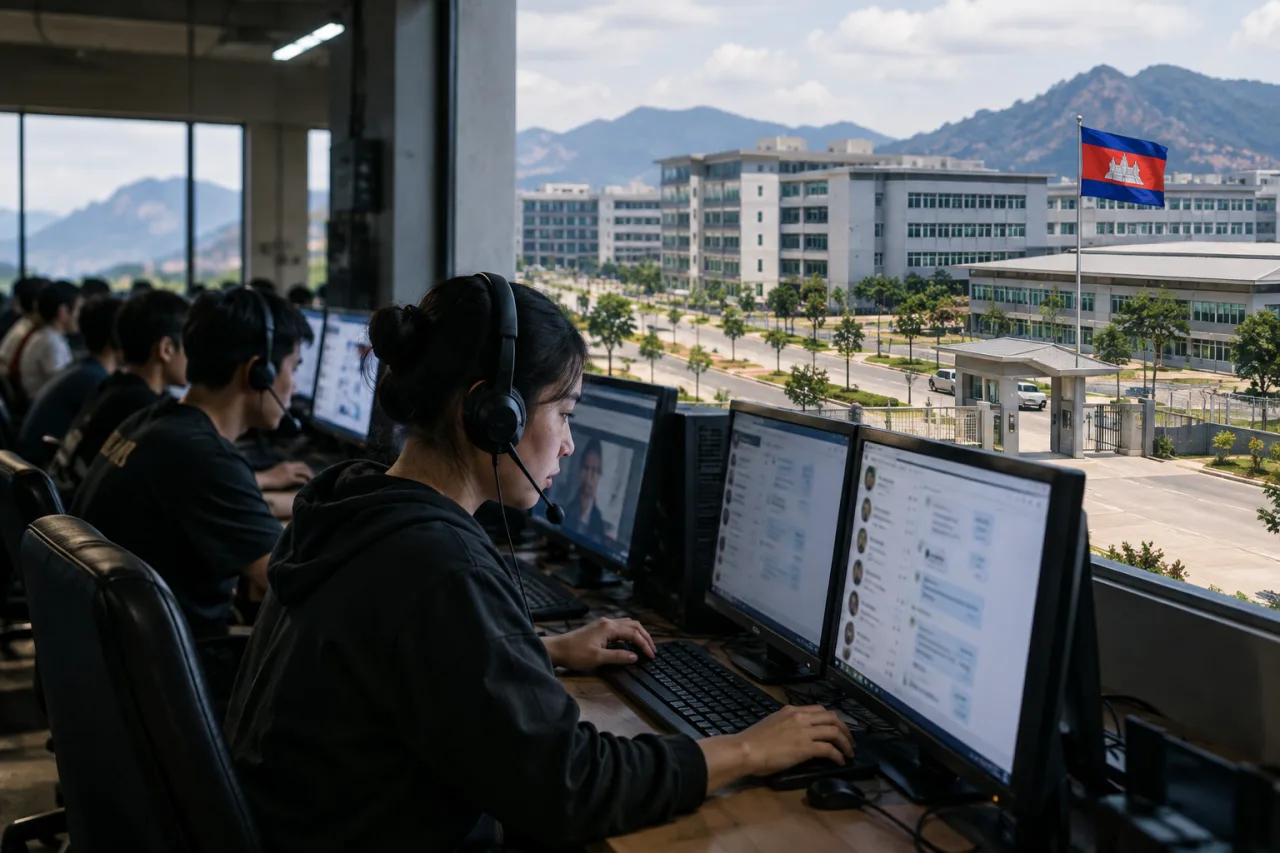
UNODC’s regional assessment is blunt: scam compounds in Cambodia, Laos, Myanmar and the Philippines were displaced by crackdowns — only to reappear in other areas, including purpose-built business parks designed to look like ordinary corporate campuses. The relocation pattern is now well documented:
- Cambodia became the industry’s center of gravity. Researchers count more than 50 major scam hubs in the country, with annual proceeds exceeding $12.5 billion — roughly half the country’s formal GDP — and US reporting links senior officials and business elites to the ecosystem’s protection.
- Myanmar’s border zones remained the industry’s worst reputations, where trafficked workers — Filipinos among them — are held inside scam farms like the one a victim named Susan described to UNODC after being trafficked there.
- Laos and purpose-built parks absorbed overflow, as operators discovered that a crackdown in one country is a marketing event in the next: land, staff and even furniture move with the syndicate.
- Thailand’s role shifted to transit, the major trafficking corridor through which victims recruited from across Asia reach the compounds.
One number puts the industry’s victim-side scale in view: one documented cohort of victims — American, Chinese and others, per UNODC’s March 2026 assessment — reported losses of roughly $10 billion to operations based in Southeast Asia. The region’s fraud infrastructure now generates billions in illicit financial flows annually, run with the discipline of a legitimate industry: KPIs, HR departments, tech support.
The Guerrilla Splinter: Scam Hubs That Stayed in the Philippines
The ban did not extract the scam hubs so much as compress them. The Philippine National Police’s anti-cybercrime group reports that some groups splintered into smaller “guerrilla-type” operations after POGOs were declared illegal — compact crews that scam over the internet from inside the country, harder to see precisely because they no longer sit inside a licensed compound. Their multi-national staffing — Chinese, Vietnamese, Korean, Malaysian, Indonesian, Myanmar and even Madagascan nationals — mirrors the region’s labor flows, and their product lineup reads like a taxonomy of modern fraud: cryptocurrency schemes, love and investment scams, spamming and text-based campaigns.
The Pasay City case made the point viscerally: a scam centre operating a few hundred meters from embassies, government departments and city hall — the kind of location that passes every casual security check. UNODC’s officials walked through rooms there where serious crime ran with corporate discipline. The lesson for Filipinos is uncomfortable but useful: geography no longer signals safety. A scam hub can share a street with the institutions meant to stop it, and the flag to trust is behavioral, not architectural.
The Modern Scam Hub Playbook: AI Upgrades on Old Fraud
The relocated industry did not just survive — it upgraded. The same artificial-intelligence wave that fuels this site’s weekly coverage is now embedded in the fraud supply chain: cloned voices for family-emergency calls, polished fake investment dashboards, script-writing models that make every victim feel individually courted, and deepfaked video for the final trust leap. Our guides on the AI voice-cloning scams behind fake family calls and the pig-butchering playbook break down the two signature products — and both trace directly back to the compound economy this article maps. The industry’s product development never stopped during the ban; it just moved offices.
What Filipinos Should Watch: the Six Scam Hubs Red Flags for 2027
- The job offer without an interview, especially for call-center or “customer relations” work in Cambodia, Myanmar or Laos that pays multiples of local rates. The compounds recruit through legitimate-looking ads; the itinerary is the trap.
- Guaranteed or fixed monthly returns from any investment platform, registered or not. No legitimate instrument promises certainty at rates that embarrass the market.
- Romance that becomes a portfolio recommendation. The love-scam pivot — weeks of warm chat, then a “shared” crypto opportunity — remains the highest-converting funnel the compounds operate.
- Platforms you cannot verify with the regulator. Registration checks with the SEC are minutes of work; our fake-website checklist complements them for the platform layer.
- Recruitment of your friends. Compounds pay members to bring new members; the moment a program rewards recruitment over product, it is the scheme itself.
- Marketplace-style pressure after a loss. Sellers and “recovery agents” materialize around people who lost money — our marketplace scam guide covers the pattern that turns one loss into two.
How the Money Moves: the Rails Behind the Scam Hubs
Tracking the industry’s relocation is half the story; the other half is following its cash. The compounds bill themselves as gaming, tech or e-commerce firms, then convert fraud proceeds into mobility through the same financial rails every modern business uses — including the stablecoin and offshore-crypto corridors that make cross-border value transfer cheap, fast and jurisdiction-hopping. Investigators describe the pattern as layering by infrastructure: proceeds land in regional exchange networks, hop through corporate shells in multiple registries, and surface as real estate, fleet purchases and political patronage. Our guide to how stablecoins work covers the technology honestly — the same efficiency that makes digital dollars legitimate for remittances makes them legible to fraud operations, and the enforcement gap is exactly what the regional cooperation machinery is being built to close.
The financial-flow picture also explains why the scam hub economy survived its most important client loss: the Philippine exit did not change the demand side. Victims in North America, China, Europe and Australia keep funding the compounds, and the industry keeps recruiting labor to target them. Every anti-scam checklist a Filipino family internalizes is, at industry scale, a revenue line removed — which is why the red flags in the section above matter as much as any raid.
The Policy Fight: Why the Palermo Convention Is the Next Battleground
The UP Law Center’s analysis of the Pasay case frames the next institutional step precisely: suspects from several countries, victims who may live outside the Philippines, infrastructure that spans borders on every axis — a crime built to frustrate single-jurisdiction prosecution. The international framework designed for exactly this shape, the Palermo Convention’s transnational-organized-crime machinery, is the legal instrument the region is being pushed toward adopting in practice, not just in signature. UNODC’s work with PAOCC on victim-centered procedures is the Philippine piece of that puzzle; Cambodia’s December 2026 joint prosecutorial visit to a raided Phnom Penh compound was the regional one.
For Filipinos, the practical meaning is steady, not dramatic: the problem will not be solved by one country’s ban, but every year of documented cooperation raises the cost of operating. The compounds’ greatest advantage — jurisdictional arbitrage — has a shrinking half-life as the evidence-sharing machinery matures. What does not mature on its own is personal skepticism: the industry’s turnover depends on one unverified “yes” at a time.
The Filipino Family Response: What Watching Actually Looks Like
“What Filipinos should watch” is easy to say and hard to operationalize, so make it concrete for the household. Watches begin before any money moves: every job offer abroad gets a verification call to the agency, a visa check and a video interview before a passport is surrendered; every investment platform gets the five-minute SEC registration lookup; every new romantic contact who mentions trading opportunities gets benched until they prove a life. The compound economy runs on speed and isolation — verification and family conversation are its natural enemies, which is why our voice-cloning family code-word guide recommends a shared family passphrase for every emergency request, and why the marketplace-scam rules exist for people who lost money once.
Communities can institutionalize the watching, too. Barangay-level fraud seminars, OFW association briefings before contract departures, and remittance-app warning banners are cheap interventions with proven reach. The state’s raids and the UN’s procedures handle the supply side of the scam hub economy; the demand side — one convincing script at a time — is defeated at kitchen tables. Families that brief before departure, verify before transferring, and report after anomalies complete the triangle the policy machinery cannot close alone. The scam industry’s entire turnover depends on the unbriefed; every briefing is thus a revenue cut the state cannot legislate as fast as families can enact it.
FAQ
Are POGOs really banned in the Philippines?
Yes. The Anti-POGO Act declared Philippine Offshore Gaming Operations illegal, ending the licensed-cover era that let scam centers operate behind gambling permits. Raids, deportations and repatriations followed throughout 2025-2026.
Did the scam industry leave the Philippines?
Partly. UNODC documents compounds relocating to Cambodia, Myanmar, Laos and purpose-built business parks, while the PNP reports splintered “guerrilla-type” groups still operating inside the Philippines — the Pasay City case being the emblem.
How big is the scam hub economy?
Cambodia alone hosts more than 50 major scam centers with annual proceeds exceeding $12.5 billion — about half its formal GDP. One documented victim cohort reported $10 billion in losses to regional operations, per UNODC’s assessment.
What are the top scam red flags for Filipinos now?
The six in this guide: no-interview job offers abroad, guaranteed returns, romance pivoting to investment, unregistrable platforms, recruitment rewards, and pressure tactics after a loss. Any single flag justifies stopping the transaction.
If a Filipino is trapped in a scam compound abroad, what happens?
The Philippines now operates victim-centered repatriation procedures built with UNODC support, and the DFA runs channels for trafficking reports. That is precisely why reporting suspected trafficking fast — before relocation deepens — is the highest-value intervention a family can make.
The Bottom Line
The Anti-POGO Act shut the licensed scam hubs down and closed a legal loophole; it did not close a business model. The scam hubs relocated to jurisdictions that protect them, splintered into guerrilla cells where they cannot relocate, and upgraded their products with the same AI tools transforming every other industry. The counterweight is equally clear: verified red flags, documented cooperation between police forces and UN agencies, and a Filipino public that treats every too-good offer with the skeptic’s checklist. The scam economy adapted to losing its license. The next adaptation it cannot survive is running out of people who say yes.
Sources: UNODC’s April 2026 Philippines crackdown report, the UP Law Center analysis, CSIS’s Cambodia assessment, and UNODC’s global fraud wake-up call.