
Table of Contents
Key Takeaway
- 🎓 CAV authentication is the school-records step your employer or school abroad actually needs: DepEd certifies basic-education documents, CHED certifies college records, before the DFA apostille can attach.
- 💻 CHED’s eCAV portal runs the college-records leg online: account, upload, pay through GCash or Landbank, track, and download the certificate without visiting an office.
- 📅 DepEd regional offices moved to online-only CAV appointments: Region III’s advisory from August 18, 2025 ended walk-ins, so booking the slot comes before gathering a single extra photocopy.
- 🏷️ First-time job seekers get the fee exempted: RA 11261’s exemption is built into the CHED eCAV flow, one of the least-known breaks in the whole document chain.
- 🔗 CAV sits before the apostille, and both must match: names, dates and spellings must agree across school documents, CAV certificate and apostille, or the file bounces at the last step.
Every Filipino applying to work or study abroad meets a document chain whose first link most guides skip: the school record that CAV authentication certifies. A diploma or transcript used overseas generally must pass CAV authentication, the certification step where the office that supervised the school confirms the record is genuine, before the DFA can apostille it for foreign use. Get CAV authentication right and the rest of the chain is mechanical. Skip it, and the embassy or the foreign registrar sends the whole file back.
What CAV Authentication Is, and Who Issues It
CAV stands for Certification, Authentication and Verification. It is the process where the supervising education agency certifies that a school document came from a school it recognizes, then authenticates the certification. The issuing office depends on the document:
- DepEd handles basic-education records: high school diplomas, Form 137 permanent records, and certificates of graduation from elementary and secondary levels, processed through its regional offices.
- CHED handles higher-education records: college diplomas, transcripts of records, and certifications for bachelor and graduate degrees, now funneled through its eCAV electronic portal.
- TESDA handles technical-vocational certificates for its own graduates, through the TESDA channels for its records.
CAV authentication sits early in the chain for documents going abroad: the school record first gains the agency’s certification, then the Department of Foreign Affairs attaches the apostille that makes it acceptable in Hague Convention countries, and non-convention destinations apply their own further legalization after that. Our DFA red ribbon authentication guide covers that apostille leg in detail, and this guide covers the leg before it.
Which Office Handles Your Document
The fastest triage question is not what you studied but where the record lives:
- High school or elementary records: DepEd regional office of the school’s location, via its CAV channel.
- College degree or transcript: CHED, through eCAV for an entirely online application.
- TESDA trade certificates: TESDA office that administered the program.
- Documents from schools that closed or merged: still the same agency, with the agency retrieving records from successor custodians; expect extra processing, not a dead end.
CAV Through CHED eCAV: the Online Flow
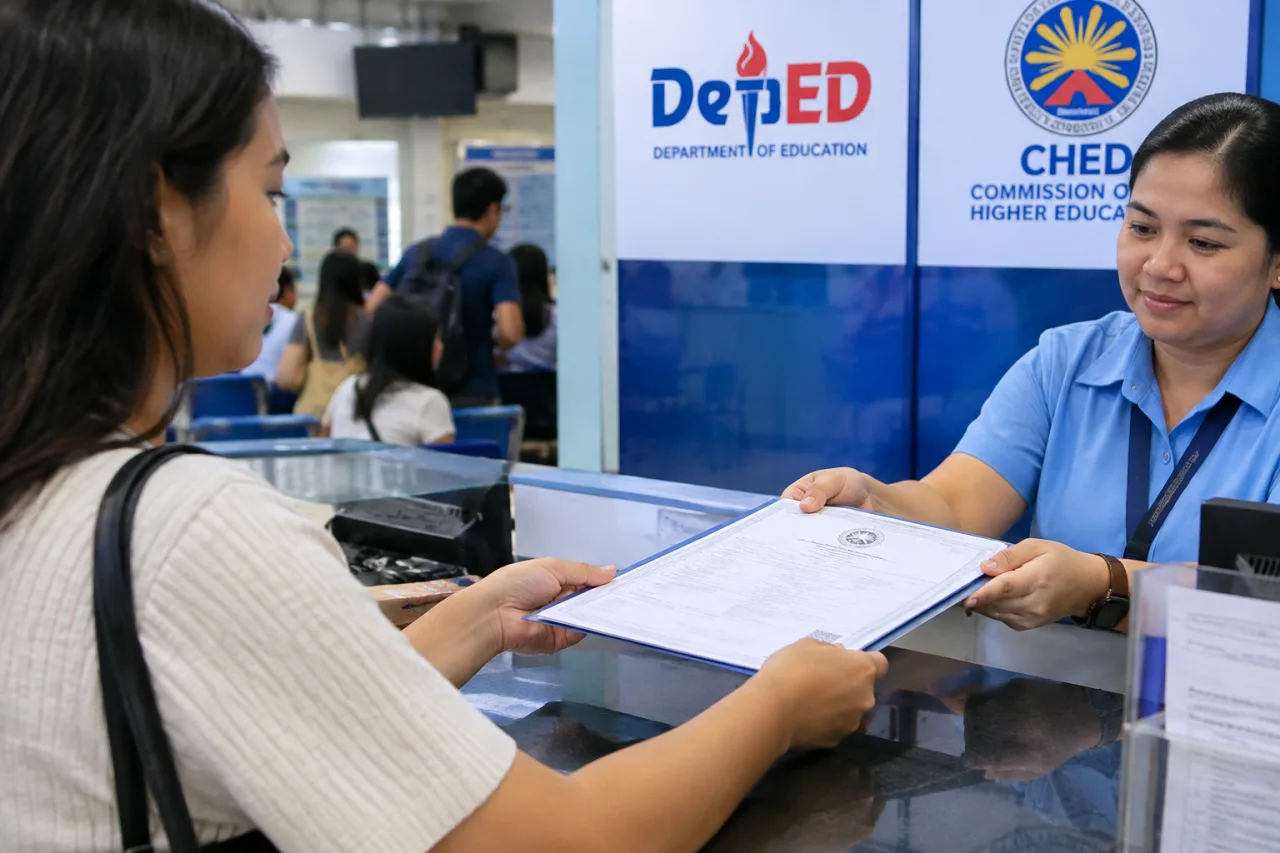
CHED’s electronic CAV portal lists the flow on its own pages, and it is the rare government process that runs fully remote:
- Create the account. Register on the portal with a valid email and complete the profile with your education details exactly as the school spelled them.
- Submit the application and documents. The requirements page lists what the system accepts, typically the diploma and transcript images plus identification, uploaded into the form.
- Pay in the portal. The listed payment rails include GCash, Landbank and other options, which matters for applicants paying from abroad.
- CHED processes and verifies. The review checks the document against the school and the agency’s own databases; notifications arrive by email and in-app.
- Download the eCAV. The certificate becomes available from the account for downloading, which removes a courier round-trip from the middle of the chain.
Two portal features deserve their own sentences. Applicants outside the Philippines can complete CAV authentication entirely remotely through the college lane, upload, pay, track and download, which is why the eCAV channel is the recommended route for OFW applicants with college records. And first-time job seekers can claim the fee exemption under RA 11261, the First Time Jobseekers Act, inside the application flow, subject to the law’s own conditions.
CAV Through DepEd: the Regional Flow
DepEd processes CAV through regional offices, and the channels keep moving online. Region III’s CAV advisory effective August 18, 2025 is the clearest published example: applications must be scheduled online, walk-ins no longer accepted, and the requirements are stated on the same page:
- Form 137, the permanent record, with one photocopy
- Certificate of graduation, with one photocopy
- Diploma, with two photocopies
- Two passport-size photos
Private school graduates add the Special Order number from their diploma records, and undergraduates submit Form 137 and a certificate of completion with photos instead. Two practical notes for applicants abroad: requirements differ slightly per regional office, so the binding list is always the one your region’s current page prints, and the online-appointment shift means the booking link, not the office address, is now the thing to hunt for.
From CAV to Apostille: the DFA Leg of the Chain
Once the CAV certificate is in hand, the document continues to the DFA for authentication, where Hague Convention members accept the apostille and non-members require the further embassy legalization. The DFA’s official apostille portal publishes the documentary requirements and application process, and the agency offers appointment-based processing at itsAuthentication offices. The chain in one line: school record, agency CAV, DFA apostille, then the destination country’s embassy step where one applies. Our documentation hub, the sixteen free OFW document tools roundup, keeps links to each agency in one place for exactly this kind of chain work.
Documents to Prepare Before You File
Every CAV application inherits its weakest document, so the preparation pass happens at home rather than at the counter:
- The source documents, checked in full. Signatures, dry seals and registrar initials are what certification certifies; a transcript missing its seal is not yet a certifiable document.
- One name everywhere. Collect your documents by exact spelling, middle names included. Where records genuinely disagree, the school-side correction or the sworn affidavit comes first, because the CAV certificate will repeat whatever the document says.
- Photocopy sets per the list. Agencies state exact counts, and the counter accepts a complete set faster than a partial one asking where the spare copies went.
- IDs of the filer and, if applicable, the representative. When a family member processes the file abroad-for-you, the authorization letter plus both parties’ valid IDs go in the folder from the start.
- Digital copies ready for the online lanes. CHED eCAV accepts uploads, so clear, complete scans of the same documents, legible seals included, save a resubmission cycle that costs weeks in processing time.
Timeline and Costing: What Each Leg Takes
Three legs, three different clocks, each published by its own agency rather than by folklore:
- Agency CAV processing. Processing windows are agency and region specific; CHED’s eCAV shows status in the account, and DepEd regional pages post their current service timelines in the citizen charter. The published channel is the only source for a number that holds.
- Fee side. CHED prices through the portal at application, DepEd fees follow its published schedule per document type, and the DFA apostille fee posts on the apostille portal. First-time job seekers hold the RA 11261 exemption on the relevant leg, and OFW applicants pricing the chain from abroad should add payment-rail costs to the agency fees.
- DFA apostille leg. The apostille portal lists its documentary requirements and application process, and the appointment belongs after the CAV certificate physically or digitally exists, not before.
Chain the bookings in order and the calendar does the quality control for you: agency release, apostille filing, embassy legalization where the destination requires it. Working the chain out of order is where files sit for weeks while one document waits for another.
Common Rejections and How to Avoid Them
- Name mismatches across documents. A middle name missing on the transcript and present on the diploma is the classic bounce; if your records disagree, request a school-side correction or a notarized affidavit before the CAV, not after.
- Unsigned or unsealed source documents. Registrar signatures and school seals are what the certification certifies; documents missing either go back to the school first.
- Photocopy-count errors. Regions state exact photocopy counts, as the Region III list shows; bring the stated extras and the counter takes the set in one pass.
- Wrong agency filed to. College records sent to DepEd, or TESDA certificates filed with CHED, restart the clock; the triage list above settles it in a minute.
- Expired appointment slots and rushed apostille bookings. The apostille appointment belongs after the CAV release date, not before it; chain your bookings in order.
The travel documents that sit alongside school records have their own routes, covered in our NBI clearance abroad guide and the PSA birth certificate from abroad guide, and the full document chain for an employment package usually needs all three plus CAV authentication of the school records.
Rejected or Blocked Files: the Recovery Path
When a CAV file comes back with a deficiency, the letter tells you which layer broke, and each layer has a known fix:
- Record-level problems. Missing grades, spelling errors or unclaimed items on the source document go back to the school registrar for correction or issuance; the agency cannot certify a document the school has not fixed first.
- Identity-level problems. A name mismatch between the school record and the government ID routes to the affidavit or correction channels before refiling, not through arguing at the counter.
- Application-level problems. Wrong agency, missing photocopies, incomplete representative papers: refile with the corrected set, and the earlier receipt usually shows whether a new fee applies.
- Agency-record problems. Closed or merged schools, records held by successor custodians, or data gaps inside the agency itself: these move at the agency’s pace through its retrieval process, and a written follow-up with the reference details keeps the file from stalling silently.
The pattern across all four: deficiency letters are specific, and the specific fix beats a repeat submission with the same contents, because CAV authentication rewards the corrected file, never the louder follow-up. Households processing from abroad should build the recovery step into the family plan from the start, because the representative who knows which office holds which problem costs one phone call instead of one round trip.
Frequently Asked Questions
What is CAV authentication in Philippine documents?
Certification, Authentication and Verification: the process where DepEd, CHED or TESDA certifies that a school record is genuine before the DFA attaches the apostille for use abroad. CAV authentication is the first official check a school document passes on its way out of the country, and it exists at every education agency for the same reason: nothing gets apostilled abroad without the issuing agency vouching for it first.
How long does CAV authentication take?
Processing times are agency and region specific, and neither DepEd nor CHED publishes a single national figure, so the working answer is: check the current posted timeline on your office’s page and in the eCAV tracking screen. The online portals at least make the queue visible instead of a mystery.
How much does DepEd CAV cost?
DepEd’s CAV fees are set by its current fee schedule per document type, published through the regional citizen charters; private-school graduates add the Special Order requirement but not a separate fee. The CHED side prices differently, and first-time job seekers can invoke the RA 11261 exemption in eCAV.
Can I apply for CAV authentication while abroad?
For college records, yes: the CHED eCAV flow supports remote account creation, document upload, online payment and certificate download. For basic-education records, expect DepEd regional offices to require appointments and document submissions, which typically needs an authorized representative at home when you cannot attend.
Do I still need an apostille after CAV authentication?
Yes, for use in Hague Convention countries the DFA apostille comes after the CAV; non-convention destinations add embassy legalization after the apostille. The CAV proves the document, the apostille makes the proof travel.
Can a family member process my CAV for me?
Yes, with an authorization letter, your IDs and the complete document set, subject to the receiving office’s representative rules; regional pages state what the representative must present. Booking the appointment under the applicant’s details still applies where online scheduling exists.
If this intelligence helps you, you can add WorldNgayon as a preferred source on Google — free, one click, and it helps other Filipinos find the answers faster.
Financial Disclaimer
This article is document-process information published for general guidance. Requirements, fees and procedures cited follow the official sources linked within this article’s research window and change without notice; each agency’s own current page is the binding reference for your file. Nothing here is legal advice, and no processing outcome is promised. WorldNgayon accepts no liability for decisions made based on this article. Readers should verify current requirements with DepEd, CHED, TESDA and the DFA before filing and consult qualified professionals for their specific situation.
- Official ecav.ched.gov.ph — eCAV electronic portal
- Official region3.deped.gov.ph/services/certification-authentication-and-verifi… — CAV advisory effective August 18, 2025
- Official apostille.gov.ph — apostille portal
- google.com/preferences/source?q=worldngayon.com — add WorldNgayon as a preferred source on Google
External sources linked in this article, in order of first mention. Spotted an error or a broken link? Tell us.
Cite this pagePublished Nov 17, 2026
Agron, E. (2026, November 17). CAV Authentication Explained: School Records for Work or Study Abroad. WorldNgayon. https://worldngayon.com/cav-authentication-abroad/
Agron, Edmon. “CAV Authentication Explained: School Records for Work or Study Abroad.” WorldNgayon, 17 Nov. 2026, worldngayon.com/cav-authentication-abroad/.
Agron, Edmon. “CAV Authentication Explained: School Records for Work or Study Abroad.” WorldNgayon, November 17, 2026. https://worldngayon.com/cav-authentication-abroad/.
Agron, E. (2026) ‘CAV Authentication Explained: School Records for Work or Study Abroad’, WorldNgayon, 17 November. Available at: https://worldngayon.com/cav-authentication-abroad/.
E. Agron, “CAV Authentication Explained: School Records for Work or Study Abroad,” WorldNgayon, Nov. 17, 2026. [Online]. Available: https://worldngayon.com/cav-authentication-abroad/
@online{agron2026cavauthentication,
  author       = {Agron, Edmon},
  title        = {{CAV Authentication Explained: School Records for Work or Study Abroad}},
  year         = {2026},
  date         = {2026-11-17},
  organization = {WorldNgayon},
  url          = {https://worldngayon.com/cav-authentication-abroad/},
  urldate      = {}
}TY - ELEC AU - Agron, Edmon TI - CAV Authentication Explained: School Records for Work or Study Abroad T2 - WorldNgayon PY - 2026 DA - 2026/11/17/ UR - https://worldngayon.com/cav-authentication-abroad/ Y2 - ER -
Cite the version you read; the page may be updated. Zotero and Mendeley can also import this page directly.