
Table of Contents
Key Takeaway
- 🥇 To buy gold in the Philippines, price three doors, not one: jewelry carries making charges on top of metal value, bars and coins trade near the world price, and app-based gold products carry platform rules worth reading first.
- 🏛️ The Bangko Sentral anchors the price and runs the official sell channel: its Gold Buying Stations pay a 99.5 percent initial payment against LBMA-based rates, and personal sellers are accepted with the right documents.
- ⚠️ Jewelry cannot go to the BSP window: the stations accept bar or disc form only, so family jewelry sells through pawnshops or jewelers at their own spreads instead.
- 🧾 The tax-exemption route is real, documented law: Republic Act 11256 exempts qualifying small-scale gold sales, processed through a BSP Certification.
- 📱 Verify before you fund anything labeled digital gold: check the product’s regulator registration and the redemption terms before money moves, not after.
Gold carries a specific reputation in Filipino households, and searches for how to buy gold in the Philippines usually start from it: it survives typhoons, remittance droughts and currency wobbles, and it sells. What most guides skip in the question of how to buy gold in the Philippines is the two-sided reality: the buying side is a pricing problem, where to buy gold in the Philippines decides how much premium you pay over the world price. The selling side is a paperwork problem, and the paperwork decides whether the sale is clean or expensive. This guide covers both, anchored to the Bangko Sentral’s own published program, the one official page every buy gold in the Philippines search should end at.
What Gold Actually Costs to Buy
Gold’s reference price is global, not local. The Bangko Sentral buys refined gold at the prevailing international buying price set by the London Bullion Market Association, converted at its own daily peso rate, per the program page updated May 2026. Every form you buy gold in the Philippines through therefore carries that world price underneath, and the difference between the world price and your purchase price is the premium that decides whether the purchase was clever or expensive.
The premium structure across the three routes:
- Jewelry: carries a making charge above metal value, since craftsmanship is a real cost. The karat logic matters here: 24-karat gold is roughly 99.9 percent pure, while 18-karat jewelry is 75 percent gold by weight, so the price per gram of the metal itself must be scaled by purity before the making charge is even discussed.
- Bars and coins: trade closest to the world price, and small denominations carry proportionally larger premiums because fixed costs spread over fewer grams.
- App-based or pooled gold products: price near the world rate but carry platform terms, spreads and redemption rules that replace the physical premium with a contractual one.
One universal pre-purchase check: get the day’s reference price from a public source such as the World Gold Council price page, weigh the item, compute the metal value at the stated purity, and then judge whatever sits on top of that number. A buyer who can do that arithmetic is, in every market, harder to overcharge.
Where to Buy Gold in the Philippines: Three Ways In
Jewelry First: the Heirloom Market
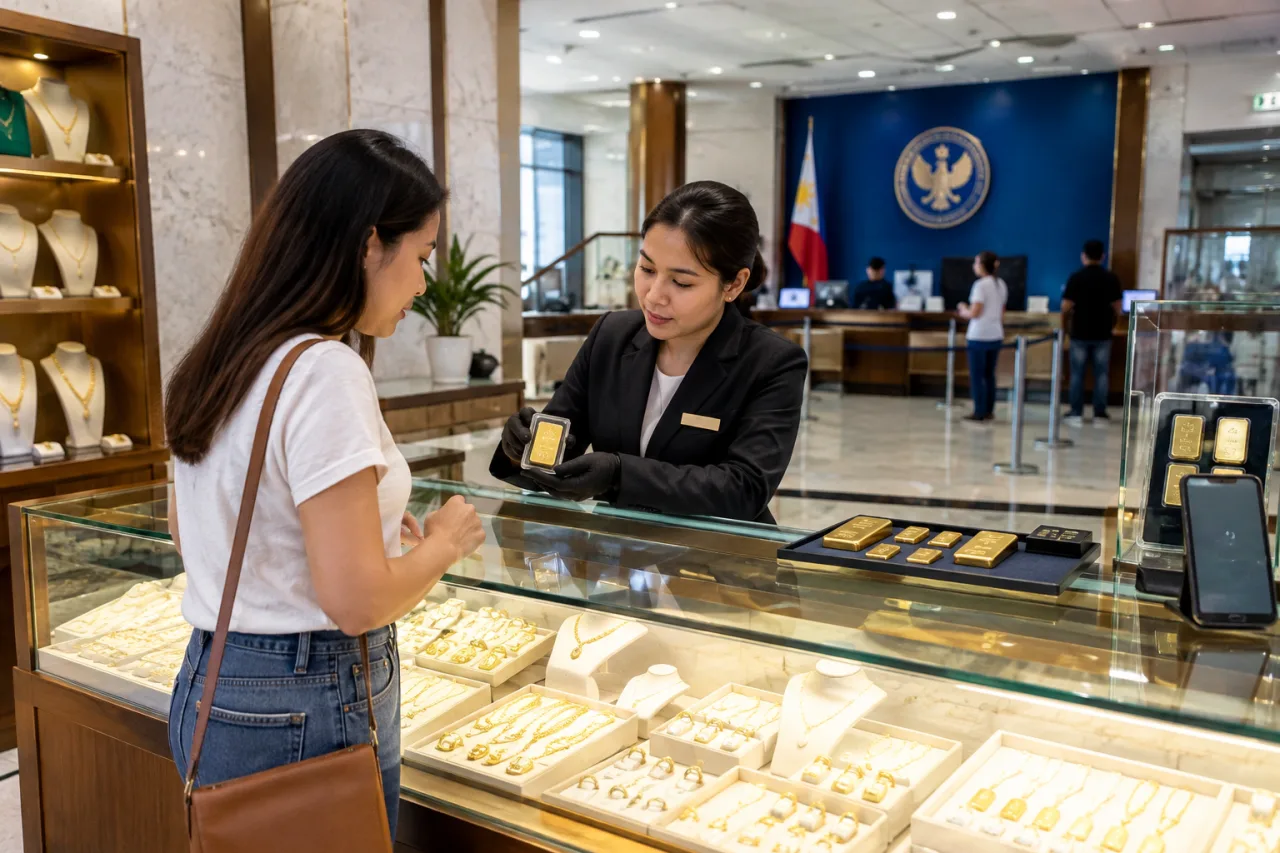
Jewelry is the most common vehicle because it doubles as an heirloom, and the practical rule is to buy where the making charge is transparent and the receipt states purity explicitly. Gulf-based readers often price Riyadh or Dubai jewelry against Manila pricing, and the working comparison needs three numbers: the day’s gold price, the purity of the piece and the making charge. Where to buy gold in the Philippines through jewelers, the receipt language to keep is purity in percentage or karat, net weight and the making charge shown separately, because those three lines are what a future buyer of your piece will price against.
Bars and Coins: Closest to Bullion Pricing
Bars and rounds are the closest retail form to bullion pricing, and the practical checks are the dealer’s registration, the bar’s serial and purity markings, the assay or certificate when one exists, and a receipt that names the seller. The resale reality is equally practical: buy in sizes you can hold and sell without dramatic spreads, because a gram-size bar resells with far less friction than a large ingot few local buyers can price on the spot.
App-Based Gold: Terms Decide Everything
Some banks and wallet apps offer gold products that track the world price and settle digitally. The terms that matter before funding any of them: how the spread is charged, how redemption converts to cash or physical metal, and which regulator covers the product. The decision to buy gold in the Philippines through an app is a decision about terms, not about gold, so read them the way you would read a loan contract.
The Selling Side: the Bangko Sentral’s Official Gold Buying Program
The Bangko Sentral operates Gold Buying Stations where refined gold may be sold directly to the central bank, a channel open not just to miners and traders but, per the published guidelines, to personal or private sellers. The verified mechanics matter to any household selling bullion:
| Program element | What the BSP page states |
|---|---|
| Rate basis | LBMA-based international buying price, converted at BSP’s daily peso rate |
| Initial payment | 99.5 percent of delivery value based on as-received weight and preliminary assay; the remaining 0.5 percent settles after final assay |
| Stations | National Capital Region (Security Plant Complex, Quezon City), Cordillera, Bicol, Davao and Butuan offices, working days, 9:00 a.m. to 2:00 p.m. |
| Form accepted | Bar or disc only, maximum 5 kilograms per piece, no mercury content, damp or jewelry forms refused |
| Core documents | Two government IDs, TIN copy, validated bank-account proof, ID photos, plus the station’s delivery-and-sale letters and BIR forms at every sale |
| Tax exemption route | Republic Act 11256 exempts qualifying gold sales, processed through a BSP Certification renewed every three years and tied to small-scale mining contracts or trader accreditation |
Three program details surprise people every time. First, jewelry is not accepted at the stations, so inherited rings and necklaces sell through the pawn and jeweler market, which prices lower than bullion channels. Second, the document list is strict but ordinary, IDs and receipts rather than anything exotic, and first-time sellers should gather them before traveling to a station. Third, the payment timeline is unusually fast by banking standards, with the regional stations paying by BSP check within ninety minutes of receipt or crediting the account within three working days.
The tax-exemption clause deserves its own sentence: Republic Act 11256, the act that strengthened the country’s gross international reserves, lets qualifying small-scale gold sales run tax-exempt through the certification process, which is the difference between a clean sale and a taxable one for mining households.
The Gulf Loop: Buying Abroad, Selling Clean at Home
Filipino workers in the Gulf live inside the world’s densest jewelry retail market, and the loop they run has two ends: gold bought in Riyadh or Dubai, and the eventual sale back in Manila. Each end has its own checklist, and matching them from the start is what keeps the loop profitable rather than lossy.
On the buying end, two Gulf advantages are worth naming. First, competition among jewelers compresses making charges below what smaller markets often carry, so the same purity costs less markup at the counter. Second, receipts in the major chains state purity and net weight explicitly, which is exactly the paper the future sale prices against. Readers planning to buy gold in the Philippines after a Gulf tour should keep those receipts with the passport copies, because the sale documents travel the rest of the way to the BSP stations or the pawn counter.
On the selling end, the form decides the channel, and this is where the loop sometimes disappoints: jewelry bought as bullion-in-disguise still sells as jewelry, not as bar, so the BSP window stays closed to it and the pawn market applies its own spread. Bullion bought as bar, kept in original packaging with its papers, is the form that re-enters the official channel cleanly. The decision to buy gold in the Philippines or in the Gulf should therefore be made with the exit already chosen, because the exit, not the entrance, is where premium gets recovered or destroyed.
One practical routing note for OFW households: the value that matters at the sale is the metal content at purity, not what the store called the design, so family members should know which pieces are investment-grade metal and which are craft. The distinction costs nothing at purchase and saves a disappointment years later.
Five Checks Before You Buy Gold in the Philippines
- Price the metal first. Reference the day’s price, weigh the piece, scale by purity, and only then evaluate the premium or making charge on top.
- Buy purity in writing. A receipt that states karat or fineness converts a future resale dispute into a receipt check.
- Prefer registered, traceable sellers. The dealer’s paperwork, the serial marks on the item and, for online buys, the traceable payment path all matter more than a discount.
- Match the form to your selling plan. If the household plan is generational holding, jewelry can fit. If the plan is liquidity, bars and coins with documents win, because the future seller, you, will face the same spreads you are avoiding today.
- Keep the exit in sight. Before choosing to buy gold in the Philippines, decide where and how you would sell it: a bullion form routes to the official stations, jewelry routes to the pawn market, app-held gold routes through the platform’s own redemption terms.
Where Gold Sits in a Filipino Family Portfolio
Gold is a store of value with no yield, which is the whole trade-off against deposit and bond products. The household logic that returns from the gold literature repeatedly: gold holds weight as a hedge slice, not as the whole plan. Emergency cash sits in liquid accounts, as our time deposit guide covers for the fixed-term side; the safety question of what happens to accounts sits beside it in our dormant account guide; and the asset-allocation frame between gold and equities runs through our China gold versus bitcoin strategy analysis and the entry-level market picture in our stock market basics piece. Gold’s role is the volatility-absorbing slice of that stack, not the engine.
Frequently Asked Questions
Can I sell old jewelry directly to the Bangko Sentral?
No. The BSP Gold Buying Stations accept bar or disc form only, and the published specifications explicitly exclude jewelry, along with powder, mercury-containing material and anything damp. Jewelry sells through pawnshops and jewelers at their own pricing spreads.
How is the price set when I sell gold to the BSP?
The stations buy refined gold at the prevailing international buying price set by the London Bullion Market Association, converted at BSP’s own daily peso buying rate. Your initial payment equals 99.5 percent of the delivery value on the preliminary assay, with the remaining 0.5 percent settling after final assay.
Is selling gold to the BSP tax-free?
Qualifying sales can be, through the certification process under Republic Act 11256. The exemption is tied to small-scale mining contracts or trader accreditation, processed with a BSP Certification renewed every three years; ordinary personal bullion sales follow the standard tax rules that apply to your situation.
Where can I buy gold in the Philippines at the world price?
Retail forms always carry a premium above the LBMA-based reference price; the closest forms are documented bars and coins from registered dealers, where the premium is smallest among physical doors. App-based gold products price near the world rate but add contractual spreads. There is no retail door that sells exactly at the world price, which is why the five-check method matters more than chasing the minimum premium.
What documents do I need for a first BSP gold sale?
The published schedule asks for two originals and photocopies of a government ID, your TIN copy, bank-account validation, passport-sized photos, and the station’s own letter and BIR forms completed at the counter, plus proof of the gold’s source. Traveling with the complete set avoids a second trip.
Is app-based gold safe to use?
It depends on the terms, not on gold. Check which regulator supervises the product, how the spread is charged, and how redemption works in cash or metal before you fund it. Those three answers decide the product’s safety more than the gold price does.
If this intelligence helps you, you can add WorldNgayon as a preferred source on Google — free, one click, and it helps other Filipinos find the answers faster.
Financial Disclaimer
This article is financial information published for general guidance. Gold prices, program terms and regulatory rules cited follow the official sources linked within this article’s research window and change without notice. Nothing here is investment, tax or legal advice, no outcome is guaranteed, and gold carries market risk including loss of value. WorldNgayon accepts no liability for decisions made based on this article. Readers should verify current rates and rules with the official pages and consult qualified professionals for their specific situation.
- gold.org/goldhub/data/gold-prices — World Gold Council price page
- Official bsp.gov.ph/Pages/CoinsAndNotes/PoliciesAndPrograms/GoldAndSilverBuyin… — refined gold may be sold directly to the central bank
- google.com/preferences/source?q=worldngayon.com — add WorldNgayon as a preferred source on Google
External sources linked in this article, in order of first mention. Spotted an error or a broken link? Tell us.
Cite this pagePublished Nov 17, 2026
Agron, E. (2026, November 17). How to Buy Gold in the Philippines: Bars, Jewelry and Digital Gold Compared. WorldNgayon. https://worldngayon.com/buy-gold-in-the-philippines/
Agron, Edmon. “How to Buy Gold in the Philippines: Bars, Jewelry and Digital Gold Compared.” WorldNgayon, 17 Nov. 2026, worldngayon.com/buy-gold-in-the-philippines/.
Agron, Edmon. “How to Buy Gold in the Philippines: Bars, Jewelry and Digital Gold Compared.” WorldNgayon, November 17, 2026. https://worldngayon.com/buy-gold-in-the-philippines/.
Agron, E. (2026) ‘How to Buy Gold in the Philippines: Bars, Jewelry and Digital Gold Compared’, WorldNgayon, 17 November. Available at: https://worldngayon.com/buy-gold-in-the-philippines/.
E. Agron, “How to Buy Gold in the Philippines: Bars, Jewelry and Digital Gold Compared,” WorldNgayon, Nov. 17, 2026. [Online]. Available: https://worldngayon.com/buy-gold-in-the-philippines/
@online{agron2026buygold,
  author       = {Agron, Edmon},
  title        = {{How to Buy Gold in the Philippines: Bars, Jewelry and Digital Gold Compared}},
  year         = {2026},
  date         = {2026-11-17},
  organization = {WorldNgayon},
  url          = {https://worldngayon.com/buy-gold-in-the-philippines/},
  urldate      = {}
}TY - ELEC AU - Agron, Edmon TI - How to Buy Gold in the Philippines: Bars, Jewelry and Digital Gold Compared T2 - WorldNgayon PY - 2026 DA - 2026/11/17/ UR - https://worldngayon.com/buy-gold-in-the-philippines/ Y2 - ER -
Cite the version you read; the page may be updated. Zotero and Mendeley can also import this page directly.