
Table of Contents
Key Takeaway
- 📊 The ranking: The identity fraud Philippines ranking from Sumsub’s Identity Fraud Report 2026-2027 puts the country at 17 percent of all fraud networks detected in Asia-Pacific, the largest share of any country in the region, built on more than 5.8 million fraud samples.
- 🎭 The surge: Deepfake attacks measured in the Philippines jumped 125 percent year on year, the second-largest increase of any market in the report, only behind Pakistan’s 217 percent.
- 🤝 The response: On November 17, 2026, at the special summit between ASEAN and the United States in Manila, both sides adopted 10 public-private partnership principles and a comprehensive work plan to tackle online scams, including sharing mule-account identifiers across borders.
- ⚠️ The honesty check: The principles are not binding, and the Sumsub figures come from one platform’ verification data, so treat them as a strong directional signal rather than a government audit.
- 🧭 Tonight’s move: Never rent out an e-wallet or bank account, confirm every video verification request out-of-band, and report anything suspicious the same day through the official channels below.
Coverage of identity fraud Philippines usually starts with a scam text or a fake job ad. This week the picture finally got its clearest data point yet: the country now tops Asia-Pacific in detected fraud networks; in identity fraud Philippines terms, it holds 17 percent of the region’s total, according to identity verification provider Sumsub’s Identity Fraud Report 2026-2027, and deepfake attacks measured against the market jumped 125 percent in a single year. Days before those numbers landed in the press, the same capital city hosted the event meant to answer them. At the special ASEAN-and-US summit in Manila on November 17, 2026, the Philippines’ ASEAN chairmanship and the United States adopted ten public-private partnership principles, plus a work plan, to tackle online scams as a shared regional security problem. Two facts, one week, one message: the fraud industry around Filipino identities is now measured, ranked, and formally targeted, and the fight is moving from press releases to mule-account lists.
This identity fraud Philippines briefing walks through what the numbers actually measure, why the Philippines ranks first, what the 125 percent deepfake spike means for your bank and e-wallet verifications, exactly what the 10 principles commit governments and industry to, and what a working Filipino professional should change this week. Where a claim depends on a single vendor’s data, the article says so. Where a promise is political rather than binding, the article says that too.
The identity fraud Philippines numbers, verified one line at a time
The identity fraud Philippines numbers in the table below trace to Sumsub’s Identity Fraud Report 2026-2027, the London-headquartered identity verification platform’s sixth annual edition, released in the third week of November 2026. The company says it analyzed more than 5.8 million fraud samples drawn from its own identity-verification and user-activity data, as the Manila Times reported when the findings reached Philippine readers. Every figure in the table below carries its source line, and where the numbers say something uncomfortable about the platform sample itself, this article flags that in the next section.
| Item | Verified figure | Source |
|---|---|---|
| Region’s global share | Asia-Pacific accounted for 33 percent of all fraud networks detected worldwide, the largest of six regions | Sumsub Identity Fraud Report, release |
| Regional attempts | Close to one million confirmed fraud attempts in Asia-Pacific, the highest count among the six regions examined | Sumsub report, via Manila Times |
| Philippines share | 17 percent of the region’s detected fraud networks, the largest share of any single Asia-Pacific market | Sumsub report, via Manila Times |
| Runner-up | India, closely behind the Philippines in detected networks | Sumsub report, via release |
| Largest single network | 3,018 linked users, detected in Thailand | Sumsub report, via release |
| Deepfake rise | Philippines +125 percent year on year; Pakistan +217, India +103, Hong Kong +72; Indonesia overall fraud fell 64 percent while its deepfakes rose 69 | Sumsub report, via release |
| Complexity | Asia-Pacific Fraud Complexity Index rose 14 percent to 2.09; Hong Kong’s rose 7 percent to 1.97 | Sumsub report, via release |
| AI agents | 61 percent of Asia-Pacific businesses detected or suspected fraud carried out by AI agents; the region reported fraudster-operated AI agents more than any other region | Sumsub report, via release |
In identity fraud Philippines coverage, two reads make the table useful instead of alarming. First, the Philippines’ 17 percent is a share of detected networks on one verification platform, and markets that run more digital identity checks surface more networks to detect; that does not make the number fake, it makes it directional. Second, the deepfake column is the fastest-moving line in the report for this market, and it is the part that reaches an ordinary professional’s next bank login, not just a compliance dashboard.
What a Fraud Network Is, and Why the Country Ranks First
A fraud network, in Sumsub’s sense of the term, is not one scammer with one phone. It is a cluster of accounts, identities, and payment rails that are linked because they share devices, documents, IP patterns, or money flows. The 3,018-user network detected in Thailand shows the scale: one operation touching thousands of opened accounts. Identity fraud Philippines data of this kind is built exactly the way banks and e-wallets defend in the real world, by noticing that one person’s selfie, one borrowed ID, or one device fingerprint keeps reappearing across accounts that claim to be strangers.
The identity fraud Philippines ranking sits first in the region for reasons that our own reporting has tracked all year. When the government banned Philippine offshore gaming operations in late 2024 and wound the centers down through 2025, the scam business did not die with the POGO ban; it moved, re-forming in smaller hubs and in remote setups that are harder to bomb and easier to rent. The industry then got a software upgrade: as we showed in our piece on AI scam compounds in Southeast Asia, the modern fraud economy runs with AI-written phishing, cloned voices, and automated victim management. A country with a huge e-wallet user base, a remittance economy that moves money at midnight, and a workforce that signs up for new digital services every month is exactly the identity pool such networks want, which is why 62 percent of Filipinos now say scam fear shapes their online behavior, a number we covered when it broke.
It is worth being honest about what the identity fraud Philippines ranking does not say. It does not say every Filipino is a fraudster, and it does not say the Philippines generates the most victims in the region, because the report measures detected networks, not victim counts by nationality. Networks choose markets for infrastructure reasons: available mule identities from recruited humans, weak cross-border friction, and high digital payment density. The Philippines has all three, which is precisely why an agreement about sharing mule-account identifiers across borders matters to this ranking more than any slogan does.
Deepfake Attacks Jumped 125 Percent: the Video Verification Problem
The single most consequential number in the identity fraud Philippines report for an individual reader is the 125 percent year-on-year jump in deepfake incidents measured in the Philippines, second in the whole dataset only to Pakistan’s 217 percent. The pattern repeats across the region in a way that tells you it is structural, not local noise: Hong Kong deepfakes rose 72 percent, India’s rose 103 percent, and even Indonesia, where overall measured fraud fell 64 percent, still posted 69 percent more deepfakes. Fraud pressure, in other words, is not disappearing anywhere in Southeast Asia; it is concentrating where the money and the identity checks are, and it is wearing a synthetic face when it arrives.
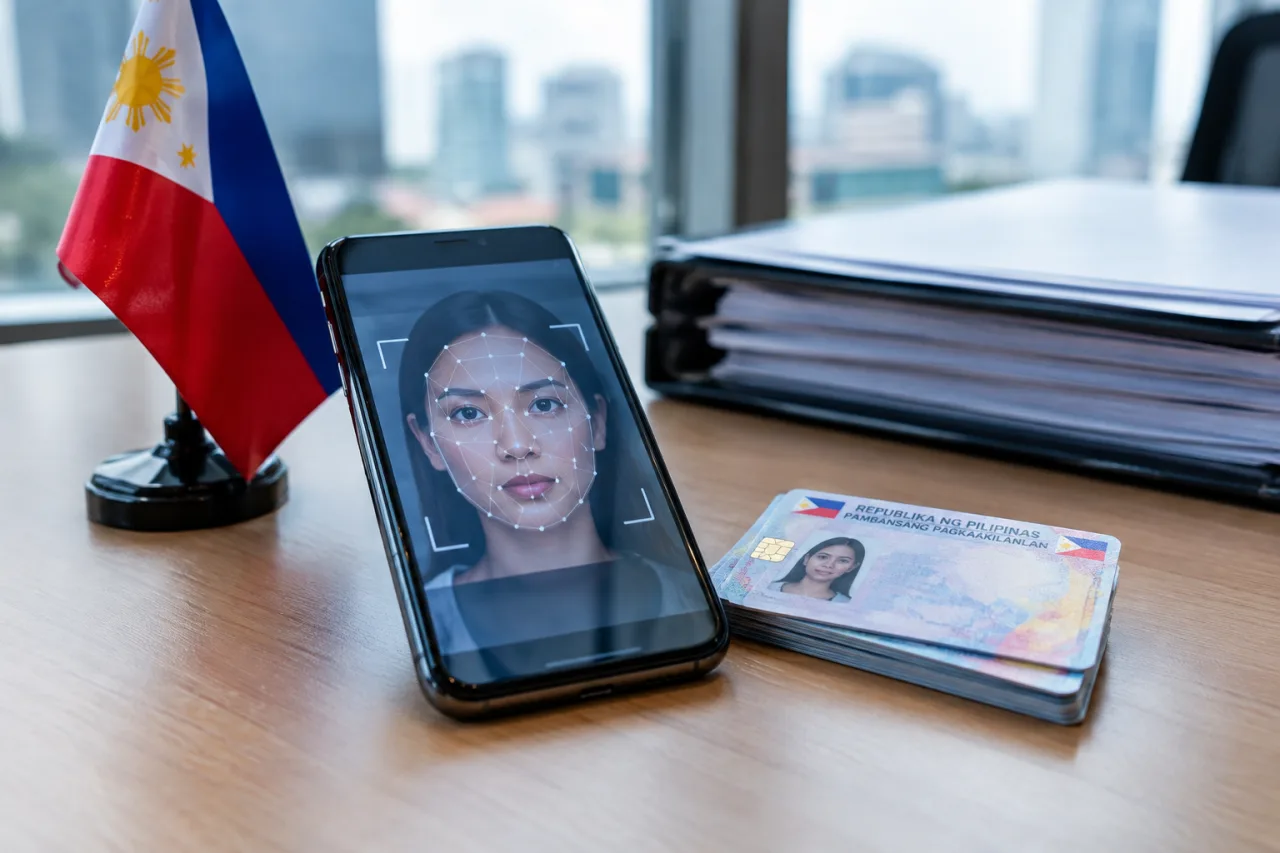
The target is verification itself. Banks and licensed e-wallets in the Philippines increasingly rely on video liveness checks, selfie matching, and document selfies, because they scale better than branch visits, and our coverage of the region’s rails noted the same drift on the Southeast Asia guide’s compliance pages. A fake face that defeats one liveness check opens accounts, resets passwords, and authorizes transfers. The defense that works is boring but real: verification requests confirmed out-of-band, meaning you call the bank on its official number or open the official app yourself, never through the link or the call that claimed to be the bank. Treat any video call that asks money of you the way you would treat a text from an unknown number, no matter how much the face looks like your manager, your relative, or your bank manager, because the machine behind the <customs fee> text is already producing calls too.
The ASEAN and US Anti-Scam Pact, Adopted in Manila
On November 17, 2026, in Manila, the member states of ASEAN and the United States adopted the ASEAN-U.S. Statement on 10 Public-Private Partnership Principles for Tackling Online Scams, plus a comprehensive work plan. President Ferdinand Marcos Jr. announced the adoption at the Manila special summit, attended by President Donald Trump, and presented it as a deliberately delivered result: “In anticipation of your arrival, Mr. President, and knowing your desire for results and not just talk, our staffs have been working together, ASEAN and your staffs have been working together, and we have come to being able to finalize and have adopted the principles to tackle online scams,” per the Philippine News Agency’s report. The statement falls under the Philippines’ ASEAN chairmanship theme of “Navigating Our Future, Together,” and builds on groundwork laid when ASEAN and US digital ministers first noted the principles in January 2026.
Distilled to what actually matters for a reader holding a phone, the ten principles do six things. They elevate online scams to a national security matter across ASEAN meetings. They commit governments to cross-border cooperation in investigating scams, assisting victims, and recovering assets, including the trafficking dimension tied to forced scam labor. They direct banks and fintechs toward enhanced information sharing on suspicious transactions and toward reviewing their identity verification, customer due diligence, and enhanced due diligence protocols. They press public and private parties to share threat indicators at machine speed: fraudulent URLs, phishing domains, and, most directly relevant to the identity fraud Philippines ranking, mule-account identifiers. They strengthen the ASEAN Working Group on Anti-Online Scams with dedicated US funding and resources behind information exchange and practical cooperation. And they add a transparency layer meant to measure outcomes, including how much stolen money actually gets back to victims. Readers who followed our earlier explainer on how ASEAN plans to trace and block will recognize the architecture; what changed this week is political weight at head-of-state level, with the United States inside the same framework.
The honesty clause belongs right here: the statement does not create binding obligations. Implementation depends on each country’s laws, priorities, and resources, and the joint text leaves additional funding decisions to the participants. A principles document is not an arrest, and a work plan is not an enforcement unit. What it does change is legitimacy and speed: mule-account lists that legally could not move between a Philippine e-wallet and a Singapore bank can now move through an agreed framework, and every subsequent joint operation inherits that permission structure.
Where the Numbers and the Pact Meet
Put the two events on one timeline and the week reads like a diagnosis followed by a prescription written the same day. The identity fraud Philippines report, published in the same week as the summit, tells the region that the Philippines carries its largest detected fraud-network footprint. The Manila statement answers with the one lever that fits the diagnosis: identity-linked enforcement, which is why the phrase mule-account identifiers appears in a head-of-state document rather than buried in a regulatory annex.
The fit is not accidental, and it is not complete. Sumsub’s complexity index says scams are harder to untangle this year, not easier, because networks now interconnect accounts the way cloud systems interconnect servers. The AI-agent number, 61 percent of regional businesses detecting or suspecting agent-driven fraud, says the automation arms race is live on both sides. The pact’s identity-check review language reads directly against that number: banks re-checking their verification flows is the institutional response to faces that lie at scale. Watch three things over the next six months to see if the week was rhetoric or turning point: whether mule-account identifier sharing starts flowing through the ASEAN Working Group, whether Philippine banks publish measurable verification changes rather than memos, and whether the next regional fraud report shows the Philippines’ deepfake curve bending the way Indonesia’s overall fraud number did, down, instead of up by another triple-digit jump.
What a Filipino Professional Should Do This Week
Nothing in the identity fraud Philippines story requires panic, and every item on this list costs minutes, not money.
- Refuse the mule pitch, permanently. Networks of the kind the report measures are built on rented identities: someone offers you a fee to lend your e-wallet, your bank card, or your GCash line. That is not a side hustle; it is the raw material of a 3,000-account cluster, and principle five exists precisely to catch those identifiers. If your identity is inside a network, your name is in someone else’s fraud file for years.
- Treat video verification requests as suspect by default. With deepfake incidents up 125 percent in the market, a live-looking face is no longer evidence of a live person. Confirm through the official app or the official support line before any money or code moves.
- Act on alerts the same day. If your bank or e-wallet sends a verification or login alert you did not cause, freeze what you can and change credentials immediately. Speed is the difference between a blocked attempt and an opened account.
- Report properly, not just loudly. Our global routing guide for reporting a scam maps the exact channels from the first screenshot, and the GCash scam report page documents the 15-day rule for e-wallet disputes. Reports are what turn one victim’s screenshot into an identifier on a shared list.
- If a job offer smells like a compound, trust the smell. Recruiting into scam operations runs through the same job boards as real work, and our fast-track explainer on how to report an OFW job scam shows the checkpoints before you book anything.
Frequently asked questions about identity fraud Philippines
Which country has the most fraud networks in Asia-Pacific?
In the identity fraud Philippines data, Sumsub’s Identity Fraud Report 2026-2027 puts the Philippines first, with 17 percent of the region’s detected fraud networks, the largest share of any single market, and India close behind. The region as a whole accounts for 33 percent of all fraud networks detected worldwide.
What is a fraud network?
A cluster of accounts and identities linked by shared devices, documents, behavior patterns, or money flows, used together to commit fraud. The largest single network in the report, detected in Thailand, connected 3,018 linked users.
What did ASEAN and the US agree in Manila?
On November 17, 2026, at the special summit between ASEAN and the United States, they adopted the Statement on 10 Public-Private Partnership Principles for Tackling Online Scams plus a comprehensive work plan. It elevates online scams to a regional security priority, commits members to cross-border investigation and asset recovery cooperation, directs banks and fintechs to strengthen identity checks and information sharing on suspicious transactions, and puts mule-account identifier sharing, with dedicated US funding behind the ASEAN Working Group on Anti-Online Scams, at its core.
Are the anti-scam principles binding?
No. The statement is a political commitment, not a treaty obligation. Implementation depends on each country’s laws, priorities, and resources, so the pact’s real effect will be judged by whether identifier sharing and bank verification changes actually start flowing through the ASEAN Working Group in the months after adoption.
Why are deepfake attacks rising in the Philippines?
The target is identity verification itself: banks and e-wallets rely on video liveness and selfie matching, and cheap AI tools now produce synthetic faces and voices that attempt to defeat those checks. Sumsub measured a 125 percent year-on-year jump in the Philippines, second only to Pakistan’s 217 percent, and the pattern holds across the region, with India up 103 percent and Hong Kong up 72 percent, a signature of what identity fraud Philippines defenses now face.
How do I protect myself from identity fraud?
Never lend or rent your e-wallet, bank account, or personal identity to anyone, confirm every money-moving request through an official channel you opened yourself, act on verification alerts the same day, and report suspected scams through official channels immediately so your case becomes a shared identifier rather than a private loss.
- manilatimes.net/2026/11/19/business/top-business/ph-tops-asia-pacific… — as the Manila Times reported
- prnewswire.com/apac/news-releases/asia-pacific-accounts-for-a-third-o… — release
- Official asean.usmission.gov/asean-u-s-statement-on-10-public-private-partners…
- Official pna.gov.ph/article/marcos-announces-asean-us-agreement-vs-online-scams — per the Philippine News Agency’s report
External sources linked in this article, in order of first mention. Spotted an error or a broken link? Tell us.
Cite this pagePublished Nov 20, 2026
Agron, E. (2026, November 20). Identity fraud Philippines Tops Asia-Pacific With 17 Percent of Networks, Deepfakes Up 125%. WorldNgayon. https://worldngayon.com/identity-fraud-philippines/
Agron, Edmon. “Identity fraud Philippines Tops Asia-Pacific With 17 Percent of Networks, Deepfakes Up 125%.” WorldNgayon, 20 Nov. 2026, worldngayon.com/identity-fraud-philippines/.
Agron, Edmon. “Identity fraud Philippines Tops Asia-Pacific With 17 Percent of Networks, Deepfakes Up 125%.” WorldNgayon, November 20, 2026. https://worldngayon.com/identity-fraud-philippines/.
Agron, E. (2026) ‘Identity fraud Philippines Tops Asia-Pacific With 17 Percent of Networks, Deepfakes Up 125%’, WorldNgayon, 20 November. Available at: https://worldngayon.com/identity-fraud-philippines/.
E. Agron, “Identity fraud Philippines Tops Asia-Pacific With 17 Percent of Networks, Deepfakes Up 125%,” WorldNgayon, Nov. 20, 2026. [Online]. Available: https://worldngayon.com/identity-fraud-philippines/
@online{agron2026identityfraud,
  author       = {Agron, Edmon},
  title        = {{Identity fraud Philippines Tops Asia-Pacific With 17 Percent of Networks, Deepfakes Up 125\%}},
  year         = {2026},
  date         = {2026-11-20},
  organization = {WorldNgayon},
  url          = {https://worldngayon.com/identity-fraud-philippines/},
  urldate      = {}
}TY - ELEC AU - Agron, Edmon TI - Identity fraud Philippines Tops Asia-Pacific With 17 Percent of Networks, Deepfakes Up 125% T2 - WorldNgayon PY - 2026 DA - 2026/11/20/ UR - https://worldngayon.com/identity-fraud-philippines/ Y2 - ER -
Cite the version you read; the page may be updated. Zotero and Mendeley can also import this page directly.