
Table of Contents
Key Takeaway
- 🧮 The full total: A business solution’s true price is monthly fee plus processor cut plus exit cost, and the sellers who ask for all three numbers in writing at the booth buy faster and cheaper than those collecting flyers.
- 📦 The four lanes on the floor: Payments, logistics, marketing, and financing cover most of the business solutions an online seller will ever buy, and each lane has a fixed question that separates a demo from a contract.
- ⚖️ Fees decide at low volume: Verified fee research shows service tiers swing take-home pay by 10 percentage points on a ten-dollar sale, so the vendor quote, not the brochure, is the real brochure.
- 🤝 The order that pays: Walk the Growth Clinic’s government desk before signing anything, because filings and trustmarks the allies route for free turn every vendor contract into a legally safe adoption.
One hundred sixty business solutions will share the ECOMEX floor this week at SMX Convention Center Aura, and every business solution on that floor arrives with the same promise: that adopting it fixes something your online seller operation currently pays for in wasted hours. With many service providers participating, the challenge for online sellers is identifying which solutions address their actual business needs; buying well among them is a discipline with a known shape, the same shape every platform decision in digital commerce follows when the emotions are taken out of the aisle.
This is the practical guide to that discipline, written for the seller walking the two days, November 20-21 at the Taguig convention center, with a budget and a bottleneck list rather than a tote bag. The framework below runs four lanes, seven questions, and one sequencing rule, and it borrows its arithmetic from the fee research this year on the exact class of business solutions sold at expos like this one, so every example carries a number you can check against your own books.
The Four Lanes of the Vendor Floor
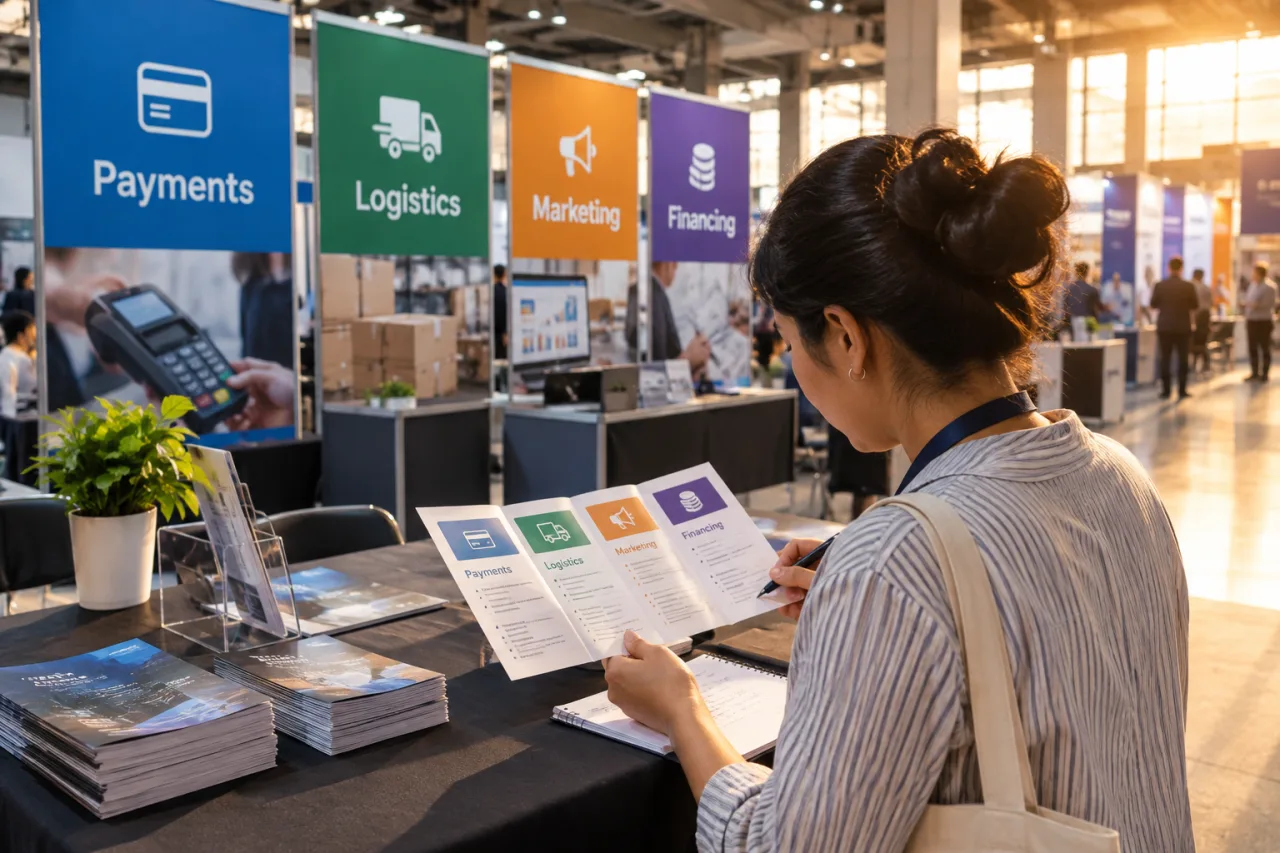
The 160-plus business solutions sort into four lanes, and each lane sells a different promise with a different failure mode. Among the business solutions that lane, payments, sits first, with gateways, wallet integrations, and remittance rails that decide how money lands, a layer we compared end to end in our PayPal vs Payoneer vs Wise corridor research. The second lane is logistics and fulfillment: last-mile couriers, warehousing, and marketplace enablers that decide whether a promised delivery date survives a typhoon week. The third is marketing and content: agencies, ad-tech, and creator services that decide whether demand arrives cheaply. The fourth is financing and compliance: lenders, registration services, and the government desks we tracked from the financing side, which decide whether growth is fundable and legal at each stage.
The business solutions in each lane fail differently, and the failure mode is the question that matters. Payment vendors fail on settlement terms and disputes, the fine print that only shows when a refund wave hits, and the best business solutions in that lane quote settlement windows in working days rather than confidence. Logistics vendors fail on exceptions, the undeliverable address, the peak volume, the remote island order, and the good business solutions there publish their exception rates rather than their averages. Marketing vendors fail on attribution, the channel that cannot prove it produced orders, so the strongest business solutions in that lane arrive with case figures tied to your order values. Financing vendors fail on true cost, the effective rate after fees and collateral requirements, and the clinic allies help separate the two before any pen moves, the same desk the trustmark questions run through. Walking the floor lane by lane with the lane’s failure in mind converts 160 pitches into four comparisons, and four comparisons fit on one page.
The Seven Questions That Separate a Demo From a Contract
Ask every vendor the same seven, in the same order, and write the answers on the vendor’s own flyer. First, what will I pay monthly at my current order volume, not at the volume your best customer runs. Second, what changes at triple volume, because tiers are where sticker prices hide their real schedules. Third, what is the processor or platform fee you do not control, the cut another service takes on top of yours. Fourth, what breaks first at peak, and what is your published uptime or settlement window. Fifth, what is the exit: notice period, data export format, and the penalty for moving out in month three. Sixth, who is liable when the failure mode above hits: your company, or mine. Seventh, show me the last customer who left and why, because a straight answer here is worth more than a demo.
The arithmetic behind questions one through three is the reason to write all three down. Fee research published this year across service tiers shows take-home margins swinging by ten percentage points or more on small tickets: on a ten-dollar transaction, the spread between a percentage-plus-fixed structure and a percentage-only one was 79 percent kept versus 89 percent kept, before processor fees stacked on top, and paid tiers carried their own break-even points near four figures of monthly volume. A vendor who cannot answer the monthly number at your volume is selling a pitchbook, not a service, and the flyer becomes the comparison table by five in the afternoon, filled by the same seven answers across every lane.
The Paid-Tier Trap, and Where It Does Not Apply
Nearly every vendor on the floor offers a free tier, and every free tier carries a crossover arithmetic the buyer should run before trusting it. Subscription tiers beat percentage tiers once monthly volume clears a computable line: the marketplace-fee comparisons published this month put free-tier crossover for one service near 967 dollars a month, another near 3,500, and a twelve-dollar monthly plan overtaking a five percent fee near 240 dollars. The lesson generalizes beyond software: percentage pricing taxes growth quietly, subscription pricing taxes stagnation loudly, and the right choice depends on which trajectory your books actually show. A vendor who volunteers the crossover volume during the first conversation is a vendor who expects a sophisticated buyer, which is itself a useful signal about the rest of the relationship.
Where the trap does not apply: compliance. The trustmark, trademark, and registration fees the state’s desks publish, zero, 1,212, or 500 pesos, are not subscriptions and carry no crossover arithmetic, because formal trust is not priced by competition but by schedule. Those filings belong before any vendor conversation, and the clinic desk inside the same building handles them without a contract at all.
The Sequencing Rule: File First, Sign Second
The one order that saves renegotiations is filings before contracts. The Growth Clinic’s government allies sit steps from the vendor aisles, and the reason is practical, not ceremonial: a trustmark registration, a trademark claim, or a business-name update changes what a vendor can legally promise you, from the liability clause in a logistics contract to the marketing claims an agency can run under your brand. Sellers who sign first and file later renegotiate under time pressure; sellers who file first sign clean papers the day the vendor’s legal team asks for the entity name, the brand owner, and the permits behind it.
This sequencing carries a second dividend the floor prices visibly. Verification and IP services sit among the 160 solutions precisely because the market’s trust infrastructure matured this decade, and the sellers who arrive with the state-issued layer done are the ones the legitimate-tooling vendors court hardest, while the shortcuts the market keeps policing lose their appeal at a booth table where paperwork is visible. The order is filings, then trust assets, then tooling, and it is the shortest path from a bottleneck list to signed, safe adoption.
The Red Flags That End a Booth Conversation Early
Some vendor answers end the meeting faster than any comparison table, and naming them here saves the walk. A business solution pitched without the monthly fee at your volume, quoted instead as “competitive”, is priced in adjectives. A contract pushed forward with the exit clause unread or the notice period missing is priced in hostages. A vendor who cannot name the processor fee because “that depends” without volunteering the range is stacking an unknown on your books. A demo that runs on the vendor’s sample store rather than your product category hides the exact failure mode you came to test. And any business solution whose representative dismisses the clinic’s compliance desk with “you can do that later” is telling you the order of their priority, which is theirs.
None of these flags mean the product is bad; they mean the sales process is ahead of the product, and at trade floors, the sales process is the product you are actually being sold. The seven questions exist to keep the conversation on your numbers, and a vendor who answers all seven plainly has earned the pilot, whether or not the pilot becomes the contract.
The Total-Cost Lens: What to Compute Before the Doors Open Friday
Before walking the floor, compute three lines at two volumes, current and triple. Line one is the monthly fee at each volume, line two is the variable fee stack, platform cut plus processor, at your average order value, and line three is the exit cost, notice period times monthly fee, plus data migration hours priced in full. Any vendor whose flyer cannot absorb those three numbers into a single monthly cost at two volumes is priced in promises, and promises are the only product on a trade floor that never ships. The seller who walks in with this one-page model and walks out with it filled, one row per vendor, converts two days of noise into a procurement decision most small businesses outsource to luck.
The model also prices the human layer vendors rarely volunteer: onboarding hours, the training cost of a new dashboard, and the support response time at your timezone. Those hours are real pesos, they are the difference between a tool that saves its fee and one that hides inside your evenings, and the seventh question, the last customer who left, is where that truth surfaces fastest, and the whole row prices the vendor the way a bank prices a borrower. Price the whole row once, sign one vendor per lane, and let the rest of the aisle wait for the pilot’s results.
The doors open at nine, and the floor repays the prepared. Register free at ticket.ecomex.ph; the full program and floor details: ecommerceexpo.ph.
Frequently Asked Questions About Choosing Business Solutions at ECOMEX
How do I choose between 160-plus business solutions in two days?
Sort the floor into four lanes, payments, logistics, marketing, financing, walk only the lanes your bottleneck list names, and run the same seven questions at every booth: monthly fee at your volume, the triple-volume tier, the uncontrolled processor cut, first failure at peak, exit terms, liability, and the last customer who left. Four comparisons on one page beat thirty flyers in a tote bag.
What is the single best question to ask a vendor at an expo?
What the service costs monthly at your actual order volume, including the processor or platform fee the vendor does not control. Published fee research this year shows structure alone, percentage-plus-fixed against percentage-only, swinging take-home on small tickets by about ten percentage points, so the specific number at your volume is worth more than any feature list.
Are paid tiers worth it for a small seller?
Only after the crossover arithmetic runs on your books: percentage tiers win below a computable monthly volume, subscription tiers win above it, and this year’s comparisons put the crossovers anywhere from roughly 240 dollars to 3,500 dollars a month depending on the service. Ask the vendor for their crossover number during the first conversation; vendors who volunteer it expect buyers who model.
Should I sign vendor contracts before registering my business?
No. File first, sign second: trustmark, trademark, and business-name status change what vendors can promise you, from liability clauses to permitted marketing claims, and signing first means renegotiating under time pressure. The clinic desk inside the same hall routes those filings free before the contracts, and the order is the shortest path to a clean signature.
What should a first-time ECOMEX visitor bring for meetings with business solutions vendors?
A one-page cost model with two volume scenarios, current and triple, your average order value, a bottleneck list of at most two problems, business and brand paperwork for the clinic desk, and a pen, because the answers get written on the vendor’s own flyer, which becomes your comparison table by the end of the day.
Can the Growth Clinic help with financing questions too?
The clinic’s allies route rather than lend: the government desks explain programs and the private allies connect you to lenders and incubators suited to your stage, but no loan is issued at the table. Bring your registration and volume numbers so the financing conversation starts from documents rather than descriptions, because the allies route faster between programs when the seller’s file speaks first.
- techcrunch.com/2021/05/19/philippine-e-commerce-enabler-great-deals-r… — survives a typhoon week
- earnthread.com/blog/creator-platform-fee-index-2026 — Fee research published this year across service tiers
- ticket.ecomex.ph
- ecommerceexpo.ph
External sources linked in this article, in order of first mention. Spotted an error or a broken link? Tell us.
Cite this pagePublished Nov 19, 2026
Agron, E. (2026, November 19). Choosing Business Solutions at ECOMEX: the 7 Questions Before You Buy Any Vendor Contract. WorldNgayon. https://worldngayon.com/ecommerce-business-solutions/
Agron, Edmon. “Choosing Business Solutions at ECOMEX: the 7 Questions Before You Buy Any Vendor Contract.” WorldNgayon, 19 Nov. 2026, worldngayon.com/ecommerce-business-solutions/.
Agron, Edmon. “Choosing Business Solutions at ECOMEX: the 7 Questions Before You Buy Any Vendor Contract.” WorldNgayon, November 19, 2026. https://worldngayon.com/ecommerce-business-solutions/.
Agron, E. (2026) ‘Choosing Business Solutions at ECOMEX: the 7 Questions Before You Buy Any Vendor Contract’, WorldNgayon, 19 November. Available at: https://worldngayon.com/ecommerce-business-solutions/.
E. Agron, “Choosing Business Solutions at ECOMEX: the 7 Questions Before You Buy Any Vendor Contract,” WorldNgayon, Nov. 19, 2026. [Online]. Available: https://worldngayon.com/ecommerce-business-solutions/
@online{agron2026ecommercebusiness,
  author       = {Agron, Edmon},
  title        = {{Choosing Business Solutions at ECOMEX: the 7 Questions Before You Buy Any Vendor Contract}},
  year         = {2026},
  date         = {2026-11-19},
  organization = {WorldNgayon},
  url          = {https://worldngayon.com/ecommerce-business-solutions/},
  urldate      = {}
}TY - ELEC AU - Agron, Edmon TI - Choosing Business Solutions at ECOMEX: the 7 Questions Before You Buy Any Vendor Contract T2 - WorldNgayon PY - 2026 DA - 2026/11/19/ UR - https://worldngayon.com/ecommerce-business-solutions/ Y2 - ER -
Cite the version you read; the page may be updated. Zotero and Mendeley can also import this page directly.