Table of Contents
Key Takeaway
- 🏭 AI scam compounds are factories, not lone hackers: the UN’s 2026 threat assessment says generative AI has dramatically reduced the technical barriers and workforce requirements for sophisticated fraud, letting operators mass-produce phishing content, real-time deepfake video calls, and cloned voices (UNODC Transnational Organized Crime Threat Assessment, July 2026).
- 💸 The money is country-scale: combined annual scam losses across East and Southeast Asia, Australia, and New Zealand hit an estimated $88.3 to 114.1 billion in 2025, a figure that exceeds the GDP of many countries in the region even at its lower bound.
- 🧍 The workforce is trafficked: around 300,000 people are estimated to be trafficked or coerced into scam centers across the region, including at least 120,000 in Myanmar, with victims arriving from at least 80 countries (IOM and UN estimates).
- 🤖 Every role in the fraud assembly line now has an AI tool: script drafting, real-time face swaps, synthetic voices, translation for multilingual targeting, and AI-configured victim databases bought as supplier services.
- ✅ Tonight-action: set a family code word with your relatives and walk them through the job-offer verification checklist below, because recruitment through social media job ads is the entry door for most victims.
Southeast Asia’s scam industry stopped being a collection of boiler rooms and became a machine, and AI is the part that industrialized it. The United Nations Office on Drugs and Crime threat assessment for Southeast Asia 2026 estimates annual scam losses across East Asia, Southeast Asia, Australia, and New Zealand at $88.3 to 114.1 billion for 2025, and behind that money stands an estimated 300,000 people trafficked or coerced into running the fraud. AI scam compounds are the buildings where those two numbers meet, and understanding how AI scam compounds work is now a family-safety skill, not a cybersecurity specialty.
This guide explains what these AI scam compounds are, how AI got wired into every step of the fraud assembly line, what the 2026 crackdowns actually reached, and the practical checks that keep your family out of both chair categories: the victims on the phone and the victims on the laptop.
What the AI Scam Compounds Are
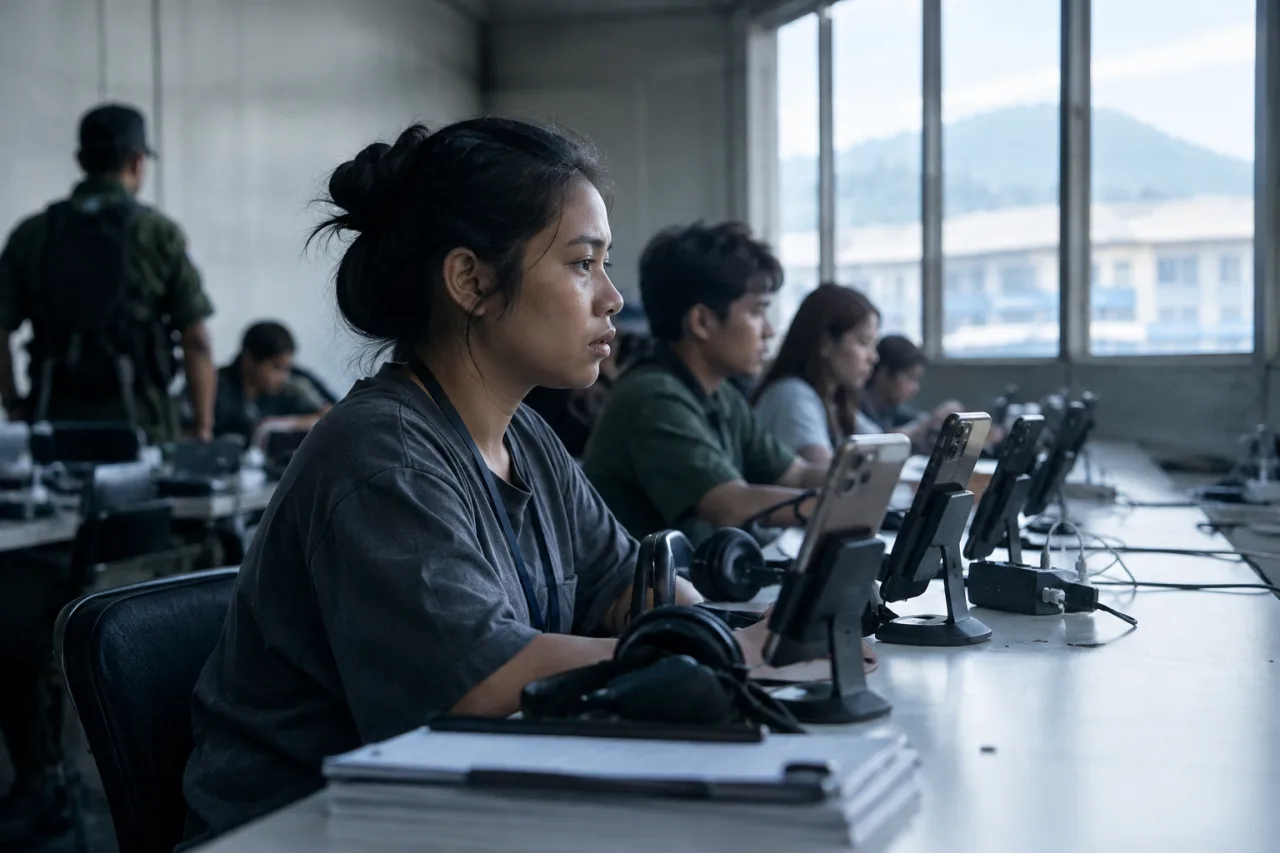
The compounds are guarded industrial-scale facilities, most concentrated in Myanmar’s border zones and Cambodia’s border provinces, where trafficked workers sit in rows of workstations running investment scams, romance scams, and impostor scams against targets worldwide. The UN human rights office’s assessment published in August 2023 found credible sources indicating at least 120,000 people may be held in forced scam work in Myanmar, with estimates of around 100,000 more in Cambodia, and the International Organization for Migration’s later field estimates put the wider regional figure near 300,000, per Council on Foreign Relations reporting in 2026.
The business did not start with AI. It started with lawless special economic zones, moved through romance-investment scams, and mutated faster than enforcement. When the Philippines banned POGO offshore gaming operations in 2024, the industry did not shrink; it relocated and diversified, a shift we covered in the POGO ban and where the scam business moved. Myanmar’s civil war left border territories without enforceable law, Cambodia’s crackdown cycle produces raids followed by rebuilds, and the UN’s July 2026 assessment describes the result plainly: once-fragmented, locally rooted syndicates have restructured into a single interconnected criminal ecosystem across financial infrastructure, communications technology, AI, and governance exploitation.
How AI Scam Compounds Automated the Fraud Assembly Line
The UN’s 2026 report is unusually direct about what changed: The UN’s 2026 threat assessment is direct about what changed: generative AI has dramatically reduced the technical barriers and workforce requirements for conducting sophisticated fraud, enabling AI scam compound operators to generate convincing phishing content, deploy real-time deepfake video calls, and run cloned voices at call-center scale. The UNODC assessment also documents the procurement layer: encrypted messaging platforms, Telegram above all, function as the marketplace backbone where stolen data, money-laundering services, and face-swapping deepfake tools can be bought in minutes.
Read the factory by workstation:
| Assembly-line role | Before AI | What AI does now |
|---|---|---|
| Script writing | Human operators improvising | LLM-drafted romance and investment scripts tuned per target |
| Victim research | Manual profile reading | AI-configured targeting services for multilingual victim selection, sold by suppliers with no direct criminal knowledge |
| Translation | Handful of language speakers | Machine translation covering dozens of victim languages, removing the language barrier entirely |
| Voice contact | Real impostors | Cloned voices from seconds of sampled audio; group tests found people correctly identified AI voices only 37.5% of the time in SumSub’s 2026 fraud-trends testing |
| Video calls | Refused or delayed | Real-time deepfake face swaps; deepfake generation sold as a packaged criminal service per TRM Labs’ 2026 AI-in-Crime Adoption Index |
| Call centers | Script readers | AI-powered scam call centers combining synthetic voices, LLM-driven coaching, and inbound AI representatives per Group-IB’s research on AI-powered cybercrime use cases |
Two supplier-service details deserve the alarm they carry. First, the UN documents that suppliers of AI configuration for multilingual victim targeting increasingly operate “with no direct knowledge of their clients’ criminal activities,” meaning legitimate businesses may be building parts of this machine without knowing it. Second, the money-laundering side industrialized too: Chinese-language money laundering networks processed an estimated $16.1 billion in illicit cryptocurrency funds in 2025 through 1,799 active wallets, per the same UNODC assessment.
The human cost sits underneath the automation. Workers are trafficked through social-media job ads promising high-paying foreign jobs with visas and travel paid, then stripped of passports and forced to meet fraud quotas under threat of abuse (IOM field research). The recruiters inside AI scam compounds increasingly target people with university degrees, technology backgrounds, and English fluency, which is exactly the profile of the region’s mobile professionals inside the AI scam compounds’ target lists, per 2026 reporting collected by the Council on Foreign Relations.
The Numbers Behind the Industry
Four dated figures frame the scale as the institutions reported them:
- $88.3 to 114.1 billion: combined annual scam losses across East Asia, Southeast Asia, Australia, and New Zealand, estimated for 2025 in the UNODC threat assessment published July 2026. Even the lower bound exceeds the GDP of many countries in the region.
- US$136.5 billion: consumer losses across 13 Asian markets over the past year, from the Global Anti-Scam Alliance’s State of Scams in Asia 2026 report presented at the Bangkok summit on November 10-11, 2026, with 71% of surveyed adults encountering scams and 51% of victims defrauded more than once (GASA, via The Nation, November 10, 2026).
- THB65.86 billion: Thailand’s own scam losses in the past year, announced at the same summit alongside a new GASA Thailand chapter built with the Royal Thai Police and the Bank of Thailand.
- ~300,000 people: IOM’s estimate of victims trafficked or coerced into regional scam centers, of whom 3,500-plus received IOM assistance from 2022 to 2025, arriving from at least 80 countries.
Put the last number against the first: if a few hundred thousand workers can extract nearly $100 billion a year, the average output per workstation is extraordinary, and that economics explains both the AI investment and the resistance to crackdowns. A business that automated its labor still fights to keep its buildings.
The 2026 Crackdowns: What They Reached, What They Missed
This year produced the strongest enforcement push in the industry’s history, and the result so far is real damage with partial reach.
What it reached. Thai military units crossed into the O’Smach border zone and occupied a compound used for scam operations per PBS reporting on the US crackdown, and Thai soldiers inspected a scam workstation compound in Samraong, Oddar Meanchey province, photographed on March 6, 2026. Mass raids across Thailand, Cambodia, and Myanmar emptied and demolished some of the region’s major compounds (The Guardian, August 20, 2026). US enforcement moved too: April 2026 saw unsealed criminal charges and arrest warrants against two PRC nationals who allegedly managed a cyber scam compound in Burma and attempted to open another in Cambodia per the US Congressional Research Service’s scam-center briefing, plus US sanctions applied to a Cambodian senator for compound-linked involvement the same month. Cambodia’s own campaign described hundreds of facilities targeted and thousands of foreign nationals removed, per May 2026 reporting on the crackdown.
What it missed. The UN’s July 2026 assessment states that criminal organizations in the region have demonstrated a capacity for structural adaptation that consistently outpaces existing regulatory and enforcement frameworks. Each emptied compound pushes operations deeper into unpoliced border zones or across borders entirely, and Thailand’s own government has publicly assessed scam network relocation into neighboring countries (October 2026, via The Nation). A demolished building is not a dismantled business model, because the AI scam compounds’ model is the trafficked workforce plus the AI stack, and both move.
The enforcement asymmetry has a technical edge too. Building and maintaining AI detection and investigation models requires resources many national agencies do not have, a gap the CFR analysis highlights, and the industry’s own tools refresh faster than the agencies’ toolkits.
Who Gets Trapped and How the Lure Works Now
The lure is a job. The standard chain: a social media advertisement offers high pay, overseas placement, visa support, and covered travel; the recruit travels to a transit hub such as Bangkok; from there they are moved across a land border instead of to an office; and at the AI scam compound, passports and phones are confiscated, and fraud quotas begin. The IOM documented more than 3,500 victims assisted between 2022 and 2025 and notes the target profile is shifting toward educated, skilled people with English fluency, because compound bosses want English-capable “customer service” operators for Western targets.
For Filipino readers this is not a foreign story. Recruitment through overseas job offers is the exact lane the AI scam compounds use on Filipino applicants that our OFW job scam reporting guide covers, and the DMW’s own advisories repeatedly flag fake overseas employers. The UN’s victim-profile shift means “I’m too smart to fall for this” is precisely the wrong safety posture; the most-sought victims now are the ones a tech-savvy reader personally knows.
How to Protect a Family From the Lure and the Clone
The defense splits into three checks, and each takes minutes:
The job-offer check. Before anyone books travel for an overseas job offer: verify the employer’s government license, never pay recruitment fees, and refuse any itinerary that lands in a third country for an unspecified “training.” The full checklist lives in our how to report an OFW job scam guide, and any offer that fails it belongs in a report, not in a luggage list.
The voice check. Family emergency calls are the cloned-voice scam’s favorite stage, and people correctly identify AI voices only 37.5% of the time, so ear-power fails alone. Agree on a code word that never appears in any database, and treat any urgent money request without it as an impersonation attempt. Our guide to phone-side fake voice detection covers the tools now built into phones as a second layer.
The channel check. Most scam losses start at a contact the victim never initiated. Refuse unsolicited investment pitches arriving through messaging apps, treat “exclusive” trading groups as hostile, and if a stranger walks you through installing an app for “security,” stop. Our report on why Filipinos avoid online transactions documents how the scam economy reshapes ordinary digital behavior, and the defense is the boring one: verified channels only.
FAQ
What exactly are AI scam compounds?
Guarded, factory-scale facilities where trafficked or coerced workers run online fraud, predominantly investment, romance, and impostor scams. AI scam compounds treat AI as the production layer: LLM-drafted scripts, real-time deepfake video, cloned voices, machine translation, and AI-configured victim targeting, documented in the UNODC 2026 threat assessment as dramatically lowering the skill and staffing the fraud requires.
How many people are trapped in Southeast Asia’s scam compounds?
The UN’s Southeast Asia scam-trafficking assessment indicates at least 120,000 people may be held in forced scam work in Myanmar, with estimates around 100,000 more in Cambodia, and IOM’s later regional estimate puts the wider figure near 300,000 victims trafficked or coerced into scam centers, from at least 80 countries. The true number is unknowable given the industry’s clandestine structure, so treat every figure as a floor.
How much money does the industry steal per year?
Two dated measures exist: the UNODC 2026 assessment estimates $88.3 to 114.1 billion in combined annual scam losses across East Asia, Southeast Asia, Australia, and New Zealand for 2025, and GASA’s Asia 2026 report estimates US$136.5 billion in consumer losses across 13 Asian markets over the past year. Tracking methods differ, so the figures together describe a range near nine figures of dollars annually, funded for the most part through the same AI scam compounds the raids target.
Which countries host the compounds?
The heaviest concentrations of AI scam compounds sit in Myanmar’s border territories and along the Cambodia-Thailand border, with documented operations in Laos and relocation pressure toward other jurisdictions after crackdowns. The UNODC 2026 assessment explicitly frames this as a regional interconnected ecosystem rather than a country-by-country problem, and Thailand has publicly assessed relocation into neighbouring states.
How do recruiters lure victims into the compounds?
Through fake social media job advertisements: high pay, overseas placement, visa and travel covered. Victims travel to transit hubs such as Bangkok, then are moved across land borders against their will, stripped of passports, and forced to run fraud under quota systems. The IOM notes recruiters increasingly seek educated, tech-capable, English-fluent candidates.
What should a family do if a relative answers one of these job ads?
Stop the travel first: verify the employer against the destination country’s licensing authority and the job against official OFW channels before any booking or payment. If travel already happened and contact went silent, file immediately with local police, the Philippine embassy, and DMW or OWWA hotlines, using the steps in our job scam reporting guide. Speed matters more than certainty in these cases.
Financial Disclaimer
This article is public-interest information about organized fraud and is not legal or financial advice. Loss figures reflect the cited institutional estimates and their stated methodologies; verify current guidance with your bank’s fraud desk and your national police or overseas worker protection agency before acting. The author holds no positions in the companies mentioned.
- unodc.org/roseap/uploads/documents/Publications/2026/TOCTA_South-East…
- bangkok.ohchr.org/sites/default/files/wp_files/2023/08/ONLINE-SCAM-OP… — UN human rights office’s assessment published in August 2023
- cfr.org/articles/ai-is-supercharging-cyber-scams-and-human-traffickin…
- sumsub.com/blog/fraud-trends — in SumSub’s 2026 fraud-trends testing
- trmlabs.com/reports-and-whitepapers/the-2026-ai-in-crime-adoption-ind… — 2026 AI-in-Crime Adoption Index
- group-ib.com/blog/ai-cybercrime-usecases — per Group-IB’s research on AI-powered cybercrime use cases
- nationthailand.com/news/general/40073330
- pbs.org/newshour/world/u-s-launches-sweeping-crackdown-on-southeast-a… — per PBS reporting on the US crackdown
- Official congress.gov/crs-product/R49432
- Official news.un.org/en/story/2023/08/1140187 — Southeast Asia scam-trafficking assessment
External sources linked in this article, in order of first mention. Spotted an error or a broken link? Tell us.
Cite this pagePublished Nov 12, 2026
Agron, E. (2026, November 12). AI Scam Compounds: How Southeast Asia’s Fraud Industry Automated Itself. WorldNgayon. https://worldngayon.com/ai-scam-compounds-southeast-asia/
Agron, Edmon. “AI Scam Compounds: How Southeast Asia’s Fraud Industry Automated Itself.” WorldNgayon, 12 Nov. 2026, worldngayon.com/ai-scam-compounds-southeast-asia/.
Agron, Edmon. “AI Scam Compounds: How Southeast Asia’s Fraud Industry Automated Itself.” WorldNgayon, November 12, 2026. https://worldngayon.com/ai-scam-compounds-southeast-asia/.
Agron, E. (2026) ‘AI Scam Compounds: How Southeast Asia’s Fraud Industry Automated Itself’, WorldNgayon, 12 November. Available at: https://worldngayon.com/ai-scam-compounds-southeast-asia/.
E. Agron, “AI Scam Compounds: How Southeast Asia’s Fraud Industry Automated Itself,” WorldNgayon, Nov. 12, 2026. [Online]. Available: https://worldngayon.com/ai-scam-compounds-southeast-asia/
@online{agron2026aiscam,
  author       = {Agron, Edmon},
  title        = {{AI Scam Compounds: How Southeast Asia’s Fraud Industry Automated Itself}},
  year         = {2026},
  date         = {2026-11-12},
  organization = {WorldNgayon},
  url          = {https://worldngayon.com/ai-scam-compounds-southeast-asia/},
  urldate      = {}
}TY - ELEC AU - Agron, Edmon TI - AI Scam Compounds: How Southeast Asia’s Fraud Industry Automated Itself T2 - WorldNgayon PY - 2026 DA - 2026/11/12/ UR - https://worldngayon.com/ai-scam-compounds-southeast-asia/ Y2 - ER -
Cite the version you read; the page may be updated. Zotero and Mendeley can also import this page directly.