Table of Contents
Remittance scam operations have never had better conditions than they do this quarter: Filipino families are receiving about ₱199.6 billion a month in hard-earned inflows, more than half of Filipinos have already been scammed at least once according to GSMA’s survey data, and the fraud industry has migrated to the exact messaging apps — Viber, Messenger, Telegram — where families actually coordinate their padala. A remittance scam no longer looks like a stranger’s email. It looks like your mother’s coworker asking for a “customs fee,” a text carrying your bank’s real logo, or a Viber admin collecting “share capital” for a group investment. This piece dissects how the modern remittance scam actually works stage by stage, then lays out the six-move defense that breaks its chain — before the money leaves, not after.
Key Takeaway
- 🚨 The scale: 52% of Filipinos have been scammed at least once — 7 points above the ASEAN average — and smishing hit 38% of mobile users.
- 💬 The shift: Scammers moved from SMS to Viber, Messenger, and Telegram, where malicious links surged 37.74% in a single quarter.
- 🛡️ The defense: Six moves — verify off-channel, never share OTPs, delay urgent requests, harden the phone, use transparent transfer rails, report within the hour.
- 📞 The rule: No legitimate remittance, bank, or government process ever requires a fee paid to a personal wallet to “release” money.
The uncomfortable truth about the remittance scam economy is that it does not hack anything. It persuades someone. The money leaves through a real app, on a real phone, pressed send by a real family member who believed they were helping. That is why remittance scam defense cannot be purely technical — it has to be social, rehearsed, and boring. Scams exploit love, urgency, and authority; the countermeasure is a family protocol that outranks all three.
Why Remittance Scams Are Peaking Right Now
The remittance scam wave is not a mood — it is three currents converging at once. First, the money got bigger. BSP data shows July 2026 cash remittances at $3.24 billion, worth roughly ₱199.6 billion at the month’s average rate — each percentage point of fraud leakage is now worth about two billion pesos a year. Second, the channels changed. GSMA’s 2026 Global State of Scam Exposure found 38% of Filipino mobile users receiving fraudulent texts, and platform data showed malicious links on messaging apps jumping 37.74% quarter-over-quarter as scammers followed users out of filtered SMS and into Viber, Messenger, and Telegram groups. Third, the tooling industrialized. AI-written Taglish scripts, cloned bank pages, and spoofed caller IDs have collapsed the cost of running a convincing fraud at scale — the same AI capability curve reshaping legitimate work is arming the scam floors.
The PNP Anti-Cybercrime Group logged 9,834 online scam incidents in 2025 — but everyone in the space agrees the reported number is a fraction of reality, because the second-order effect of being scammed in a Filipino family is shame. Victims hide. Families quietly absorb losses. The scam economy depends on that silence as much as on any script.
The Anatomy of a Modern Remittance Scam
Every effective padala fraud runs the same four-stage chain, and once you see the skeleton, you see it everywhere. Every modern remittance scam opens with stage one, context theft: the scammer acquires a detail that makes them credible — a name scraped from a breached list, a Facebook photo from your cousin’s public post, a leaked delivery record, a voice clip from a group chat. Our reporting on the 150 million licenses on the dark web shows how cheap raw material has become. Stage two is channel capture: the approach arrives where the family already talks — a Viber community, a Messenger thread, an SMS thread styled to continue a real conversation. Stage three is urgency engineering: a deadline, a penalty, a loved one in trouble, an expiring prize — anything that makes verification feel like it will cost more than compliance. Stage four is the off-ramp: the money moves to a personal wallet, a “verification fee,” a gift code, or a crypto on-ramp — rails designed to be instant and irreversible.
Break any stage and the chain fails. Most victims are engineered past stage two before they ever think about stage four — which is why the six moves below target the earliest stages, not the last click.
The Four Frauds Every Padala Family Should Know by Name
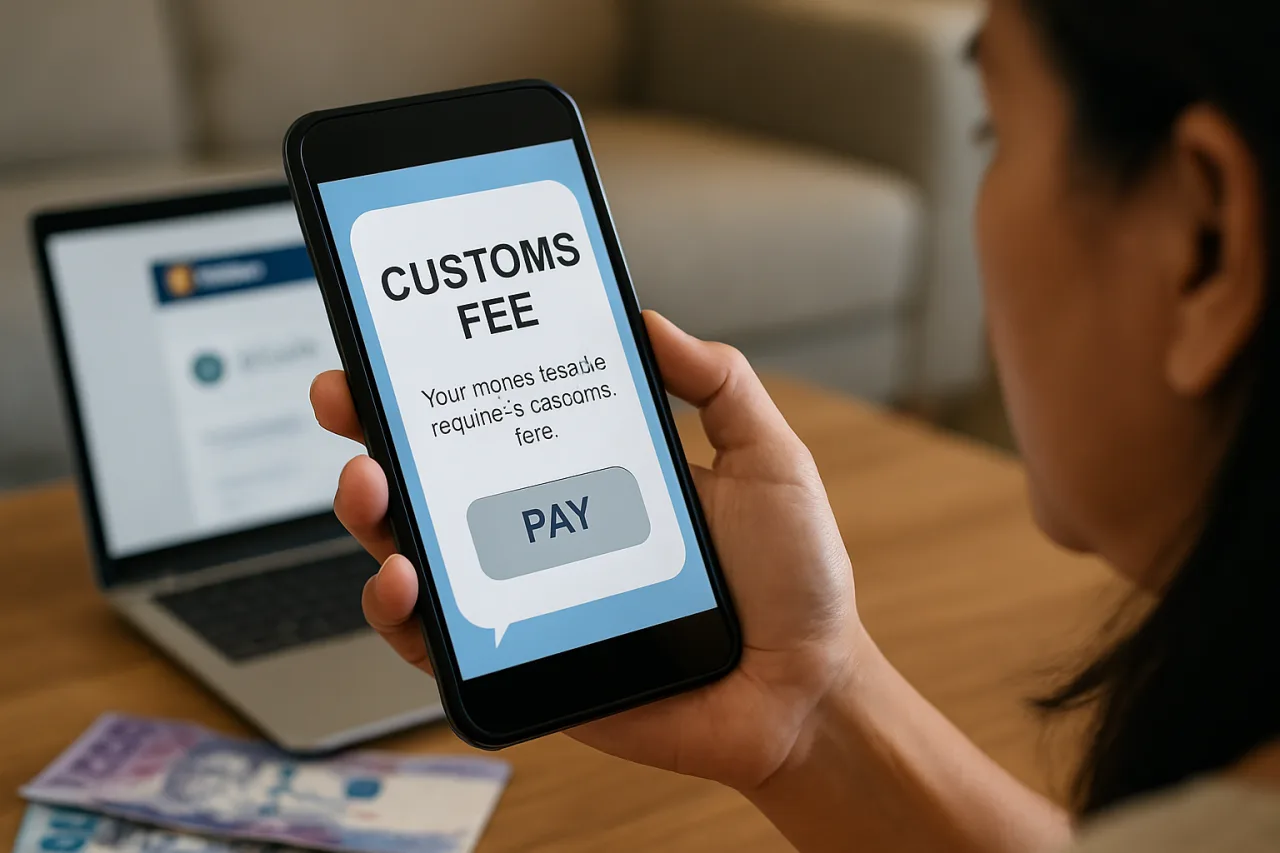
The authority impersonation play runs on Viber and WhatsApp: a message from “the general manager,” “the agency head,” or “the barangay captain” requests an urgent favor — a load, a transfer, a “processing fee” — exploiting exactly the group-chat norms our coverage of online scams in the Philippines documented. The fake OTP play pairs a spoofed bank text with a follow-up call: the scammer reads back a “verification code” and asks you to read them yours; the moment you do, your account is theirs — the pattern our smishing investigation traced through BDO and UnionBank cases. The customs-and-release play targets OFW families directly: a “package” or “loan approval” is held until a fee is paid to a personal GCash number — no legitimate courier, bank, or government agency collects release fees that way. And the investment-group play — the paluwagan reborn inside a Viber circle — collects “share capital” with screenshots of fake payouts until the admin vanishes.
Notice what all four share: none of them requires breaking encryption, and none of them happens without a payment the victim initiates. The remittance scam is a confidence crime wearing a logistics costume — and every padala family should be able to name its four costumes on sight.
The Six-Move Defense That Breaks the Chain
The six moves below form the complete remittance scam defense, in the order they intercept the fraud chain., in the order they intercept the chain. They cost nothing and take one family meeting to install.
- Verify off-channel, always. A request that arrives on Viber gets confirmed by voice call to a saved number — never a number the message itself provides. Ten seconds of off-channel contact defeats the entire industry, because scammers cannot survive the switch.
- Treat every OTP as a live grenade. No bank, remittance center, or government agency will ever ask you to read an OTP aloud or type it into a link. The person asking is the thief — full stop.
- Install the 24-hour rule for money requests. Urgency is the tell. Agree as a family that any request involving pesos — even from “relatives” — waits 24 hours or gets confirmed through a second family channel. Real emergencies survive a day; scams do not.
- Harden the phone itself. Enable scam-call filtering and phishing protection, keep the OS updated, and consider a security app that blocks malicious links before they load — the anti-scam and anti-phishing layers in a next-gen antivirus suite like NordVPN’s intercept the malicious links that messaging apps now carry. The phone is the family’s bank branch; it deserves bank-grade defense.
- Move transfers onto transparent rails. Use licensed services that show the exact fee and verify the recipient’s full name before money moves — the practice our Wise transfer guide details, and the reason fee opacity is itself a red flag. If a “remittance center” texts you asking for a top-up fee, it is not a remittance center.
- Report within the first hour. Call the bank’s hotline, file with the PNP-ACG, and use GCash’s in-app reporting the moment money moves wrong. The first 60 minutes are when freezing and recall attempts have any chance — and reporting breaks the silence the scam economy depends on.
The First 30 Minutes After Money Leaves
If the worst happens, sequence beats panic. Minute one: call the bank or wallet’s fraud hotline and demand a hold on the receiving account — recall attempts only work early. Minute five: screenshot everything (numbers, threads, wallet addresses, receipts) before blocking; evidence survives, anger does not. Minute ten: file the report with the PNP Anti-Cybercrime Group and the BSP financial consumer protection complaint if a bank is involved. Minute twenty: warn the network — the same group chat the scammer used is the fastest way to warn the next victim. And minute thirty: tell one person outside the family. Shame is the scammer’s accomplice; disclosure is its disassembly.
What the Scam Wave Says About Filipino Trust
Here is the analytical point the news cycles miss. The remittance scam does not exploit stupidity; it exploits the strongest thing in Filipino family economics — the reflex to help, instantly, across any distance. Every defense that works (off-channel verification, the 24-hour rule, rehearsed protocols) works by adding friction to love, which is why they feel awkward and why they must be agreed in advance, calmly, when nobody is mid-crisis. The families that survive this era are not the suspicious ones. They are the ones who made verification a sign of care rather than an insult. That reframe — checking is loving — is the single most transferable security control ever invented, and it is free.
There is also a systemic layer worth naming. Every report filed, every scam name shared in a family chat, every merchant who refuses the “processing fee” script raises the operating cost of the fraud floors. The 37.74% quarterly jump in malicious messaging links is the industry responding to success; it is also a sign of fragility, because channels that grow that fast burn trust that fast. The scam economy’s greatest weakness is that it must keep moving — new apps, new scripts, new impersonated authorities — while a family’s defense only has to hold six boring moves. Time favors the disciplined side of this fight. The remittance scam industry optimizes for the first hour of trust; the Filipino family that has rehearsed its protocol wins every hour after that.
Frequently Asked Questions About Remittance Scams
What is the most common remittance scam in the Philippines right now?
Authority impersonation on messaging apps: a message from a fake “boss,” “agency official,” or “coordinator” requesting an urgent fee or favor, sent on Viber or Messenger where such requests look normal. The fake OTP bank call and the customs-release fee scam are close behind — all three engineered around remittance flows.
Can I get my money back after a remittance scam?
Sometimes, if you act within the first hour. Bank-to-bank transfers can occasionally be frozen or recalled when the fraud team intervenes fast; wallet-to-wallet and crypto off-ramps are far harder. This is why the sequence (hotline → evidence → report) matters more than any after-the-fact service promising recovery — most “recovery agents” are second-stage scammers.
How do I verify a remittance message is legitimate?
Off-channel, always: call the sender’s known number, check the transaction inside the official app rather than any link, and remember the iron rule — no legitimate release process collects fees to a personal wallet. If money must be paid before money is received, walk away.
Are remittance apps themselves safe?
Licensed apps from Bangko Sentral-registered operators are safe; the scam layer lives around them, in fake versions and lookalike texts. Download only from official app stores, verify recipient names before sending, and check fee transparency — legitimate services display the full cost upfront, as our Wise guide explains.
What should I tell my family to watch for?
Three sentences work: never read an OTP to anyone; no fee is ever needed to release money; any urgent money request gets a callback to a saved number. Rehearse them the way families rehearse fire drills — the script only works if it exists before the call comes.
Where do I report a remittance scam in the Philippines?
The PNP Anti-Cybercrime Group accepts reports online and at regional offices; your bank’s fraud hotline is the simultaneous first call; GCash and Maya have in-app reporting for wallet cases. File everything — even if recovery fails, reports build the pattern intelligence that shuts these operations down.
Disclosure: WorldNgayon may earn a commission if you purchase through links in this article. Full details on our disclaimer page.
Financial Disclaimer
This article is published for general information and consumer protection education. It is not financial, legal, or law-enforcement advice. Fraud patterns, statistics, and reporting procedures cited reflect sources available as of September 2026 and evolve quickly. Verify current procedures with your bank, wallet provider, and the PNP Anti-Cybercrime Group, and make transfer decisions based on your own circumstances.