Key Takeaway
- 🧭 Three doors, one direction: to report a data breach in the Philippines, the formal privacy route runs through the National Privacy Commission, the fast-response route is the CICC-managed I-ARC hotline 1326, and criminal cases belong with the PNP Anti-Cybercrime Group and the NBI’s cybercrime unit.
- 📜 The law backs you up: the Data Privacy Act gives you complaint rights when personal data is exposed, and the NPC has a defined complaint process — form, notarization, submission — with the fee schedule published in NPC Circular 2023-01.
- 📞 Hotline 1326 is the joint reporting desk: DICT, CICC, the NPC, and the NTC run the Inter-Agency Response Center together — one number where scam and breach reports get routed to the right agency.
- 🧾 Evidence decides the case: screenshots with visible dates, the exact URLs, the affected accounts, and your first written contact with the agency’s data protection officer make a complaint move; a rant without records does not.
- 🌏 OFWs can file from abroad: email, courier, and embassy notarization mean location is not a barrier — and the PNP and NBI have even stationed cybercrime help along the OFW lanes.
Table of Contents
What a Data Breach Is Under Philippine Law
A data breach under the Data Privacy Act of 2012 (Republic Act 10173) is any unauthorized access, acquisition, disclosure, or loss of personal information — whether it happened through hacking, a misconfigured server, a rogue insider, or a lost device. The law does not require drama for it to count: an agency database left open, a hospital’s patient list surfacing on a forum, or a lender app scraping your contact list all fall in scope. When a breach is likely to cause real harm, the organization holding the data is required to notify the National Privacy Commission and the affected individuals, and controllers now file those notifications exclusively through the NPC’s online DBNMS platform — the Commission has announced that email, physical, and courier submissions of breach notifications are no longer treated as valid.
For the affected individual — you — the Data Privacy Act does something simpler and stronger: it gives you rights. You can demand notification, you can ask what happened to your records, and you can file a formal complaint when an organization ignores exposure they caused or refuse to answer for it. Our Data Privacy Act rights guide walks those rights line by line. This piece covers the other half: the actual doors you report through, and what to put in the report so it doesn’t bounce.
Where to Report a Data Breach in the Philippines
There are three doors, and picking the right one at the start saves you weeks. The division of labor is straightforward: privacy enforcement goes to the NPC, live scam and hacking incidents get routed through hotline 1326, and criminal investigation belongs to the PNP Anti-Cybercrime Group and the NBI. Nothing stops you from hitting more than one door — in fact, a genuine breach with money at stake usually deserves them all — but each wants a different kind of file.
The National Privacy Commission: the formal privacy complaint
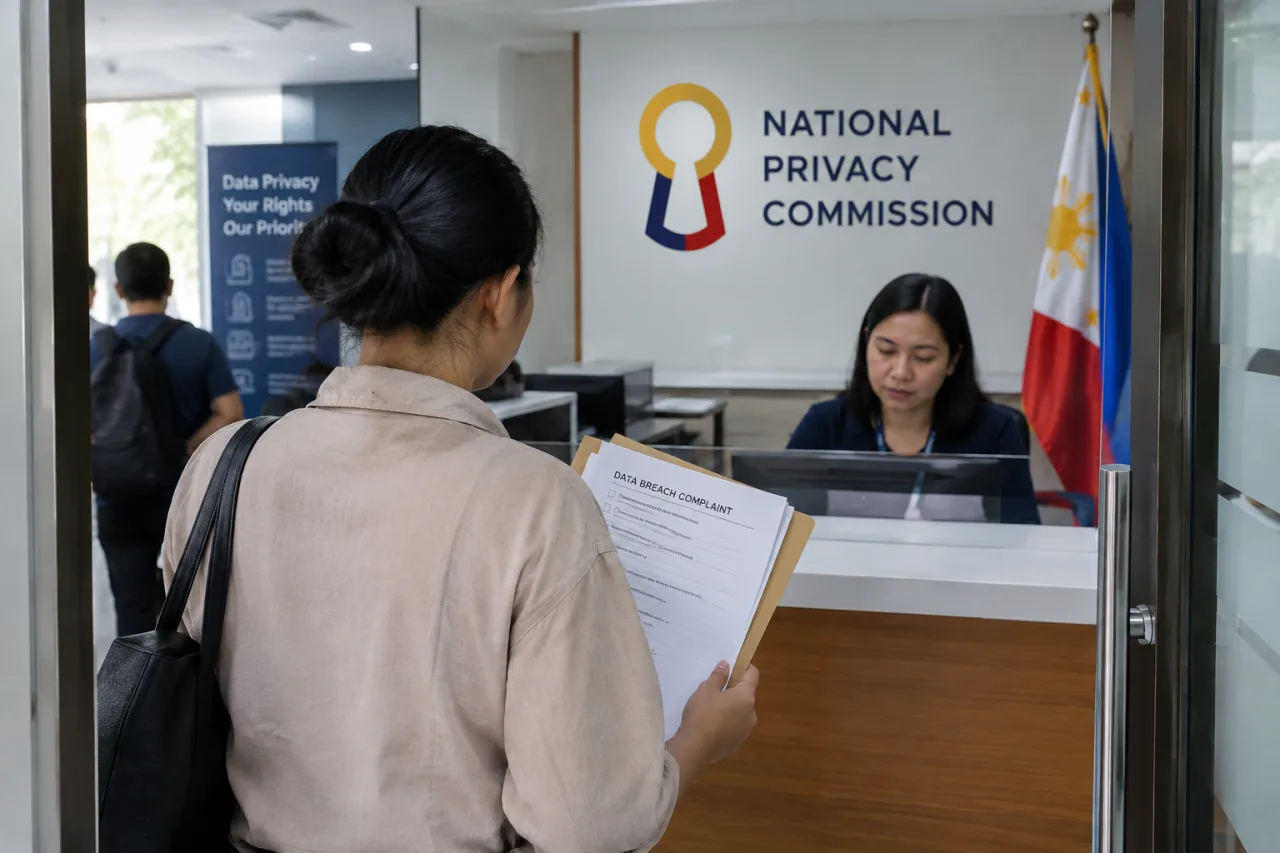
The NPC is the regulator created by the Data Privacy Act, and its official filing-a-complaint page defines the process in four steps. Download the complaint form from the NPC website. Print and fill it out as a complaint-affidavit, attaching copies of your evidence and any witness affidavits. Have it notarized. Submit it in person, by courier, or by scanning and emailing it to complaints@privacy.gov.ph. Filing fees follow the schedule published under NPC Circular 2023-01, and the NPC does not accept cash or over-the-counter payments on Fridays — those payments run through the Land Bank Link.Biz portal instead.
One rule catches most first-time complainants: exhaustion of remedies. Before the NPC accepts your case, you must show that you gave the organization itself a good-faith opportunity to fix things — a written demand to the data protection officer, an email asking for confirmation of the breach and for remediation. That first contact is not a formality to skip; it is evidence, so write it properly and keep the reply, or the silence.
Do not assume a breach claim gets ignored because the agency is big. When the BIR faced a forum listing that claimed more than 10 million taxpayer records — which our BIR leak coverage for taxpayers followed as it developed — the agency had to respond publicly, investigate with DICT and the PNP Anti-Cybercrime Group, and answer for the claim while denying any confirmed breach. Public reporting pressure and the complaint process work together.
Hotline 1326: the joint fast-response desk
When you are actively being harmed — a hacked account right now, a scam message today, unauthorized fund transfers this weekend — report to 1326. The Philippine Star’s coverage of the hotline quotes CICC executive director Alexander Ramos directly: report the incident to the I-ARC instead of posting losses on social media, because social media platforms will not resolve them. The ScamWatch Pilipinas desk lays out the full routing: the Inter-Agency Response Center is a joint project of DICT, the CICC, the NPC, and the NTC, built to centralize reporting of online scams and route them to whichever agency acts on them. Beyond the 1326 landline, the I-ARC publishes direct mobile lines per telco — SMART at 0947-714-7105, GLOBE at 0966-976-5971, DITO at 0991-481-4225 — and the CICC accepts email reports at report@cicc.gov.ph.
1326 is also the practical entry point for a data breach you cannot yet classify: the desk’s whole purpose is taking a raw report and connecting it to the right regulator or investigator. Call first if the breach is in progress, then formalize with the NPC in parallel.
The PNP Anti-Cybercrime Group and the NBI: when it becomes a crime
Criminal investigation belongs to the Philippine National Police’s Anti-Cybercrime Group and to the NBI’s cybercrime unit. These are the doors for identity theft, account takeover, illegal access, and the fraud chains that follow a leak — the PNP Anti-Cybercrime Group, for instance, is the unit agencies themselves call in when a breach claim like the BIR listing needs investigation. Bring the same evidence file you prepared for the NPC, plus whatever financial records show damage. Their complaint desks preserve digital evidence properly, which matters once a case advances past reporting into potential prosecution. Government platform intrusions, like the defacement waves our root-causes analysis of the government hack waves documents, route through DICT’s cybersecurity units in coordination with these two.
How Do You Even Know a Data Breach Happened?
Most Filipinos learn about a breach backward — a scam text arrives referencing details only a database could know. Work the other direction and you keep control. The markers: a login or verification alert for an account you did not touch; transactions you cannot explain; an agency or company publicly confirming an incident, the way PhilHealth or BIR announcements do; a leaked dataset circulating with your name in it. Type your email into a breach checker before the criminals type it into a wordlist — our data breach checker guide shows exactly how the free check works and what to do with a positive result.
For agency-scale exposure, our PhilHealth data breach explainer shows what a confirmed leak looks like end to end, and the Philippine government website verification checks keep impostor portals out of the process entirely.
Unconfirmed forum claims are their own category and they explode every few months in the Philippines. Treat a claim as real for your own defense — change the password, watch the accounts — while treating it as unproven for your report. Say plainly in your complaint-filing that the exposure is a claim under investigation; regulators read honesty as credibility, and it protects you if the listing turns out to be noise.
What to Put in a Data Breach Report
A report is a case file, not a story. Five components, in this order, and the same file serves every door you walk through.
1. The facts of exposure, dated. When you discovered it, how you discovered it, and what data types appear affected — names, ID numbers, transactions, member records. 2. The accountable party. The exact portal, agency, or company involved, and the URL where the exposure touched you. 3. The evidence. Full screenshots with dates visible, the SMS and email texts verbatim, account notices, transaction records. 4. Your account of the harm. Money lost, identity risk, what you already changed or froze. 5. Your paper trail. The written demand you sent to the organization’s data protection officer under the exhaustion-of-remedies rule — with their reply, or the fact of none.
Two habits separate complaints that move from complaints that die in an inbox. First, keep timestamps in every filename — a screenshot renamed with the capture date defeats the “old evidence” argument. Second, one incident per report: regulators triage by clarity, and a single clean exposure case reads ten times stronger than a wall of everything that ever annoyed you.
For business owners reading this, the mirror rule applies: if your platform holds customer data, a breach triggers your own duty to notify, not just your customers’ right to complain — our first 48-hour response plan for businesses covers the controller side, and the NPC’s DBNMS platform is where your own notification lands.
What Happens After You Report
The NPC’s Complaints and Investigation Division evaluates every complaint it receives and provides feedback within a reasonable time — on the order of a few working days for initial evaluation, per the Commission’s own guidance — before deciding whether the case proceeds to mediation, investigation, or formal prosecution. The NPC can order compliance, impose fines and damages through its quasi-judicial process, and refer cases for criminal action. The CICC-side desk at 1326 refers live incidents to whichever unit acts on them. Criminal referral to the PNP Anti-Cybercrime Group or the NBI opens its own, slower track with its own evidence rules.
Set your expectations honestly: regulators move in weeks on clean cases and months on complicated ones, and a breach denial turns your file into the evidence that decides it. The complainants who win are the ones who documented, dated, and demanded — the ones who merely vented are the ones agencies never see.
Reporting a Data Breach From Abroad
None of this process requires Philippine residence. The NPC accepts emailed complaints — scan and send the notarized form per the official page — the Land Bank Link.Biz portal handles fee payments remotely, and the 1326 desk and its mobile lines are reachable for live incidents. Notarization for Filipinos overseas runs through Philippine embassy and consulate notarial services, a routine consular errand.
Help has also followed OFWs out: the PNP and NBI have stationed cybercrime personnel along the overseas Filipino lanes, and our OFW cybercrime filing-from-abroad playbook documents exactly how the attached units work and where to reach them. An OFW whose records surfaced in the migrant workers agency incident — the 69 GB exfiltration covered in our DMW OFW protection piece — reports through precisely these same channels, with one addition: flag any fake deployment or contract offer that references the leaked records, because the resale of agency data into job scams is the pattern that follows government breaches of OFW-held records.
One last door deserves its own mention: if the breach is really a scam pitch in disguise — a “verification” text after a headline, a fake portal mimicking an agency — the routing guide in our global report-a-scam breakdown and the GCash scam report piece cover the money-specific channels, including the 15-day rule that banks and e-wallets apply.
FAQ
Where should I report a data breach in the Philippines first?
If harm is happening right now — a hacked account, unauthorized transfers — call 1326 first, the Inter-Agency Response Center desk jointly run by DICT, CICC, NPC, and NTC. If the harm is exposure without an active incident, start with a written good-faith demand to the organization’s data protection officer, then file the formal complaint with the National Privacy Commission per its published process. Criminal elements — identity theft, account takeover — go to the PNP Anti-Cybercrime Group or the NBI cybercrime unit with your evidence file.
Can I report a data breach anonymously?
Hotline reports can start without full identifying details, but a formal NPC complaint runs on a complaint-affidavit under your name — the notarized form is the legal document. Anonymous tips go to 1326 or the agency’s DPO and pressure investigations; they do not build an enforceable case. If you fear retaliation, say so in the complaint — the law’s protections exist partly for that.
What is hotline 1326 for?
1326 is the Inter-Agency Response Center hotline — a DICT, CICC, NPC, and NTC joint project that centralizes reports of online scams, hacking, and cybercrime and routes each report to the agency that acts on it. It runs 24/7, with per-telco mobile lines (SMART 0947-714-7105, GLOBE 0966-976-5971, DITO 0991-481-4225) and email intake at report@cicc.gov.ph.
Is there a filing fee at the NPC?
Yes — complaint fees follow the schedule published under NPC Circular 2023-01, and payments on Fridays run through the Land Bank Link.Biz portal because the NPC does not accept over-the-counter cash on that day. The breach-notification side is different: organizations file their own Personal Data Breach Notifications through the NPC’s DBNMS platform, which is now the only channel the Commission accepts for those submissions.
How long does the NPC process take?
The NPC’s Complaints and Investigation Division conducts initial evaluations of complaints and provides feedback within a reasonable time — its guidance describes a few working days for that first evaluation. Full processing varies: clean, well-documented complaints move fastest; contested cases with denied breaches extend into months of investigation. Your evidence file is the variable you control, so make it complete before filing.
What if the data breach is also costing me money?
Then run the money channels in parallel — do not wait for the regulator. Banks and e-wallets have their own fraud desks and dispute windows, and our GCash scam report piece documents the exact channels and the 15-day rule for recoveries. Freeze what you can, change the credentials of every account that shares a password with the breached one, and keep every transaction record — those same records feed both the NPC complaint and any criminal case.
Financial Disclaimer
This article is published for general information only and does not constitute financial, legal, or investment advice. References to reporting channels, fees, and timelines reflect publicly available guidance at the time of writing and may change. Readers should verify current requirements with the National Privacy Commission, the CICC, and their financial institutions, and consult qualified professionals for advice specific to their situation.
- Official privacy.gov.ph/filing-a-complaint — official filing-a-complaint page
- philstar.com/nation/2024/11/11/2399174/report-scams-hotline-1326-cicc — Philippine Star’s coverage of the hotline
- scamwatchpilipinas.com — ScamWatch Pilipinas desk
External sources linked in this article, in order of first mention. Spotted an error or a broken link? Tell us.
Cite this pagePublished Nov 10, 2026
Agron, E. (2026, November 10). How to Report a Data Breach in the Philippines. WorldNgayon. https://worldngayon.com/how-to-report-data-breach-philippines/
Agron, Edmon. “How to Report a Data Breach in the Philippines.” WorldNgayon, 10 Nov. 2026, worldngayon.com/how-to-report-data-breach-philippines/.
Agron, Edmon. “How to Report a Data Breach in the Philippines.” WorldNgayon, November 10, 2026. https://worldngayon.com/how-to-report-data-breach-philippines/.
Agron, E. (2026) ‘How to Report a Data Breach in the Philippines’, WorldNgayon, 10 November. Available at: https://worldngayon.com/how-to-report-data-breach-philippines/.
E. Agron, “How to Report a Data Breach in the Philippines,” WorldNgayon, Nov. 10, 2026. [Online]. Available: https://worldngayon.com/how-to-report-data-breach-philippines/
@online{agron2026howto,
  author       = {Agron, Edmon},
  title        = {{How to Report a Data Breach in the Philippines}},
  year         = {2026},
  date         = {2026-11-10},
  organization = {WorldNgayon},
  url          = {https://worldngayon.com/how-to-report-data-breach-philippines/},
  urldate      = {}
}TY - ELEC AU - Agron, Edmon TI - How to Report a Data Breach in the Philippines T2 - WorldNgayon PY - 2026 DA - 2026/11/10/ UR - https://worldngayon.com/how-to-report-data-breach-philippines/ Y2 - ER -
Cite the version you read; the page may be updated. Zotero and Mendeley can also import this page directly.