Key Takeaway
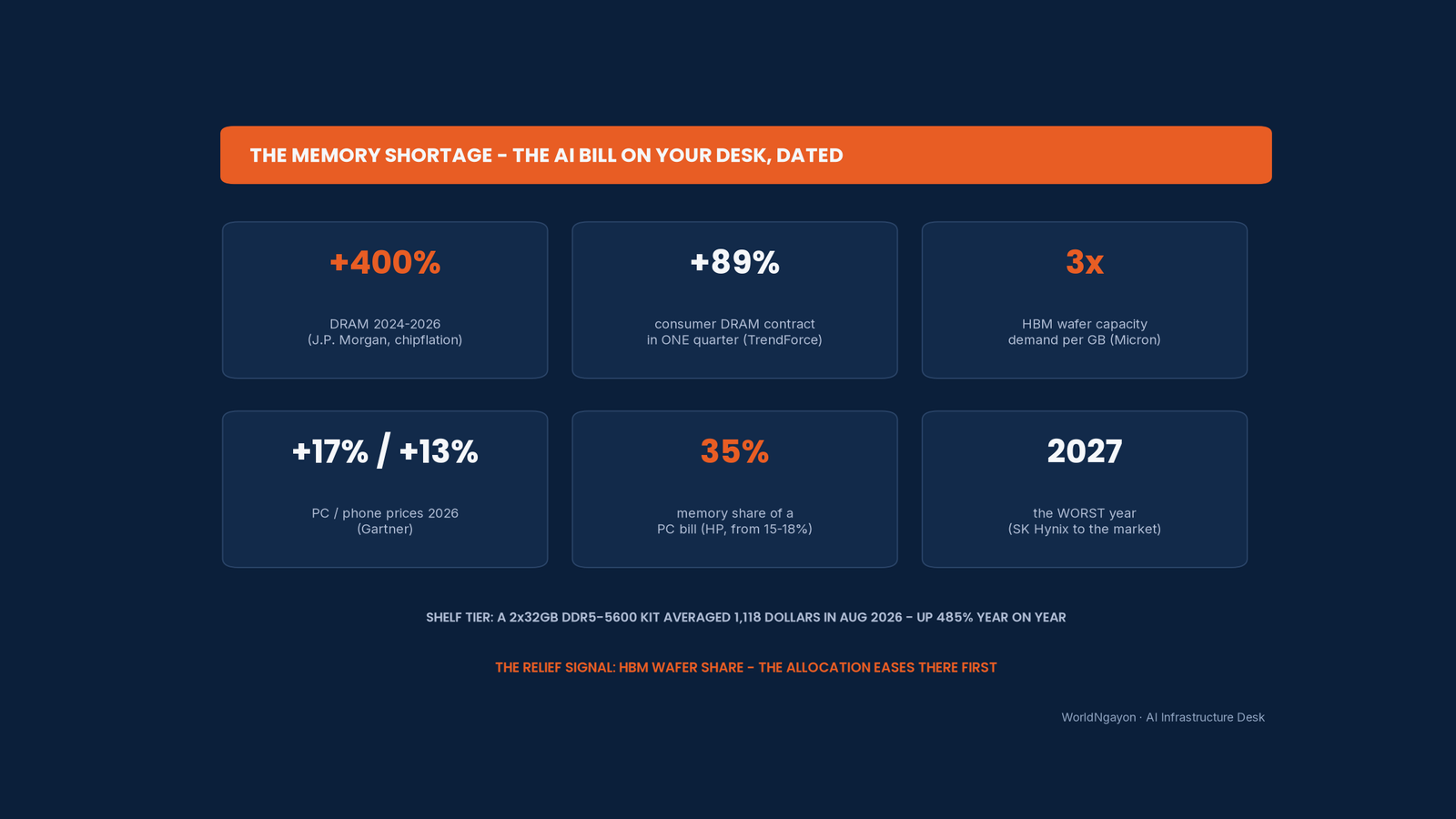
- 📈 The memory shortage’s naked number: J.P. Morgan Global Research J.P. Morgan Global Research estimates DRAM prices will have risen more than 400% from the start of 2024 to the end of 2026 — and it has a name for what AI is doing to your hardware bill: “chipflation.”
- 🏭 The cause, in one sentence: AI data centers consumed the world’s memory-manufacturing capacity — HBM, the stacked memory packaged next to AI accelerators, eats roughly 3× the wafer capacity per gigabyte of ordinary DRAM (a Micron executive’s figure), so Samsung, SK hynix and Micron — who make over 95% of the world’s DRAM — shifted wafers to HBM and left consumer memory short.
- 💥 What it already costs: TrendForce data shows consumer DRAM contract prices climbing up to 89% in a single quarter of 2026; Gartner estimates a 130% combined DRAM-and-SSD surge by end-2026, pushing PC prices up ~17% and smartphone prices up ~13%; memory went from about 16% of a PC’s component bill to about a third-class share (HP put it at 35%, from 15-18%).
- 📉 When it ends: the RAM prices calendar says not soon — the supplier’s own roadmap says relief is years away, and SK hynix told investors 2027 will be the worst year for the shortage; the memory makers are re-investing the windfall, but fabs take years to build.
- 🎯 The reader action: buy memory-bearing hardware by the dated math (prices compound quarter to quarter), watch the HBM build-out announcements as the relief signal, and treat “RAM will come back down by a named-quarter promise” claims as guesses until the fabs physically land.
Table of Contents
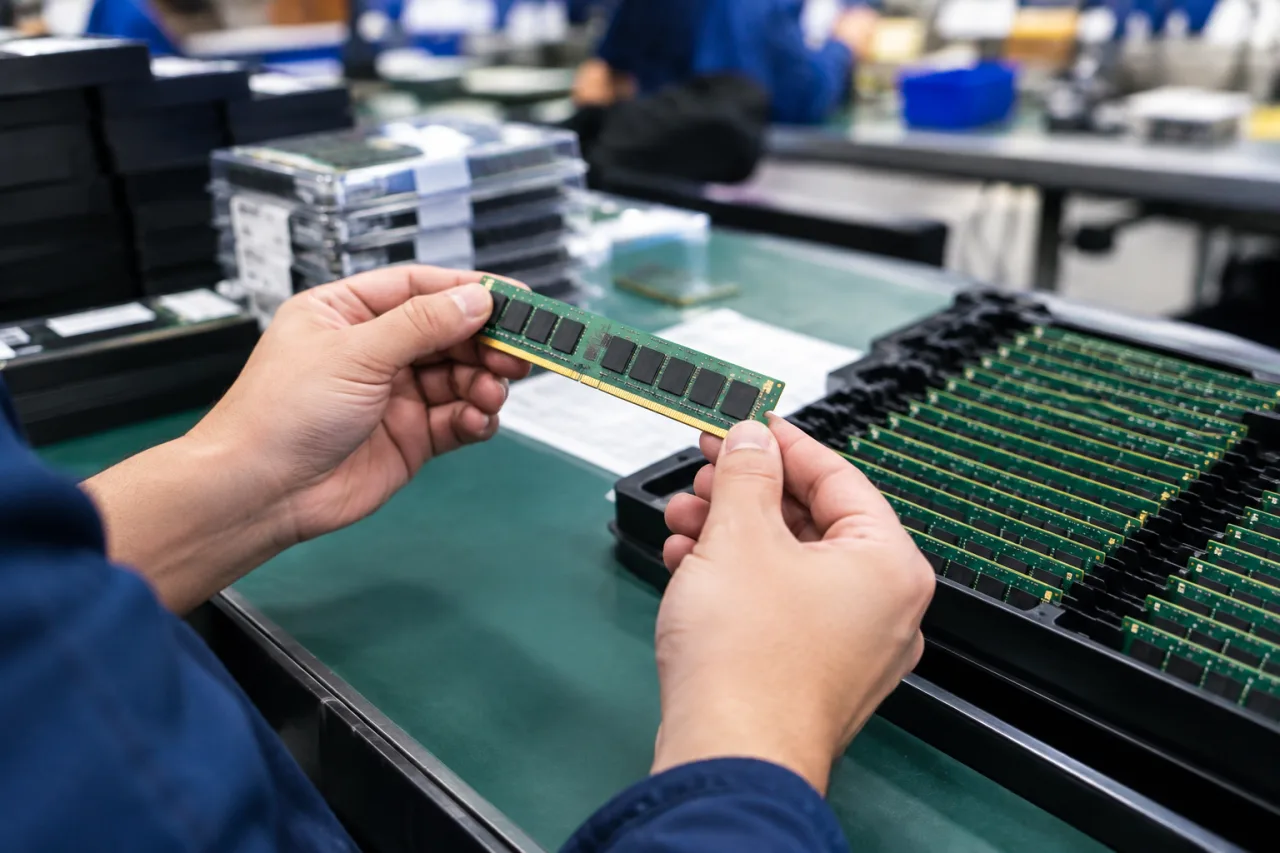
Your RAM bill went up because a data center got hungry — and the first searchers’ question, why are RAM prices so high, has a mechanism answer — this is the memory shortage, explained from the record with dates. Somewhere between late 2024 and now, the quiet, boring price of computer memory became the loudest number in consumer technology: memory kits that cost one price at the start of 2026 cost multiples of it by the third quarter; pre-built PCs, gaming consoles and phones all repriced upward at once; and the company that runs the world’s largest research operation on the AI economy — J.P. Morgan — published the sentence that names the whole era: DRAM prices rising more than 400% from the start of 2024 to the end of 2026, a phenomenon the researchers called “chipflation.” This guide carries the verified record — who drove the memory shortage, the dated price numbers, why the suppliers themselves say 2027 is the worst year, and what a buyer should do about a bill that AI inflated.
The memory shortage in one dated paragraph
The mechanics, as the record assembled them: the same wafer fabs that make ordinary DRAM make HBM — high-bandwidth memory, the stacked DRAM that sits next to every AI accelerator (an H100-class GPU carries multiple HBM stacks; the next-generation accelerators carry more). An HBM gigabyte consumes roughly three times the wafer capacity an ordinary DRAM gigabyte needs — the figure comes from a Micron executive speaking on the record — and HBM carries higher margins. So the world’s three memory manufacturers — Samsung, SK hynix and Micron, who together produce over 95% of global DRAM — did the profitable thing: they moved wafers to HBM for AI accelerators. The consumer and enterprise DRAM lines shrank; the AI build-out did not; and prices for everything left over climbed. The memory shortage is not a mystery — it is an allocation.
Allocation stories resolve into winners and payers. The winners are the three manufacturers (Micron’s fiscal-third-quarter revenue grew 345.7% year over year to $41.46 billion, with its cloud-memory segment alone at $13.77 billion — the AI build-out is literally on the invoice). The payers are everybody who buys a device: PC builders, phone makers, console buyers, the enterprise IT department renewing servers. The custom-ai-chips forge and the rack-density ladder carry the same shape: AI’s bill always lands somewhere real.
The shortage, in one line: a capacity allocation to the highest-margin customer — and the highest-margin customer is AI.
How AI inflated the price of memory
The demand side, dated: AI servers need HBM in bulk — each accelerator package carries stacks of it, and every large rack order multiplies the stack count. As the AI data center build-out accelerated (the rack-scale platforms, the gigawatt campuses, the custom-accelerator forges), HBM orders ate manufacturing capacity quarter after quarter. TrendForce’s quarterly tracking — the industry’s standard read — shows consumer DRAM contract prices climbing as much as 89% in a single quarter of 2026, with projections for the second quarter at a further 58-63% quarter-over-quarter jump, after an overall DRAM rise of 80-90% between the fourth quarter of 2025 and the first of 2026. Memory, in other words, did not inflate gently — it repriced like a panic asset.
The supply side, equally dated: the three manufacturers could not add capacity fast enough. A DRAM fab is a multi-year, multi-billion-dollar construction project; HBM requires additional packaging steps (the stacking and bonding layers) that themselves became the bottleneck. Micron’s executive framed it plainly for the enterprise press: HBM production consumes approximately three times the wafer capacity of standard DRAM per gigabyte, forcing the reallocation away from consumer and enterprise products — and the customers ordering small volumes (the industrial buyer, the PC shop, the smaller enterprise) found themselves at the back of a line that now serves trillion-dollar AI customers first. Samsung’s own warning to the market (reported across the enterprise trade press in January): the shortages will drive an industry-wide price surge through 2026.
AI did not steal memory — it outbid it, and the auction never stopped.
The price record: what the memory shortage already cost
The price record, tiered by source and by date: J.P. Morgan Global Research (the macro tier): DRAM prices up an estimated more than 400% from the start of 2024 to the end of 2026, with the CPI for software and accessories and the PPI for storage devices both up 23% since the end of 2024 — chipflation is already inside official inflation math. Gartner (the forecast tier): a 130% combined surge in DRAM and SSD prices by the end of 2026 versus 2025, translating to roughly +17% PC prices and +13% smartphone prices, with memory’s share of a PC’s bill of materials climbing from 16% (2025) toward the third-class range — HP’s own Q1-2026 figure put it at 35%, from a 15-18% norm. TrendForce (the tracking tier): contract prices +80-90% between the 2025 fourth quarter and the 2026 first, +89% in a single quarter at the peak reading, and still rising through the third quarter. The retail shelf (the tier you can feel): a standard 2×32GB DDR5-5600 desktop kit averaged $1,118 in August 2026 — up 485% year over year, per the shelf measurements.
These numbers survive because they triangulate. A research house (JPM), a forecast shop (Gartner), an industry tracker (TrendForce) and shelf pricing all tell the same story at different tiers — the money-trail discipline applies to memory exactly as to model funding: when four independent counters agree within their error bars, the number is real.
Four independent counters, one direction: up — and the shelf tier is the part the wallet already met.
Why 2027 is scheduled to be the worst year
The supplier’s own dates: SK hynix — one of the three manufacturers — told the market in mid-2026 that 2027 will be the worst year of the memory shortage. The logic is arithmetic, not drama: AI demand is still compounding (every new accelerator generation carries more HBM than the last; the rack platforms multiply the count again), the capacity additions announced in 2025-2026 reach useful output in stages across 2027-2028, and the world’s device markets — PCs, phones, consoles, cars — need the memory those same fabs used to make. Until new wafer capacity catches the two demands, the shortage widens before it narrows. TrendForce’s own quarterly line through mid-2026 says the same: slowing growth in price rises, but still rising.
The caveat worth carrying: “worst year” is a supplier’s planning statement, not a prophecy — and the memory market has a fifty-year history of violent reversals when capacity lands (the crash of 2018-2019 turned a shortage into a glut in about a year). The guide’s read: plan on 2027 pain, verify against the quarterly tracker, and treat any “shortage is over” call the way you treat a bottom call — as someone’s position, not a fact. The energy-side buildouts and the optics layer carry the same verification law: capacity signals count when the concrete is poured.
The peak is scheduled, the relief is phased, and the fabs are the calendar.
What it means for PCs, phones and the devices you buy
For PC and console buyers watching RAM prices: the bill of materials math says memory is now roughly a third of what a consumer PC costs to build (HP’s 35%, from the teens) — which means device prices rise with memory prices nearly one-for-one at the margin; Gartner’s 17% PC-price estimate and the 20%+ pre-built and GPU-accessory repricing through 2026 are the same number wearing different clothes. The practical play: buy the memory configuration you will actually keep for years at the moment of purchase (upgrading later multiplies the premium), and treat the “wait for prices to fall” strategy as a dated bet — the suppliers’ own calendar says the fall is 2027-2028 minimum.
For phone buyers: the 13% Gartner price estimate lands as flagship repricing and the quiet death of the budget segment’s 8GB tier (memory pricing pushed phones toward the storage configurations that carry margin). The practical play: the same buy-once rule, weighted to the storage tier you will keep.
For enterprise and small-business IT: the JPM analysis carries the security-infrastructure warning — memory cost inflation pressures the refresh cycles of servers and network gear, and aging installed bases are the classic attack surface (the shortage’s security chapter is not hypothetical; it is the hardware-security surface wearing a CFO costume). The practical play: front-load the critical refreshes, spec the memory tier in advance, and lock supply agreements where the budget allows.
Every device tier pays the AI bill; buying once and keeping is the only lever the buyer controls.
The other side: what the memory makers are building
The build-out, dated: the three manufacturers are re-investing the windfall — Micron’s record-quarter revenue funds expanded DRAM and HBM capacity (its US fab program and packaging lines), SK hynix is building HBM capacity on the schedule its customers contracted (the NVIDIA-class supply deals run through the decade — the TPU supply-lock pattern at the chip-forge level), and Samsung is re-entering the HBM leadership race its rivals ran away with. The industry’s capacity answer is real, expensive and slow — which is precisely why the shortage’s own participants date its relief in years: fabs and packaging lines are construction projects, not software.
The relief signals to watch (the guide’s dated watchlist): quarterly TrendForce price prints (slowing rises first, then plateaus); HBM wafer-capacity share announcements from the three makers (the allocation easing appears there first, because it is the allocation’s original sin); new fab groundbreaking and packaging-expansion reports; and the AI-accelerator demand curve itself — because the shortage’s other end is the customer who outbid everyone, and if the AI build-out’s financing wobbles (the funding questions carry their own record), the memory market would feel it within a quarter or two. The watchlist is the capacity-calendar discipline applied to atoms instead of megawatts.
The builders are building; the signal to watch is the HBM wafer share, not the press-release count.
Verdict: the bill is real and the relief is dated
The memory shortage, settled as verified: AI’s HBM appetite outbid the world’s consumer and enterprise memory — roughly three times the wafer capacity per gigabyte moved upstream — and the prices tell the truth at four tiers (JPM’s 400%, Gartner’s 130%, TrendForce’s 89%-a-quarter, the shelf’s 485% kit). The suppliers date the worst at 2027; the capacity response is real and phased; the consumer’s lever is configuration-now, upgrade-never at these premiums. Chipflation is the honest name: AI did not break the memory market, it re-priced it — and the buyers who understand that the bill has a mechanism (not a mood) can both plan around it and call the turn when the HBM wafer share finally says relief.
Frequently Asked Questions
Why are RAM prices so high in 2026?
Because AI data centers consumed the world’s memory-manufacturing capacity. HBM, the stacked memory packaged next to AI accelerators, consumes roughly three times the wafer capacity of standard DRAM per gigabyte, so Samsung, SK hynix and Micron – who together make over 95% of global DRAM – shifted wafers to HBM. The consumer and enterprise supply shrank and prices climbed: TrendForce data shows consumer DRAM contract prices up as much as 89% in a single quarter of 2026.
How much have RAM and memory prices gone up?
The dated tiers: J.P. Morgan Global Research estimates DRAM prices rising more than 400% from the start of 2024 to the end of 2026; Gartner estimates a 130% combined DRAM and SSD surge by end-2026 versus 2025 (PC prices up about 17%, smartphones about 13%); TrendForce tracked DRAM up 80-90% from Q4 2025 to Q1 2026; retail shelf pricing measured a standard 2x32GB DDR5-5600 kit at about $1,118 in August 2026, up 485% year over year.
What is chipflation?
J.P. Morgan’s term for the AI-driven inflation of semiconductor prices – most visibly DRAM – showing up inside official consumer and producer price indexes: the CPI for software and accessories and the PPI for storage devices have both risen about 23% since the end of 2024. The word captures the mechanism: AI demand re-prices chips the way energy shocks re-price fuel, and the bill lands in ordinary device prices.
When will RAM prices come back down?
The suppliers’ own calendar says years, not quarters: SK hynix has told the market that 2027 will be the worst year of the shortage, with capacity additions built through 2025-2026 reaching useful output across 2027-2028. Memory-market history adds one caveat: when new capacity lands, the turn can be violent (the 2018-2019 cycle turned shortage into glut within about a year); RAM prices fell hard when those lines opened, so watch quarterly price prints and the makers’ wafer-allocation statements rather than quarter-by-quarter promises.
Will PC and phone prices keep rising because of the memory shortage?
The bill-of-materials math says yes at the margin: memory’s share of a consumer PC’s component cost has climbed from roughly 16% in 2025 toward a third (HP put it at 35% in Q1 2026, from a 15-18% norm), so device prices move with memory prices. Gartner’s 2026 estimates – PC prices up about 17% and smartphone prices up about 13% on the memory shortage – are the forecast tier; the console, pre-built and accessory repricing through 2026 is the realized tier.
What should buyers do about high RAM prices?
Three plays: buy the memory configuration you will keep for years at the moment of purchase, because upgrading later multiplies the premium; front-load critical enterprise refreshes, since aging hardware is the classic attack surface while replacement budgets inflate; and track the dated relief signals – quarterly TrendForce price prints, the manufacturers’ wafer-allocation announcements, and the AI accelerator demand curve – rather than waiting for a promised dip.
Financial Disclaimer
This article is editorial analysis of publicly reported information, not investment or financial advice, and no outcome is promised. Market data are as reported by the named sources at the stated dates and remain subject to revision; verify figures before decisions. Markets carry risk.
The reading rule for the memory-shortage era: the RAM prices that shocked the market are not a mood, they are an allocation with dated prints. Track the RAM prices tier you actually buy in — contract (TrendForce), forecast (Gartner), research macro (J.P. Morgan) — and let the memory shortage’s own arithmetic schedule your purchases: a kit that doubled in two years does not owe you a retrace on your calendar; it owes you one when HBM wafer share says the allocation eased. Until then, the memory shortage is the buyer’s backdrop, and every memory-bearing purchase is a dated bet on a construction calendar.
The device-tier reading of the memory shortage closes the guide’s practical layer. Every tier of this market — the manufacturers pricing HBM contracts, the assembler quoting your build, the store shelf pricing a kit — passes the memory shortage’s premium along, and every tier documents it differently: the contract tier in quarterly percentage prints, the OEM tier in bill-of-materials shares, the shelf tier in the card price you can photograph. The reader who stacks the three tiers learns the guide’s core discipline: the memory shortage is not a story about chips alone, it is the AI era’s first bill delivered to every desk.
- jpmorgan.com/insights/global-research/artificial-intelligence/dram-me…
- azterion.com/en-us/ram-prices-2026-memory-shortage — Gartner estimates a 130% combined DRAM-and-SSD surge
- tech-insider.org/ram-shortage-gaming-hardware-prices-2026 — up 485% year over year, per the shelf measurements
External sources linked in this article, in order of first mention. Spotted an error or a broken link? Tell us.
Cite this pagePublished Nov 5, 2026
Agron, E. (2026, November 5). How AI Inflated Your RAM Bill: the Memory Shortage Explained. WorldNgayon. https://worldngayon.com/ai-memory-shortage/
Agron, Edmon. “How AI Inflated Your RAM Bill: the Memory Shortage Explained.” WorldNgayon, 5 Nov. 2026, worldngayon.com/ai-memory-shortage/.
Agron, Edmon. “How AI Inflated Your RAM Bill: the Memory Shortage Explained.” WorldNgayon, November 5, 2026. https://worldngayon.com/ai-memory-shortage/.
Agron, E. (2026) ‘How AI Inflated Your RAM Bill: the Memory Shortage Explained’, WorldNgayon, 5 November. Available at: https://worldngayon.com/ai-memory-shortage/.
E. Agron, “How AI Inflated Your RAM Bill: the Memory Shortage Explained,” WorldNgayon, Nov. 5, 2026. [Online]. Available: https://worldngayon.com/ai-memory-shortage/
@online{agron2026aimemory,
  author       = {Agron, Edmon},
  title        = {{How AI Inflated Your RAM Bill: the Memory Shortage Explained}},
  year         = {2026},
  date         = {2026-11-05},
  organization = {WorldNgayon},
  url          = {https://worldngayon.com/ai-memory-shortage/},
  urldate      = {}
}TY - ELEC AU - Agron, Edmon TI - How AI Inflated Your RAM Bill: the Memory Shortage Explained T2 - WorldNgayon PY - 2026 DA - 2026/11/05/ UR - https://worldngayon.com/ai-memory-shortage/ Y2 - ER -
Cite the version you read; the page may be updated. Zotero and Mendeley can also import this page directly.