Key Takeaway
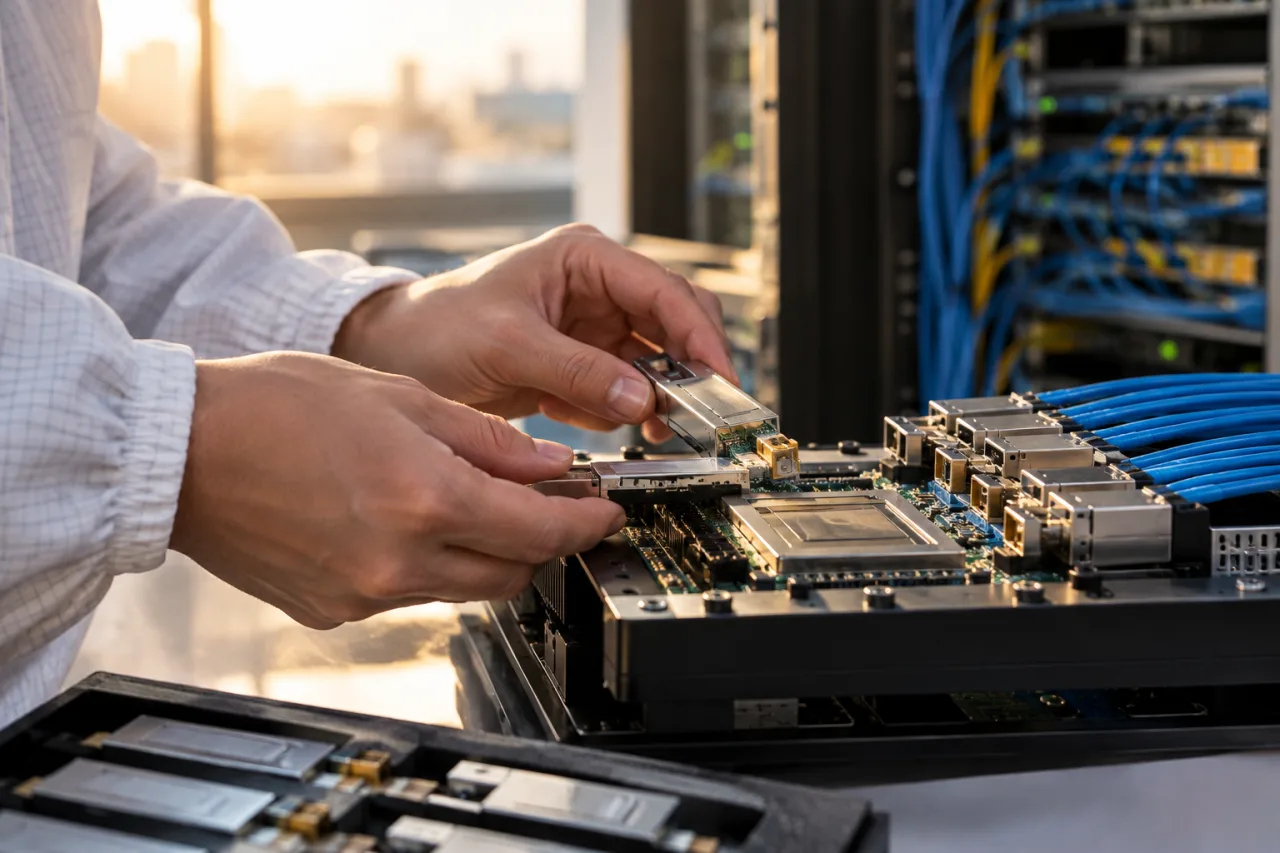
- 💡 What co-packaged optics is: the move that replaces pluggable optical transceivers (the hot-swappable modules sitting at the edge of a switch) with optical engines placed directly on the switch’s package, right next to the switching ASIC — shrinking the copper run that wastes power and hurts signal integrity, and pushing the network’s physics into the board itself.
- 📈 The mass-production moment, dated: TrendForce’s July 29, 2026 research marks the transition INTO mass production — NVIDIA began shipping its Spectrum-X CPO switch to select partners while Broadcom continues volume shipments of its 51.2T Bailly CPO switch (deployment-validated with hyperscalers such as Meta) — with optical-engine supply and advanced packaging capacity named as the expansion bottlenecks.
- ⚡ The power math that drives it: Broadcom’s Bailly cuts optics power up to ~70% versus conventional pluggable transceivers; NVIDIA’s published claims run 3.5×-5× power-efficiency gains plus 4× fewer lasers and 10× resiliency — directionally one story at both vendors (and vendor-figured, labeled as such).
- 🧗 Why NOW: AI cluster networking scales toward terabits per GPU port — 800G ports on 200G electrical lanes are what 2026’s CPO switches terminate (Quantum-X: 144×800G; Spectrum-X Photonics: up to 409.6 Tb/s aggregate per NVIDIA’s pages; Bailly: 128×400G faceplate) — the electrical path cannot keep carrying that growth at acceptable power.
- 🏭 The honest bottlenecks: laser reliability and replacement (can’t hot-swap an integrated engine), optical-engine yield, and advanced packaging capacity (TSMC’s COUPE on the NVIDIA side) — CPO wins the physics but inherits the factory’s problems.
Co-packaged optics (CPO) is the networking technology the AI data center has been waiting for — optics moved from the edge of the switch to the package of the switch — and in 2026 it crossed from roadmap to mass production. The pluggable transceiver, the industry’s standard interface for decades, wastes power and signal margin driving electrical signals centimeters that should be photons; co-packaged optics puts the optical engine next to the switching ASIC and replaces those centimeters of lossy copper with short, efficient runs. TrendForce’s July 29, 2026 research marks the transition into the mass-production phase: NVIDIA’s Spectrum-X CPO switches shipping to select partners, Broadcom’s 51.2T Bailly in volume manufacture with hyperscalers as customers, capacity (optical engines, SiPho chips, advanced packaging) named the growth governor. This guide defines the technology in plain language, dates the field, reads the power math, and carries the honest bottleneck list.
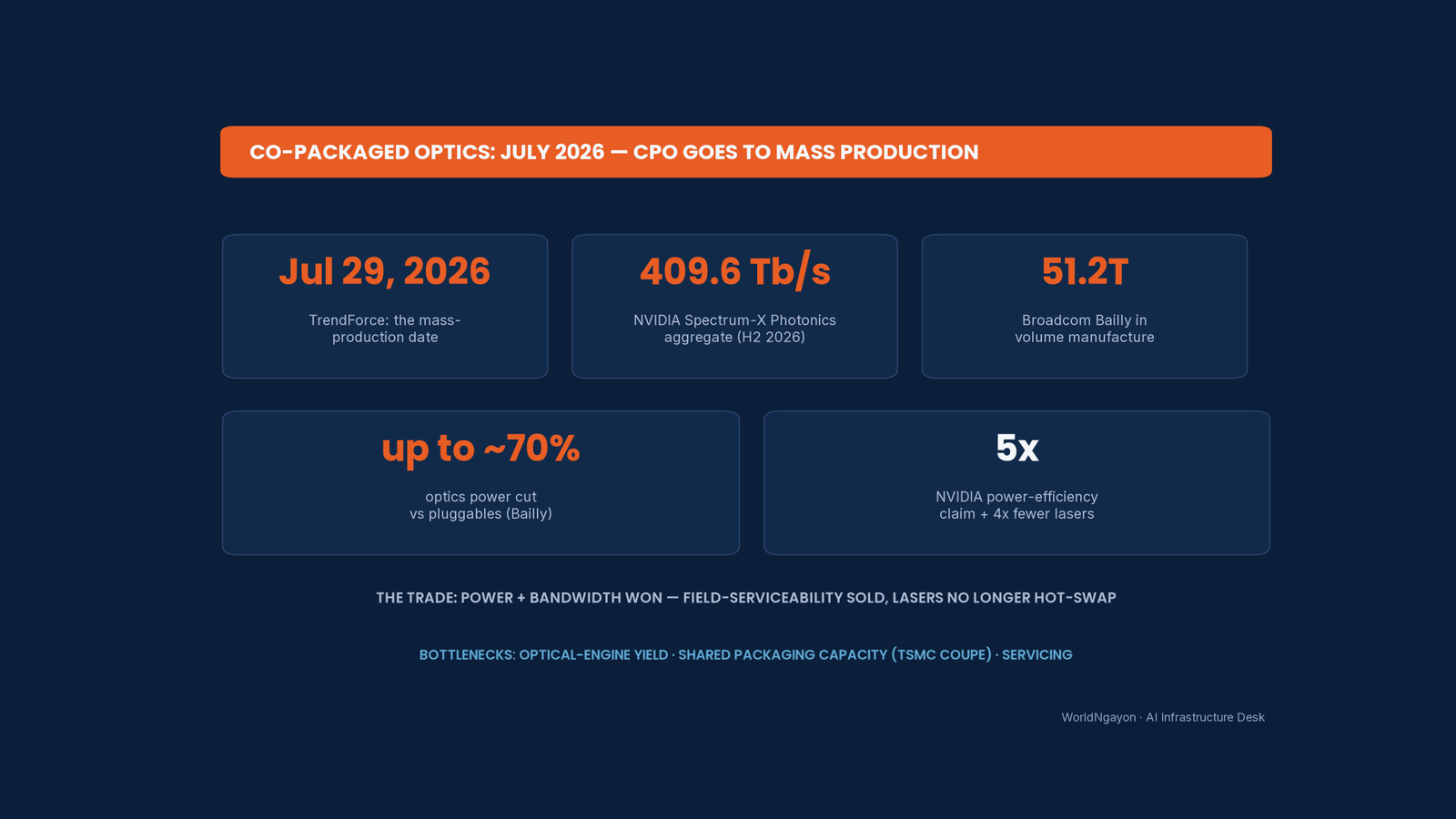
Table of Contents
Co-packaged optics, defined in one paragraph
The one-paragraph physics: every AI cluster runs on a network of switches; those switches connect to other switches through optical links — light through fiber — but between the switch chip and the transceivers that convert electricity to light, electrical signals travel on copper that costs power, adds jitter and caps speed. A pluggable transceiver solves this by doing conversion at the panel edge — after several centimeters of high-speed copper, plus connector discontinuities, plus the signal-shaping power on both ends. Co-packaged optics moves the optics INTO the package: the optical engine sits beside the switch ASIC on the same substrate, where the electrical run shrinks to millimeters and the SerDes power shrinks with it. The switch gets optical ports built in; the transceiver disappears as a separate component.
What the buyer experiences: lower power per port (the headline), higher aggregate bandwidth per switch (the Quantum-X and Spectrum-X Photonics classes carry 400-Tb/s-class aggregates), and a service model that changes — optics that cannot be unplugged fail IN the switch, which is why reliability engineering is the trade-off the field talks about most (NVIDIA’s own resiliency claims — 10× — are the answer it sells; the honest guide keeps both halves of the trade).
WorldNgayon Analysis: co-packaged optics is the same architectural move the computing industry makes at every layer when signals outgrow their medium: integrate the interface closer to the silicon. It is HBM’s story at the board level (the custom-silicon pieces carry the package-integration logic) — and the reason the trade comes with factory physics attached.
Bottom Line: CPO is integration physics: millimeters of copper instead of centimeters — and the savings compound at cluster scale.
The mass-production moment, dated
The dated record (as reported): July 29, 2026 — TrendForce: NVIDIA began shipping its next-generation Spectrum-X CPO switch to select partners; Broadcom continues LIMITED shipments of its 51.2T Bailly — the industry’s transition of CPO into the mass production phase; optical engines, silicon photonics chips and advanced packaging named the primary expansion bottlenecks; production capacity expected to expand in H2 2026. NVIDIA’s platform pages (as of the cycle): Spectrum-X Ethernet Photonics — up to 409.6 Tb/s bandwidth, available in the second half of 2026, marketed for the agentic-AI scale (“million-GPU AI factories” is the launch frame); Quantum-X InfiniBand Photonics shipping first in the CPO line (the January 2026-class availability per the vendor’s own availability messaging). Broadcom: Bailly (51.2T Ethernet, all-optical I/O — eight 6.4T optical engines) in volume manufacturing with Delta Electronics and Micas supporting, Meta-class hyperscalers in deployment validation.
The truth-tier check before buying any clip: volume-manufacturing and select-partner shipping are FACTS (named research house, dated); general availability, pricing and deployment at YOUR scale remain claims and roadmaps — the announced-vs-shipped discipline applies to switches exactly as it applies to models (the July record is the shipped tier; the 409.6-Tb/s class claims are vendor figures attached to shipping products — usable, labeled).
WorldNgayon Analysis: the moment’s meaning: CPO’s decade of demos ended in July 2026 — the technology is now a procurement conversation with lead times, yields and second-source questions. The procurement lens matters for every operator planning AI capacity late 2026 into 2027: the interconnect layer is where AI factory power budgets were quietly bleeding, and the supply of the fix is the bottleneck the research names first.
Bottom Line: July 2026 was CPO’s demo-to-factory date — the procurement conversation starts there.
The power math: why CPO wins the watts
The published figures, labeled by source: Broadcom’s Bailly: up to ~70% optics-power reduction versus conventional pluggable transceivers (vendor figure, Meta-class deployment validation); NVIDIA’s published claims: 3.5× better optical-interconnect power efficiency (Quantum-X/Spectrum-X introduction figure) rising to 5× per the Spectrum-X Ethernet Photonics product pages, plus 4× fewer lasers and 10× resiliency (vendor claims, not third-party numbers — the honest guide marks them vendor-figured). Why the savings are structural, not tuning: the pluggable path pays power twice — for signal integrity across centimeters of copper (equalization, re-timing) and for the transceiver’s own conversion losses; CPO deletes the first payment and shrinks the second by shortening the run. At a hyperscale switch’s port count, the difference compounds to the megawatt class per hall (the rack-density guide carries where those megawatts live).
The strategic read: AI factories sell intelligence per megawatt (the capex lens, serving economics) — and the network’s optics are a fixed tax on every token that crosses a rack. CPO is the tax cut; the reason every major vendor moved simultaneously.
Bottom Line: the power math is structural at cluster scale — vendors trade between 60-70% and 5× figures by counting different envelopes, and all of them are pointing at the same copper.
The 2026 field: who ships what
| Vendor | Product | Dated status & figures (as reported) |
| NVIDIA | Quantum-X InfiniBand Photonics | Shipping first in NVIDIA’s CPO line; 200G SerDes class; 144×800G ports; built on TSMC’s COUPE packaging; the 3.5× power-efficiency figure attached at intro (vendor figure) |
| NVIDIA | Spectrum-X Ethernet Photonics | Select-partner shipping began by the July 29, 2026 TrendForce record; up to 409.6 Tb/s aggregate; H2-2026 general availability messaging; 5× power-efficiency claim per the product pages (vendor figure); jointly developed with TSMC (COUPE packaging, 400-Tb/s-class switching) |
| Broadcom | Bailly (51.2T Ethernet CPO) | Volume manufacturing; limited shipments continuing; all-optical I/O (8 × 6.4T engines); up to ~70% optics-power cut; Delta Electronics + Micas supporting; Meta hyperscaler validation reported |
| Marvell, others | CPO-class engines/switches | Engine roadmaps in the 6.4T class with larger footprints per the industry analysis; the second-source conversation for the field |
WorldNgayon Analysis: the field’s shape is the familiar two-forged pattern: NVIDIA’s network line carries the switch+GPU stack story; Broadcom carries the Ethernet-merchant story (the same vendor at the center of the custom-chip forge read) — and the supply bottleneck is shared: optical engines and advanced packaging (TSMC’s COUPE runs under both camps’ products). For buyers, that means the CPO decision and the capacity decision arrive together — the switch class you can actually get next year is priced by the yield of today’s optical engines.
Bottom Line: two camps, one packaging bottleneck — the field’s real currency is engine yield, not switch specs.
The bottlenecks: lasers, yield, packaging
Bottleneck 1 — the laser problem: a co-packaged switch’s lasers sit where nothing hot-swaps; laser failure means switch service, and lasers were always the optical path’s first failure point — which is why NVIDIA leads its claim set with laser count (4× fewer lasers) and resiliency (10×) — the vendor’s answer to the buyer’s first question. Bottleneck 2 — optical-engine yield: the research names engine yield as the primary expansion constraint: engines that couple lasers to processors to fiber must be manufactured to tolerances the packaging industry is still scaling up; yields set prices. Bottleneck 3 — advanced packaging capacity: TSMC’s COUPE (and equivalents) is the shared dependency of both camps — the wafer-level integration the switches need competes with every other advanced package (the materials and supply-chain pieces carry the shortage economics).
The honest service-model note: CPO’s integration buys power and bandwidth at the cost of the pluggable’s field-serviceability — the deployment conversation (spares, training, the switch’s failure mode) belongs on every operator’s checklist before the first CPO rack arrives (the interconnection-layer guide carries the network design frame).
Bottom Line: lasers, yield, packaging — the three bottlenecks all live in the factory, which is why July’s mass-production date came with capacity warnings attached.
What this means for work, money and the Philippines
For operators and builders: CPO enters the planning set for any AI cluster built in 2027+: power per token crossing the network drops structurally, and the trade (field-serviceability) is manageable with spares strategy — the procurement checklist now prices pluggable legacy against CPO volume, and the honest answer depends on lead times (the density guide carries the facility half of the decision).
For investors: the July 2026 date turned CPO from roadmap into revenue — optical-engine suppliers, packaging players and the hyperscaler networking names reprice on yield news (the money-trail pieces carry the financing frame; the warning-numbers discipline applies to the concentration on single-source packaging).
For careers: silicon photonics packaging and test engineering is the new specialization the field hires for — a skills corridor between RF engineering and photonic integration (the AI-jobs analyses carry the adjacent demand).
For Filipino professionals and OFWs: the region rides the buildout side: data center construction in Southeast Asia (the SEA analysis) imports the networking generations as they land — the field engineering and operations roles around high-speed optical infrastructure are the travel-capable trades of this layer (Gulf and regional jobs maps). And the knowledge layer compounds: understanding where the watts go in an AI factory is the advisory skill the agent-tools ledger monetizes for operators everywhere.
Verdict: the network’s physics just moved onto the package
Co-packaged optics, settled: the integration move that puts optical engines beside the switching ASIC — millimeters of copper instead of centimeters — crossed into mass production in July 2026 (TrendForce’s dated record: NVIDIA’s Spectrum-X CPO to select partners, Broadcom’s 51.2T Bailly in volume manufacture with Meta-class validation), carrying published power wins of 60-70% and 3.5-5× (labeled vendor figures), 8×1600G-class port densities and 400-Tb/s-class aggregates — all gated by lasers that no longer hot-swap, engine yield, and shared advanced-packaging capacity. The network’s physics just moved onto the package; the factory’s yield curves now set the AI networking map.
Sources on the record: the NVIDIA silicon-photonics product page · the TrendForce July 2026 CPO research record.
Financial Disclaimer
This article is editorial analysis of publicly reported information, not investment or financial advice, and no outcome is promised. Figures are as reported by the named sources at the stated dates; verify before acting. Markets and infrastructure projects carry substantial risk.
The co-packaged optics reading rule: separate the shipped tier from the vendor-tier claims. The co-packaged optics field crossed its July 2026 mass-production date with named products – Spectrum-X CPO shipping to select partners, Bailly in volume manufacture – so every co-packaged optics quote after that date prices real yield curves, and every co-packaged optics figure that predates it is a roadmap memory. The bottlenecks list tells you which part of the yield curve to watch.
- nvidia.com/en-us/networking/products/silicon-photonics — the NVIDIA silicon-photonics product page
- chiplet-marketplace.com/insights/news/nvidia-broadcom-cpo-switches — the TrendForce July 2026 CPO research record
External sources linked in this article, in order of first mention. Spotted an error or a broken link? Tell us.
Cite this pagePublished Nov 2, 2026
Agron, E. (2026, November 2). Co-Packaged Optics Explained: How CPO Reshapes AI Cluster Networking. WorldNgayon. https://worldngayon.com/co-packaged-optics/
Agron, Edmon. “Co-Packaged Optics Explained: How CPO Reshapes AI Cluster Networking.” WorldNgayon, 2 Nov. 2026, worldngayon.com/co-packaged-optics/.
Agron, Edmon. “Co-Packaged Optics Explained: How CPO Reshapes AI Cluster Networking.” WorldNgayon, November 2, 2026. https://worldngayon.com/co-packaged-optics/.
Agron, E. (2026) ‘Co-Packaged Optics Explained: How CPO Reshapes AI Cluster Networking’, WorldNgayon, 2 November. Available at: https://worldngayon.com/co-packaged-optics/.
E. Agron, “Co-Packaged Optics Explained: How CPO Reshapes AI Cluster Networking,” WorldNgayon, Nov. 2, 2026. [Online]. Available: https://worldngayon.com/co-packaged-optics/
@online{agron2026copackaged,
  author       = {Agron, Edmon},
  title        = {{Co-Packaged Optics Explained: How CPO Reshapes AI Cluster Networking}},
  year         = {2026},
  date         = {2026-11-02},
  organization = {WorldNgayon},
  url          = {https://worldngayon.com/co-packaged-optics/},
  urldate      = {}
}TY - ELEC AU - Agron, Edmon TI - Co-Packaged Optics Explained: How CPO Reshapes AI Cluster Networking T2 - WorldNgayon PY - 2026 DA - 2026/11/02/ UR - https://worldngayon.com/co-packaged-optics/ Y2 - ER -
Cite the version you read; the page may be updated. Zotero and Mendeley can also import this page directly.