Table of Contents
Key Takeaway
- Deep research is one product name on three very different meters: OpenAI’s printed task counts retired after 2025, Google switched Gemini to a shared compute meter on May 17, 2026, and Perplexity now publishes no consumer count at all, so budget by documented windows, not the retired “25 a month” guides.
- Time splits the three tools first: Google documents 5 to 10 minutes per report, Perplexity launched promising most reports in under 3 minutes, and ChatGPT’s full runs are documented to take up to 30 minutes, with PCMag recording 49 on one run.
- Citations need the audit: published audits put citation accuracy between 40 and 80 percent across deep research systems, so open at least five sources behind any number before you forward a report.
- Free tiers behave very differently: Gemini’s free plan can still run a full report subject to demand, Perplexity’s free tier is down to about one Research query a month, and ChatGPT free users only get the lightweight engine.
- What to do tonight: pick the service you already pay for, run the same 5-task kit below on it, log time, cost and citation checks, and only then decide whether a second subscription earns its place.
All three services that made “deep research” a household term stopped publishing the one number that governed it. OpenAI dropped its printed task counts after 2025, Google tore up printed daily report caps for a shared compute meter on May 17, 2026, and Perplexity now describes Pro limits as a monthly allowance it does not number. The result is simple: the quota figures most guides still quote are dead, and the practical questions shift from “how many do I get?” to “how long, how much, and can I trust the citations?”
This piece answers those questions on one page: it logs the three services against the same 5 tasks using each vendor’s documented specifications read in November 2026, plus published independent measurements, including PCMag’s same-brief test, a November 2026 citation audit by Magpie Index, and two research audits on arXiv. You finish with the same 5-task kit written out in copy-paste form, a cost table in dollars and pesos, and a decision guide for which service runs your work first.
Deep Research, One Name, Three Engines
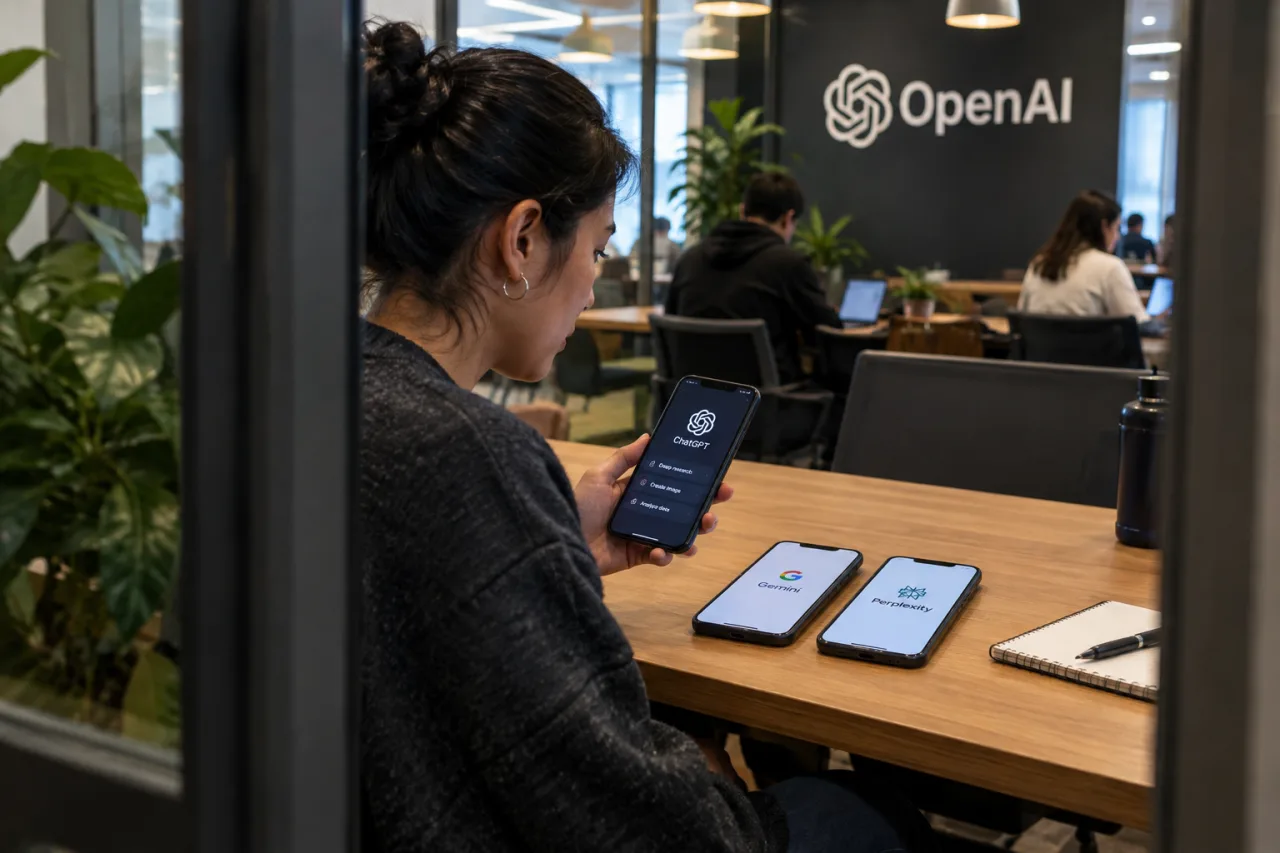
“Deep research” began as a marketing label and became a format: you submit one question, the service plans the work, then it performs dozens of searches, reads sources, refines its plan, and hands back a long report with citations. OpenAI shipped its version on February 3, 2025, built to browse the web for 5 to 30 minutes; Google added Deep Research to Gemini in December 2024; Perplexity joined on February 14, 2025, with a 2 to 4 minute speed promise.
Under the shared name, the engines differ. ChatGPT runs a full engine and, since April 2025, a lighter one that kicks in after your full runs are used; the service moved deep research from its original o3-based model to a GPT-5.2-based model in February 2026 and added steering controls, site-restricted search and MCP connections, per the service’s own release history. Gemini shows you an editable research plan before it starts and reports take a documented 5 to 10 minutes, longer for complex topics. Perplexity’s Research mode reads hundreds of sources and, since late 2026, runs inside Perplexity Computer, where the report can then be turned into a file or slide deck in the same session.
The Same 5 Tasks: a Test Protocol Anyone Can Run
Comparisons fail when each tool gets a different brief. The protocol below fixes five tasks once, so the same prompts run on ChatGPT, Gemini and Perplexity and the outputs score on four metrics: time, cost, source quality and citation check. If you want sharper briefs before you run anything, the guide to prompt engineering in 2026 covers how to load context and constraints into a work prompt.
Method note: no live accounts were run for this piece. Every figure below carries its source in the sentence, either a vendor help page read in November 2026 or a published independent test, and the scorecard states which kind of evidence sits behind each cell. That is deliberate: a report you can source is worth more than a screenshot you cannot verify.
- Task 1, market scan:
Research [industry] for the past 90 days. List the five biggest changes with dates, cite every claim, name who announced each change. - Task 2, literature review:
Summarize what major studies from [year] to now say about [topic]. Separate consensus from disagreement and cite the exact paper for each point. - Task 3, product comparison:
Compare [products] for a [role]. Produce a table of price, limits and gaps, then state which product fits which situation and cite your sources. - Task 4, decision memo:
Should [a professional like me] build, buy or wait on [capability]? Give a recommendation, the risks and the assumptions that would change it, with sources. - Task 5, citation audit:
Give me 10 load-bearing facts about [topic] with primary sources only. Number every fact and its citation.
Task 5 is the guard. After any of the five runs, open five citations at random and check one sentence each: does the page say what the report claims? Log the time, the plan that was used and the citation result. Five tasks on one service is an hour of waiting, not an hour of work, which is why the protocol is cheap to run.
What Deep Research Costs in 2026
The cost story changed twice. First came the price cuts that moved the feature downmarket, then came the quiet end of printed quotas. ChatGPT includes deep research on Free, Go ($8 a month, about ₱511), Plus ($20 a month, about ₱1,277) and Pro in three tiers that OpenAI’s help center now prices at $100, $200 and $500 (about ₱6,385 to ₱31,926). OpenAI describes the access as limited, expanded and maximum, and publishes no task counts for any current plan; the November 2026 check confirms the language and the reset is 30 days from first use. The printed numbers retired into history: in April 2025 OpenAI raised allowances to 25 tasks a month on Plus and 250 on Pro, and by mid-2025 the split was 10 full plus 15 lightweight on Plus and 125 plus 125 on Pro. Guides still print both sets. Neither is today’s number.
Gemini moved first to a meter. Since May 17, 2026, Google’s personal plans carry compute-based limits that refresh every 5 hours inside a weekly cap, AI Plus ($4.99) runs 2 times standard limits, AI Pro ($19.99) runs 4 times, and the two Ultra tiers ($99.99 and $199.99) run 5 and 20 times, per Google’s limits page. A deep research report is rated a heavier feature than a chat exchange, so each report spends the shared meter faster. Google printed true per-day counts until May 2026, the last set gave Pro 20 reports a day and Ultra 120, and its Deep Research help page now confirms only that limits exist on daily and concurrent requests, with Gemini announcing what is left when you near the cap. Free users can still run reports, but deep research may go unavailable for standard accounts during high demand.
Perplexity prices Research by plan and prints no consumer counts. Deep Research is included on Pro ($20 a month now, $17 billed yearly), Max ($200) and the enterprise plans, where the printed caps live: Enterprise Pro gives 50 Research queries per seat per month and Enterprise Max gives 500. Pro and Max describe “average” and “advanced” usage with a monthly limit that recovers on a rolling basis instead of resetting on a date; your billing day does not restore it. The free tier, which started in February 2025 at 5 queries a day against 500 for Pro, tightened by late 2026 to roughly one Research query a month in independent November checks. In Perplexity Computer, runs consume included usage first and then draw on credits, and changing the effort level or picking a model yourself moves the run to credits too.
| Plan path | Documented price | Documented deep research terms, November 2026 |
|---|---|---|
| ChatGPT Plus | $20/mo | “Expanded” access; no count published; 30-day rolling reset; full and lightweight engines |
| ChatGPT Pro | $100 / $200 / $500 per mo | “Maximum” access; no count published (250 a month was the last printed figure, mid-2025) |
| Gemini free | $0 | Standard limits; reports possible but “may be unavailable during periods of high demand” |
| Google AI Pro | $19.99/mo | 4x standard compute limit; report rated high use on the shared 5-hour meter; last printed cap 20/day, retired May 2026 |
| Google AI Ultra | $99.99 / $199.99 per mo | 5x or 20x AI Pro; adds visuals like charts and simulators inside reports |
| Perplexity Pro | $20/mo ($17 yearly) | Monthly unpublished limit, rolling recovery; premium sources included; enterprise Pro prints 50/seat/month |
| Perplexity Max | $200/mo ($167 yearly) | Higher unpublished monthly limit; extra Computer credits |
One more price line: if your work runs on the API rather than the apps, research agents bill per token and the arithmetic is different, which the AI API pricing comparison covers in per-million-token terms. And if you are weighing subscriptions for chat, coding and research together, the subscription comparison we published after real work tasks is the direct companion piece.
How Long Each Deep Research Run Takes
Time is the dimension where the three designs show their bones. Google documents its own window: a report usually takes 5 to 10 minutes, longer for complex work, and you can leave the chat while it runs because Gemini notifies you on completion. Perplexity built its brand on the fastest lane: at launch it promised most reports in 2 to 4 minutes, under 3 for most tasks, and PCMag’s tester saw that hold at about three minutes on a shared brief. OpenAI documents the slowest ceiling: 5 to 30 minutes for the full engine, which auto-falls back to the lightweight engine after full runs are used.
Documented windows are ceilings, not promises. On PCMag’s single shared topic, the full ChatGPT engine took 49 minutes, roughly 6 minutes longer than its own documented maximum, while Gemini finished in about 8 minutes and Perplexity in about 3. The same brief, the same week, three different clocks. Whatever service you run, log your own start and finish times on the 5 tasks: the number that matters is the one on your desk.
| Run, on the record | ChatGPT | Gemini | Perplexity |
|---|---|---|---|
| Vendor-documented window | 5 to 30 minutes, full engine; a few minutes for lightweight | 5 to 10 minutes, longer for complex reports | 2 to 4 minutes; most under 3 at launch |
| PCMag’s same-brief run | 49 minutes (full) and about 5 (lightweight) | About 8 minutes | About 3 minutes |
| While you wait | Progress stays sparse until the report lands | Shows sites as they are read; leave the chat, get notified | Live list of areas and sites being read |
What Each Tool Reads: Sources and Connectors
AI Workflow: How to Combine ChatGPT, Claude, and Gemini for Maximum Productivity makes the point that these tools shine as parts of a pipeline, and sources are exactly where deep research stops being interchangeable. Gemini starts from Google Search and lets you add your Gmail, Drive files, NotebookLM notebooks or uploads as sources, which turns the tool into a reader of your own archives as well as the web; with an Ultra plan, reports can also come back with charts, diagrams and interactive simulators, a visual layer Google explicitly blocks when Workspace files are a source. ChatGPT added steering in 2026: edit the plan before it starts, restrict search to chosen sites and connect data through MCP servers. Perplexity reads hundreds of sources per report and pays for data you cannot scrape for free, putting PitchBook, Statista and S&P Capital IQ behind Pro answers, which matters most for finance and market work, then exports the result to Markdown, PDF or DOCX.
Where the free research tool story fits: the free research tool on this site’s radar is NotebookLM, and it remains the zero-cost alternative for working inside your own documents, while these three services cover the open web scan. Pair them: a deep research report frames the field, NotebookLM interrogates your own files against it.
The Citation Check: Where Deep Research Reports Break
Every deep research report ships with links, and the audits keep finding gaps behind them. The DeepTRACE framework, published on arXiv in September 2025 by Salesforce Research authors, measured citation accuracy between 40 and 80 percent across generative engines and deep research configurations. On debate-style questions, deep research modes reduced overconfidence compared with plain engines, but still produced one-sided answers, and large fractions of statements were not supported by the sources they listed.
Two 2026 audits sharpen the picture, with opposite home-field problems. Magpie Index sent the same three research questions to five research models through their APIs on October 28, 2026, opened every cited page and had each sentence judged against the page under it: the model behind Claude Research fully supported 93 percent of checked citations with zero outright failures, OpenAI’s GPT-6.1 Sol fully supported 71 percent with 7 percent failures, Google’s Gemini 4 Argon fully supported 34 percent and failed 10 percent, and Perplexity’s own Sonar Deep Research model (which cites heavily) fully supported 28 percent with almost one in four citations failing. The caveat carries weight: Magpie checked API models, not the consumer apps, and Perplexity says the app has since moved to Claude-powered research models. DRACO, a February 2026 benchmark, scored deep research systems and put Perplexity first at 70.5 percent, Gemini at 59.0 and OpenAI’s o3 at 52.1, on tasks drawn from anonymized Perplexity usage data, which is a home-field advantage the authors disclose themselves.
Read together, the audits support three habits rather than a winner. Citation numbers move with the question type, so a fast Perplexity scan is fine when the stakes are low. The model behind the run matters as much as the brand, so ask which engine your plan serves before a high-stakes task. And nothing beats the 4-step audit: pick five load-bearing claims, open the linked source for each, mark each link as supported, partial or failed, and drop the unverified claims before the report leaves your hands. Deep research reduces the work of finding sources; the checking is still yours. The full method for catching invented facts sits in the hallucination guide, and the same discipline applies to any AI-drafted research.
The Same-Tasks Scorecard
Here is the table the three services never publish together: the same 5 tasks, with each cell stating what the documentation and the published tests actually support. The evidence type in each entry matters, so read it as a record, not a rating.
| Task | ChatGPT | Gemini | Perplexity |
|---|---|---|---|
| 1. Market scan | Deep, slow: full runs up to 30 minutes documented and a 49-minute run measured; best when depth beats deadline | Middle lane: 5 to 10 documented minutes, strong structure with timelines and charts on Ultra | Fastest: about 3 minutes measured, lighter analysis per PCMag, fits a same-day brief |
| 2. Literature review | Site-restricted search and MCP connectors help pull from set paper lists; verify each paper, OpenAI flags rumor risk itself | NotebookLM and file connectors let your own PDFs join the scan, free tier included | Hundreds of sources read per report; export to DOCX for a working draft, citations need the audit habit |
| 3. Product comparison | Edit the plan to force a table and state-of-the-market structure | Edit the plan the same way; visuals land only on Ultra and only without Workspace sources | Citation-dense tables inline; premium databases behind finance rows on Pro |
| 4. Decision memo | Widest reasoning depth at Pro tiers; Magpie’s audit gave its API model the strongest non-Claude citation support at 71 percent fully backed | Free tier makes drafting cheap; runs are metered, so schedule the brief off-peak because free deep research may drop out at high demand | Highest DRACO overall score, though the benchmark used Perplexity-derived tasks; rolling monthly limit needs rationing on Pro |
| 5. Citation audit | GPT-5 deep research config scored 79.1 percent citation accuracy with 12.5 percent unsupported statements in DeepTRACE | Strongest in that same audit on volume but weakest on fit: 40.3 percent citation accuracy and 14.5 percent uncited sources | Sonar Deep Research API model: 28 percent fully supported, 23 percent failed in Magpie’s sample; the app engine has since changed |
The summary across the five cells, read as one record: no service swept the same tasks. Time favors Perplexity in the documented record, structure favors Gemini, depth favors ChatGPT, and the citation column flags every brand for the checking habit. That is precisely why the protocol fixes the tasks before the run: the winner can change with the brief, and across independent panels the same brand scores differently on accuracy and citation fit.
Which Deep Research Tool Should Your Work Run
Decide by the work, in this order. If your week runs on Gmail, Drive and NotebookLM, Gemini’s free tier plus AI Pro at $19.99 (about ₱1,276 at the BSP reference rate of ₱63.852 on November 23, 2026) is the cheapest road to a full report that can read your own files, with the caveat that reports are metered, not counted. If you write, analyze or publish for work and depth beats deadline, ChatGPT Plus at $20 (about ₱1,277) answers with the strongest documented reasoning depth and the expanded engine; its Pro tiers ($100 to $500) sit in the research-department budget, not a freelancer’s. If you live in fast briefs, competitor scans and finance questions, Perplexity Pro at $20 with PitchBook and Statista behind it is the quick lane, and its rolling monthly limit rewards rationing your hardest questions. One fourth door is worth its line: if citations decide your work, Magpie Index’s audit put Claude Research’s citations at 93 percent fully backed with zero failures, though it tested the model behind the feature, not a consumer run.
Whatever you pick, keep the cost per report in view: $20 divided over even twenty deep research reports a month is about ₱64, cheaper than an hour of your time in most professions, and the same arithmetic at the $200 and $500 tiers prices a single run into the hundreds. The 5-task kit below is how you find out which run you actually need. And for the work itself, prompt craft still decides report quality; the prompt engineering guide’s techniques hold unchanged in research briefs.
What Deep Research Still Gets Wrong
OpenAI documents the core risk itself, in wording the deep research release history records: deep research can hallucinate, make incorrect inferences, and reference rumors, and it does not always convey uncertainty correctly. The external audits add the shape of the failure: unsupported statements survive into reports, debate questions pull one-sided answers, and citation counts look impressive while accuracy wobbles between 40 and 80 percent. PCMag’s run adds the operational lesson: the fastest report was also the thinnest, so speed is a budget decision, not a quality one.
Nothing here reads as a reason to quit the format. Reports are strongest as drafts that assign your next hour: scan the report, audit five citations, mark what must be re-verified, then send the surviving claims to whoever decides. The failure mode is not the technology; it is forwarding a report that nobody opened. Keep the audit habit and the same tasks that produce the noise also produce the check.
FAQ
What is deep research in ChatGPT, Gemini and Perplexity?
It is a mode that researches for you: the service plans the work, performs dozens of searches, reads sources, refines the plan and returns a long report with citations. OpenAI launched it on February 3, 2025, Google added Deep Research to Gemini in December 2024, and Perplexity introduced its version on February 14, 2025. Same format, different engines, limits and models behind each.
How long does a deep research report take?
Google documents 5 to 10 minutes for a Gemini report, Perplexity launched with most reports in 2 to 4 minutes, and ChatGPT documents 5 to 30 minutes for full runs. Real runs drift from the windows: PCMag recorded one 49-minute ChatGPT run and an 8-minute Gemini run on the same brief. Log your own times on the 5 tasks.
How much does deep research cost?
It is included with your plan: ChatGPT Plus $20 (expanded) and Pro $100, $200 or $500 (maximum); Gemini via Google AI Plus $4.99, AI Pro $19.99 and Ultra $99.99 to $199.99; Perplexity Pro $20 and Max $200. None of the three publishes a consumer task count as of November 2026, so cost per task depends on how many runs your plan’s meter allows. At the BSP reference rate of ₱63.852 to the dollar on November 23, 2026, the $20 plans each cost about ₱1,277 a month.
Can I run deep research for free?
Yes, with different floors. Gemini’s free plan can run full reports subject to standard limits and demand, Perplexity’s free tier allows about one Research query a month by late 2026, and ChatGPT Free only reaches the lightweight engine, never the full one. Gemini free is the only one of the three with a genuinely usable free lane.
Which deep research tool has the best citations?
For the citation-supported record: Magpie Index’s October 28, 2026 API check fully supported 93 percent of citations for the model behind Claude Research, 71 percent for OpenAI’s GPT-6.1 Sol, 34 percent for Gemini 4 Argon and 28 percent for Perplexity’s Sonar Deep Research. DRACO scored Perplexity first overall, DeepTRACE put the GPT-5 deep research config near the top on citation accuracy, and Gemini’s deep research showed the weakest fit in that audit. Every result carries a methodology caveat, which is why the 4-step audit above belongs in your workflow.
How do I check if a deep research report’s citations are real?
Four steps, five minutes: pick five load-bearing claims, open the source behind each, decide supported, partial or failed for each link, then rewrite or drop every unverified claim. Run the audit on every report that informs a decision, and every time, the five-task log tells you which service deserves the next brief.
- pcmag.com/explainers/chatgpt-gemini-perplexity-grok-deep-research-ai-… — PCMag’s same-brief test
- magpieindex.com/guides/best-ai-deep-research-tools — Magpie Index
- Research arxiv.org/abs/2509.04499 — research
- Research arxiv.org/abs/2602.11685 — audits
- en.wikipedia.org/wiki/ChatGPT_Deep_Research — browse the web for 5 to 30 minutes
- perplexity.ai/hub/blog/introducing-perplexity-deep-research — 2 to 4 minute speed promise
- help.openai.com/en/articles/9793128-what-is-chatgpt-pro — OpenAI’s help center
- support.google.com/gemini/answer/16275805 — per Google’s limits page
- support.google.com/gemini/answer/15719111 — Deep Research help page
- perplexity.ai/help-center/en/articles/10738684-what-is-research-mode — Deep Research is included
- spiritt.ai/resources/guides/perplexity-ai-for-research
- thedroidguy.com/perplexity-free-vs-pro-1290255 — roughly one Research query a month
- perplexity.ai/hub/pricing — PitchBook, Statista and S&P Capital IQ
- Official bsp.gov.ph/statistics/external/day99_data.aspx — BSP reference rate of ₱63.852
External sources linked in this article, in order of first mention. Spotted an error or a broken link? Tell us.
Cite this pagePublished Nov 24, 2026
Agron, E. (2026, November 24). What ChatGPT, Gemini and Perplexity Deep Research Actually Deliver: a Same-Tasks Test. WorldNgayon. https://worldngayon.com/deep-research-compared/
Agron, Edmon. “What ChatGPT, Gemini and Perplexity Deep Research Actually Deliver: a Same-Tasks Test.” WorldNgayon, 24 Nov. 2026, worldngayon.com/deep-research-compared/.
Agron, Edmon. “What ChatGPT, Gemini and Perplexity Deep Research Actually Deliver: a Same-Tasks Test.” WorldNgayon, November 24, 2026. https://worldngayon.com/deep-research-compared/.
Agron, E. (2026) ‘What ChatGPT, Gemini and Perplexity Deep Research Actually Deliver: a Same-Tasks Test’, WorldNgayon, 24 November. Available at: https://worldngayon.com/deep-research-compared/.
E. Agron, “What ChatGPT, Gemini and Perplexity Deep Research Actually Deliver: a Same-Tasks Test,” WorldNgayon, Nov. 24, 2026. [Online]. Available: https://worldngayon.com/deep-research-compared/
@online{agron2026deepresearch,
  author       = {Agron, Edmon},
  title        = {{What ChatGPT, Gemini and Perplexity Deep Research Actually Deliver: a Same-Tasks Test}},
  year         = {2026},
  date         = {2026-11-24},
  organization = {WorldNgayon},
  url          = {https://worldngayon.com/deep-research-compared/},
  urldate      = {}
}TY - ELEC AU - Agron, Edmon TI - What ChatGPT, Gemini and Perplexity Deep Research Actually Deliver: a Same-Tasks Test T2 - WorldNgayon PY - 2026 DA - 2026/11/24/ UR - https://worldngayon.com/deep-research-compared/ Y2 - ER -
Cite the version you read; the page may be updated. Zotero and Mendeley can also import this page directly.