Table of Contents
The November Rotation: Where the Money Goes After the Best Dow Day in 18 Months
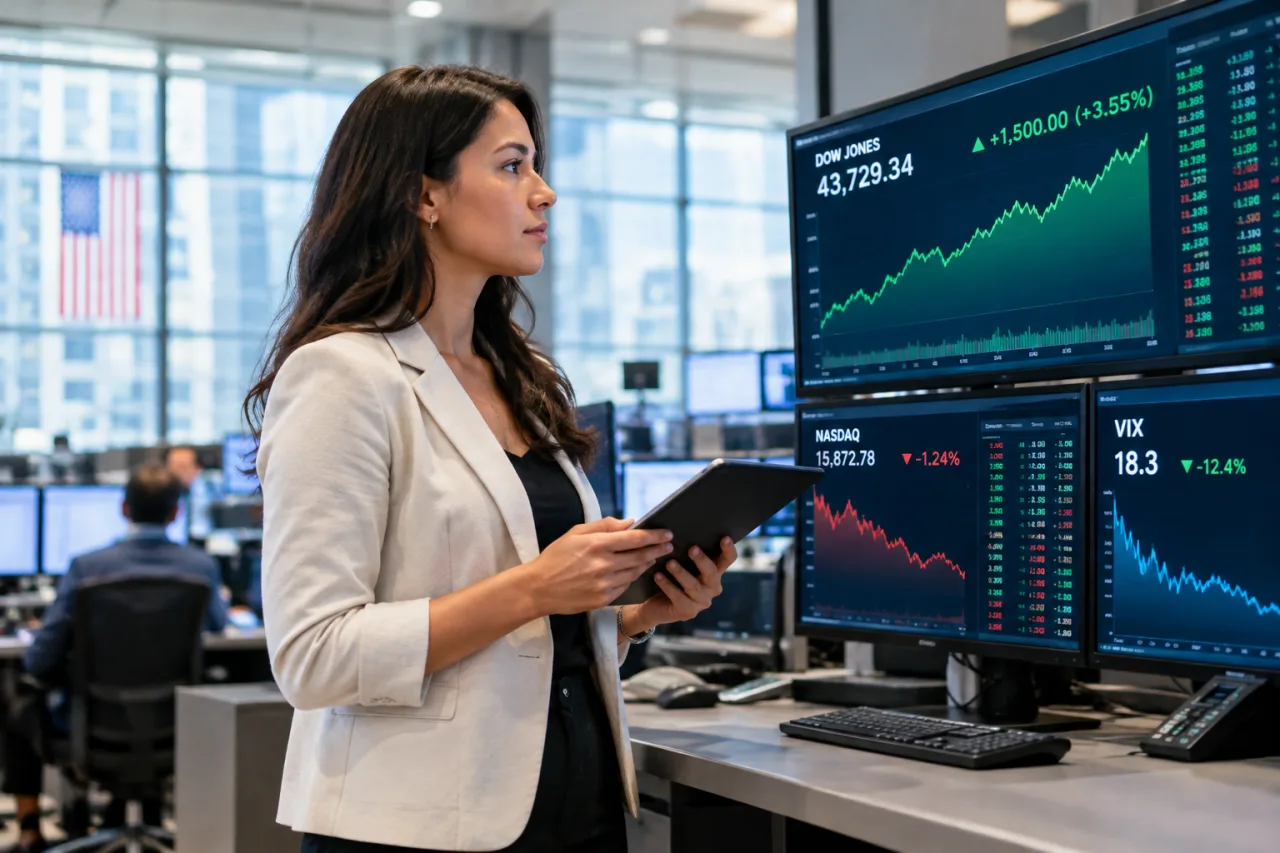
The tape (November 4): the Dow soared 1,500 points for its best day since April 2025 (CNBC’s live record: the clear-cut Democratic win plus falling oil) — while the Nasdaq spent the prior sessions extending the tech selloff | the fear gauge retreated in double digits: the Cboe VIX fell to near 18.3 from highs near 22 (Schwab’s morning record; above 20 = uncertainty) | Schwab’s strategist frame: a divided government limits sweeping policy, possibly easing inflation-and-rates fears — “markets generally don’t mind political gridlock” | where the money is rotating and what it means for a small portfolio — inside
Key Takeaway
- 🎲 The election resolved the market’s biggest known unknown — and the tape told the story in one line: the Dow’s biggest gain of the year (~1,000 points on the record) landed while the Nasdaq’s AI complex had just spent three sessions selling; that divergence — not the Dow’s size alone — IS the November rotation.
- 🤝 The divided-government mechanism, named: gridlock means fewer sweeping policy surprises, fiscal tug-of-wars instead of spending waves, and Treasury yields held in check — Schwab’s Townsend put it plainly on the record; Sonders added the limit case: “Tariffs remain largely a presidential lever,” so one policy lever never resolved at all.
- 📉 The rotation’s shape: from concentration to breadth. Money that had crowded into a handful of AI names is probing value-class and rate-sensitive lanes — financials, industrials and utilities carry the 2026 value-rotation tag on record; the clear guide: breadth returning is healthy, but a one-week rotation is signal only if it persists.
- 🧭 The small-investor rule survives every rotation: chasing yesterday’s winning sector is buying the fear or greed at its freshest price; the written allocation with rebalancing bands is the tool that harvests rotations automatically — the November rotation rewards exactly the investors who didn’t bet the portfolio on any single lane.
- 🇵🇭 The Filipino-professional lane: the same logic maps to the PSE — local breadth beats local concentration the same way; the corridor family’s real exposure to the US rotation is indirect (rate paths, the peso line, global risk appetite), so the sound move is portfolio breadth on both books, not election-week trades.
One day after the AI complex absorbed its worst week in three months, the Dow soared 1,500 points for its best day since April 2025 — CNBC’s live record names the drivers: a clear-cut Democratic win and falling oil — while the Cboe Volatility Index retreated in double digits to near 18.3, a level that told the week’s real story: the U.S. midterm election, the calendar’s largest known unknown, had resolved, and the market’s first act was to re-price certainty itself. “Markets generally don’t mind political gridlock because it limits the possibility of sweeping policy decisions,” Schwab’s Townsend said on the morning record — and the tape agreed within hours: Trump accepting the results and vowing to work with Democrats took the contested-election tail risk off the table, a divided Congress took the spending-wave risk down with it, and money that had been hiding in cash-class and mega-cap parking spaces began looking for seats in the rest of the market. This is the November rotation: not a prediction, a migration — and the November rotation’s take: the reading matters more than the timing, because the small investor’s edge in a rotation week is not speed but structure.
Why Divided Government Buys Equities: the Mechanism, Stated Once
The market’s post-election habit has a mechanical core worth naming exactly once. A split Congress constrains both sides’ fiscal ambitions: Democratic spending plans meet a presidential veto, Republican initiatives meet Democratic committees — the tug-of-war Schwab’s morning record described — and the result the bond market prices is a narrower range of fiscal-outcome expectations, which usually means less fear of inflation-and-rates surprises. Tighter-to-unchanged yield paths feed equity valuations from the bottom up, especially the segments that had suffered most under rate anxiety: small-and-value, financials (whose net-interest margins need rate certainty more than rate levels), and the long-duration lanes that sold off with every hawkish print. The second-order effect runs through the fear gauge itself: a VIX that retreats from 22 to 18.3 makes every options-dependent strategy cheaper, unlocks risk-budget allocations that mechanically add exposure when volatility falls, and lets liquidity return to names that were being funding-costed out of portfolios. None of this requires optimism about policy — the mechanism works on reduced uncertainty alone, which is exactly why the market does not need to “like” the election’s winners to buy them.
Where the Money Goes: the Lanes With the 2026 Evidence
- The breadth lane (the Dow’s own message): the blue-chip index outgaining the tech Nasdaq for days running — the Monday and Tuesday records showed the pattern before Wednesday’s 1,500-point burst — is the November rotation’s clearest signature: leadership broadening from a handful of mega-cap AI names toward the index’s other 490 members and the industrials-and-consumer core that never left it.
- The value lane (financials, industrials, utilities): the 2026 value-rotation record names the trio directly — banks and insurers for rate certainty, industrials for fiscal-construction visibility in any spending outcome, utilities for duration relief; the one limit stands: these lanes’ 2026 rallies are cyclical episodes inside a market still dominated by the AI complex’s cash flows, and each has its own valuation wall.
- The rate-sensitive lane (small caps and duration): divided-government arithmetic favors the borrow-heavy segments most — the small-cap complex and the long-duration growth names that rate anxiety kept suppressed; the lane’s strength is the cleanest read on whether the rotation is real or cosmetic.
- The hold-fast lane (the AI complex itself): rotation weeks do not mean the AI complex dies — the week’s own record (the selloff, the triggers, the Palantir-style valuation debates) prices a different regime: AI leadership earning its multiple print by print, with capital rotating around it rather than abandoning it; the complex’s own weather continues independently (the desk’s AI-file pieces carry it).
The Investor-Mindset Read: What a Rotation Actually Asks of a Small Portfolio
Nothing — if the portfolio was built correctly, and something instructive — if it wasn’t. The November Rotation’s practical lesson is that sector leadership is unforecastable at week scale, which is why the durable defense is structural: a written allocation across lanes (the desk’s US-vs-PSE and broker-file pieces carry the mechanics), rebalancing bands that sell the winners and feed the laggards automatically, and new money that defaults to breadth rather than chasing the tape’s freshest winner. An election-week rotation is the mechanism demonstrating itself: the investor who held a broad allocation captured the Dow’s burst and kept the AI complex’s optionality intact, while the investor who was 100% concentrated in either lane spent the week as a spectator to whichever side was losing. The November rotation’s disciplined answer to “where does the money go” is therefore not a sector answer at all — it is a process answer: the money goes to the portfolio that was already diversified, on any schedule the owner wrote, and the November rotation is simply the market paying out to structure over speed.
The Limits Worth Carrying
Three real limits on the rotation trade belong in every November-4 portfolio memo. First, one session is not a November rotation trend: the Dow’s 1,000-point day proves certainty was being re-priced, not that value will outperform through December — confirmations of any November rotation need weeks of relative-strength evidence, the same two-week rule this desk applies to every November rotation candidate. Second, the tariff lever never resolved: Sonders’s line on the record — tariffs remain largely a presidential lever — means a full policy lane of uncertainty survives the election, and it reaches currencies, supply chains and the peso-corridor’s trade arithmetic directly. Third, the rate context stands unmoved: the Fed’s hawkish hold (3.75–4.00% with two hike dissents on last week’s record) caps how far duration-trade enthusiasm can run before the next inflation print tests it. The rotation is real; its durability is the open question the tape will answer on its own schedule, and the small portfolio’s job is to be indifferent to the answer in exactly the ways its allocation already is.
What Falling Oil Changes in the Rotation Read
CNBC’s same record names the second driver — falling oil — and the addition is not cosmetic: the week’s risk-off had two engines, the tech valuation unwind and the Brent spike (the $116.72 settlement record two weeks ago), and the election week knocked an energy-pressure leg out from under inflation fears. The plain chain for a portfolio: cooling oil cools the inflation expectations the spike fed, which cools the rate-anxiety premium that had been loading against rate-sensitive lanes — the mechanism reinforces the rotation’s direction rather than reversing it. The limit the desk keeps attached: one week of energy relief (a conflict-premium unwind, not a fundamentals story) proves nothing about the months ahead; the two-week rule applies to oil exactly as it applies to any bounce — the watch is whether Brent settles back through the $105-110 band or re-tightens the screw. For the OFW household, the budget view layer of the same print: the pump-price arithmetic (the DOE’s weekly adjustments) finally gets a breather week if the relief holds — the family budget and the index celebrate the same print, for once. The November rotation’s fullest clear guide runs through exactly this layer: certainty in the macro calendar, relief in the energy tape, and breadth returning to the tape are the same event seen from three desks.
FAQ
What is the November Rotation?
The post-election pattern this week is showing: money moving from concentrated AI-momentum positioning and cash parking toward broader market participation — the Dow’s roughly 1,000-point, biggest-gain-of-the-year session against a Nasdaq that had just absorbed a three-month-worst week is the divergence that defines it. The November Rotation is a market regime read, not a sector prediction.
Why do markets rally when government splits?
Largely through the uncertainty channel: a divided Congress narrows the range of fiscal outcomes, which the bond market prices as steady-yield arithmetic — Schwab’s record put it plainly (“markets generally don’t mind political gridlock”) while noting the tug-of-war limits both sides’ spending ambitions; equity valuations and risk appetite respond to the reduced surprise risk rather than to any policy preference.
Which sectors benefit from divided government?
By the 2026 record: financials (rate certainty for margins), industrials (fiscal-construction visibility in any spending mix), utilities and small caps (duration relief), and the rate-sensitive growth lanes the hawkish year suppressed — each with its own valuation wall, and each moving on reduced uncertainty rather than on specific new policy.
Should small investors chase a November rotation?
The disciplined answer is no — chase is how yesterday’s winner gets bought at today’s freshest price; the structure answer is rebalancing into whatever the written allocation says the portfolio needs, which harvests rotations automatically. The November Rotation rewards investors who owned breadth beforehand, not those arriving afterward with a market headline as their thesis.
Does the rotation mean the AI trade is over?
The week’s own record argues otherwise: capital is rotating around the complex, not abandoning it — the selloff was valuation-and-trigger-driven (the Intel forecast, the Palantir-class debates), while the complex’s cash flows and guidance keep printing. The regime is AI leadership held to higher evidence standards, with the rest of the market participating again — coexistence, not replacement.
How does the rotation reach a Filipino investor’s portfolio?
Indirectly: through global risk appetite, the rate path and the peso line — and directly if the portfolio owns US-listed breadth through the fractional or broker lanes the desk’s comparison pieces carry. The discipline is identical on both books: written allocations, rebalancing bands, and no election-week improvisation with remittance-funded money.
One more reading for the rotation weeks: watch the calendar, not the mood. Election sessions, rate decisions and earnings clusters set the rotation calendar; the mood prints follow it. A rotation week that arrives on schedule is ordinary market function – the record prints it session by session – and the written allocation is exactly the instrument that turns an ordinary rotation into harvested gains rather than an impulse trade. The reader who carries both books – the global tape for context, the local board for decisions – reads the same week correctly in two currencies.
Financial Disclaimer: This article is an educational market-analysis feature, not investment advice, and no action on any index, sector or stock mentioned is recommended. Index moves, volatility readings and sector returns change by session; figures are cited from records on file (October 28–November 4, 2026) and must be verified on live sources before any decision. worldngayon.com is not affiliated with Charles Schwab or any market institution named and accepts no liability for outcomes from actions taken on this content.
Carriers on record: Charles Schwab’s election-morning market record (the mechanism and the VIX print, on file), CNBC’s 1,500-point election-session record and Yahoo Finance’s tech-selloff-Dow-gains divergence print; the desk’s own layers: the AI-selloff file, the US-vs-PSE comparison, and the PSEi print episode.
- schwab.com/learn/story/stock-market-update-open — Charles Schwab’s election-morning market record
- cnbc.com/2026/11/03/stock-market-today-live-updates.html — CNBC’s 1,500-point election-session record
- finance.yahoo.com/markets/live/stock-market-today-monday-november-2.h… — Yahoo Finance’s tech-selloff-Dow-gains divergence print
External sources linked in this article, in order of first mention. Spotted an error or a broken link? Tell us.
Cite this pagePublished Nov 5, 2026
Agron, E. (2026, November 5). The November Rotation: Where the Money Goes After the Best Dow Day in 18 Months. WorldNgayon. https://worldngayon.com/november-rotation/
Agron, Edmon. “The November Rotation: Where the Money Goes After the Best Dow Day in 18 Months.” WorldNgayon, 5 Nov. 2026, worldngayon.com/november-rotation/.
Agron, Edmon. “The November Rotation: Where the Money Goes After the Best Dow Day in 18 Months.” WorldNgayon, November 5, 2026. https://worldngayon.com/november-rotation/.
Agron, E. (2026) ‘The November Rotation: Where the Money Goes After the Best Dow Day in 18 Months’, WorldNgayon, 5 November. Available at: https://worldngayon.com/november-rotation/.
E. Agron, “The November Rotation: Where the Money Goes After the Best Dow Day in 18 Months,” WorldNgayon, Nov. 5, 2026. [Online]. Available: https://worldngayon.com/november-rotation/
@online{agron2026novemberrotation,
  author       = {Agron, Edmon},
  title        = {{The November Rotation: Where the Money Goes After the Best Dow Day in 18 Months}},
  year         = {2026},
  date         = {2026-11-05},
  organization = {WorldNgayon},
  url          = {https://worldngayon.com/november-rotation/},
  urldate      = {}
}TY - ELEC AU - Agron, Edmon TI - The November Rotation: Where the Money Goes After the Best Dow Day in 18 Months T2 - WorldNgayon PY - 2026 DA - 2026/11/05/ UR - https://worldngayon.com/november-rotation/ Y2 - ER -
Cite the version you read; the page may be updated. Zotero and Mendeley can also import this page directly.