Key Takeaway
- 💡 The definition, dated: an AI factory is NVIDIA’s term for a purpose-built production facility for intelligence — “AI factories… train and serve massive mixture-of-experts models” at scales above 100,000 GPUs (NVIDIA’s own October 12, 2026 blog language) — versus a data center, which stores and computes for general workloads; the factory produces tokens, the data center hosts services.
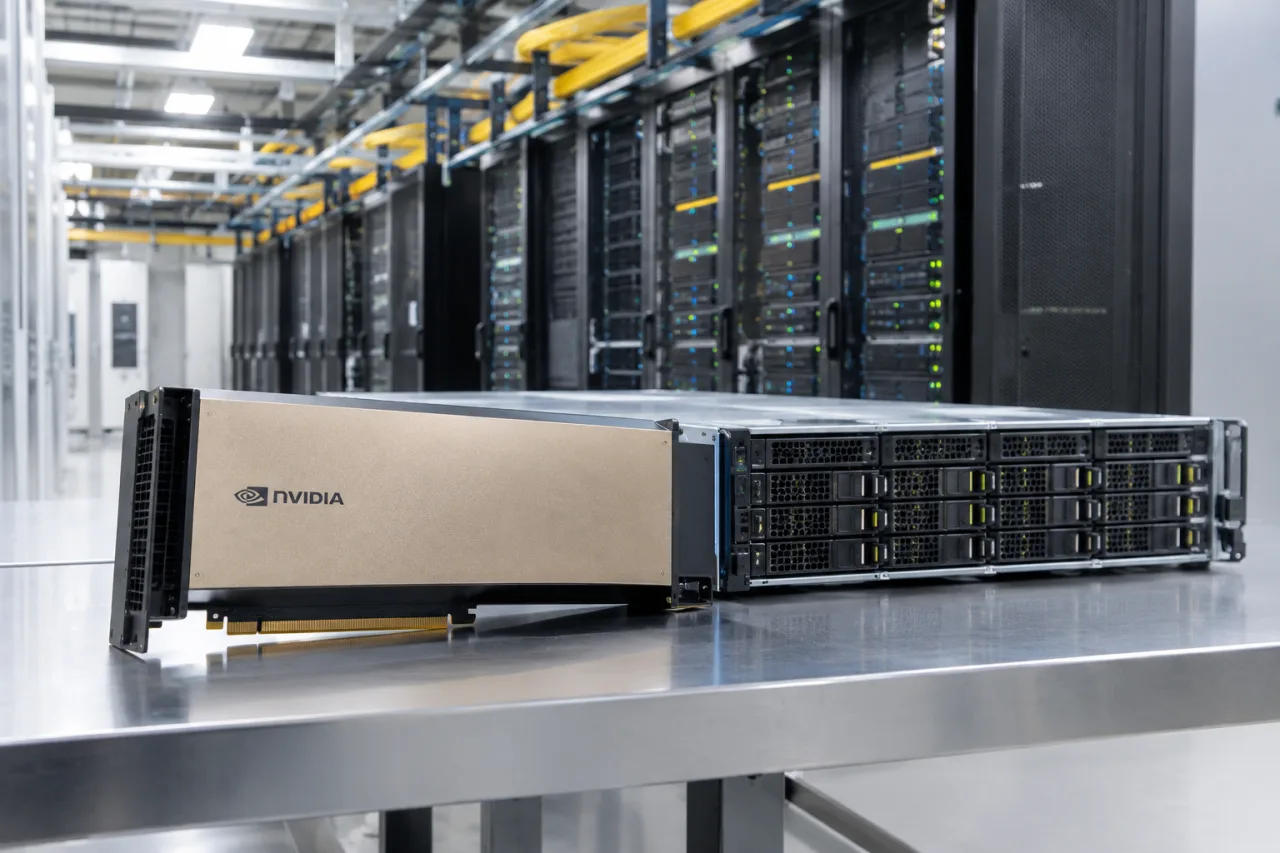
- 🏭 The flagship proof: the Vera Rubin platform — in full production since NVIDIA’s GTC Taipei announcement of May 31, 2026 — is a multi-rack pod-scale system built for agentic AI factories: Vera Rubin NVL72, a Vera CPU rack, BlueField-class storage racks and Spectrum Ethernet racks, five connected rack-scale systems in one pod, with Microsoft, Dell and CoreWeave already standing up engineering racks.
- 🔓 The architecture opened: at the OCP Global Summit (October 12, 2026) NVIDIA opened the Vera Rubin architecture itself — Cisco, Google, Meta, Microsoft and Visionbay building on it; Meta’s hyperscale operations experience + NVIDIA networking is the marquee pairing; Visionbay’s K-1 platform runs the 800-VDC power architecture with future Vera Rubin deployments in mind.
- ⚡ Why the word “factory” is load-bearing: a factory implies production economics — tokens out, watts and capital in, uptime as yield — which is exactly how the money now flows (the rack-density ladder at ~120kW per NVL-class pod runs on 800-volt DC power designs, not the 415-volt three-phase of the old data center).
- 🎯 What it means for you: the shift to factory-scale AI infrastructure is why capacity, power agreements and memory all tightened this year (the memory-shortage arithmetic carries the consumer bill) — and why the platforms you use get priced by production economics, not hosting fees.
Table of Contents
An AI factory is not a bigger data center — it is a different machine, and 2026’s announcements made the difference official. The term now carries precise meaning across NVIDIA’s own records: at the OCP Global Summit on October 12, 2026, the company’s blog described “agentic AI factories of more than 100,000 GPUs that train and serve massive mixture-of-experts models”; at GTC Taipei on May 31, 2026, the investor press release described the Vera Rubin platform “ramping into full production to power agentic AI factories worldwide.” The AI factory is the production line where intelligence itself gets manufactured — inputs: compute, memory, power, cooling; products: tokens served to models and agents. This guide defines what is an AI factory, explains the AI factory vs data center difference layer by layer, and walks the flagship pod (Vera Rubin) component by component, with the milestone record from the company’s own announcements.
AI factory: the definition and the milestone record
The definition, from the source’s own words: an AI factory is a facility designed around one workload family — with its own supply chain, its own shift schedule, and its own yield discipline that conventional hosting never carried — training and serving large models, especially the agentic and mixture-of-experts class — instead of the mixed tenant workloads of a general data center. The production framing is NVIDIA’s deliberate and dated choice: the company’s executives have used “AI factory” for years to describe facilities that convert raw compute into intelligence products, and the 2026 announcements hardened it into architecture: rack-scale pods, 800-volt DC power, liquid cooling to the rack, and interconnect bandwidth measured in terabits — the physical plant of a manufacturing process, not the leasing plant of a hosting business. The May 31 Taipei release carries the platform claim (“full production… agentic AI factories worldwide”); the October 12 OCP blog carries the scale claim (100,000+ GPUs, training and serving, MoE class).
The other meaning floating in search results — named honestly: “AI Factory” also names early AI companies (the first-ever “AI Factory” was a 1980s expert-systems company) and some analytics products; the ring’s ambiguity is real, and the guide’s discipline is to define the infrastructure term with the dated architecture while flagging the corporate-history namesake (the 1980s firm, now a brand of analytics tooling, is a different thing entirely — navigational intent, not this lane).
one word, two definitions — the 2026 record defines the factory as manufacturing architecture; the 1980s company is a footnote, not the lane.
AI factory vs data center: the load-bearing difference
Layer by layer, the two machines diverge: power: a conventional data center provisions 415-volt three-phase distribution and measures per-racket density in kilowatts (the legacy ladder ran 3-8kW, the AI-ready rung 30-100kW); an AI factory pod runs 800-VDC — Visionbay’s K-1 platform (built “with future NVIDIA Vera Rubin deployments in mind”) combines NVIDIA’s 800-VDC reference architecture with Vertiv’s power and thermal engineering — because the pod’s power density demands it (the rack-density ladder carries the kW math: the GB-class racks already run near 120kW loaded). cooling: air dies below the current rack class — the factory racks are liquid-cooled end to end (direct-to-chip through immersion-class designs; the immersion-cooling guide carries the physics), with the facility’s water and power budgets sized to a production line’s pulse, not a hosting floor’s hum. interconnect: the factory’s spine is NVLink-class GPU fabric plus Spectrum Ethernet (the pod’s five systems include the network racks); the fabric bandwidth, not storage capacity, is the constraint the design optimizes. workload: a data center serves many tenants’ mixed loads; a factory trains and serves one organization’s models — the token production schedule replaces the tenancy mix. economics: a data center earns colocation fees; a factory’s output is measured in tokens and the cost is measured in watts per token — an AI factory of the 100k-GPU class turns the power bill and the wafer bill into two line items of one production report — different margins, different risks, different financing (the money-trail analyses follow exactly this capital).
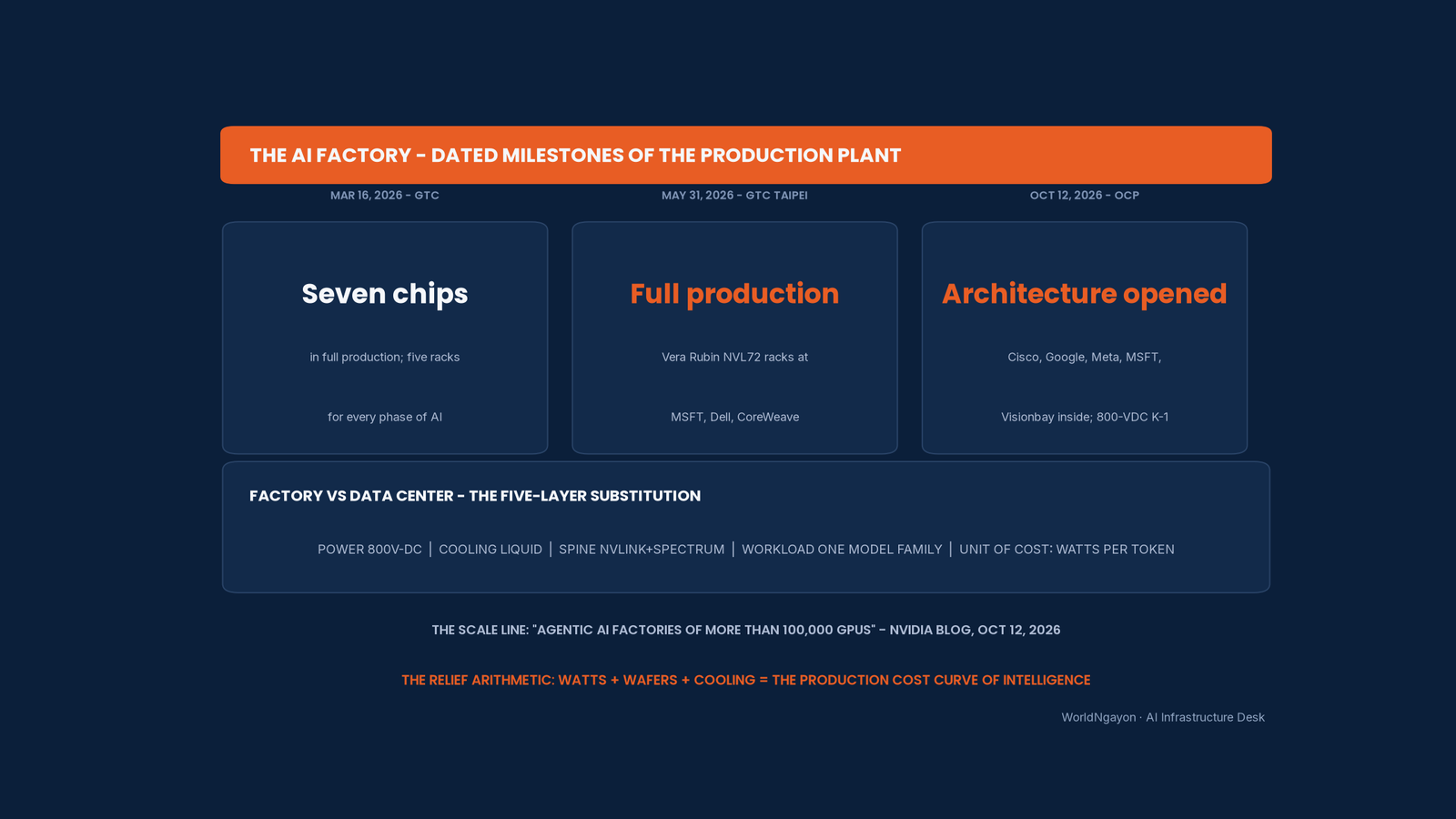
the AI factory vs data center question is a layer-by-layer substitution: power, cooling, interconnect, workload, economics — five layers, five different design answers.
Inside the factory: the Vera Rubin pod, component by component
The pod, as the dated announcements describe it: Vera Rubin is a multi-rack pod-scale system — five connected rack-scale systems, each purpose-built for a phase of AI: 1 — the NVIDIA Vera Rubin NVL72, the GPU rack (Vera Rubin GPUs + NVLink fabric in a 72-package rack, the successor read to the GB-class ladder); 2 — the Vera CPU rack (Arm-architecture CPU generation built for the AI factory’s data plumbing); 3 — the BlueField-class storage rack (the data-plane processing tier); 4 — the Spectrum Ethernet racks (Scale-up and Scale-out switching tiers); and 5 — the security/inference tier in the pod’s confidential-computing layer. The platform ships with full-stack NVIDIA Confidential Computing: data encrypted across the high-speed interconnects, hardware-level attestation for a tamper-proof execution environment at rack scale — the security design is IN the pod definition, not an add-on shelf.
The production status, dated: GTC (March 16, 2026): “seven new chips now in full production to scale the world’s largest AI factories”; GTC Taipei (May 31, 2026): the platform “ramping into full production… worldwide,” with Microsoft, Dell and CoreWeave each standing up Vera Rubin NVL72 engineering racks; the October OCP Summit: the architecture opened (below). The comparison table the era invites — Vera Rubin vs Blackwell — is a production-status race: Blackwell-class racks run today’s deployed factory floor; Vera Rubin pods are the ramping successor (our optics-layer analysis and the custom-chip forge carry the ladder’s preceding rungs).
a factory pod is five racks, one schedule — and the schedule’s milestone dates are public.
The open architecture: who builds inside NVIDIA’s factory now
The October 12 OCP announcement, dated and named: NVIDIA opened the Vera Rubin architecture to help scale AI factories worldwide — the marquee names: Cisco, Google, Meta, Microsoft and Visionbay. Meta + NVIDIA: the hyperscale operations experience pairing (Meta operates AI infrastructure at scale; NVIDIA’s networking technology — including the Facebook-built FBOSS switch software on the Switch Abstraction Interface, an OCP standard NVIDIA helped develop — carries the vendor-independent control layer). Visionbay’s K-1: the 800-VDC AI-factory platform combining NVIDIA’s reference architecture with Vertiv’s power/thermal technologies. The open-architecture play inverts the closed-stack history of the data center era: the factory’s blueprints are public, the partners are named, and the deployments compound (agentic AI factories at 100,000+ GPUs class).
the open-architecture move is the distribution lesson the AI-browser and platform stories kept proving — control of the default surface wins; but at infra scale, “surface” means the reference designs everyone copies. NVIDIA opening Vera Rubin’s architecture converts would-be competitors into builders-inside-the-factory; the power-side capacity calendar and the storage buffer guides carry the facility-level consequences.
the blueprints are open — the moat moved from the stack to the supply chain.
The factory economics: watts, capital and tokens
The economics, plainly: a factory’s profit is (tokens sold) − (watts + capital + memory) — and 2026’s market events are the ledger of that arithmetic: the memory prices that repriced (the memory-shortage record: DRAM’s 400% climb, HBM’s three-times-a-gigabyte wafer appetite), the power deals (the SMR-era capacity contracts and the energy-storage buffers), the optics bottleneck (the co-packaged optics ramp — the interconnect tier’s own supply squeeze), and the funding questions hanging over the build-out (rounds pared, commitments tallied — the money-trail lane). The factory frame makes these stories one story: the production cost curve of intelligence.
One more thing the reader should carry: “factory” is also a marketing frame — NVIDIA sells the racks; the buyers’ production economics depend on utilization, power contracts and demand durability that no vendor announcement measures. The guide’s discipline: quote the architecture from the milestone record, price the economics from the market record, and keep the tiers apart.
the factory word prices intelligence in production terms — watts per token is the ratio that organizes every infra story this year.
What it means for users, buyers and the industry
For AI users: the factory build-out is why your inference bill and your tool latency ride capacity cycles — the 100k-GPU-class factories exist to serve agentic, mixture-of-experts workloads at scales that shape what the platforms charge; capacity tightness upstream shows up as pricing and rate limits downstream (the platform-guides lanes carry the consumer-side effects).
For infrastructure buyers: the 800-VDC revolution is the procurement fork: new builds spec to the factory architecture (pod-scale, 800-volt, liquid-cooled); retrofit decisions price the old distribution against the new power math. Visionbay’s K-1 and the Vertiv pairing are named vendors on the record — the procurement shortlist writes itself from the announcement.
For the industry and investors: the AI factory is the frame in which every infra company now competes — the chip makers at the ladder’s top, the power and cooling vendors in the middle, the financiers at the base (the funding-questions lane carries the dated stress tests). The watchlist discipline follows production milestones, not demos: full-production dates, engineering-rack stand-ups (Microsoft, Dell, CoreWeave — the named first movers), and architecture adoptions (Cisco, Google, Meta, Visionbay — the named builders). The Google schools policy story carries the other end of the pipe: where the factory’s output lands.
Verdict: the word changed the business
What is an AI factory, settled: the production plant for intelligence — defined by the 2026 record (100,000+ GPU agentic factories, train-and-serve, MoE class), embodied in the Vera Rubin pod (five rack-scale systems, full production since May 31, 2026, architecture opened October 12, 2026), and financed by a power-memory-cooling supply chain whose cost curves explain the year’s infra headlines. AI factory vs data center is no longer a metaphor: five layers (power, cooling, interconnect, workload, economics) each carry a different design answer, and the 800-VDC pod is the answer in deployment. The word changed the business — and the milestone record is the proof.
Frequently Asked Questions
What is an AI factory?
An AI factory is a purpose-built production facility for intelligence: a plant that trains and serves large AI models and outputs tokens the way a conventional factory outputs goods. NVIDIA’s dated usage defines it precisely in 2026 – its October 12, 2026 blog describes ‘agentic AI factories of more than 100,000 GPUs that train and serve massive mixture-of-experts models,’ and the May 31, 2026 GTC Taipei press release describes the Vera Rubin platform ‘ramping into full production to power agentic AI factories worldwide.’ The term contrasts with a data center: the factory manufactures intelligence products, the data center hosts mixed tenant workloads.
What is the difference between an AI factory and a data center?
Five layers carry different design answers: power (800-volt DC distribution in AI factory pods versus 415-volt three-phase in conventional data centers); cooling (liquid-cooled end to end versus air-limited racks); interconnect (NVLink-class GPU fabric plus Spectrum Ethernet as the spine versus storage-centered networks); workload (training and serving one organization’s models versus mixed tenant hosting); and economics (tokens out, watts per token as the cost unit versus colocation fees). A rack can host gigawatt campuses; a factory makes tokens the product.
What is the NVIDIA Vera Rubin NVL72?
The GPU rack at the core of the Vera Rubin platform: a pod-scale multi-rack system combining Vera Rubin GPUs with NVLink fabric in a 72-package rack, alongside four sibling rack-scale systems (Vera CPU rack, BlueField-class storage rack, Spectrum Ethernet switching racks, and the confidential-computing tier). NVIDIA announced full production in 2026: seven new chips in full production at GTC on March 16, 2026, then ‘ramping into full production’ at GTC Taipei on May 31, 2026. Microsoft, Dell and CoreWeave each stood up Vera Rubin NVL72 engineering racks.
Why does an AI factory use 800-volt DC power?
Because of power density: AI-factory racks are the highest-density compute installations ever built, and stepping power down from 415V AC through multiple conversions wastes energy and adds hardware at scale. The 800-VDC architecture distributes power with fewer conversion stages; NVIDIA published a 800-VDC reference architecture and partners build to it – Visionbay’s K-1 AI factory platform (announced at the October 2026 OCP Summit) combines it with Vertiv’s power and thermal technologies for future Vera Rubin deployments.
Who is building with NVIDIA's opened Vera Rubin architecture?
The October 12, 2026 OCP Global Summit announcement names the builders: Cisco, Google, Meta, Microsoft and Visionbay. Meta pairs its hyperscale operations experience with NVIDIA networking; NVIDIA’s FBOSS switch software (built on the Switch Abstraction Interface, an OCP standard NVIDIA helped develop) provides vendor-independent switch control; Visionbay unveiled the K-1 800-VDC AI factory platform; Microsoft and Dell stood up engineering racks with CoreWeave earlier in the ramp.
Is 'AI Factory' also a company name?
Yes – two different things share the name. The 1980s ‘AI Factory’ was an early artificial-intelligence company known for expert-system software, now a brand associated with analytics tooling; that corporate namesake serves navigational searches. This guide’s lane is the infrastructure term: the purpose-built production facility for intelligence defined by the 2026 NVIDIA announcements. Both definitions are real; they belong to different decades and different searches.
Financial Disclaimer
This article is editorial analysis of publicly reported information, not investment or financial advice, and no outcome is promised. Product and market statements are as reported by the named sources at the stated dates; verify specifications and figures before decisions. Markets carry risk.
The timeline read makes the production race legible. Blackwell-class racks moved from announcement to full-floor deployment across 2025, and today they carry the AI factory’s running shift: the deployed pods, the training schedules, the serving latency contracts. Vera Rubin’s record runs the same path with its own dated milestones — March 16, 2026 (the GTC announcement: seven chips in full production), May 31, 2026 (GTC Taipei: the platform ramping into full production, the first engineering racks standing at Microsoft, Dell and CoreWeave), October 12, 2026 (OCP: the architecture opened to Cisco, Google, Meta, Microsoft and Visionbay). The reading rule for AI factory vs data center arguments across 2027: a data center’s question is capacity; an AI factory’s question is schedule. When a deployment story lands, date the milestone, name the rack class, and place it on either side of that line — the vocabulary does the sorting, and the factory’s milestones do the timing.
The buying guide’s closing layer: organizations shopping this market should price three factory inputs before quoting a vendor’s token claims — watts under contract (the power purchase and interconnection lane), memory and HBM allocations (the wafer-assignment math the memory-shortage record carries), and the cooling plant (a liquid-cooled floor’s water budget and its regulator relationship). The AI factory definition matters commercially because each of those inputs is now procured factory-scale: pods, not racks; campuses, not rooms; decades, not quarters. The AI factory era prices commitments accordingly — and the AI factory’s dated milestones, from the March GTC announcement to the October OCP opening, is the buyer’s evidence base.
One more operational layer separates the AI factory from the rack-house it replaces: staffing and failure models. A data center staffs for uptime — ticket queues, change windows, tenant SLAs. An AI factory staffs for yield — because the product is a token stream, the operations team watches interconnect errors, GPU-hours lost to faults, and the schedule’s throughput curve the way a chip fab watches wafer yields. The monitoring stack differs accordingly: utilization-to-schedule dashboards replace per-rack health boards. That difference is why the AI factory concept spread so fast through the industry’s operating teams: it names a machine they already run, in the language the business already bills.
- blogs.nvidia.com/blog/ocp-global-summit-vera-rubin-scale-ai-factories — the company’s blog
- investor.nvidia.com/news/press-release-details/2026/NVIDIA-Vera-Rubin… — seven new chips now in full production
External sources linked in this article, in order of first mention. Spotted an error or a broken link? Tell us.
Cite this pagePublished Nov 5, 2026
Agron, E. (2026, November 5). What Is an AI Factory? the Term Redefining the Data Center, Explained. WorldNgayon. https://worldngayon.com/ai-factory/
Agron, Edmon. “What Is an AI Factory? the Term Redefining the Data Center, Explained.” WorldNgayon, 5 Nov. 2026, worldngayon.com/ai-factory/.
Agron, Edmon. “What Is an AI Factory? the Term Redefining the Data Center, Explained.” WorldNgayon, November 5, 2026. https://worldngayon.com/ai-factory/.
Agron, E. (2026) ‘What Is an AI Factory? the Term Redefining the Data Center, Explained’, WorldNgayon, 5 November. Available at: https://worldngayon.com/ai-factory/.
E. Agron, “What Is an AI Factory? the Term Redefining the Data Center, Explained,” WorldNgayon, Nov. 5, 2026. [Online]. Available: https://worldngayon.com/ai-factory/
@online{agron2026aifactory,
  author       = {Agron, Edmon},
  title        = {{What Is an AI Factory? the Term Redefining the Data Center, Explained}},
  year         = {2026},
  date         = {2026-11-05},
  organization = {WorldNgayon},
  url          = {https://worldngayon.com/ai-factory/},
  urldate      = {}
}TY - ELEC AU - Agron, Edmon TI - What Is an AI Factory? the Term Redefining the Data Center, Explained T2 - WorldNgayon PY - 2026 DA - 2026/11/05/ UR - https://worldngayon.com/ai-factory/ Y2 - ER -
Cite the version you read; the page may be updated. Zotero and Mendeley can also import this page directly.