Key Takeaway
- 📰 What is verified: Gemini 4 Carbon is an upgrade to Gemini 4 Argon (which launched the week before), reported by The Information on October 28, 2026 as on Google’s preparation list — announced, not yet released; developers told the paper Google’s models remain particularly strong at visual tasks including video analysis and website testing.
- 🧬 Why the name matters: the Argon → Carbon ladder continues the element-series naming that Google revived with Gemini 4 — each rung shipping weeks apart — so the release cadence itself is now part of the competitive story, and “which Carbon version am I buying” is a question for every enterprise evaluation.
- 🗺️ Where it fights: the same October cycle carries OpenAI’s GPT-6.1 Terra (released October 26 at $1/$5 per million tokens) and OpenAI’s next Terra-family model, plus Anthropic’s intent-reading model in testing — three labs stacking releases within weeks; the Carbon-vs-Terra-vs-Anthropic triad is the quarter’s model race.
- ⚖️ The honest status board: Carbon is announced (read about it), Terra is released (use it) — and every “benchmark comparison” mixing announced and shipped models is comparing different truth-tier facts; the checklist below separates them.
- 🎯 The practical takeaway: no switching decisions yet — Argon remains the shipped Google frontier option, Carbon’s release-date signals (the signals checklist below) tell you when to run your own evaluation; the field guide’s model-choice discipline applies unchanged.
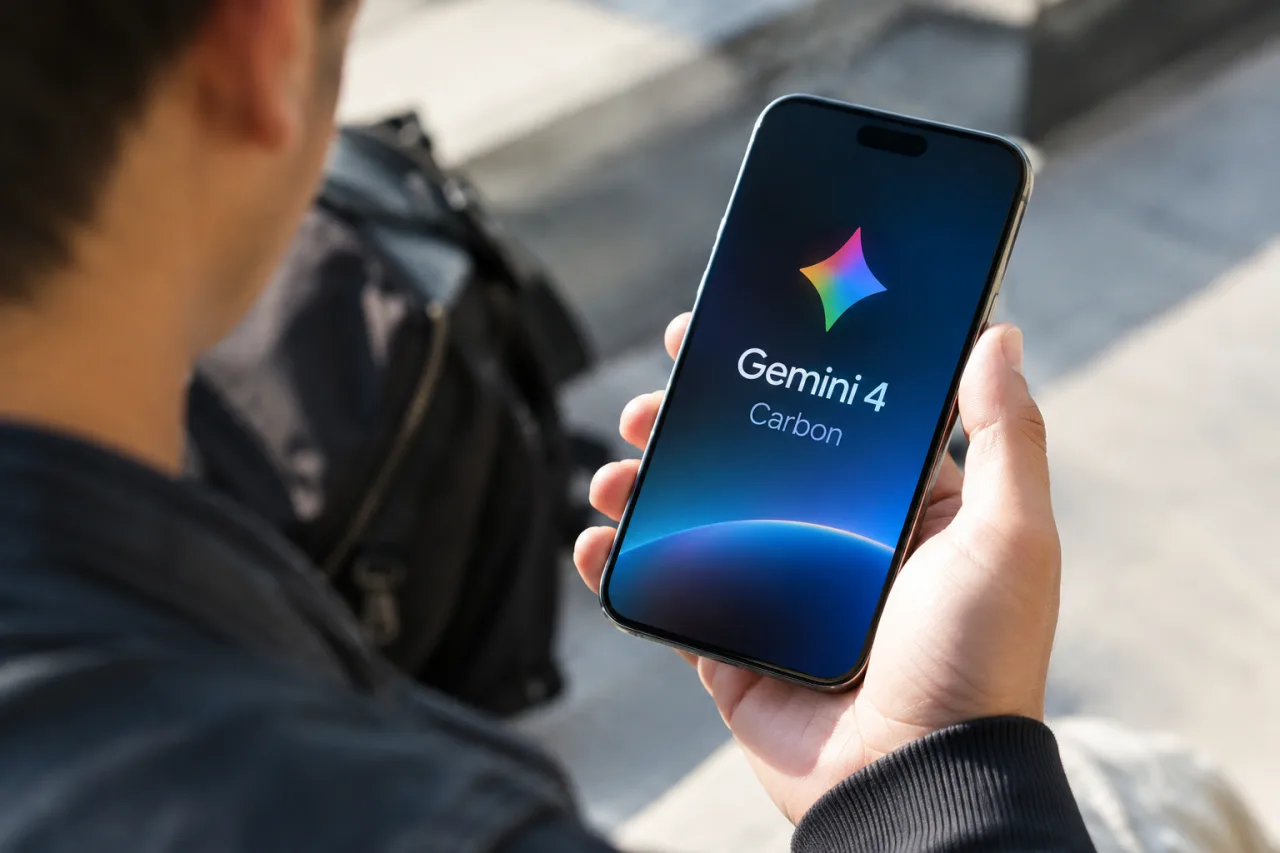
Gemini 4 Carbon is Google’s announced upgrade to Gemini 4 Argon — and this guide sorts what is verified from what is speculation. The Information reported on October 28, 2026 that Google is working on Gemini 4 Carbon, an upgrade to Gemini 4 Argon, which had launched the week before; developers told the paper that Google’s models remain particularly strong at visual tasks, including video analysis and website testing. Carbon arrives inside a compressed model race — OpenAI released GPT-6.1 Terra on October 26 at $1/$5 per million tokens, Anthropic is reported preparing an intent-reading model — three labs stacking releases inside weeks. This guide carries the verified-dated Carbon record, the naming ladder’s information content, the announced-vs-shipped truth tiers, and the release-date checklist that tells you when an evaluation is actually possible.
Related: GPT-6.1 Sol vs Terra: Which One for Your Work?.
Related: Genie 4 Explained: Google’s Real-Time World Model and What It’s For.
Table of Contents
What is Gemini 4 Carbon: verified, dated, tiered
Verified (dated, sourced): The Information’s October 28 report places Gemini 4 Carbon as an upgrade to Gemini 4 Argon in Google’s preparation pipeline; the element-series naming continues the Gemini 4 family’s cadence; and the developer-sourced strength claim — visual tasks, video analysis, website testing — describes where Google’s models currently lead, which is the capability territory Carbon inherits. Gemini 4 Carbon NOT verified (at publication): a release date, benchmark numbers, pricing, or which tier of the lineup Carbon occupies (flagship-adjacent? mid-tier like OpenAI’s Terra play?). Every Carbon number circulating online should be checked against this list — an announced model generates benchmark leaks the way a movie generates rumors, and the verification discipline is the defense: dates and named sources, or shelf the claim.
Why the announce-first pattern matters: Google’s October cycle (Argon shipped, Carbon announced within a week) shows the lab managing expectation windows — the announce keeps developer attention inside Google’s tier story while the prior version sells. It is also an enterprise signal: organizations evaluating an annual commitment can time contracts to the ladder’s visible next rungs.
WorldNgayon Analysis: this guide’s job is honest tiering. The model race’s information hygiene has collapsed — announced models get reviewed as if shipped. The dates this piece carries (October 26 Terra release; October 28 Carbon announcement; Argon’s launch the prior week) are the skeleton; everything else is rumor-grade until Google ships, and the claims-ledger rule applies: name the source, date the claim, or flag it as unverified.
Bottom Line: Carbon is a dated announcement — treat every benchmark attached to it as rumor until Google publishes.
The Argon to Carbon ladder: why the naming now carries information
The Gemini 4 element series: Argon shipped first (the week before Carbon’s announcement), Carbon is announced next in the series — and the element ladder itself has become a release-cadence signal: labs now telegraph the NEXT tier by naming the one that landed. The series naming does three jobs at once: it preserves family identity (Gemini 4 stays the brand), it sequences releases clearly (Argon → Carbon, with later rungs predictable by atomic number), and it converts each launch into a ladder event rather than a standalone drop — which trains buyers into “wait-for-the-next-rung” behavior labs must then fight with pricing.
What the ladder predicts: cadence compression. The Argon-to-Carbon window (weeks) is the fastest major-family refresh this site has tracked — consistent with the demand-side story (customers choosing by cost-per-task now, the capex and inference-economics pieces) and with the pricing war the October releases carried (Terra at $1/$5). The ladder also predicts the comparison-table inflation: every new rung triggers a wave of announced-vs-shipped confusion, which the checklist below inoculates.
WorldNgayon Analysis: naming-as-roadmap is a double-edged transparency: buyers gain a predictable sequence (good for planning), while the market loses the launch-event clarity that used to gate evaluations (bad for hygiene). The operators who win are the ones who evaluate SHIPPED models on their own workloads and treat named-but-unshipped tiers as calendar intelligence — the model field guide’s discipline.
Bottom Line: the element ladder is a public roadmap now — read it for cadence, not for benchmarks.
The October race: Carbon, Terra and an Anthropic model in the same weeks
The three-track October, dated: OpenAI shipped GPT-6.1 Terra on October 26 — priced $1 input/$5 output per million tokens, available in ChatGPT Work, Codex and the API, positioned for faster computer use at a lower cost, with a next Terra-family model reported in preparation at an even lower price than GPT-6.1 Sol. Anthropic is reported preparing a model with improved reasoning and intuition — a tested-user told The Information it infers users’ underlying goals from limited instructions and proposes more comprehensive fixes; no name or date disclosed. Google announced Gemini 4 Carbon as the Argon upgrade inside the Gemini 4 Carbon cadence as the Argon upgrade, with visual-task strength the developer-sourced claim. Three labs, three strategies: OpenAI competes on price-per-task tiers; Anthropic on capability depth; Google on cadence and visual strength.
WorldNgayon Analysis: the race’s real headline is the SHIFT IN PURCHASING CRITERIA the reporting names explicitly: developers increasingly weigh cost and task-specific performance alongside raw intelligence — the market moved from “which model is smartest” to “which model is smartest per task per dollar.” That is the same purchasing shift the per-token and serving-economics pieces document (the serving layer), and it explains why a mid-tier with a $1/$5 price (Terra) made a bigger market ripple than many flagship increments: the mid-tier is where budgets live. Model-line strategy, not raw capability, is now the competitive frontier — and October was the week that became obvious.
Bottom Line: October’s race was three strategies in three weeks — price-tier competition won the week’s attention share.
Announced vs shipped: the truth-tier checklist
The checklist that keeps model comparisons honest (run before citing any comparison): 1 — status tier: shipped, in-preview, or announced? (Terra: shipped Oct 26. Carbon: announced Oct 28. Argon: shipped. The Anthropic model: reported in testing.) 2 — source tier: vendor-published, named-report (The Information), or anonymous summary? Each tier prices trust differently. 3 — date tier: is the claim dated at, before or after the status change? Announced-model benchmarks predating release are rumors wearing lab coats. 4 — evaluation tier: did the tester run YOUR kind of task, or a bench suite? Benchmarks transfer badly (the field guide’s rule). 5 — pricing tier: released models carry published prices (Terra: $1/$5); announced models carry projections. Five checks, ninety seconds — and most “Carbon vs X” tables collapse into different truth tiers.
WorldNgayon Analysis: the checklist exists because the model-news cycle now compresses to weeks: by the time a careful reader finishes a comparison, a rung changes. The hygiene that survives compression is tiering — the same date-and-source discipline this site’s claims series runs (the dated-claims ledger). The practical version for teams: maintain a one-page model matrix with STATUS and PRICE columns, updated on announcement day — the artifact that keeps evaluations honest between releases.
Bottom Line: status, source, date, evaluation, price — five checks that keep the model race legible.
The release-date signals that matter
The signals, ranked by reliability: 1 — the vendor’s own pages (the day a Carbon product page appears, the release is real-time). 2 — the API-changelog (availability in AI Studio/the API precedes most public launches). 3 — benchmark infrastructure presence (published eval harnesses naming the model). 4 — pricing publication (the tier assignment becomes fact). 5 — developer-credential reports (The Information-class sources, useful but unnameable). What does NOT herald release data: leaks, “tested” screenshots without provenance, and comparison tables mixing tiers. The ladder pattern adds one: successive element-named rungs have shipped within weeks — so Carbon’s window is bounded by the cadence its own sibling set.
WorldNgayon Analysis: the signal stack also disciplines the buying decision: enterprises renew infrastructure contracts against RELEASE evidence, not announcements — the same registration-then-launch logic the Apple-China compliance ladder uses. Announced models are calendar intelligence; shipped models are procurement objects. The teams that keep the distinction buy better.
Bottom Line: a product page is a release; everything else is the marketing calendar.
What this means for work, money and the Philippines
For developers and teams: October’s lesson is procurement timing — Terra’s $1/$5 changed the mid-tier price anchor the same week Carbon was announced; run your evals on shipped models and set your contract renewals to the cadence (the build-and-launch pieces carry the subscription discipline). For the local-LLM crowd: the open-weight side keeps moving too (DeepSeek’s V4.1 Flash updated October 17 in the same race-coverage span) — the field guide tracks that lane.
For investors: cadence compression is a margin event: faster refreshes mean shorter pricing power windows per model — the tape the money-trail pieces track, and the crash-series instruments (the watchlist numbers) apply: watch for pricing announcements inside announcement weeks (the price war is red-flag one on Storm’s list).
For Filipino professionals and OFWs: the practical angle is unchanged and good: every tier war lowers the price of the intelligence tiers you use daily — the assistant features, the coding tools, the meeting summarizers — and the region’s talent market rides the same wave (the jobs maps). Your model-matrix artifact is a one-pager; keep it current and it becomes a client-ready advisory asset.
For policy watchers: cadence compression also compresses oversight windows — the safety review lag (OpenAI’s next flagship still addressing safety concerns per the reporting) is the policy gap the regulation pieces document.
Verdict: Argon ships, Carbon is coming, run your own eval when it lands
Gemini 4 Carbon, settled at the verified layer: an announced upgrade to Argon (the week-prior launch), dated October 28 in The Information’s report, inheriting Google’s visual-task strength, arriving inside the densest model race of the quarter (Terra shipped October 26 at $1/$5; Anthropic’s intent model reported in testing), with no release date, benchmarks or pricing verified yet. The element-ladder naming is now a public cadence signal — read rungs for timing, not for truth. Evaluate shipped models on shipped workloads, run the five-check truth-tier list on every comparison you read, and time contracts to the release evidence. Argon ships, Carbon is coming — the ladder is the roadmap, the product page is the truth.
Sources on the record: the Google blog · the Yahoo Finance model-race report.
Financial Disclaimer
This article is editorial analysis of publicly reported information, not investment or financial advice, and no outcome is promised. Statements are as reported by the named sources at the stated dates; verify before acting. Markets carry substantial risk.
One more note on reading the Gemini 4 Carbon cycle: the announcement itself was the news, and every subsequent Gemini 4 Carbon rumor should be graded against what Google has actually published. A Gemini 4 Carbon product page will be the first release-grade signal, the Gemini API changelog the second, and published pricing the third — and until those land, Gemini 4 Carbon stays in the announced tier where this guide holds it.
One more practical layer for teams tracking Gemini 4 Carbon: keep the evaluation calendar aligned to the cadence. The Argon launch, the Carbon announcement, and the rungs that follow now arrive weeks apart, which means a quarterly eval cycle is already too slow to catch a tier shift – a biweekly ten-minute matrix review (status, price, task fit for your top three workloads) is the rhythm the October race just normalized. The teams that ran that rhythm through the Terra launch priced their renewals better than the ones who read about it afterward.
- blog.google/innovation-and-ai/technology/ai/google-io-2026-all-our-an… — the Google blog
- au.finance.yahoo.com/news/anthropic-google-openai-prepare-ai-14421201… — the Yahoo Finance model-race report
External sources linked in this article, in order of first mention. Spotted an error or a broken link? Tell us.
Cite this pagePublished Nov 1, 2026
Agron, E. (2026, November 1). Gemini 4 Carbon: What We Know and How It Stacks Against Argon and Opus. WorldNgayon. https://worldngayon.com/gemini-4-carbon/
Agron, Edmon. “Gemini 4 Carbon: What We Know and How It Stacks Against Argon and Opus.” WorldNgayon, 1 Nov. 2026, worldngayon.com/gemini-4-carbon/.
Agron, Edmon. “Gemini 4 Carbon: What We Know and How It Stacks Against Argon and Opus.” WorldNgayon, November 1, 2026. https://worldngayon.com/gemini-4-carbon/.
Agron, E. (2026) ‘Gemini 4 Carbon: What We Know and How It Stacks Against Argon and Opus’, WorldNgayon, 1 November. Available at: https://worldngayon.com/gemini-4-carbon/.
E. Agron, “Gemini 4 Carbon: What We Know and How It Stacks Against Argon and Opus,” WorldNgayon, Nov. 1, 2026. [Online]. Available: https://worldngayon.com/gemini-4-carbon/
@online{agron2026gemini4,
  author       = {Agron, Edmon},
  title        = {{Gemini 4 Carbon: What We Know and How It Stacks Against Argon and Opus}},
  year         = {2026},
  date         = {2026-11-01},
  organization = {WorldNgayon},
  url          = {https://worldngayon.com/gemini-4-carbon/},
  urldate      = {}
}TY - ELEC AU - Agron, Edmon TI - Gemini 4 Carbon: What We Know and How It Stacks Against Argon and Opus T2 - WorldNgayon PY - 2026 DA - 2026/11/01/ UR - https://worldngayon.com/gemini-4-carbon/ Y2 - ER -
Cite the version you read; the page may be updated. Zotero and Mendeley can also import this page directly.