Key Takeaway
- 🇨🇳 Apple Intelligence China – the deal, dated: Apple Intelligence launches in mainland China in December 2026 with Alibaba’s Qwen powering the build — features open for developer testing in the iOS beta on November 4, 2026, ending roughly two years of regulatory waiting (the iPhone 16 launch promised the feature “subject to regulatory approval”).
- 🏛️ The regulatory ladder, fully dated: July 15, 2026 — the Cyberspace Administration of China (CAC) published the registration notice clearing Apple Intelligence as one of seven approved on-device generative-AI services for smartphones (Apple alongside Huawei, Xiaomi, Samsung, OPPO, vivo and Nubia); October 15 — Tim Cook confirmed the approval in Shanghai; October 31 — Alibaba officially announced the partnership; November 4 — developer beta; December — public rollout with iOS 27.3.
- 🧩 What is actually in the box: the initial rollout carries about 18 features — Writing Tools (summarizing, proofreading), live translation for calls and messages, and Visual Intelligence through camera controls — while the upgraded Siri AI stays OUT of this release’s scope.
- 🔀 Why the China stack differs: Apple Intelligence elsewhere leans on its own and American-partner models; in China, local rules are met by local partners — Alibaba’s Qwen confirmed by an Alibaba spokesperson (per CNBC and Reuters), with Baidu also reported in a role — the same device, two brains depending on the market.
- 💼 The market read: the approval clears Apple’s path in its second-largest market after two blockbuster-recovery quarters, and Alibaba gains distribution across Apple’s device ecosystem — a structural event for both companies, priced the moment the notices landed.
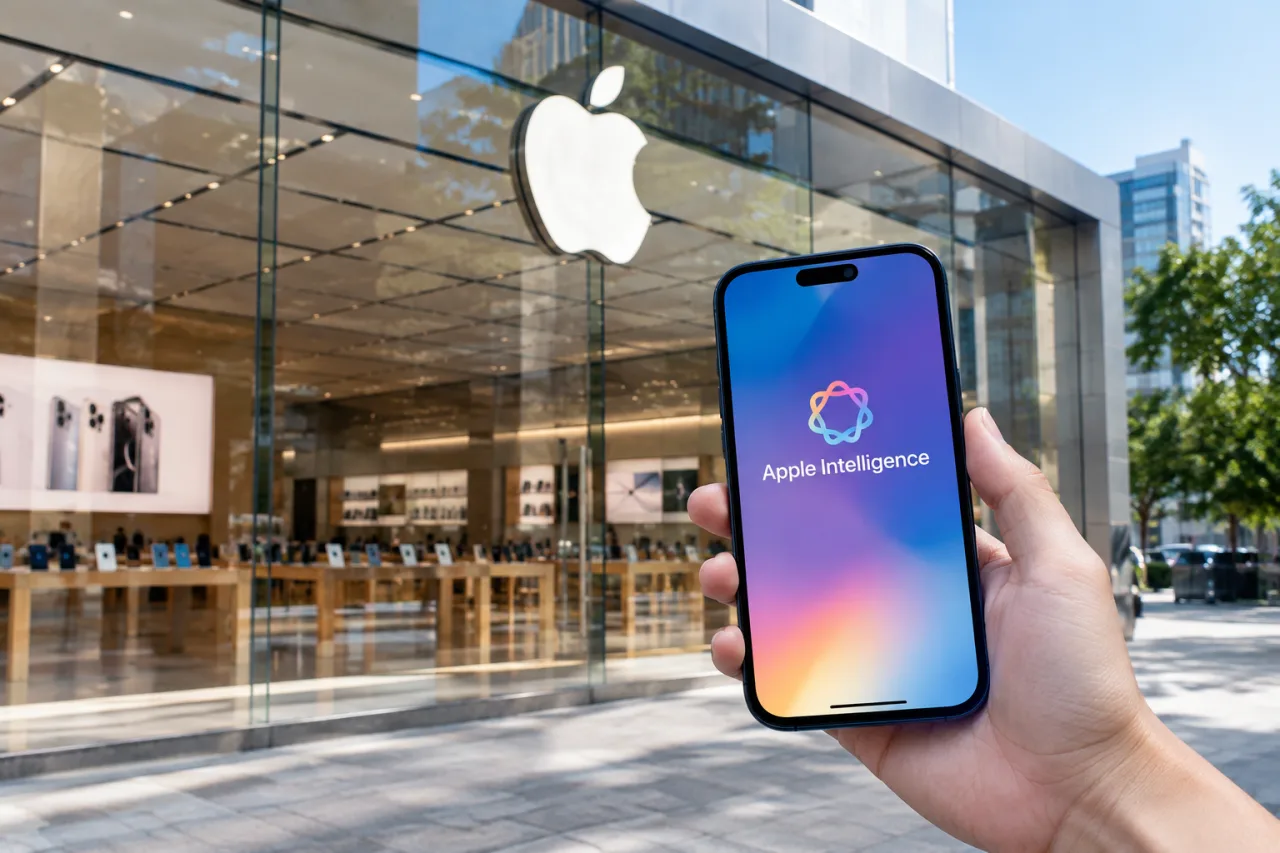
Apple Intelligence China is officially dated. On Saturday, October 31, 2026, Alibaba announced the partnership that puts its flagship Qwen model family inside Apple Intelligence for mainland-China users — with the features opening for developer testing in Apple’s iOS beta on November 4, 2026, and launching publicly with iOS 27.3 in December. The announcement ends roughly two years of regulatory uncertainty: Apple promised the feature at the iPhone 16 launch “subject to regulatory approval,” the Cyberspace Administration of China cleared it with a formal registration notice on July 15, 2026, and Tim Cook confirmed the approval to reporters in Shanghai on October 15. This guide dates the whole ladder, explains what Qwen actually powers and what is left out, and decodes why the world’s most valuable device company ships two different AI brains in two different markets.
Table of Contents
Apple Intelligence China: the deal in one paragraph
The one-paragraph version of the Apple Intelligence China story, in the order the events happened: Apple promised Apple Intelligence in China at the iPhone 16 launch (2024), subject to approval it could not control. On July 15, 2026, the CAC’s registration notice cleared the on-device AI service — in a batch of seven smartphone AI approvals that included Huawei, Xiaomi, Samsung, OPPO, vivo and Nubia. Speaking to reporters in Shanghai on October 15, Tim Cook confirmed Apple Intelligence and the related Alibaba Qwen model had received approval, naming live translation, Writing Tools and Clean Up as the initial features. On October 31, Alibaba officially announced the partnership: Qwen will power Apple Intelligence inside the China edition across iOS, iPadOS, macOS and visionOS, developer testing opens November 4, and the public rollout rides iOS 27.3 in December. Apple Intelligence China — the phrase that dominated two years of Apple-Asia coverage — finally has dates, features and a model behind it.
WorldNgayon Analysis: two years is the headline number most coverage skips. The delay was not engineering — Apple shipped Apple Intelligence elsewhere in 2024 — it was regulatory architecture: China’s rules require the on-device generative services sold in China to clear the CAC’s registration process, and Apple’s global AI stack could not simply be ported. The two-year gap is the price of compliance architecture, and the Alibaba partnership is the solution’s visible half (with Baidu also reported working with Apple — the second half). For any global platform operator reading this: the China entry pattern is now fully documented — partner locally, register explicitly, ship the compliant subset first, and expand features by approval batches.
Bottom Line: the deal is less a partnership announcement than a compliance story with dates on it.
The full timeline: July approval to December launch
| Date | Event |
| 2024 | Apple Intelligence debuts in the US at the iPhone 16 launch; China entry promised “subject to regulatory approval” |
| July 15, 2026 | The CAC publishes the registration notice clearing Apple Intelligence for mainland China — one of seven approved on-device generative-AI services for smartphones (Huawei, Xiaomi, Samsung, OPPO, vivo, Nubia alongside Apple); Baidu separately confirms its involvement to TechCrunch; Alibaba confirms Qwen’s role to CNBC and Reuters |
| October 15, 2026 | Tim Cook, in Shanghai: Apple Intelligence and the Alibaba Qwen model “have received approval”; initial features named: live translation, Writing Tools, Clean Up photo editing; the upgraded Siri AI is outside this release’s scope |
| October 23, 2026 | Apple’s new China-product push continues (the foldable iPhone line shown in Shanghai stores) — the AI feature dates into a market Apple is actively re-investing in |
| October 31, 2026 | Alibaba officially announces the partnership: Qwen inside Apple Intelligence for the China edition, across iOS, iPadOS, macOS and visionOS |
| November 4, 2026 | Developer preview opens in the iOS developer beta |
| December 2026 | Public rollout bundled with iOS 27.3; roughly 18 Apple Intelligence features ship, per the statement |
WorldNgayon Analysis: three things make this timeline unusually legible: every stage has a public artifact (a registration notice, an on-record quote, an official announcement), every artifact is dated, and the two companies confirmed from opposite ends (Apple’s approval, Alibaba’s integration). That is what a verifiable market event looks like — and it is the standard this site applies before any “historic” label goes on anything (the claims-ledger discipline).
Bottom Line: four months from registration notice to public rollout — the fastest China-AI approval-to-launch cycle of the Western majors.
What Qwen powers: the 18 features and what is left out
In the Apple Intelligence China box (about 18 features at launch, per the statement): Writing Tools for summarizing and proofreading; live translation for phone calls and messages; Visual Intelligence through camera controls; and the Cleanup-class photo-editing features — the utility tier of Apple Intelligence, the features users touch daily. Left out of this release: the upgraded Siri AI — Cook said in October the revamped assistant is outside the current scope — and any feature requiring the global model stack. The companies have not publicly detailed which model powers each feature or how processing divides between device and cloud — a disclosure gap worth remembering when reading any “Qwen replaces Apple’s models” headline: what the announcements establish is that Qwen powers the China build, not that it underpins every function.
The honest read of “18 features”: this is a deliberately conservative launch set — no generative wildness, no Siri rewrite; the features chosen are ones where a local partner model meets Chinese rules comfortably (translation, text tools, vision) and where the on-device/compliance model has been worked out. Expect the feature list to grow in approval batches, exactly as the registration process batches by service. The platform-retirement and staged-rollout pieces on this site document the same pattern from the Western side: feature shipping follows approval architecture, not marketing calendars.
WorldNgayon Analysis: the feature scope tells you the real division of work: the local partner carries the language-facing intelligence in Chinese regulatory territory, and Apple carries the platform. For the models involved, distribution is the prize — Qwen gains placement on hundreds of millions of Chinese iPhones — and for Apple, the features unlock a market where AI-driven upgrade cycles had stalled. Both sides bought something concrete; the launch schedule reflects what each could actually clear.
Bottom Line: the utility tier ships first, Siri waits, and the feature list grows by approval — the China release is a compliance product by design.
The registration ladder: how China approves on-device AI
The mechanism, visible in this very case: generative-AI services sold in China register with the CAC — the July 15 notice was a batch clearance of seven smartphone AI services, published on the regulator’s own site, each cleared as an on-device generative service for smartphones sold in China. The batch structure matters: approvals arrive as classes, not one-offs, which is why seven vendors cleared together and why feature expansion (more services per vendor) will arrive batch-by-batch too. The practical consequences for any vendor: the China path is modeled — partner with a local model provider, register the service, ship the compliant subset, expand by batch. Apple’s two-year wait was the cost of building that path from scratch; every vendor after Apple reads the map Apple drew.
WorldNgayon Analysis: the registration ladder is the least-covered part of the story in Western coverage and the most useful part for global operators — including the Southeast Asian device and services industry this site tracks (the SEA buildout analysis carries the regional frame). The pattern the Apple-Alibaba pair documents — local AI partner + formal registration + batched features — is the reusable template for every foreign AI product approaching a market with its own AI registry. The sovereign-AI pieces predicted this shape: model sovereignty expresses itself as regulatory architecture long before it reaches devices.
Bottom Line: the CAC’s seven-service batch is the case study every global AI operator will cite for the next five years.
Two brains, one device: why the stack splits by market
The architecture fact this deal makes explicit: Apple’s AI stack already differed by market (Gemini-class partners power Apple Intelligence in the US market), and the China edition adds the second documented variant — Qwen (with Baidu involvement) inside China. The device is identical; the intelligence is regional. The consequences run deeper than features: model updates, feature parity timelines, privacy architecture and the upgrade-marketing story all split by market. An iPhone user in Guangzhou and one in California carry hardware twins with differently-brained software — and the parity questions (why does my market lack feature X?) become regulatory questions, not engineering ones.
What it predicts: more market-specific model pairings — the “AI edition” becomes a product dimension like storage or color. The device industry’s supply chain already runs this way (the chip-and-materials pieces carry the physical splits); the intelligence layer is catching up. For global users the practical takeaway: the features your region’s edition ships reflect the partnerships your regulator approved — read the partner list, and you can predict the feature list.
What this means for work, money and the Philippines
For markets watching Apple Intelligence China: Alibaba’s US-listed shares rose on the news of the Apple integration the first time it surfaced (July, per CNBC’s market desk), and the December rollout converts the approval into revenue at scale. For careers: localization engineering — the discipline of adapting AI products to regulatory markets — is now a hireable specialty on both sides of every such deal (the AI-jobs maps carry the regional demand).
For Filipino professionals and OFWs: the OFW angle is direct: Hong Kong and mainland-based Apple users in the Filipinos-abroad community gain live translation and Writing Tools in the December rollout — the corridor’s daily-call and messaging needs sit exactly in the shipped feature set. The Philippines’ own device market reads the deal as an upgrade-cycle signal: Apple’s Greater-China recovery (two consecutive quarters of growth per CNBC’s framing) tends to precede Southeast Asia’s flagship demand (the build-and-launch pieces and the peso lens in the OFW money playbook carry the consumer math). And the deal is a live lesson for the region’s own policy debate: sovereignty expressed through approval ladders, not just through data centers (the sovereign-AI guide carries the five-layer test).
For investors: the Apple Intelligence China event is a case study in priced-in timing — the July registration notice moved the first money, the October 31 announcement confirmed the structure, and the December launch delivers it. The lesson generalizes: in regulated-AI markets, the REGISTRATION date prices the trade and the LAUNCH date delivers it — a distinction the crash-series discipline applies to every dated event.
Verdict: two years of waiting, one weekend of dating
Apple Intelligence China, settled with dates: the CAC cleared it on July 15, 2026, as one of seven approved smartphone AI services; Cook confirmed the Alibaba partnership on October 15; Alibaba announced the integration October 31; the developer beta opens November 4; iOS 27.3 delivers the public rollout in December with roughly 18 features — Writing Tools, live translation, Visual Intelligence — while the upgraded Siri waits for its own approval cycle, and Qwen (with Baidu involvement) powers the China build where the global edition uses its own stack. Two years of regulatory waiting converted into a documented approval ladder any global operator can read. Two brains, one device — and the dates say the second Apple Intelligence China market just opened.
Sources on the record: the South China Morning Post report · the EqualOcean Apple-Intelligence-China report.
Financial Disclaimer
This article is editorial analysis of publicly reported information, not investment or financial advice, and no outcome is promised. Statements are as reported by the named sources at the stated dates; verify before acting. Markets carry substantial risk.
The Apple Intelligence China story also carries a reading rule worth keeping: the phrases matter. Apple Intelligence China, Apple Intelligence in China, and Apple’s China edition refer to the same gated product — the compliant build powered by Qwen for mainland users — while the global Apple Intelligence continues on its own stack. Reading the coverage with that distinction keeps every date straight: registration in July, beta access in November, public Apple Intelligence China rollout in December, and feature expansion in the approval batches that follow.
- scmp.com/tech/big-tech/article/3372831/apple-intelligence-roll-out-ip… — the South China Morning Post report
- equalocean.com/news/2026101622304-apple-intelligence-china-beta-due-l… — the EqualOcean Apple-Intelligence-China report
External sources linked in this article, in order of first mention. Spotted an error or a broken link? Tell us.
Cite this pagePublished Nov 1, 2026
Agron, E. (2026, November 1). Apple + Alibaba’s Qwen: the Chinese AI Deal, Dated and Explained. WorldNgayon. https://worldngayon.com/apple-intelligence-china/
Agron, Edmon. “Apple + Alibaba’s Qwen: the Chinese AI Deal, Dated and Explained.” WorldNgayon, 1 Nov. 2026, worldngayon.com/apple-intelligence-china/.
Agron, Edmon. “Apple + Alibaba’s Qwen: the Chinese AI Deal, Dated and Explained.” WorldNgayon, November 1, 2026. https://worldngayon.com/apple-intelligence-china/.
Agron, E. (2026) ‘Apple + Alibaba’s Qwen: the Chinese AI Deal, Dated and Explained’, WorldNgayon, 1 November. Available at: https://worldngayon.com/apple-intelligence-china/.
E. Agron, “Apple + Alibaba’s Qwen: the Chinese AI Deal, Dated and Explained,” WorldNgayon, Nov. 1, 2026. [Online]. Available: https://worldngayon.com/apple-intelligence-china/
@online{agron2026appleintelligence,
  author       = {Agron, Edmon},
  title        = {{Apple + Alibaba’s Qwen: the Chinese AI Deal, Dated and Explained}},
  year         = {2026},
  date         = {2026-11-01},
  organization = {WorldNgayon},
  url          = {https://worldngayon.com/apple-intelligence-china/},
  urldate      = {}
}TY - ELEC AU - Agron, Edmon TI - Apple + Alibaba’s Qwen: the Chinese AI Deal, Dated and Explained T2 - WorldNgayon PY - 2026 DA - 2026/11/01/ UR - https://worldngayon.com/apple-intelligence-china/ Y2 - ER -
Cite the version you read; the page may be updated. Zotero and Mendeley can also import this page directly.