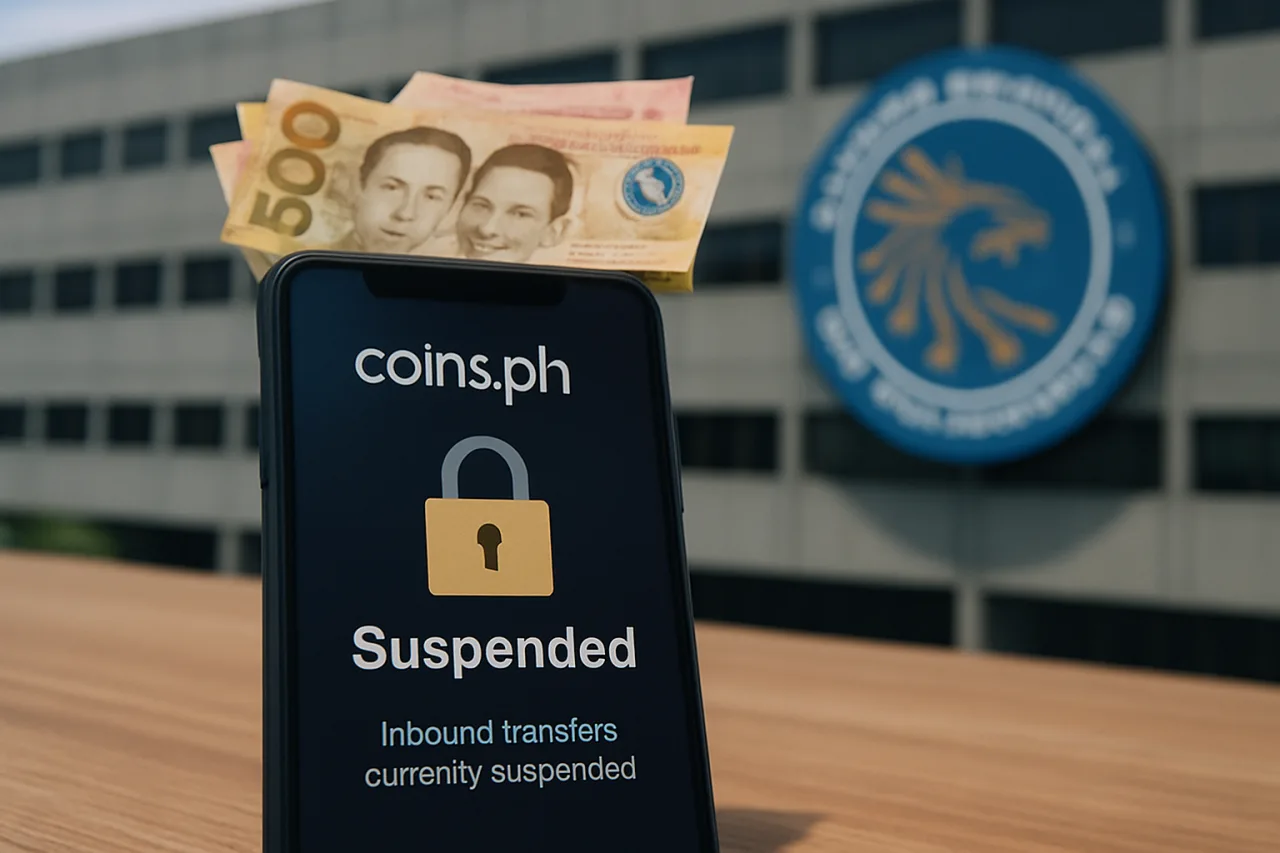
THE BOARD — Thursday, October 1, 2026 → Cyber Watch #005 (Emergency Insert): While Manila was watching the ₱6.60 pricing print, the BSP quietly froze the other half of the fintech week’s map: DCPay Philippines Inc. — the e-money operator behind Coins.ph — is partially suspended from receiving inbound InstaPay and PESONet transfers under Monetary Board Resolution No. 839. Cash-ins from banks and e-wallets bounce. Outbound transfers and QR Ph merchant spending still work. Here is what the Coins.ph suspension means for people who actually have funds inside.
Key Takeaway
- 🏦 The Coins.ph suspension is partial, not total: the BSP suspension hits DCPay’s inbound rails (InstaPay + PESONet cash-ins from BDO, BPI, UnionBank, GCash, Maya). Your Coins.ph wallet is not shut down.
- ⬆️ Outbound still works: you can still move funds OUT of Coins.ph to any Philippine bank or e-wallet — today, in normal processing.
- 🛒 Spending is alive too: QR Ph person-to-merchant payments are expressly unaffected, so pesos inside the wallet still pay at stores.
- 🪙 Crypto is a separate license: trading services run under Betur Inc., legally distinct from DCPay. What broke is the fiat cash-in rail that funds trades — not the trading engine.
- 🧭 The 5-move playbook below: secure what’s inside, exit if you’re done, fund through a second rail, ignore “reactivation fee” scams, and track the lift order like an operator.
What Actually Happened: The Coins.ph Suspension Order, in Plain Numbers
On September 29, 2026, the Philippine Payments Management Inc. (PPMI) — the self-governing body of the national payment system — issued PPMI Advisory No. 2026-0929-029 to every participating financial institution. Its instruction was surgical: implement, immediately and until further notice, the Coins.ph suspension of its operator DCPay Philippines, Inc. from receiving incoming credit transfers cleared through InstaPay and PESONet. The authority behind it is the Bangko Sentral ng Pilipinas’ Monetary Board Resolution No. 839.
Related: BSP Puts Coins.ph License on Watch: 18M Users, Gambling Allegations
Reported by BitPinas and Bilyonaryo Business News on September 30, and independently by Manila Bulletin and Fintech News Philippines on October 1, the operational consequences are precise:
- Cash-ins die at the receiving end. A sender trying to load a Coins.ph wallet from BDO, UnionBank, GCash, Maya, or any other InstaPay/PESONet participant gets a rejected transaction — because the rails themselves are instructed not to credit DCPay.
- Incoming person-to-person QR transfers die. Someone scanning your Coins.ph personal QR to pay you will bounce, the same reason as above.
- InstaPay for Business inbound processing (DCPay’s pilot participation) is suspended. Merchants relying on that pilot for incoming payments feel it directly.
- Outbound transfers keep running. DCPay remains authorized to send money out — to Philippine banks and other e-wallets. This is the single most important sentence of the Coins.ph suspension for anyone with a balance inside: your money is not locked in.
- QR Ph person-to-merchant spending continues. The national merchant QR standard is unaffected, so the peso (and crypto-denominated) balances inside the wallet still spend at stores and checkouts.
Coins.ph’s own system status page corroborates the pattern the regulator-side order produces: InstaPay Cash In and PESONet Cash In show as “Under Maintenance”, while the API, spot exchange, conversions, P2P transfers, and payment gateway read operational. That is what a regulator-ordered partial suspension looks like from the inside: the intake valves are chained shut while the outflow valves and the trading floor stay open.
The Two-License Split That Explains the Coins.ph Suspension
The single biggest confusion risk around the Coins.ph suspension is the name “Coins.ph” itself. It is not one regulated entity — it is two, and this week that distinction is doing all the heavy lifting:
- DCPay Philippines, Inc. holds the e-money issuer (EMI) authorization — the license that lets it hold and move pesos at scale, and connect to InstaPay, PESONet, and QR Ph. That is the entity the Monetary Board partially suspended.
- Betur, Inc. holds the virtual asset service provider (VASP) authorization — the license under which the crypto exchange features operate. That entity is not the subject of Resolution No. 839 — a deliberate carve-out that defines the Coins.ph suspension’s real edges. As the industry press put it, virtual asset trading under Betur remains structurally distinct — but the fiat side of funding trades is affected, because the peso you’d convert has to arrive through DCPay’s suspended inbound rails.
Read that back and the picture comes into focus: your crypto inside Coins.ph is not affected by the order; your ability to push new pesos INTO the ecosystem is. If you already hold balances, the wallet’s internal paths — hold, convert, trade, spend, send out — continue under their respective licenses. What’s severed is the bridge that tops up from the banking system.
Why would the BSP sever exactly that bridge, selectively and “until further notice”? The Monetary Board does not publish a statement of findings with rail-level advisories, and neither outlet carries a stated cause as of this writing — BitPinas notes Coins.ph did not respond to its inquiry at publication. What the shape of this Coins.ph suspension order tells a trained observer is this: partial suspensions of clearinghouse access are a supervisory containment tool — the regulator keeping an institution alive, liquid, and able to return money while it reviews something the intake could worsen. That is categorically different from a shutdown, and it is also why the outbound channel being left running is the tell to watch.
The OFW Playbook: Five Moves for the Coins.ph Suspension
This site’s readers hold balances in these wallets, send into them, and build budgets around them. Here is the sequence, in order of urgency:
- Move 1 — Secure what’s already inside (tonight). Log in, reconcile your balances (peso and crypto), and screenshot your transaction history as of today. If any family member sends YOU money into Coins.ph wallets as a routine, warn the sender tonight: their transfers to that wallet will bounce until the lift order. Redirect them to your bank or primary e-wallet now — a bounced remittance during IPO week is the exact window where confused senders accept “alternate” instructions from strangers.
- Move 2 — Exit if you were leaving anyway. Because outbound transfers remain fully authorized, this is the cheapest exit window you will get: push your peso balance to your bank or primary wallet while the outflow works normally. If the suspension escalates to a full one (unprecedented, but this is what contingencies are for), you’ll be glad you moved on a normal-processing day.
- Move 3 — Fund trading through a second rail, not a workaround. Crypto funding via DCPay’s suspended rails is effectively severed. If you trade actively, route peso funding through a BSP-licensed VASP platform that still has clean rails — the licensing universe of digital wallets in the Philippines is public, and the practical test is simple: can you cash in from your bank today? If yes, that rail is alive. What you should NOT do is follow anyone selling “cash-in assist” with a percentage kickback — that’s covered in Move 4.
- Move 4 — Treat the confusion window as scam season. Partial suspensions breed three specific scams: fake “reactivation/verification” pages harvesting logins, “cash-in agents” reselling reloads at a premium (using their own still-open channels as bait), and phishing pages impersonating BSP advisories. The defense stack is the same one this site drilled in the 20-minute vault build — a password manager that refuses to autofill on impostor domains — plus one rule: the official lift order will arrive via PPMI/BSP channels, never via SMS, Messenger, or an in-app popup asking you to “verify.”
- Move 5 — Track the lift order like an operator. The suspension ends the way it started: with a PPMI advisory referencing a new Monetary Board resolution. Watch, in order, Coins.ph’s status page (fastest “Under Maintenance” → operational flip), the PPMI bulletin stream, and BSP’s press page. When the advisory lands, cash-ins resume — and if your timing matters (an IPO subscription budget parked in a Coins.ph wallet, for instance), set the alert now.
One timeline note for the family-finance readers: this lands in the same week the GCash IPO priced at ₱6.60, with the offer window opening October 6. Some of you keep subscription budgets inside secondary wallets. If that describes your setup, Move 2 is due before Monday — subscription windows do not wait for regulator schedules.
If You Remit Through Coins.ph-Adjacent Rails: The Two-Rail Home Front During the Coins.ph Suspension
Many households reading the Coins.ph suspension news hold a “second wallet” — a Coins.ph account that receives crypto-converted remittances, buys load, pays bills, or cashes out via partner channels. If that describes your family, the Coins.ph suspension rewrites one specific choreography: the receiving side. A worker abroad sending via crypto-to-peso flows that terminate in a Coins.ph wallet will see those terminal legs fail or pause while the inbound rails are frozen — the crypto leg (Betur) still trades, but the peso payout into the local wallet depends on DCPay’s receiving capacity, which the advisory has cut off. The fix is boring and effective: temporarily route the payout to your primary bank or main e-wallet, not the Coins.ph wallet, until the lift order lands. Update the sender’s template once tonight; skip the bounced-transfer dance entirely.
And one more family-finance layer: if your household’s IPO subscription plan (the ₱6.60 print week, offer window October 6–12) runs through a Coins.ph-funded pathway, rebuild that pathway now through your broker’s direct bank funding instead. The offer window will not pause for a wallet’s regulatory review, and subscription budgets that sit in stranded rails on October 6 are the single most avoidable loss of this week. This is the practical payoff of regulator-watching: not prediction, but arrangement — arranging your money so that no single instrument, advisory, or suspension can strand it mid-plan.
Reading the Regulator: Why the Coins.ph Suspension Looks Like Containment, Not Punishment
Stack this order against the BSP’s recent pattern and a coherent enforcement cascade becomes visible. In December 2025, the NTC — on BSP request — ordered ISPs to block 50 unlicensed crypto trading platforms. In 2025, BSP Memorandum M-2025-029 forced e-wallets to strip gaming ads (Coins.ph itself complied and blogged about it). September 2026 brought the draft rules against the QR Ph workaround that offshore platforms use with mule accounts. This site has followed that full arc in the BSP-NTC cascade guide — and the DCPay order is the next rung: from blocking outside platforms, to reaching inside the licensed system when a specific EMo/EMI institution needs containment.
The practical read for Filipino users: the era of “licensed equals never touched” is over. Being regulated now means being supervised — with rail-level instruments that can immobilize specific functions for review, sometimes within days, without a consumer-facing press conference. That is not a reason to distrust licensed fintech; it is a reason to keep operational redundancy in your money stack: two rails, not one; your remittance path and an alternate; balances distributed so no single suspension — partial or full — can touch everything at once. The households that banked single-path in 2026 have now been warned twice by the same authority.
And for the record, this order is also a reminder about where the real risk in fintech has moved. The dramatic hacks — like the DMW breach pattern this site covered in September — dominate headlines. But the instruments that actually strand ordinary users’ daily flows look like this: an advisory number, a clearinghouse directive, and a status page flipping two tiles to “Under Maintenance.” Building the habit of reading regulatory instruments — not the rumor versions of them — is now a core financial skill. This site will keep publishing those reads every time they land.
The Context Stack: One Quarter of Escalating Payments Scrutiny
Place this order in its quarter and the pattern gets sharper still. On September 7, the BSP circulated a draft circular imposing a one-year moratorium on new payment-system-operator (OPS) registrations — a freeze on new applications while it overhauls the OPS taxonomy and licensing framework, per Philstar’s report on the draft. The same package proposes a National QR Code Merchant Database, tighter oversight of high-risk merchants like gambling operators and money service businesses, and a 24-hour reporting duty for major fraud or cyber incidents. Earlier in the year, supervised institutions were instructed to deal only with properly authorized virtual asset businesses. Then, on September 29: the DCPay partial suspension. The sequence is not random, and the Coins.ph suspension is its latest rung: — it is a regulator tightening the payments perimeter on every layer at once: the perimeter (blocked offshore platforms), the licensing pipeline (the OPS freeze), the merchant layer (QR database + risk rules), and now the individual licensed EMI (DCPay).
For readers of this site’s coverage, the through-line matters: the enforcement target has been the plumbing of digital money, not any single app. Households that read these advisories as isolated events keep getting surprised by the next one. Households that read them as a cascade — perimeter, pipeline, merchants, operators — prepare once and ride out every next move with their money stack already structured for it: licensed rails only, two paths, balances distributed, alerts on the status pages that matter.
There is also a quiet signal in what the BSP did not do. No press release, no consumer-facing statement, no app-level announcement from Coins.ph itself as the Coins.ph suspension entered its first full day — the advisory moved through institutional channels first, exactly as a containment order would. For consumers, the operational lesson generalizes: your fastest truth source is the status page, not social media. Coins.ph’s status page was describing the incoming rails as “Under Maintenance” while rumor versions of the story were still forming. The families that check instruments and status pages first make better money decisions during weeks like this than the ones that refresh group chats.
Frequently Asked Questions About the Coins.ph Suspension
Is Coins.ph shut down by the BSP?
No. The BSP partially suspended DCPay Philippines Inc., Coins.ph’s e-money operator, from receiving inbound InstaPay and PESONet transfers. The app, wallet, crypto trading (under Betur), outbound transfers, and QR Ph merchant spending all continue operating.
Can I still withdraw or send money out of Coins.ph?
Yes. Outbound transfers to Philippine banks and other wallets remain fully authorized — this is explicitly preserved in the suspension. If you have funds inside and want them in a bank, push them out while the outbound channel runs normally.
Can I still cash in to Coins.ph?
Not via InstaPay, PESONet, bank transfers from institutions like BDO, BPI or UnionBank, or inflows from e-wallets like GCash and Maya — those inbound rails are suspended until a new PPMI advisory lifts the order. Some non-InstaPay/PESONet channels (like physical partner over-the-counter arrangements) may operate independently; check the app for any channels listed as available.
Is my cryptocurrency on Coins.ph safe or affected?
Crypto services operate under Betur, Inc.’s separate VASP license, which is not the subject of the suspension. Your holdings and trading functions are structurally distinct from the EMI action — what’s affected is the fiat rail you would use to add pesos.
Why did the BSP suspend DCPay?
The rail-level advisory doesn’t carry a public statement of cause, and Coins.ph and the BSP have not published findings at the time of this writing. The form of the order — partial, inbound-only, outbound preserved — reads as supervisory containment while a review proceeds, a standard BSP supervisory tool rather than a shutdown action.
How long will the Coins.ph suspension last?
“Until further notice” — lifted the same way it was imposed: a new PPMI advisory citing a Monetary Board resolution, implemented bank-side the same day. Coins.ph’s status page is the fastest public indicator; when InstaPay Cash In flips from “Under Maintenance” to operational, the bridge is back.
Editorial note: This is regulatory analysis for consumers, not legal or investment advice. The situation may evolve — this piece updates as PPMI/BSP advisories land.
Financial Disclaimer
This article is for general information and consumer-protection analysis only and does not constitute financial, legal, or investment advice from WorldNgayon or its editor. Regulatory actions and their practical effects can change without notice; verify current details with official BSP, PPMI, and Coins.ph channels before acting. The editor holds no position in any security or e-money product mentioned and is not affiliated with DCPay Philippines Inc. or Betur Inc.
OCTOBER 2 UPDATE — Two days in, the freeze is now international news: crypto trade press (CryptoRank carrying Coinpedia’s read, KuCoin news flash, Coinfomania via @WuBlockchain) and mainstream Manila Bulletin (October 1) have all confirmed the shape we reported on day one — MB Resolution No. 839 blocks DCPay’s inbound InstaPay and PESONet, personal QR transfers and InstaPay-for-Business inbound are suspended too, while outbound transfers, QRPh merchant payments, and Betur Inc.’s separate trading arm stay live. The new confirmed detail: the advisory still carries no public restoration date, and Coins.ph’s app still shows the affected cash-in services as unavailable. No material change to the 5-move playbook below — if anything, the international read adds one line: this is now the reference case for how a BSP-licensed e-money operator’s inbound rails get frozen, watched from Manila to global desks. We’ll update again the moment an advisory date appears.
>