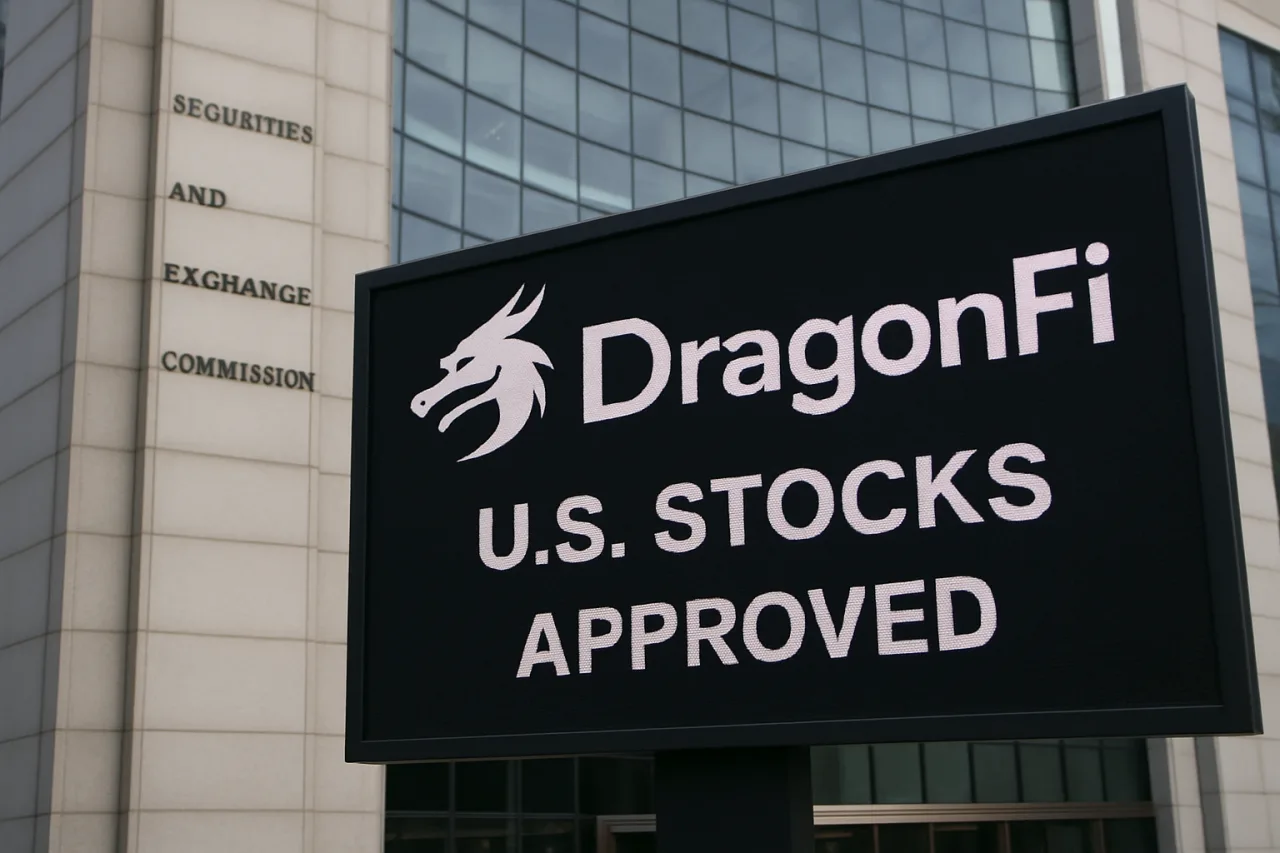
THE BOARD — Friday, October 2, 2026 → The Flex Ledger, Local Money Gets a Global Door: While the GCash IPO consumed the market’s attention, a quieter license landed — the SEC granted final approval (September 24) for DragonFi Securities to begin testing under Securities and Exchange Commission StratBox, the regulator’s strategic sandbox: the first Philippine broker cleared to trial US equities and ETF access for eligible local investors through an over-the-counter depositary-receipt model. This week DragonFi opened interest registration. This is the reading of what the sandbox actually grants for DragonFi US stocks, what investors should verify before queuing, and how a DragonFi US stocks test window compares with the offshore broker route Filipinos have used for years.
Table of Contents
Key Takeaway
- 🏛️ What’s approved: SEC StratBox final approval for the DragonFi US stocks test (September 24) a product giving eligible Philippine-based investors access to pre-approved US equities and ETFs via an over-the-counter depositary-receipt structure — not direct offshore accounts, and not yet a general launch.
- 🔬 The structure detail that matters: economic rights without direct US-market ownership — the SEC designed the exposure limit around your participation in the PH capital market, a deliberate domestic-first tether that offshore accounts sidestep.
- ⏳ Timeline honesty: no fixed start date or duration was published as of October 2 — the sandbox’s “controlled testing” phase precedes any consumer GA, and the SEC explicitly said results may shape future rules for the whole industry.
- ⚖️ Regulation trade-off: the PH-regulated route brings SEC (not foreign-regulator) protection, peso-side onboarding, and domestic dispute venues — with a narrower product set (pre-approved names only) during the test.
- 🧮 The investor drill: verify eligibility economics, compare the DR fee stack against an offshore account’s full cost, watch the pre-approved list breadth, and read the sandbox’s investor-protection parameters before funding anything.
The DragonFi US stocks test and what the approval says
The regulator’s language matters here, and the SEC’s September 24 announcement as covered by GMA plus the Daily Tribune’s sandbox read agree on the shape: DragonFi received final approval to commence testing under SEC StratBox — the sandboxed regime for innovative financial products — of an offering that lets eligible Philippine-based investors reach pre-approved US stocks and ETFs. The mechanism is an over-the-counter depositary-receipt model: investors gain exposure to the underlying securities without direct ownership and without opening a foreign brokerage account. The SEC framed the outcome explicitly: results of the testing “may help inform the further enhancement” of the SEC’s own regulations — if the test works, this becomes the template for more local brokers, not a DragonFi monopoly.
Two design constraints separate DragonFi US stocks from the offshore norm. First, the pre-approved universe: eligible names only, chosen under the sandbox’s parameters — this is not a 10,000-ticker US market. Second, the domestic tether: the exposure for DragonFi US stocks takes account of the investor’s participation in the Philippine capital market, keeping foreign-equity access linked to local investing — a design choice that protects domestic market liquidity and, practically, means heavy US allocation through this door requires substantial local activity as the base. Neither is a flaw; both are the sandbox’s terms. Reading the parameters before funding is the difference between a participant and a customer who assumed a different product.
How the DR model differs from the offshore account route
Filipino investors who already own US-listed stocks mostly do so through offshore brokers or foreign-registered platforms: direct ownership in the US market, foreign-regulator protection paths, full ticker breadth, USD-side funding, and the tax/custody paperwork that route implies. The DragonFi US stocks test offers the domestic inverse: SEC-regulated onboarding in pesos, local dispute resolution, and the depositary-receipt’s economic exposure without cross-border securities ownership. The comparison that matters for your decision isn’t “which is richer” — it’s the fee-and-protection stack: the DR structure carries issuance/custody charges inside its pricing that direct offshore ownership doesn’t, while offshore accounts carry funding friction (outward remittance limits, dollar funding rails), foreign tax filings, and jurisdiction-based dispute costs. A sandbox test that prices transparently against the offshore route is exactly what the SEC should want the data to show — and what investors should demand before GA.
The PERA pedigree points at the strategic logic: DragonFi previously secured the SEC’s first accreditation as a Personal Equity and Retirement Account administrator — the long-horizon, locally-administered retirement lane. A DR product on PERA rails would let peso-funded retirement capital reach approved US names under Philippine stewardship — a structural answer to the “US growth exposure without abandoning the PH system” question raised in this site’s OFW PERA coverage.
The DragonFi US stocks verification drill: five checks before this door gets your money
Check 1 — Eligibility economics. Sandbox products often stage by investor class: minimums (DragonFi’s current PH platform runs a ₱25,000 initial-deposit tier comparable to the digital-bank onboarding tiers), net-worth or knowledge attestations, and the domestic-participation sizing rule. Verify your own class before queues, not after funding. Check 2 — The pre-approved list breadth (and rebalance truth). Ask: how many names, which sectors, how often does the list change — a 30-ticker concentrated list behaves nothing like a 500-name broad list; rebalancing a concentrated DR book creates the concentration risk the offshore route’s breadth avoids. Check 3 — The full fee map. DRs carry issuance and custody economics — get the trading fee, FX conversion spread, custody/DR charges, and any exit friction in one table before comparing an offshore account’s total cost. Check 4 — Protection mapping. Confirm the sandbox’s investor-protection parameters: dispute venue, custody segregation of underlying shares, what happens if the test ends (winding-up rule). Sandbox ≠ lighter protection; it’s different protection on a new product. Check 5 — The timeline discipline. As of October 2, the SEC did not publish when testing starts or ends. Treat “register your interest” as information, not a commitment; funds that enter before parameters are public are the ones that learn the terms the hard way.
The DragonFi US stocks watch dates and the industry door this opens
Circle the three DragonFi US stocks watch items. One, the testing start and participant window: when DragonFi’s sandbox testing officially begins and what cohort sizes the SEC allows — registration interest now — the participant terms are the real document, the same lesson the Anthropic IPO window coverage drew about reading terms before windows. Two, the pre-approved list publication: the names list is the product’s real shape; breadth and turnover of that list tell you whether this is a token gesture or a genuine door. Three, the SEC’s rule-makings after the test: the announcement’s language — results informing “further enhancement” of regulations — means the endpoint isn’t one broker’s product; it’s a potential industry template (other brokers, fund wraps, maybe EIP/PERA integration). For the peso-based investor who has priced offshore friction for years, the sandbox week is the first credible sign the onshore door is being drafted. Watch it without funding it blind.
The Sandbox Playbook: How StratBox Testing Usually Unfolds
Sandbox regimes worldwide (from the Monetary Authority of Singapore’s pioneering framework to the BSP’s own circular-driven sandboxes) share a testing arc worth knowing before you calibrate expectations. The parameters phase comes first: the regulator and the participant agree on caps — exposure limits per investor, cohort size, eligible product universe, reporting cadence. The controlled pilot follows: real customers in restricted numbers or restricted product breadth, with the regulator watching unit economics AND conduct data (complaints, confusion points, dispute outcomes). The readout is the third phase: the commission publishes or applies what it learned — a rule enhancement, a wider sandbox cohort, a standard-license pathway, or a shutdown. Philippine precedent suggests the timelines are measured in quarters, not weeks: the BSP’s own sandbox-era digital-bank authorizations moved through announcement to consumer operations across multiple quarters. The investor translation is sober: the DragonFi US stocks test this month is a parameters-phase event; consumer trading availability, if the test succeeds, sits at the far end of the pilot arc — and the registration page’s interest form is the front door to a queue, not a trading account.
There’s a second-order effect investors should pre-own: the peso-channel competition. If the DR route prices transparently against offshore accounts, the immediate beneficiary may be the offshore brokers’ PH-funding friction shrinking — competition in the corridor usually compresses the spread somewhere. The rational posture during the test window: run your actual numbers on BOTH routes once DragonFi publishes its fee map, and let total-cost-of-ownership decide — not brand nationality, not app polish, not launch-week enthusiasm. The sandbox’s entire purpose is to produce exactly that comparison data; an investor who uses it that way converts a regulatory circus into a personal pricing win.
The behavioral layer deserves its own ledger line, because sandbox launches breed their own mistakes. The first is queue-as-FOMO: registration-interest forms converting into implied scarcity (“limited slots”) that were never announced — read the forms themselves, not the screenshots circulating in group chats. The second is list-chasing: buying whatever single name anchors a pre-approved list instead of sizing exposure to the whole approved universe — concentration through narrow menus is a product design, not a market opportunity. The third is fee amnesia at conversion: DR economics include peso-dollar conversion spreads applied at trade time; the investor who compares headline fees but ignores the conversion spread measured the wrong number. And the fourth is sunset misunderstanding: a test program can conclude with a wind-down (the sandbox’s terms exist precisely so that outcome is orderly) — knowing the exit rule before funding is the difference between a contained experiment and a personal problem. None of these are warnings against the product; they’re the reading conditions the SEC’s controlled-environment assumes its participants meet.
Frequently Asked Questions
Can Filipino investors buy US stocks through DragonFi now?
Not yet in general release. As of October 2, DragonFi holds SEC StratBox final approval (September 24) to TEST pre-approved US equities and ETFs via an OTC depositary-receipt model for eligible investors; no start date, participant window, or duration was published. Registration interest is open; funding waits for published parameters.
What is the SEC StratBox?
The SEC’s strategic regulatory sandbox: a controlled environment where innovative financial products test under defined parameters and oversight, with results potentially informing future regulation. DragonFi is the first Philippine broker-dealer cleared to test global-equities access through it.
How does the depositary-receipt model work?
You buy OTR depositary receipts that convey economic rights to underlying US-listed stocks or ETFs without direct ownership in the US market — priced in pesos through a local-regulated broker, with exposure sized against your Philippine capital-market participation per the sandbox terms.
Will DragonFi’s US stock access be cheaper than offshore brokers?
Unknowable until the fee map is published. DRs carry issuance/custody economics that direct offshore ownership avoids, while offshore accounts carry remittance friction, foreign tax/custody paperwork, and dispute jurisdiction costs the DR route avoids. Judge on the total stack when the test’s pricing goes public — that’s what the sandbox exists to reveal.
Is my money safe in a sandbox product?
Sandbox participation means SEC oversight and defined investor-protection parameters — not reduced protection, but new-product risk: the product is new, the approved name list is finite, and exit/winding-up terms of a test program differ from an established service. Verify the protection parameters in the participant terms before funding.
Does this connect to PERA retirement accounts?
DragonFi was the SEC’s first accredited PERA administrator; the DR test and the PERA credential point at the same strategy — peso-funded, Philippines-administered long-horizon investing that can include approved foreign exposure. Concrete PERA-DR integration hasn’t been announced; treat it as a watch item, not a promise.
Financial Disclaimer
This article is market-structure analysis, not investment advice or a solicitation for any specific broker or product. The DragonFi StratBox test is a regulated trial whose terms, eligibility, fees, and timelines were not fully published as of October 2, 2026; verify all parameters from the SEC and DragonFi directly before any funding decision. Securities mentioned are illustrative of categories, not recommendations. Affiliate relationships are disclosed on this site’s disclaimer page. The editor holds no position in DragonFi or any broker named.