THE BOARD — Friday, October 2, 2026 → Prompt of the Day #013, Friday = Learning: This week handed Filipinos two real prospectuses worth reading — GCash’s Mynt IPO documents (final price ₱6.60, offer days October 6–12) and the Anthropic S-1 filing review that showed a $4.6B-revenue company carrying a $42B net-loss headline. Most readers will get both from headlines alone. Today’s pack fixes that: the S-1 Reading Club — six copy-paste prompts that turn any prospectus or SEC filing into a 10-minute decision brief, with a worked example on the Mynt numbers you’re already deciding about.
Table of Contents
Key Takeaway
- 📚 The skill: read filings like an underwriter, not a fan. Six prompts — Fact Harvest, Business Model Interrogation, Risk-Factor Ranking, Numbers Cross-Check, Red-Flag Hunt, Decision Brief — each copy-paste ready with [BRACKETED] placeholders only.
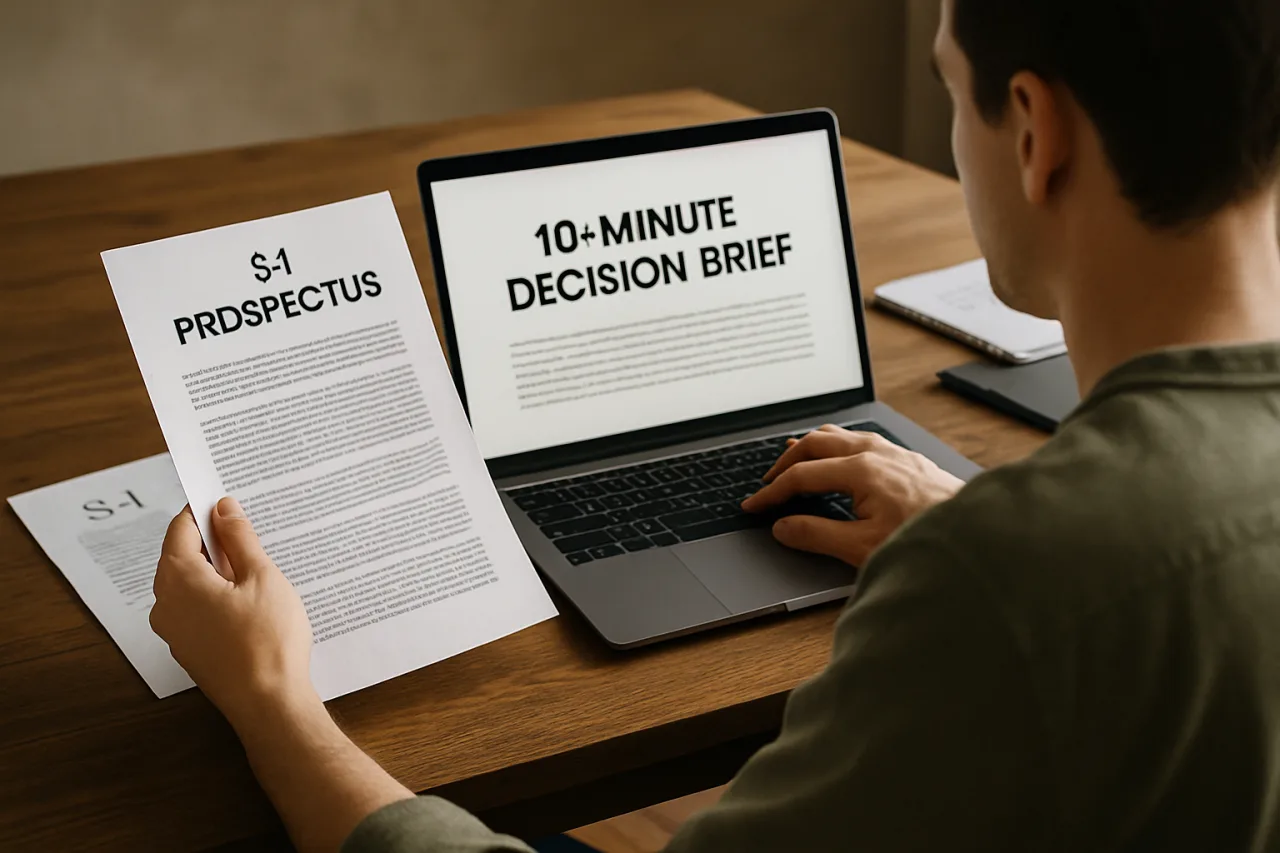
- ⚡ The workflow: 10 minutes, three prompts, one page of output. You don’t need all six every time — the 10-minute version uses Fact Harvest → Risk-Factor Ranking → Decision Brief.
- 🧾 Worked example inside: the pack runs against real 2026 numbers — the Mynt/GCash offer (₱6.60 print, ₱53B base, ~68.8% cornerstone absorption) and the Anthropic S-1 filing figures this site decoded (WIW #008: $4.6B revenue, $8B operating loss, $42B writedown story, $518B compute plans), so you see the output shape before running it on your own target.
- 🛡️ Honesty boundary: an LLM reads fast but can confabulate — every prompt below forces the model to quote the filing verbatim and flag anything it can’t find, which is what makes the output checkable.
- 🔗 Why now: offer-period week is subscription-decision week — these prompts run on the Mynt prospectus today, the Anthropic S-1 when it publicly amends, and any PSE or SEC filing you ever touch after.
Why the S-1 Reading Club Prompt-Pack Beats Headlines for Filings
A prospectus is a structured dump of obligations: an issuer legally required to disclose everything material — growth, losses, dependencies, risks — in a specific order. Headlines compress it into one number (the price!). But the decision-relevant content lives in the structure: the use-of-proceeds section tells you what the money is for; the risk factors tell you what management is legally afraid of; the dilution section tells you what your slice becomes. An AI reading a filing well is better than an AI summarizing it — because the model can extract and cross-reference at length, and the six prompts below direct that muscle. The teach-by-artifact standard applies: copy the blocks, swap the [BRACKETS], paste your PDF link or text — and the worked example shows the exact output shape on real, current numbers.
One boundary before the S-1 Reading Club pack: the S-1 Reading Club pack works with a capable long-context model (a Frontier-class chat model with file or URL input — Claude, ChatGPT, Gemini, or Grok all qualify in their 2026 releases; pricing per this week’s token map runs from Luna’s $0.10/$0.50 to Opus 5.5’s $4/$20 — or free in the consumer apps). And a rule that outranks the pack: the model’s brief is a first draft of understanding, not investment advice — verify verdict-number quotes against the PDF before money moves.
The S-1 Reading Club Copy-Paste Pack: Six Prompts, In Order
Prompt 1 — The Fact Harvest (2 minutes; the structured skeleton)
You are a securities analyst. I will give you a prospectus or regulatory filing for [COMPANY].

Extract ONLY verifiable facts, in this exact structure:
1. Offering basics: price, structure (primary/secondary/greenshoe), size.
2. Business model in 2 sentences — how the company actually earns.
3. Five financial anchors with the exact figures AND page/section quotes:
   revenue (latest FY + latest interim), operating profit/loss, net loss,
   cash position, planned use of proceeds.
4. Customer/supplier concentration: any client or vendor over 10% of revenue or costs.
5. Any figure the filing describes with qualifiers ("approximately", "at least").

Rules: Quote the filing verbatim for every number. If a figure is absent, write
"NOT FOUND IN DOCUMENT" — do not estimate. No interpretation, no advice.

Document: [PASTE TEXT OR FILE]
Prompt 2 — The Business Model Interrogation (2 minutes; the “how does it earn” pass)
Using the same filing for [COMPANY], answer as a skeptical investor:

1. What must stay true for revenue to double again? List the 3 hard dependencies
   (users, partners, contracts, regulations) the filing itself names or implies.
2. Where does the money GO — rank the top cost items the filing discloses,
   with figures.
3. Who are the two most disclosed-related parties (founders, parent companies,
   big clients) and what do they control?
4. In ONE sentence: what is the single assumption whose failure breaks the model?

Quote verbatim for every claim. Mark anything you infer with [INFERENCE].
Prompt 3 — The Risk-Factor Ranking (2 minutes; the priority filter)
From the same filing for [COMPANY]:

1. List every risk factor the filing discloses. Then rank the top 5 by:
   (a) the filing's own emphasis (position, repetition, cross-references),
   (b) materiality to the business model from Prompt 2.
2. For each top-5 risk: quote the filing's exact language, then translate it
   into one plain sentence an ordinary retail subscriber understands.
3. Flag any risk the filing downplays that a 2026 reader would reasonably
   consider material — mark these [MY VIEW].

Output as a ranked table: RISK | QUOTE | PLAIN TRANSLATION | [MY VIEW].
Prompt 4 — The Numbers Cross-Check (2 minutes; the consistency audit)
Audit the filing for [COMPANY] for internal mathematical consistency:

1. Does revenue growth match the stated growth drivers?
2. Do the use-of-proceeds allocations sum to the stated total? Show the math.
3. Does the stated dilution match the share-count changes in the cap table?
4. Are there figures that contradict each other anywhere in the document?
5. Convert the stated valuation/benchmark into comparable multiples the
   filing permits (e.g., price-to-revenue against the disclosed figures).

Show every calculation step-by-step. If numbers don't reconcile,
say exactly where and quote both sides.
Prompt 5 — The Red-Flag Hunt (1 minute; the honest-skeptic pass)
Act as a forensic accountant reviewing the filing for [COMPANY].

Hunt ONLY for these patterns and quote each instance verbatim:
1. Unusual writedowns or one-time items that flatter the operating numbers.
2. Related-party transactions that move money between insiders and the company.
3. Aggressive revenue-recognition language ("annualized", "run-rate",
   "contracted backlog" without breakdowns).
4. Regulatory or legal proceedings with potential material cost.
5. Changed-in-recent-period accounting policies.

For each hit: VERBATIM QUOTE + why a conservative investor would care.
If none found, say "NO PATTERNS FOUND" per category.
Prompt 6 — The Decision Brief (1 minute; the output the other five fed)
Based on everything extracted above from the [COMPANY] filing — and ONLY that
material — produce a one-page decision brief:

DECISION CONTEXT: [e.g., "subscribe to the IPO offer Oct 6-12" /
"buy after listing" / "monitor"]
THESIS (3 sentences max): the bull case as the filing supports it.
COUNTER-THESIS (3 sentences): the bear case as the filing supports it.
THE 3 NUMBERS TO WATCH POST-LISTING: each with the exact filing figure.
WHAT WOULD CHANGE MY MIND: 2 specific disclosure events (a filing type,
a deadline, a metric threshold).
CONFIDENCE LIMITS: list what an ordinary investor CANNOT verify from this
filing alone.

No recommendations. No prices. No external data. Filing-derived content only.
The S-1 Reading Club Worked Example: Six Minutes on the Mynt Numbers
To show the S-1 Reading Club’s output shape, here’s a compressed run using the week’s verified public figures (as reported — PSE Watch #008’s OFP-day ledger: the sourced ₱6.60 print, the Inquirer’s confirmation, the PSE prospectus timetable; your own run should use the official PDF from PSE Edge):
Prompt 1 output (Fact Harvest), compressed: Offering basics — price ₱6.60/share (reported Oct 1 print, 34% under the ₱10 ceiling); structure: up to 8.03B primary + secondary shares plus 1.2B greenshoe; base ~₱53B, ~₱60.9B with full greenshoe. Financial anchors — proceeds allocation per prospectus (~₱14.95B net primary proceeds to digital financial services growth, product development, general corporate purposes per SEC-approved filing coverage). Concentration — cornerstone program covering 20+ institutional investors absorbing ~68.8% of the offer (BlackRock-led with FIL, Capital Group, Schroders, Citadel, T. Rowe, IFC; domestic: ATRAM, BPI AMC, China Bank Capital per Reuters). NOT FOUND IN DOCUMENT (from news coverage alone): audited latest-FY statements, full risk-factor text — a deliberate lesson: news summaries ≠ the filing, which is exactly why the prompts exist.
Prompt 3 output (Risk Ranking), compressed to the top 3: [1] Partial allocation mechanics — the cornerstones pre-absorb most of the book; retail oversubscription gets scaled (the filing’s own LSI/allocation terms govern; plain translation: “your ₱66,000 application is a ceiling, not a fill”). [2] Post-listing float dynamics — the cornerstone lock-ups mean listing-day liquidity is structurally thin (translation: the price on Oct 20 is set by a small float against big demand, and days 1-30 can swing on unlock calendars). [3] Valuation anchor risk — the ₱441B/~$7B repriced valuation against 2026 earnings is the number the market will test in week one (translation: “the IPO price is a negotiated compromise, and week-one trading is the referendum”).
Prompt 6 output (Decision Brief), the shape to expect: Decision context — subscribe Oct 6–12 or wait-list (the family-decision layer lives in POTD #012’s IPO council prompts). Thesis — dominant payment rail, priced 34% under ceiling, institutions pre-committed at 68.8%, retail minimum ₱6,600. Counter-thesis — week-one liquidity is float-thin, the price cleared lower than the ceiling the company set, and the two-cornerstone-structure lock-ups create unlock dates nobody can price yet. The 3 numbers to watch — subscription oversubscription count (Oct 6-12 filings), day-one PSEi correlation, first unlock date. What would change my mind — a revised timetable notice, or a greenshoe exercise announcement. Confidence limits — actual audited financials, the full risk-factor text, cornerstone lock-up durations: all read from the real prospectus, not from this worked example.
Run the S-1 Reading Club prompts against the Anthropic S-1 filing review material and the output writes itself differently: Fact Harvest pulls $4.6B revenue / >$8B operating loss / $42B net loss “mostly writedowns tied to previous fundraising” / $20.28B cash / $518B planned compute spend; Red-Flag Hunt pounces on exactly that writedown-vs-operating gap (this week’s WIW #008 did that work). Same pack, opposite conclusions — which is the point: the tool is neutral; the filing isn’t.
The S-1 Reading Club Discipline Rules That Keep the Pack Honest
- Verbatim-or-void: every prompt forces quotes; a model claim without a quote is treated as fiction. This is the single rule that separates a reading tool from a confabulation machine.
- Filing-only inputs: prompts 1–6 exclude external data by design. Market color (news, analyst takes) enters after the brief — never inside it. Mixing them is how confirmation bias gets automated.
- The 10-minute version: time-pressed? Run prompts 1, 3, and 6 only — harvest the facts, rank the risks, get the brief. Prompts 2, 4, 5 are the deep-read layer for tickets above ₱50,000 or filings you’ll discuss professionally.
- Verify verdict numbers: before any money moves, the 3 numbers in your Decision Brief get checked against the official PDF (PSE Edge for PH listings; SEC EDGAR when the Anthropic S-1 amends publicly). The pack reads; you ratify.
Financial Disclaimer
This article provides prompt templates for reading public filings — it is not investment advice, not legal advice, and not a recommendation regarding any security. AI-derived briefs are first drafts of understanding: every figure must be verified against the official filing before any financial decision. Figures cited are from published reporting as of October 2, 2026. The editor holds no positions in the securities named.
Frequently Asked Questions
Do I need to pay for an AI to run the S-1 Reading Club pack?
No — any current frontier-class chat model with file/URL input runs it: Claude, ChatGPT, Gemini or Grok in their free consumer tiers all handle a prospectus PDF; API pricing (if you build this into your own workflow) runs from Luna’s $0.10/$0.50 to Opus 5.5’s $4/$20 per 1M tokens per this week’s token map. The pack is model-agnostic by design.
Which filing should a beginner run the pack on first?
The Mynt/GCash prospectus — it’s timely (offer period October 6–12, 2026), consequential, and downloadable from PSE Edge. The worked example above shows the expected output on its real numbers. Graduation level: the Anthropic S-1 when it publicly amends, then any 10-K or annual report you actually rely on.
Can the AI be wrong when reading a prospectus?
Yes — models can misquote, miss figures, or hallucinate sections. That’s why every prompt forces verbatim quotes and “NOT FOUND IN DOCUMENT” honesty, and why the Decision Brief ends with confidence limits. Treat every number as unverified until you match it to the PDF page yourself.
What’s the fastest version for a 10-minute decision?
Prompt 1 (Fact Harvest) → Prompt 3 (Risk-Factor Ranking) → Prompt 6 (Decision Brief): roughly ten minutes including PDF upload. Skip 2/4/5 for small tickets; never skip the verbatim rules.
Does this replace reading the prospectus myself?
For ticket decisions it doesn’t have to — think of the pack as the difference between reading with a checklist and reading blind. For ₱50,000+ subscriptions, professional involvement, or anything you discuss publicly, run all six prompts and read the source sections yourself. The pack makes you faster; it doesn’t make you exempt.
Can I use this pack for non-IPO filings?
Yes — annual reports, 10-Ks, SEC Form 17-A, even a cooperative’s audited financials work with the same structure. Replace [COMPANY] and the decision context in Prompt 6; everything else transfers.