Table of Contents
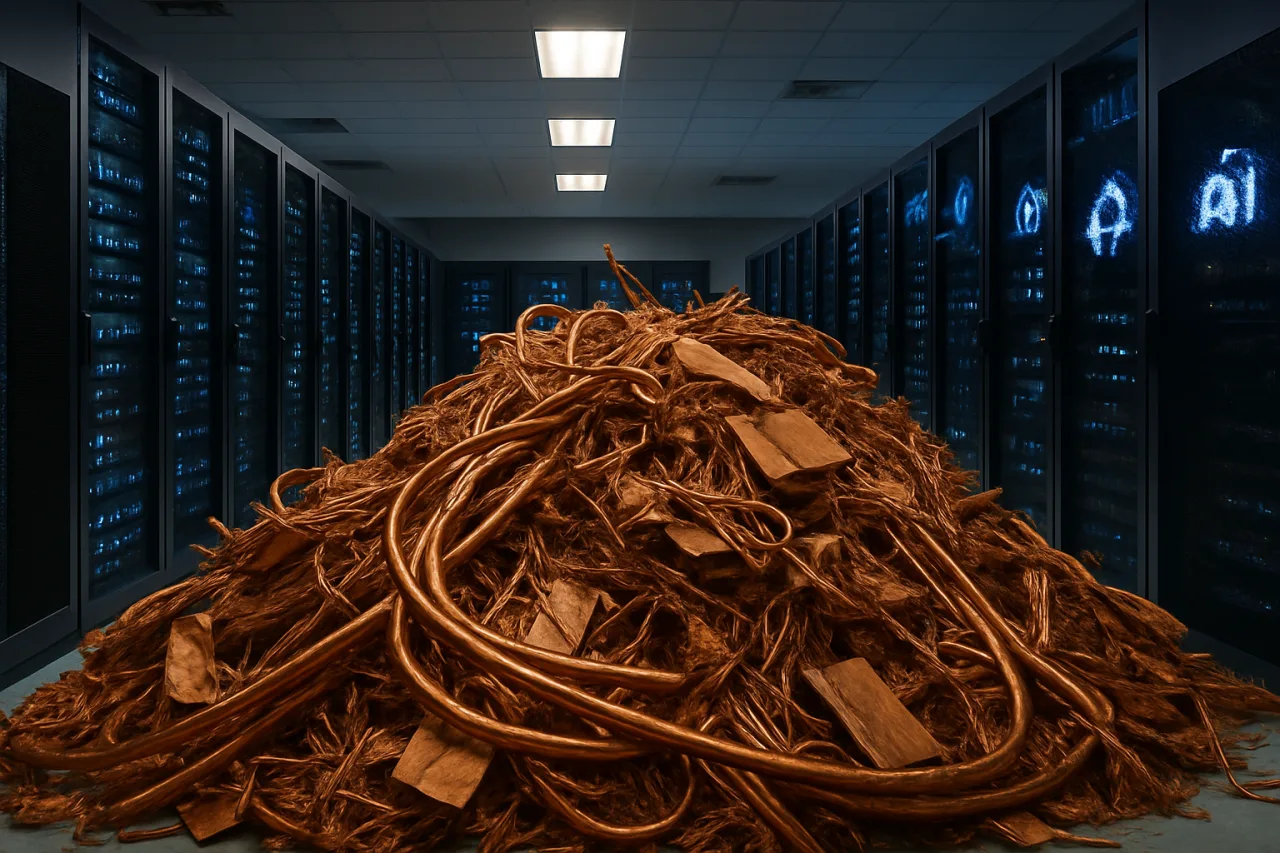
Copper data centers — the phrase sounds like a materials error, but the copper is real and so is the shortage: a single AI facility carries 30 to 40 metric tons of copper per megawatt of capacity, and the S&P Global Commodity Insights analysis puts data-center copper demand on a path from 1.1 million metric tons in 2025 to roughly 2.5 million by 2040 — with AI training centers eating 58% of all data-center copper by 2030. The metal that powers AI is now a capacity constraint with a decade-long supply gap for the AI buildout, and this guide measures the problem honestly: where the copper actually goes, why supply cannot keep pace, what the substitution options are really worth, and what operators and buyers should do while the metal is still available.
The analysis below leans on named studies — the S&P Global copper outlook, CIBC’s asset-management research, the IEA’s 2026-2035 mined-supply outlook and a skeptical Reuters counter-view — so the reader sees the case and the counter-case for copper data centers, not a bull thesis. — S&P Global’s copper outlook, CIBC’s asset-management research, the IEA’s 2026-2035 mined-supply chart and a skeptical Reuters counter-view — so the reader sees the case and the counter-case, not a bull thesis.
Key Takeaway
- ⚡ The numbers are the story: copper data centers need 30-40 metric tons of copper per megawatt, and data-center copper demand doubles from 1.1Mt (2025) to about 2.5Mt by 2040 (S&P Global Commodity Insights).
- 🚨 Supply is the constraint: a projected deficit up to 10 million metric tons by 2040; CIBC’s research puts supply trailing demand by ~9% on average through 2040 — the gap lands “in full view by 2030”.
- 🔌 AI training dominates: AI training data centers account for 58% of all data-center copper demand by 2030 — the buildout is not a broad commodity story; it is an AI-concentrated one.
- 🔁 Substitution is real but bounded: aluminum replaces copper in busbars where amps allow; fiber cuts interconnect copper by only 4-5 tons per megawatt against a 30-40 t/MW total — both blunt, neither solves.
- 🇵🇭 Where this lands for the Philippines: copper data centers across the region’s corridor buildouts pull (our SEA infrastructure scoreboard) pulls copper through regional supply chains — and Filipino metallurgy, electrical engineering and logistics professionals sit on the hiring side of that pull.
Where the copper actually goes in copper data centers
The shorthand “copper data centers” compresses thousands of kilograms of metal into four physical jobs. Power delivery first: busbars (the fat copper rails that carry hundreds of amps through switchgear and distribution), transformer windings, grounding grids and the cabling between gear — the S&P analysis ties roughly 60% of facility copper to power systems. Cooling second: pumps, heat exchangers, chillers and the liquid loops that our water and cooling analysis covers all carry copper in coils and piping. Connectivity third: Ethernet cable, transceiver internals and the short-reach copper interconnects (DACs, AECs) inside racks — NVIDIA’s own guidance to the market: “we should stay with copper for as long as we can,” because copper beats optics on cost, latency and power at rack scale. Construction fourth: structural mesh, piping and the ground systems that a hyperscale build uses by the kilometer.
The crypto comparison puts AI’s intensity in scale: a crypto facility uses about 21 metric tons per megawatt; copper data centers built for AI training concentrate 30-40 t/MW — and S&P expects copper demand from AI training facilities to reach 58% of all data-center copper demand by 2030. The metal is not decorative; it is the physical bus under every rack.
The demand math behind copper data centers: from 1.1Mt to 2.5Mt
| Metric | Value | Source and date |
|---|---|---|
| Data-center copper demand, 2025 | ~1.1 million metric tons | S&P Global Commodity Insights |
| Data-center copper demand, 2040 | ~2.5 million metric tons (range 1.7-2.7Mt) | S&P Global Commodity Insights |
| AI-training share of data-center copper by 2030 | 58% | S&P Global Commodity Insights |
| Global copper supply deficit by 2040 (all drivers) | up to 10 million metric tons | S&P Global (“systemic risk” language) |
| Average supply shortfall vs demand through 2040 | ~9% per year | CIBC Global Asset Management (Dec 2025 research) |
| Global demand growth | +50% vs current levels | S&P Global |
| AI/data-center + defense incremental demand | ~4 million metric tons combined | S&P Global |
Read the table as a stacking problem, not a single cause: copper data centers expand alongside grid upgrades, EVs, renewables and defense — every driver scales at once, and the S&P statement behind the “systemic risk” warning is exactly that — “economic demand, grid expansion, renewable generation, AI computation, digital industries, electric vehicles, and defense are scaling all at once, and supply is not on track to keep pace.” The power pipeline analysis covers the electricity side; copper is its physical shadow, and both move the same direction.
Why supply cannot keep pace
Mining arithmetic is brutal and slow, and it sets the pace copper data centers cannot dictate. New copper mines take a decade or longer from discovery to production; grades on existing ore bodies decline; and the industry’s installed smelting capacity already runs tighter than concentrate supply (the IEA’s 2026-2035 mined-supply outlook shows demand outpacing mined output in nearly every year of the window). CIBC’s December 2025 research adds the pricing consequence: with supply trailing demand by about 9% on average through 2040, prices stay “elevated well into the future,” and the copper balance reaches a visible deficit by 2030 — pulled forward by the same AI data center buildouts that created the demand.
One honest counterweight: Reuters’ markets commentary argues the AI buildout may not boost copper demand as bulls expect — new copper data centers are designed to minimize copper through fiber backbones and aluminum busbars, and efficiency gains (the same ones our HBM shortage and water-wall coverage track) cut intensity per megawatt. Both things are true: intensity per megawatt falls while total demand doubles — the AI buildout grows faster than the efficiency gain.
Substitution: aluminum, fiber and better design — what each is really worth
| Substitute or lever | Real effect | Verdict |
|---|---|---|
| Aluminum busbars | Second-order beneficiary of the deficit (CIBC); works where ampacity and joint engineering allow | Blunts new busbar demand; adds engineering cost and joint-maintenance discipline |
| Optical fiber for interconnect | Cuts copper intensity by 4-5 t/MW per S&P — against a 30-40 t/MW total | Meaningful but small relative to power and cooling copper; the rack still runs on copper |
| Efficiency (better chips, CPO-class optics) | Reduces transceiver and interconnect copper per device | Intensity lever, not a volume solve at the facility level |
| Recycling and scrap | Secondary supply grows but lags the doubling demand | Supportive; cannot close a multi-million-ton structural gap this decade |
The substitution ledger is why the supply story for copper data centers holds: everything that replaces copper replaces a slice of it. Aluminum takes the busbar where voltage drop and joints allow; fiber takes the long-distance links; chips and better architectures shave intensity. The 30-40 t/MW facility total is the number no substitution fully reaches, which is why the shortfall language survives both bulls and skeptics.
The 2030 squeeze: what operators and buyers actually do
Operators: copper data centers procure early and contract on price-escalation clauses — a 2030-visible deficit means copper-heavy scope (busbars, grounding, cooling loops) gets financed years ahead; design for substitution where the electrical code and reliability math allow; and track the water-cooling crossover, because liquid loops shift some copper into different equipment classes. Builders and buyers: the metal’s cost curve flows into colocation pricing and power-adjacent capex — the same constraint chain that pushes the world’s sovereign AI programs to co-locate compute with generation, because copper is one of the physical reasons compute follows power now.
The investor lens, stated carefully: CIBC frames copper as a long-duration thematic with the same demand drivers; the Reuters commentary frames the AI boost with skepticism. Both agree on the structural fact — supply trails demand through 2040 on every projection shown here. The difference is the AI-share attribution, and the honest article position is the S&P one: AI training becomes the majority driver of data-center copper by 2030 regardless of how the bulls and bears price it.
WorldNgayon Insight: the metal under the intelligence
What changed: copper moved from a construction line item to a named capacity constraint — with “systemic risk” language in an S&P Global report and per-megawatt intensity math attached to AI specifically. Why now: the 2025-2026 training-campus wave concentrated demand (58% AI-training share by 2030) while mine supply ran a decade behind. Why it lasts beyond the news cycle: the deficit projections run to 2040 with named update triggers — IEA annual supply-demand charts, S&P deficit revisions, and every hyperscaler power-contract announcement that adds megawatts to the pipeline. Who is affected: data-center operators and colos, electrical contractors, cable and busbar makers, mining regions — and every professional market whose wages ride infrastructure employment. What to do next: if you build or buy data-center capacity, treat copper lead-times like GPU lead-times; the copper data centers of 2027 are being wired now.. Risks, opportunities, costs, skills: the risk is 2030-2031 procurement squeeze; the opportunity is substitution engineering; the cost shows up in colocation rates; the skills gap sits in metallurgy, electrical engineering and logistics — exactly the trades our AI-proof careers analysis covers. Connection to work and money: the metal under AI is a jobs story as much as a commodity one — the same buildout that doubles copper demand hires welders, wiremen, metallurgists and planners on the countries that supply it.
For Filipino and global readers: the region’s copper lane
The Philippines sits on both sides of this trade. On the supply side, the country’s long-running copper mining industry (large operations in Cebu, Bulacan, Davao del Norte and Benguet, alongside smaller players) feeds global concentrate markets, and a world bid for refined copper keeps existing mines and exploration programs economically interesting; the demand the S&P projections describe is a reason exploration licensing and mine-life extensions matter. On the demand side, the copper data centers rising across the Philippines and Southeast Asia — tracked in our SEA scoreboard and the regional water-power work — import and install the busbars, cable, cooling equipment and switchgear, which converts copper demand into electrical, metals and logistics jobs. For OFW engineers and technicians in data-center, energy and construction roles worldwide, the demand line doubles as a hiring map: wherever copper flows into copper data centers, the crews and engineers who install and maintain it live. The metal is the constraint; the skills are the opportunity.
How much copper do copper data centers use?
The industry benchmark range is 30-40 metric tons per megawatt of capacity for non-crypto data centers (S&P Global, drawing on 2025 studies), with crypto facilities in the 21 t/MW class as the lower benchmark. A 100-megawatt AI campus therefore embeds several thousand tons of copper across power systems, cooling, grounding and connectivity.
Why do copper data centers need so much copper?
Three reasons stack: hyperscale power distribution runs on copper busbars and switchgear at every level from the grid interface to the rack, cooling systems (chillers, heat exchangers and liquid loops) are copper-intensive, and in-rack interconnects stay copper because copper beats fiber on cost, latency and power for short reaches — NVIDIA’s own guidance is to stay with copper “for as long as we can”.
Is there a copper shortage coming in 2026?
The projections describe a widening structural gap rather than a sudden 2026 event: CIBC’s research puts supply trailing demand by about 9% on average through 2040, S&P’s outlook allows a deficit up to 10 million metric tons by 2040, and both date the visible deficit near 2030 — with AI and data-center demand adding roughly 4 million tons alongside defense as incremental pull.
What is the S&P Global copper warning in plain language?
S&P Global Commodity Insights projects that global copper demand grows about 50% while supply is “not on track to keep pace,” calling the shortfall a systemic risk for industries and growth. For data centers specifically, AI training facilities take 58% of data-center copper demand by 2030 and total data-center copper roughly doubles to about 2.5 million metric tons by 2040.
Can aluminum replace copper in data centers?
Partially. Aluminum serves high-amperage busbar runs where joint engineering and maintenance discipline allow, and it is a named second-order beneficiary in CIBC’s research; but aluminum’s conductivity and joint reliability limits keep copper dominant in switchgear, transformers, grounding and dense connectors — and in a deficit market, substitution raises engineering cost and complexity rather than making copper disappear.
Does fiber optics reduce copper demand?
Some, and the number is bounded: S&P estimates the shift from copper to fiber in interconnects could reduce data-center copper intensity by 4-5 metric tons per megawatt — meaningful against rack interconnect demand, small relative to the 30-40 t/MW total, because power delivery and cooling copper remain structural.
What percentage of copper demand comes from AI?
Within data-center copper — the AI-relevant slice — S&P Global projects AI training data centers to account for about 58% of data-center copper demand by 2030. Across all global copper demand, data centers add up to millions of tons alongside EVs, grid expansion and defense; AI is a fast-growing share of an already stretched market. Note: commodity analysts caution that AI demand estimates are sensitive to buildout pace and design choices (the Reuters counter-view), so treat the AI-share numbers as scenario ranges, not certainties.
What should data center operators do about copper supply?
Lock copper-heavy scope early (busbars, transformers, grounding, cooling loops) with escalation-aware contracts; design for substitution where reliability allows (aluminum busbars, fiber backbones, efficient interconnects); track deficit-trigger updates (IEA charts, S&P revisions, hyperscaler power-contract announcements); and treat copper lead times like accelerator lead times in the build schedule.
Financial Disclaimer
This article is editorial analysis of commodity supply-demand studies, not investment advice, and no price direction or return is promised. Copper demand and deficit figures are from the named studies (S&P Global Commodity Insights, CIBC Asset Management, IEA) as published and dated; scenarios differ by source and the AI-demand share is buildout-sensitive. Metals and mining markets involve substantial risk; verify current data with the named institutions before making any financial decision.
Sources: CIBC Global Asset Management — Copper Crunch (9% supply shortfall, 2030 deficit); IEA — Mined supply and demand outlook for copper 2026-2035 (iea.org chart page, bot-walled here; figures as published). SDxCentral — AI’s appetite for copper poses a systemic risk (the S&P Global findings in full); and the Reuters markets commentary (June 2026) on the copper-bull counter-view (bot-walled here).