Key Takeaway
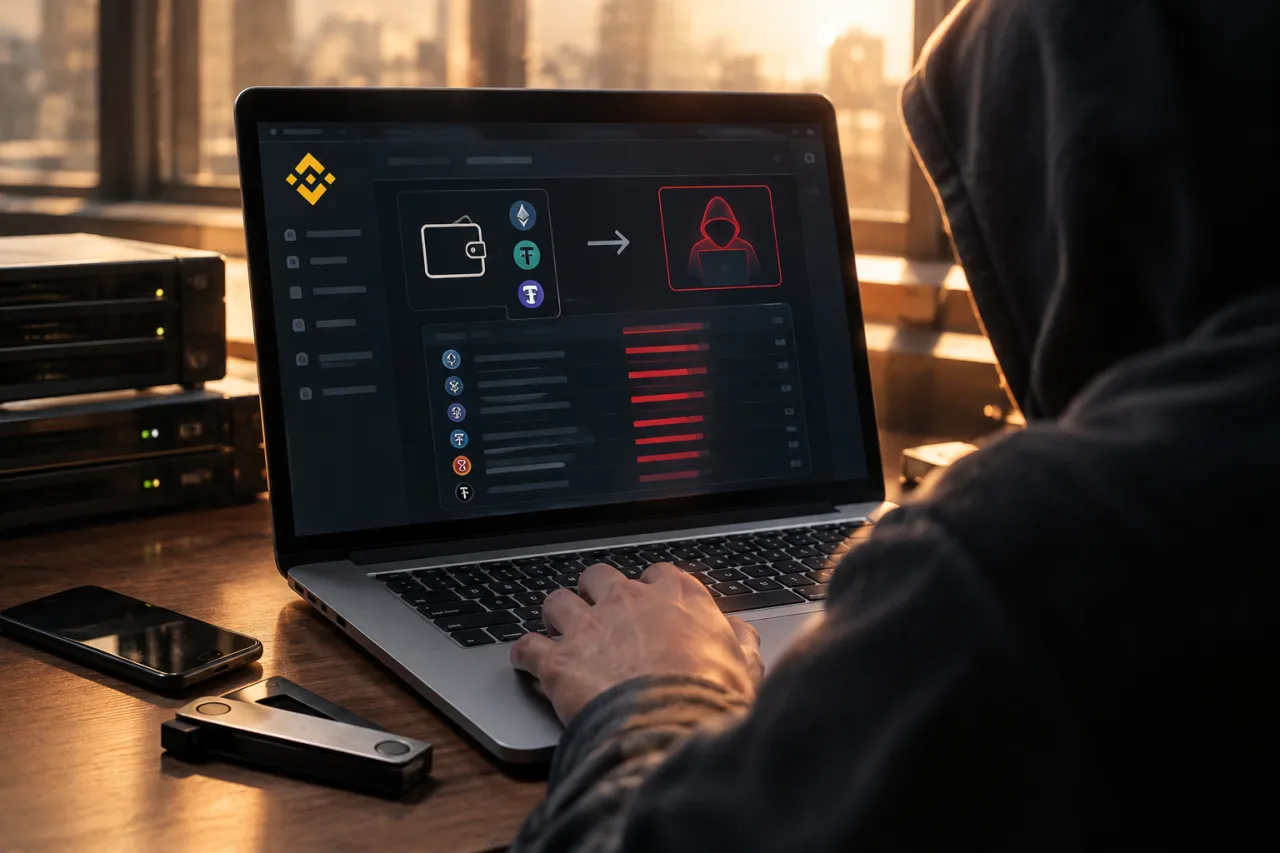
- 🔑 The Binance hack was a signature-system heist, not a password heist: fifty pre-signed authorizations in one transaction turned Binance hot wallets on Ethereum into attacker-controlled sweepers, and 167,464 ETH plus 63 tokens (including 1.615 billion USDT) drained 3 minutes and 24 seconds later.
- 💻 The entry point was a compromised DevOps engineer’s laptop: Binance’s own initial investigation ties the breach to that laptop gaining access to a service container that submitted unauthorized withdrawal transactions — user logins were never the vector.
- 🇰🇵 TRM Labs and Chainalysis attribute the theft with high confidence to TraderTraitor: the North Korean group behind the $1.5 billion Bybit hack — the clincher being stolen Binance funds commingling with last month’s Bitget proceeds, plus Tornado Cash staging.
- 🧊 About $3 billion has been frozen on-chain so far: with “never-seen-before” automated laundering (1-TRX relay wallets, USDT sold to market makers, ETH borrowed on Aave to outrun freezes), the attacker still holds roughly 420,000 ETH and 18,270 BTC.
- 🛡️ Binance says SAFU and company funds cover all losses and deposits remain open: your first-hour job is not panic-withdrawing — it is the nine-step account hardening below, starting with the withdrawal whitelist and ending with the cold-storage ladder.
Table of Contents
Fifty pre-signed authorizations. Three minutes, twenty-four seconds. 167,464 ETH. Those three numbers are the skeleton of the Binance hack, the largest theft in crypto history, and this guide dissects them the way no headline does: how a compromised engineer laptop became access to Binance’s hot-wallet signing system, how the EIP-7702 delegation feature turned a routine withdrawal layer into an attacker-operated sweeper, why the evidence points to North Korea’s TraderTraitor rather than an opportunistic crew, and — the part every account holder should read — the nine hardening steps that matter now, because the next attack on your funds will not ride the exchange’s infrastructure; it will ride yours.
Binance Hack Explained: the October 29 Timeline
The money began leaving Binance hot wallets across multiple blockchains around 4:20 p.m. Eastern on October 29 — funds moving “out of Binance wallets on 10 blockchains, most of it in about 20 minutes,” in TRM Labs’ reconstruction, with a total impact now estimated between $6.3 billion per Binance’s own statement and $6.4 billion per Chainalysis. On Ethereum, the largest single move — one transaction carrying 167,464 ETH and 63 tokens including 1.615 billion in USDT — executed 3 minutes and 24 seconds after the attacker delegated the hot wallet, per TRM Labs’ timeline. The other chains drained through ordinary signed transfers from Binance wallets, which is what told investigators the signing infrastructure itself had been taken. Binance’s incident response followed: deposits and withdrawals suspended, blockchain partners freezing assets — roughly $3 billion on-chain so far — and an announcement that all losses will be covered by the SAFU fund and company reserves.
The Entry Point: a DevOps Laptop, Not a Password
Binance’s own announcement states the hypothesis plainly: the incident “may involve a compromised DevOps engineer’s laptop, which allowed an attacker to gain access to a service container and submit unauthorized withdrawal transactions.” Read that sequence slowly, because each hop widens the blast radius: a single engineer’s endpoint falls first (phishing, stealer malware, or a supply-chain vector — the announcement stays open), that endpoint had credentials into a production service container, and the container had reach into the systems that sign withdrawals. This is the DevOps-triangle problem security teams have warned about for years: the laptop that deploys code to money-moving infrastructure is itself money-adjacent, and treating it as “just an internal workstation” is the misjudgment the attacker banked on. For account holders, the message is a hard one but a clear one: nothing in this chain involved your password, your 2FA, or your device — and that is precisely why the account-hardening playbook below focuses on the levers you do control.
The Signature Machine: How EIP-7702 Turned Hot Wallets Into Sweeper Targets
The Ethereum leg is the technically surprising half of the Binance hack, and it deserves its one paragraph of anatomy. EIP-7702 — shipped in Ethereum’s May 2025 Pectra upgrade — lets an ordinary wallet hand its signing authority to a smart contract it designates. The design intent is account-abstraction UX: recoverable wallets, gas sponsorship, batching. The attacker’s use was straight theft-as-automation: one transaction containing 50 authorizations, each signed by a Binance hot wallet, each pointing the wallet to a sweeper contract that accepts instructions only from the operator. The delegation took the wallets’ signing power away from Binance’s own systems and gave it to machine code the attacker controlled; the 3-minute-24-second sweep was the first instruction it ran. Chainalysis’s on-chain picture agrees — a Tornado Cash-funded operational wallet submitted valid signed authorizations that allowed a Binance hot wallet to run attacker-deployed code, which swept its assets — while the nine other chains’ ordinary transfers point to the same root: the signing system, not the chain technology, was the breach.
Who Did It: TraderTraitor and the Bybit-Bitget Thread
The attribution case stacks three independent signals. First, technique: the staging (pre-theft preparation funded through Tornado Cash) and the operational tempo match earlier TraderTraitor attacks including the Bybit and KelpDAO heists — the group the FBI previously tied to North Korea’s $1.5 billion Bybit theft. Second, the clincher Chainalysis flagged: stolen Binance funds commingling in real time with proceeds from last month’s Bitget exploit, already attributed to North Korean actors — shared infrastructure across crimes is the strongest practical fingerprint there is. Third, the laundering style: thousands of automated transactions cycling funds among addresses in short windows, relay wallets receiving exactly 1 TRX each, USDT sold to market makers, and ETH borrowed against USDT on Aave to outrun issuer freezes — described by Chainalysis as “never-seen-before laundering patterns” executed by tooling, not hands. North Korea has denied prior allegations, but the three-firm convergence (TRM, Chainalysis, and Pangolin Intelligence, per press reports) is as confident as attribution gets in this industry.
The Money Now: Freezes, Laundering, and What SAFU Actually Covers
Three ledgers matter for account holders, and they read in this order. The frozen ledger: roughly $3 billion frozen on-chain by blockchain partners and stablecoin issuers, with Circle and Tether blacklisting addresses within hours. The laundering ledger: the attacker converts what freezes cannot reach, currently holding more than 420,000 ETH and 18,270 BTC — roughly $2.4 billion beyond any issuer’s reach, in Chainalysis’s count. The coverage ledger: Binance states all losses will be covered by the SAFU fund and company funds, deposits remain unaffected and operating normally, and an updated Proof-of-Reserves will publish after remediation. The SAFU guarantee is real and — unlike most exchange promises — this is the fund’s exact designed use case since 2018. What it does not change is the counterparty lesson underneath: your funds on any exchange sit one signing-system breach from this headline, and the guarantee’s reliability is something you verify at deposit time, not after the withdrawal queue freezes.
The Nine Steps That Still Protect Your Funds
- Withdrawal whitelist, always on. Address whitelisting plus a 24-hour hold on new addresses makes your account’s exit doors pre-registered — the exact control that turns “attacker with access” into “attacker with nothing” for user-side takeovers.
- API keys: read-only or scoped-to-death. Trading keys without withdrawal permission; IP-locked where possible; rotated on a schedule. The old 2019 Binance API heist taught this lesson with a 7,000-BTC bill — the Binance hack family has a decade-long record.
- Passkeys or app-based 2FA, never SMS. The SMS 2FA shutdown lane is documented — SIM swaps defeat code-by-text, and the phone number was never a security boundary.
- Anti-phishing code and session sweeps. Turn on Binance’s anti-phishing code (the only legitimate emails carry it), sign out unused sessions monthly, and treat any login redirect from an email link as hostile until you typed the domain yourself.
- The cold-storage ladder. Funds in the post-Binance hack world should not live where trades happen: the hardware-wallet buyer’s shield and the cold-wallet setup guide sequence the migration — and the Coldcard theft case shows why the device matters as much as the decision.
- Counterparty diversification. One exchange holding everything is one signing-system breach holding everything — split across custodians, size each by trust, and check Proof-of-Reserves publishing practice (the updated audit Binance just promised) before you size a position anywhere.
- Withdrawal-queue literacy. Suspension is containment, not collapse: the exchanges that survive heists freeze movement first, and your best action during a freeze is never the panic move out of the queue you cannot exit anyway.
- The hack-news phishing wave — expect it now. Every record breach triggers the secondary wave: fake “compensation claim” portals, fake support reps asking for 2FA codes or wallet seeds, cloned deposit pages. The 10-point fake-website check catches every variant; the compensation stories that arrive by gift card or “verification fee” belong to the gift-card scam family, full stop.
- Remittance realism for the OFW lane. Crypto remittances ride the same exchange rails — if your salary-to-family pipeline touches Binance or any exchange, the same nine steps apply with one addition: keep the fiat off-ramp on a separate account from the trading account, so a frozen queue never strands the family transfer.
Frequently Asked Questions
Was My Binance Account Hacked in This Incident?
Almost certainly not — the Binance hack ran through the exchange’s own signing infrastructure, per the Binance hack findings (a compromised engineer laptop reaching a service container), not through user logins, and Binance states user funds are covered by SAFU and company reserves. The user-side risk this incident creates is the secondary wave: phishing that uses the hack news. Check the account security tab for unknown sessions anyway — the two-minute audit is free reassurance.
What Is EIP-7702 and Why Did the Attacker Use It?
EIP-7702 is the May 2025 Ethereum feature that lets an ordinary wallet delegate its authority to a smart contract. The attacker used it as automation: one transaction with 50 pre-signed authorizations delegated Binance hot wallets to a sweeper contract, which emptied them on the operator’s command 3 minutes and 24 seconds later. The Binance hack did not break Ethereum — it abused the delegation feature once the signing system was already compromised, on Ethereum only because bulk sweeping there was easiest.
Who Stole the Funds in the Binance Hack?
TRM Labs and Chainalysis attribute the theft with high confidence to TraderTraitor, the North Korean state-linked hacking group previously tied to the Bybit and KelpDAO heists — with the decisive evidence being stolen Binance funds commingling with Bitget-exploit proceeds and the documented Tornado Cash staging. North Korea has previously denied such allegations, but three independent firms converged on the same conclusion.
Will Binance Cover the Losses?
Binance has stated all losses from the incident will be covered by the SAFU fund and the company’s own funds, deposits remain unaffected and continue operating normally, and an updated Proof-of-Reserves will publish once remediation completes — the exchange also confirmed it is working with law enforcement. Roughly $3 billion in assets is already frozen on-chain through issuers and blockchain partners, with recovery operations ongoing.
What Should I Do First About My Own Crypto Accounts?
The first-hour order: turn on the withdrawal whitelist, check active sessions and revoke unknowns, upgrade 2FA to an app or passkey, then decide your custody split — what stays on-exchange for trading and what moves to cold storage. Then harden the family’s accounts: the hack-news phishing wave now targeting every Binance user is the attack most likely to reach people you know, and the 10-point website check is the defense that works against it.
Financial Disclaimer
This article provides general security and educational information and does not constitute financial or investment advice. Incident details, recovery claims, and security features change over time; verify against the official Binance announcements, Chainalysis and TRM Labs publications, and your own provider pages before acting. The author and publisher disclaim any liability for actions taken based on this information.
- chainalysis.com/blog/binance-exploit-latest-findings-and-response
- cnbc.com/2026/10/29/circle-tether-freeze-funds-impacted-by-potential-…
- trmlabs.com/resources/blog/north-korea-steals-usd-6-36-billion-from-b… — TRM Labs’ timeline
- reuters.com/legal/transactional/tether-circle-freeze-238-billion-afte… — deposits and withdrawals suspended
- binance.com/en/support/announcement/detail/c5a8729a97ac486d963784d96c… — Binance’s own announcement states the hypothesis plainly
External sources linked in this article, in order of first mention. Spotted an error or a broken link? Tell us.
Cite this pagePublished Oct 30, 2026
Agron, E. (2026, October 30). Binance Hack Explained: the 50-Signature Theft That Emptied the Hot Wallets. WorldNgayon. https://worldngayon.com/binance-hack-explained/
Agron, Edmon. “Binance Hack Explained: the 50-Signature Theft That Emptied the Hot Wallets.” WorldNgayon, 30 Oct. 2026, worldngayon.com/binance-hack-explained/.
Agron, Edmon. “Binance Hack Explained: the 50-Signature Theft That Emptied the Hot Wallets.” WorldNgayon, October 30, 2026. https://worldngayon.com/binance-hack-explained/.
Agron, E. (2026) ‘Binance Hack Explained: the 50-Signature Theft That Emptied the Hot Wallets’, WorldNgayon, 30 October. Available at: https://worldngayon.com/binance-hack-explained/.
E. Agron, “Binance Hack Explained: the 50-Signature Theft That Emptied the Hot Wallets,” WorldNgayon, Oct. 30, 2026. [Online]. Available: https://worldngayon.com/binance-hack-explained/
@online{agron2026binancehack,
  author       = {Agron, Edmon},
  title        = {{Binance Hack Explained: the 50-Signature Theft That Emptied the Hot Wallets}},
  year         = {2026},
  date         = {2026-10-30},
  organization = {WorldNgayon},
  url          = {https://worldngayon.com/binance-hack-explained/},
  urldate      = {}
}TY - ELEC AU - Agron, Edmon TI - Binance Hack Explained: the 50-Signature Theft That Emptied the Hot Wallets T2 - WorldNgayon PY - 2026 DA - 2026/10/30/ UR - https://worldngayon.com/binance-hack-explained/ Y2 - ER -
Cite the version you read; the page may be updated. Zotero and Mendeley can also import this page directly.