
Table of Contents
Key Takeaway
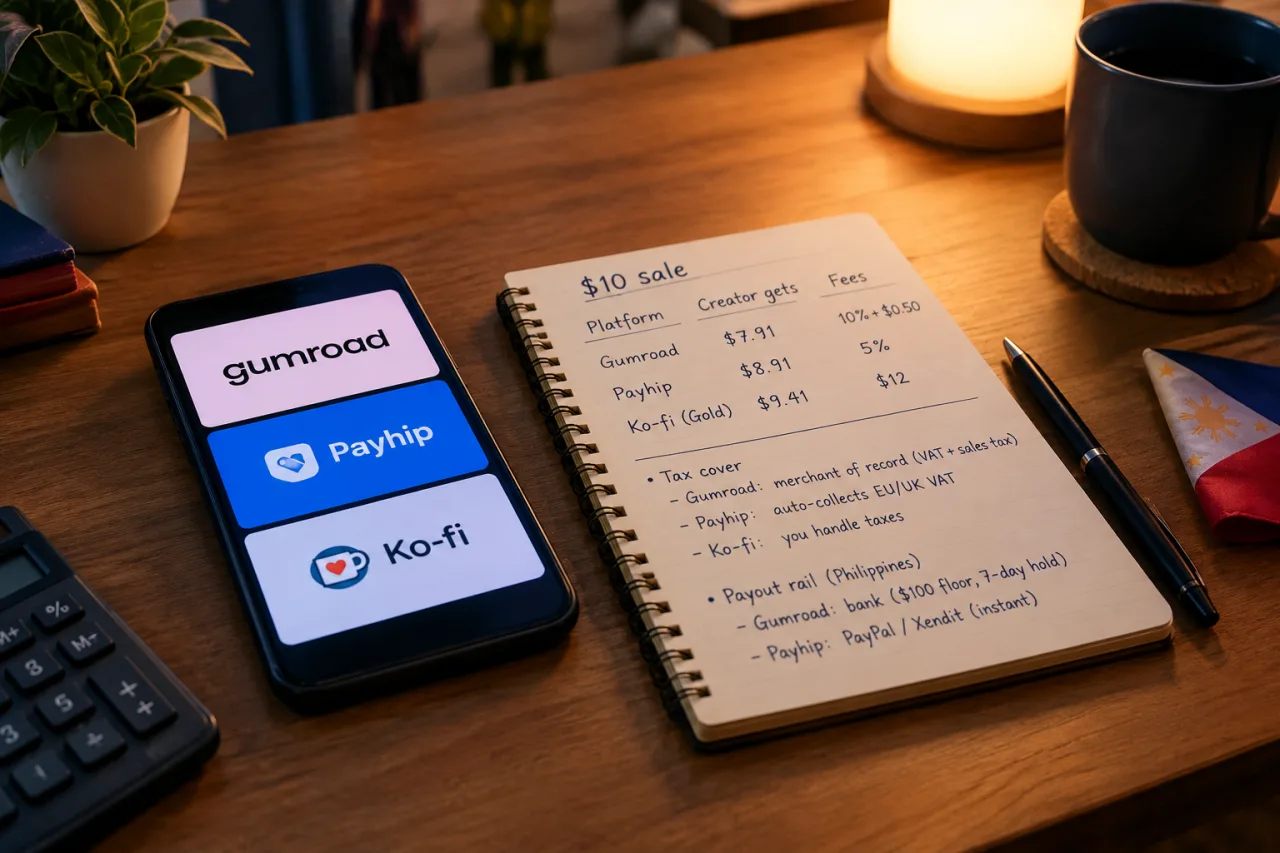
- 💸 The Gumroad vs Payhip fee table: On a $10 digital-products sale, Gumroad takes 10% plus 50 cents and leaves the creator $7.91, Payhip’s free plan leaves $8.91, and Ko-fi Gold leaves $9.41, because small sales are where fixed fees hurt most.
- 🏥 The tax cover: Gumroad acts as merchant of record and remits sales tax and VAT for you since January 2025, Payhip auto-collects EU and UK VAT on its plans, and Ko-fi leaves tax handling mostly to you.
- 🇵🇭 The payout rail decides: Gumroad pays Philippine bank accounts but holds funds to a $100 floor with a 7-day hold, while Payhip sends each sale straight to your own PayPal or regional gateway like Xendit the moment a buyer pays.
- 🎯 The verdict: Start on Payhip free for margin and payout control, add Gumroad if you want tax handling and its marketplace reach, and use Ko-fi when tips and low-price supporter sales, not a catalogue, are the business.
Compare Gumroad vs Payhip vs Ko-fi before you upload your first digital products, because the three platforms price the same sale in three different ways, and one of the differences is invisible until the day you try to withdraw. Gumroad keeps 10% plus 50 cents on direct sales and adds another 30% if a customer finds you through its Discover marketplace. Payhip takes 5% on its free tier, 2% on its $29 Plus tier, and nothing on its $99 Pro tier, while your own PayPal or card processor charges separately on every plan. Ko-fi takes nothing on tips, 5% on shop sales for free accounts, and removes the fee entirely on its $12 Gold plan. This Gumroad vs Payhip vs Ko-fi piece runs the three through four filters that matter to a Filipino creator: the fee table, the tax coverage, the payout rail, and the storefront each service is actually built for.
The Gumroad vs Payhip question is timely for local creators because the decision changed shape this decade. Payout rails to the Philippines matured, regional processors reached the market, and the platforms themselves split philosophically: one became a merchant of record, one became a pass-through wallet, and one stayed a tip jar with a shop attached. Those three philosophies produce the differences below, and the differences produce your take-home pay.
The Fee Table, and Where Fixed Fees Bite
Listed platform fees are checked against each company’s own pricing page, with card processing separate on Payhip and Ko-fi and bundled by Gumroad. The percentages hide the shape of the cost, so the table shows what a creator keeps on typical sales.
| Plan (2026) | Monthly | Platform fee | Keep on $10 | Keep on $50 | Keep on $200 |
|---|---|---|---|---|---|
| Gumroad direct | $0 | 10% + $0.50 | $7.91 (79.1%) | $42.75 (85.5%) | $173.40 (86.7%) |
| Gumroad Discover | $0 | 30% (processing included) | Marketplace-sourced customers only | ||
| Payhip Free Forever | $0 | 5% | $8.91 (89.1%) | $45.75 (91.5%) | $183.90 (92.0%) |
| Payhip Plus | $29 | 2% | $9.21 | $47.25 | $189.90 |
| Payhip Pro | $99 | 0% | Plus the processor’s own card rate | ||
| Ko-fi Standard | $0 | 5% on shop sales; 0% on tips | $8.91 | $45.75 | $183.90 |
| Ko-fi Gold | $12 | 0% platform | $9.41 | $48.25 | $193.90 |
Read the Gumroad vs Payhip $10 column before the $200 one, because small sales are the Philippine reality for template packs, ebook singles, and first-time products. Gumroad vs Payhip diverges hardest there: the 50-cent portion plus the double-digit percentage leaves just 79.1% of a ten-dollar sale, while a percentage-only plan keeps 89%. The gap narrows as ticket size grows, which is why Gumroad’s model suits premium-priced products and Payhip’s suits a high volume of small ones. Two more Gumroad details belong in the ledger: sales above a monthly threshold shift into a lower fee band per its pricing updates, and the 30% Discover fee applies only to customers the marketplace delivers, never to buyers you bring yourself through your own links, which makes Gumroad vs Payhip a question of where your customers come from as much as what you sell.
The Break-Even Point of Every Paid Plan
Paid tiers look expensive until the pricing runs, and the Gumroad vs Payhip choice changes sides depending on the month. Payhip’s Plus tier costs $29 and 2%, so against the free plan’s flat 5% it saves you 3 percentage points; it breaks even once monthly sales pass about $967. Its Pro tier costs $99 with no platform fee at all, so it breaks even against Plus at roughly $3,500 a month. Ko-fi Gold costs $12 to erase the 5% shop fee, which means the paid plan starts winning near $240 a month. Gumroad publishes no subscription at all, so its curve stays a single line: the same 10% plus 50 cents whether you sell $40 or $4,000, and that simplicity is genuinely worth something to a first-year creator who never wants to think about plan tiers.
Two practical readings follow. A creator under $200 a month, which is most first-year sellers in the Philippines, owes no upgrade anywhere except deciding whether $12 fits for Ko-fi Gold. A creator past $1,000 a month on small-ticket products should already be modeling the switch, because 5% of a growing catalogue soon costs more than any plan fee. The habit that settles it: mark your monthly sales level at quarter’s end, run it against the two break-even lines, and change tiers only when the arithmetic changes sides, not when the pricing page redesigns.
The Tax Cover: Who Files, and What That Is Worth
Since January 2025, Gumroad handles all tax obligations on platform sales as merchant of record, collecting and remitting sales tax and VAT across jurisdictions, an arrangement that removes an entire compliance category from a solo creator’s week. Payhip sits just behind: its plans automatically collect, report, and remit digital EU and UK VAT as well as US and Canadian sales tax, though it is not a merchant of record and an accountant should still confirm what obligations remain yours. Ko-fi is the lightest of the three on tax cover and the one that leaves the most paperwork with you. The practical framing for a Filipino creator: the tax-handling premium is real, it is part of what the bigger percentages buy, and it is worth more at catalogue scale in multiple countries than it is on a first template pack sold to followers at home, one more way the Gumroad vs Payhip ledger differs from Ko-fi’s.
Read a Payout Statement From Your First Three Sales
Every number above is verifiable in your own money the week you start selling. Run three small sales, one per platform, and then read each statement line by line: the platform fee, the processor’s cut, the currency conversion, and the payout charge. Gumroad bundles its card processing, so expect the total deduction near 13% on a small sale and verify it rather than trusting any published table, including this one. Payhip separates its 5% from your processor’s own line, which makes the statement the cleanest teaching document of the three. Ko-fi shows its 5% on shop sales and nothing on tips, and the tips line will teach you what the platform is really for. The lesson generalizes beyond platforms: the payout statement is the ledger of your business, and creators who read them monthly catch rate changes, processor switches, and fee experiments the day they happen instead of the quarter after.
The Payout Rail: Where Philippine Creators Feel the Difference
This is the filter that changes minds locally. Gumroad pays Philippine bank accounts in local currency, among a long country list, but the money waits for a $100 minimum, a 7-day hold after each sale, and weekly to quarterly payout schedules; where bank payout is unavailable it falls back to PayPal with a 2% fee, and Payoneer and Wise are not supported at all. Payhip holds nothing: each sale flows to the payment gateway you connected, at the moment of purchase, with no floor and no hold, and Payhip connects regional processors including Xendit, whose coverage list includes the Philippines, alongside PayPal at its standard rates. Ko-fi lands payments in the Stripe or PayPal account you attach, with no payout fee claimed on its help pages.
The practical consequence in pesos: a Gumroad balance of $40 sits locked until it reaches $100 and survives its hold, while the same $40 arrives in a Payhip-connected wallet the day the buyer pays. For a creator treating this as side income for family expenses, that liquidity difference is the whole decision; for a creator optimizing for tax cover and marketplace discovery, the hold is the price of a service they wanted anyway.
Which Platform Fits Which Filipino Creator
The Gumroad vs Payhip verdict picks by what the business actually is. The template or Notion-pack seller with small ticket sizes and local to regional buyers fits Payhip: the free tier’s 5% beats every comparable rate at low volume, the paid tiers have simple break-evens, about $967 a month where Plus beats Free and about $3,500 where Pro beats Plus, and the instant payout via PayPal or a regional gateway matches how household budgets here actually run. We mapped the selling side of that product class, including the make-and-sell figures, in our Notion templates guide, and the same economics extend to fonts, ebooks, and Lightroom presets.
The premium-course or bundle seller with international buyers fits Gumroad: the merchant-of-record tax cover absorbs a compliance layer that international sales genuinely create, and its Discover marketplace can add customers you would never have reached, at the 30% fee you accept for exactly those. The tip-jar creator, streamers, artists, and writers living off a loyal audience, fits Ko-fi: tips carry no platform fee, the $12 Gold removes the shop fee once monthly shop sales pass roughly $240, and the storefront stays simple by design. Newsletter and content operators should also read our Substack vs Beehiiv comparison, because some monetization plans belong on a newsletter platform rather than a shop, and the same fee-vs-control logic runs through every one of these choices. For cross-border money movement after payout, our PayPal vs Payoneer vs Wise comparison covers the corridor from a landed payment to a Philippine bank account.
What Comes Next for Creator Platforms
Watch three movements. Merchant-of-record services keep absorbing the tax-handling premiums as digital-products rules tighten worldwide, which pushes pure pass-through platforms to partner for coverage or price their lower fees as the compensation. Regional gateways keep extending into Southeast Asia, which widens Payhip-style instant-payout options for Philippine creators specifically. And the split between tip economies and shop economies keeps deepening Ko-fi on the supporter side while the catalogue platforms consolidate the higher-ticket business. The fee table above will move with those currents; the four filters you just ran, fee shape, tax cover, payout rail, and storefront fit, are the stable way to re-run the decision every year.
The full platform comparison belongs to WorldNgayon’s Build and Earn practice files. If you want an outside eye on your own product line, pricing, and payout setup, WorldNgayon Studio’s consultation path begins at our contact page.
Frequently Asked Questions About Gumroad vs Payhip vs Ko-fi
Which platform charges the least for small sales?
Ko-fi Gold at 0% platform fee keeps the most per sale ($9.41 on $10), followed by Payhip Free at 5% ($8.91), with Gumroad last because its 10% plus 50-cent structure takes 20.9% of a ten-dollar sale. Add each platform’s card or PayPal processing on top when comparing totals.
Can Gumroad pay out to the Philippines?
Yes, via bank deposit in local currency to Philippine accounts listed on its payout pages, with a $100 minimum balance, a 7-day hold per sale, and weekly to quarterly schedules. If bank payout is unavailable for an account, it pays by PayPal with a 2% fee; Payoneer and Wise are not supported.
Why do creators keep recommending Payhip for instant payouts?
Because Payhip never holds your money: each sale charges to the PayPal, Stripe, or regional gateway account you connected, landing at the moment of purchase with no minimum and no hold. Its gateway list includes Xendit, which covers the Philippines, so proceeds arrive the day someone buys.
Does Gumroad handle sales tax for me?
Yes. Since January 2025 Gumroad acts as merchant of record on platform sales, collecting and remitting sales tax and VAT, which removes most filing work for those sales. You still owe income tax on what you earn, per its own terms.
When does Ko-fi Gold pay for itself?
Gold costs $12 a month and removes the 5% platform fee on shop sales, so it overtakes the free plan once monthly shop sales pass roughly $240. Below that, the free plan costs less; tips carry no platform fee on either plan.
Can I use more than one platform at once?
Yes, and many creators do, though the Gumroad vs Payhip vs Ko-fi trio works best when each service sells a different product class: a tip-supported audience on Ko-fi, a small-ticket catalogue on Payhip, and premium bundles on Gumroad, each connected to the payout rail that fits it. Keep the products distinct across platforms so none cannibalizes another, and track your own numbers monthly against the fee tables above.
- gumroad.com/pricing — 10% plus 50 cents on direct sales
- earnthread.com/blog/creator-platform-fee-index-2026 — 5% on its free tier, 2% on its $29 Plus tier
- ko-fi.com/pricing — fee entirely on its $12 Gold plan
- remotebuilders.io/guides/sell-digital-products — Philippine bank accounts in local currency
External sources linked in this article, in order of first mention. Spotted an error or a broken link? Tell us.
Cite this pagePublished Nov 19, 2026
Agron, E. (2026, November 19). Gumroad vs Payhip vs Ko-fi: Where Filipino Creators Actually Get Paid. WorldNgayon. https://worldngayon.com/gumroad-vs-payhip-vs-kofi/
Agron, Edmon. “Gumroad vs Payhip vs Ko-fi: Where Filipino Creators Actually Get Paid.” WorldNgayon, 19 Nov. 2026, worldngayon.com/gumroad-vs-payhip-vs-kofi/.
Agron, Edmon. “Gumroad vs Payhip vs Ko-fi: Where Filipino Creators Actually Get Paid.” WorldNgayon, November 19, 2026. https://worldngayon.com/gumroad-vs-payhip-vs-kofi/.
Agron, E. (2026) ‘Gumroad vs Payhip vs Ko-fi: Where Filipino Creators Actually Get Paid’, WorldNgayon, 19 November. Available at: https://worldngayon.com/gumroad-vs-payhip-vs-kofi/.
E. Agron, “Gumroad vs Payhip vs Ko-fi: Where Filipino Creators Actually Get Paid,” WorldNgayon, Nov. 19, 2026. [Online]. Available: https://worldngayon.com/gumroad-vs-payhip-vs-kofi/
@online{agron2026gumroadvs,
  author       = {Agron, Edmon},
  title        = {{Gumroad vs Payhip vs Ko-fi: Where Filipino Creators Actually Get Paid}},
  year         = {2026},
  date         = {2026-11-19},
  organization = {WorldNgayon},
  url          = {https://worldngayon.com/gumroad-vs-payhip-vs-kofi/},
  urldate      = {}
}TY - ELEC AU - Agron, Edmon TI - Gumroad vs Payhip vs Ko-fi: Where Filipino Creators Actually Get Paid T2 - WorldNgayon PY - 2026 DA - 2026/11/19/ UR - https://worldngayon.com/gumroad-vs-payhip-vs-kofi/ Y2 - ER -
Cite the version you read; the page may be updated. Zotero and Mendeley can also import this page directly.