Key Takeaway
- 📄 The Anthropic S-1 filing means the company has publicly disclosed its financial results: the company filed its S-1 with the SEC on October 26, 2026 and amended it on November 2. The filing includes some financial tables drawn from audited statements and others, the interim and nine-month figures, from unaudited interim statements, with revenue, compute spending, losses and cash all laid out in detail.
The filing is read here table by table: the revenue figures reported in the filing, the breakdown of the reported loss, and the company’s cash holdings and voting structure.
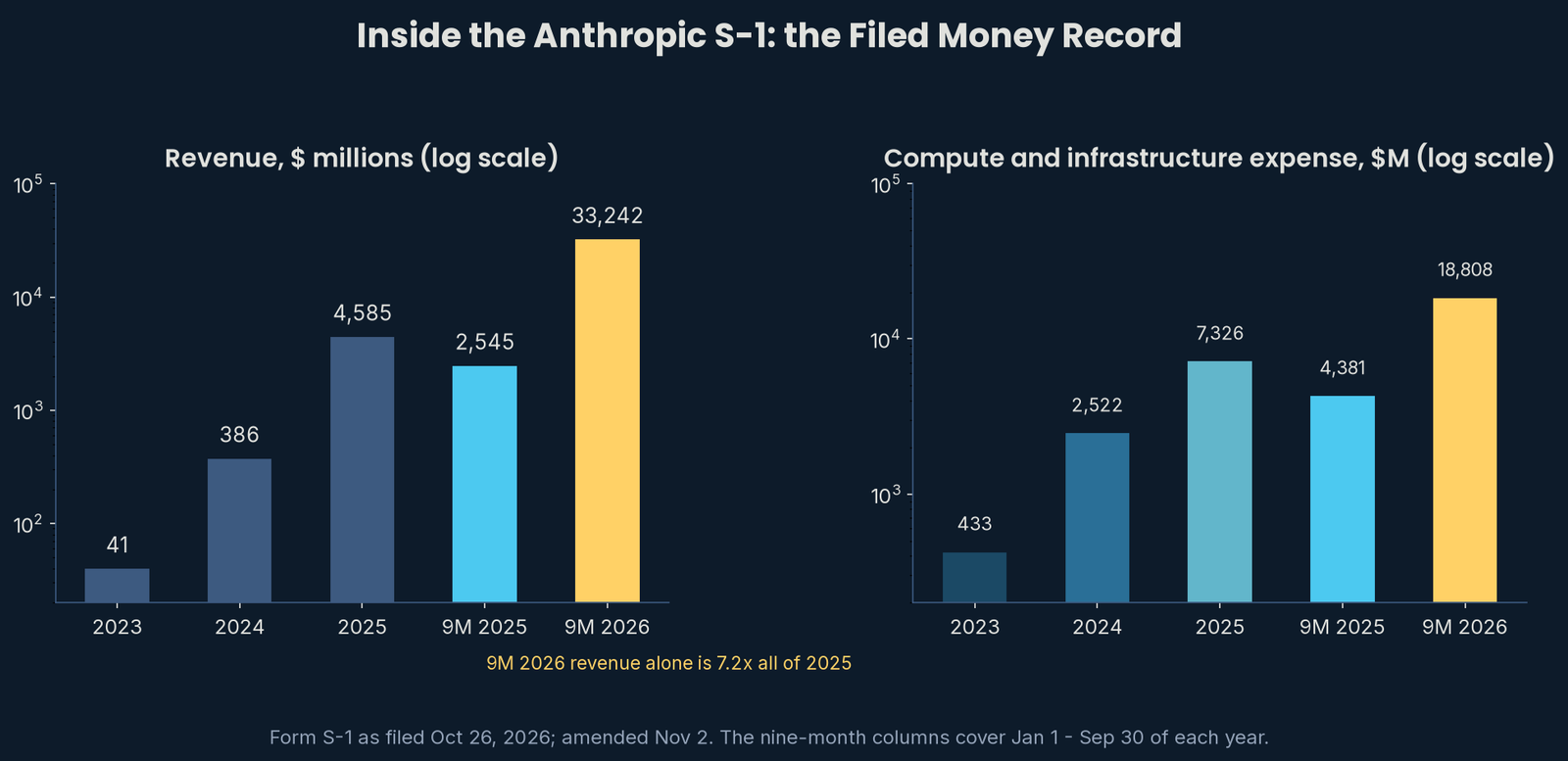
💵 The revenue figures show how quickly the company has grown: 2023 revenue of $41 million grew to $386 million in 2024, $4,585 million in 2025, and $33,242 million in just the nine months ended September 30, 2026. The nine-month figure alone is 7.2 times all of 2025.
- 🧮 Much of the reported net loss reflects fair-value adjustments rather than cash payments: the nine-month net loss of $104,039 million carries $94,324 million from changes in the fair value of convertible notes and SAFEs, accounting adjustments related to fundraising instruments, while the operating loss narrowed to $1,260 million for the whole nine months. Operating cash flow was positive $6,569 million for the same period, per the filing’s cash-flow statement.
- 🏦 Cash and investments reported in the filing: $141.1 billion of capital raised as of September 30, 2026, with $95.6 billion in cash and $36.3 billion in short-term investments. The compute-and-infrastructure expense for the nine months was $18,808 million, reported alongside those figures, and the filing separately discloses roughly $895.4 billion of aggregate committed purchase spend, substantially all related to compute and infrastructure.
- 🏛️ One important feature of the ownership structure: a Founder LLC holds Class F shares carrying 50.1 percent of voting power with no economic rights; public investors receive the economic rights attached to their Class A shares, and the Founder LLC retains significant voting control. The structure also includes a Long-Term Benefit Trust (Class T) that elects the board’s majority, limited-vote Class E employee shares, and non-voting Class N shares held primarily by strategic partners.
The Anthropic S-1 filing gives the public a detailed look at the company’s revenue, expenses, losses, cash holdings and ownership structure. Filed October 26, 2026 and amended November 2, the document rewards careful reading: the revenue growth everyone debates is in there as a multi-column table, the loss that gets misquoted is broken down line by line, and the ownership structure is spelled out in plain terms. This guide reads the filing the way an analyst would: what the revenue figures say, what the losses actually are, where the money sits, and what the structure means for whoever buys in at the IPO.
The Anthropic S-1 filing also explains how Anthropic calculates its annualized revenue run rate. This provides a consistent basis for interpreting the company’s reported growth: trailing 28-day consumption fees multiplied by 13, plus monthly subscription fees multiplied by 12, so any run-rate number quoted from now on can be checked against the company’s own stated methodology.
Anthropic’s Revenue Growth, 2023–2026
The Anthropic S-1’s summary financial data uses five reporting periods, and the growth rates show how quickly revenue increased. Revenue: $41 million for 2023; $386 million for 2024; $4,585 million for 2025; $2,545 million for the nine months ended September 30, 2025; and $33,242 million for the nine months ended September 30, 2026. The growth figures show: the 2024 increase was roughly nine-fold, the 2025 increase roughly eleven-fold, and the first nine months of 2026 ran seven point two times the whole of the prior year. The filing’s deeper revenue disaggregation (by API versus subscription lines) sits further in the document; the revenue table provides the useful starting point.
These figures show how much Anthropic spends on its operations. Compute and infrastructure: $433 million (2023), $2,522 million (2024), $7,326 million (2025), and $18,808 million for the nine months of 2026. Personnel expenses also increased, from $95 million to $4,863 million over the same span, including stock compensation that reached $3.3 billion for the nine months. A separately identified one-time expense, the Bartz settlement, added $1.5 billion in 2025. The operating loss for the nine months of 2026: $1,260 million, against $5,224 million for the same nine months of 2025. The operating loss narrowed even while compute spending tripled, because revenue increased faster than operating expenses.
Understanding Anthropic’s Reported Losses
Anthropic reported a net loss of approximately $104 billion for the first nine months of 2026, a figure most likely to be misunderstood. However, most of that amount came from fair-value adjustments rather than operating expenses. The filing breaks down the loss, making it possible to distinguish operating performance from accounting adjustments. The change in fair value of convertible notes, derivative liabilities and SAFEs: a negative fair-value adjustment of $94.324 billion, a line that changes as the company’s valuation and the pricing of its share classes change, and the Anthropic S-1 explains the pro forma adjustment explicitly. An additional $10,397 million negative line sits in “Other income (expense), net,” driven per the filing’s MD&A by the initial fair-value recognition of the assets and liabilities from its partner-financing arrangements with Google and Amazon. Total other expense on the nine months: $102,362 million. Loss before taxes: $103,622 million. Provision for taxes: $417 million.
Operating results are reported separately from those fair-value adjustments: the operating loss of $1,260 million for the nine months is the company’s reported operating result once the accounting marks are set aside, and it sits against revenue of $33,242 million. Interest income added $2,359 million for the nine months, more than the operating loss itself, an important implication of holding $95.6 billion of cash and $36.3 billion of short-term investments. And the filing’s cash-flow statement adds the number that matters for cash questions: operating cash flow of positive $6,569 million for the nine months, the company’s actual operating cash position was a surplus, not a deficit. A reader should consider both figures: the $104 billion headline is an accounting figure driven by fundraising instruments; the $1.26 billion operating loss is the company’s reported operating result; and the $6.6 billion operating cash flow shows the business generated more cash than it consumed in operations. None of the three is interchangeable, and cash consumption questions belong to the statement of cash flows, not to the net-loss line.
Capital Raised, Cash and Investments
The Anthropic S-1 states the totals as of September 30, 2026: $141.1 billion of capital raised in aggregate, $95.6 billion of cash and cash equivalents, and $36.3 billion of short-term investments. The prospectus describes the position plainly: the company’s financial resources help it obtain computing capacity from investors and partners, and the filing’s own language describes self-reinforcing relationships between funding, computing resources and AI model quality (the compute side, covered in our Google-Broadcom TPU guide). The filing also discloses roughly $895.4 billion of aggregate committed purchase spend across purchase agreements and leases not yet commenced, substantially all related to compute and infrastructure, the forward obligation behind the cash figures. For an investor, that cash position is one reason the November IPO is a different kind of offering: the company is seeking additional capital despite its substantial cash holdings, entering the IPO process with one of the larger cash reserves among companies heading to market, already reported in its financial statements.
The Anthropic S-1 filing describes the proposed offering as an initial public offering of Class A common stock, with the cover page carrying the standard subject-to-completion language. The share count, proposed price range and offering details remain blank in the current amendment and must be checked in the applicable filing as they are added. The underwriting syndicate is named (Goldman Sachs and Morgan Stanley lead it, with more than a dozen further banks), and the listing is applied for on the Nasdaq Global Select Market under the symbol “ANT.” One important feature of the ownership structure is the voting arrangement described in the next section.
How Anthropic’s Voting Structure Works
The Anthropic S-1’s capitalization section describes an unusual share structure. Class F common stock, held by the Founder LLC organized by the co-founders, will carry an aggregate number of votes equal to 50.1 percent of the total voting power of outstanding stock on shareholder matters, including director elections, while, as the filing states plainly, that Class F stock has no economic rights. Public investors receive the economic rights attached to their Class A shares, where each share carries one vote; the Founder LLC holds the control through Class F. The company’s approximately 5,300 employees fall under a separate arrangement: Class E common stock issued to employees (excluding the co-founders) will vote only on certain limited matters and also carries no economic rights, with the equity table the filing itemizes.
For investors assessing corporate governance, the structure answers the question buyers ask about frontier labs: who controls major corporate decisions. In the filing’s own terms, the Founder LLC holds the fixed 50.1-percent block, and the founders’ control does not move with share-price changes. Two further layers belong in any complete picture: the Long-Term Benefit Trust, which through Class T shares elects the Class T directors who form the board’s majority (those directors are the exception within the Founder LLC’s shareholder-level vote), and the “controlled company” status the filing discloses under Nasdaq’s governance rules. This voting arrangement differs both from a conventional one-share, one-vote structure and from the super-voting founder share classes of past decades.
Key Financial Terms Investors Should Understand
Three definitions in the filing are essential for interpreting the financial figures. Run-Rate Revenue: the estimated annualized value as of a measurement date, trailing 28-day consumption fees multiplied by 13, plus aggregate monthly subscription fees multiplied by 12, which is why reports about annualized revenue and the nine-month revenue figures in the filing can disagree without either being wrong. The filing also defines customer size-classes (“$1 million or more of revenue on a trailing-twelve-month basis,” “$10 million or more”) that define how customers are grouped. And it names SIs, systems integrators, as the third-party firms that design and build deployments: the channel through which enterprise rollouts are implemented.
Those definitions also help explain earlier reports: the spring disclosures about million-dollar customer cohorts used the filing’s own cohort classes, and the February-announced run-rate milestones now have a formal definition (the earlier record on both sits in our run-rate analysis for the demand record). Interpret reported figures using the company’s definitions, not against them.
What the Filing Means for Investors and Employees
Retail investors considering Anthropic’s IPO should examine four areas: revenue growth, operating expenses, the accounting adjustments behind its reported losses, and the company’s voting structure. Together, these figures offer a clearer picture of the financial performance and the rights available to shareholders. For current employees and prospective applicants: the Anthropic S-1 itemizes stock-based compensation at $3.3 billion for the nine months and reports roughly 5,300 employees as of September 30, 2026, up from approximately 940 at the end of 2024; revenue per employee, if that is the intended measure, can be calculated from the disclosed information.
For the market: this is one of the first detailed public financial records from a leading AI model developer, and its disclosures will be quoted the way filings are quoted, using the reported figures and their definitions. The filing names its investors directly, including Amazon and Google, whose stakes form part of the capital table, the same partners behind the company’s compute arrangements. The filing documents their roles as investors and infrastructure partners, available to any reader conducting diligence.
What the S-1 means for readers in the Philippines and beyond
The filing is public and free, which makes this an opportunity for readers to examine the financial figures themselves. For Filipino investors watching a first-of-its-kind listing: the same figures an American institutional buyer reads are in English, on EDGAR, free to access — and this analysis of the public filing teaches how to interpret the financial tables, a skill useful when examining other companies’ financial statements. For Filipino professionals working in the AI services industry: 5,300 employees support a company reporting $33 billion of nine-month revenue. The filing is a clear statement of how concentrated frontier-lab headcount is relative to revenue — and, if supported by further evidence, of what those figures may indicate about productivity and compensation.
And for market observers: the Anthropic S-1 filing allows investors to compare a company’s earlier claims with its reported financial results. The Anthropic S-1 now carries the filed answers, replacing previously published speculation; our earlier analysis asking the $2 trillion question (Anthropic IPO: the $2 Trillion Question) remains a related article examining Anthropic’s valuation alongside this analysis of the public filing.
Financial Disclaimer
This article is published for general information and analysis, not as investment advice, and it does not recommend buying or selling any security or participating in any offering. Figures cited are drawn from Anthropic’s Form S-1 as filed with the SEC on October 26, 2026 and as amended on November 2, 2026; the annual 2023–2025 figures are drawn from audited statements, the 2026 interim figures from unaudited interim statements, and they change as amendments and follow-on filings arrive. Fair-value items are accounting mark adjustments, not cash losses; operating loss, operating cash flow and net loss are distinct measures. Consult a licensed professional before making financial decisions; WorldNgayon accepts no liability for decisions taken on the basis of this article.
FAQ
What is the Anthropic S-1?
The S-1 is the registration statement a US-listing candidate files with the SEC to prepare an IPO. Anthropic filed its S-1 on October 26, 2026 and an amended version on November 2. The documents carry the summary financial data, the risk factors, the governance structure and the offering terms in process. Anthropic did not respond publicly beyond the document itself at the time of filing.
How much revenue does Anthropic have, per the filing?
The summary table shows: $41 million revenue for 2023, $386 million for 2024, $4,585 million for 2025, $2,545 million for the nine months ended September 30, 2025, and $33,242 million for the nine months ended September 30, 2026 — a nine-month figure 7.2 times the full 2025 year. The filing defines the run-rate metric separately: trailing 28-day consumption fees multiplied by 13, plus monthly subscriptions multiplied by 12.
How big is Anthropic’s net loss — is it really $104 billion?
The nine-month net loss is $104,039 million as filed. The filing’s own breakdown shows $94,324 million of that comes from changes in the fair value of convertible notes, derivative liabilities and SAFEs — accounting adjustments that move with valuation, not cash spent — with a further $10,397 million negative line from the initial fair-value recognition of its partner-financing arrangements. The operating loss for the same nine months was $1,260 million, interest income of $2,359 million exceeded it, and operating cash flow was positive $6,569 million.
How much cash does Anthropic have, and how much has it committed to spend?
As of September 30, 2026, the filing states: $141.1 billion of capital raised in aggregate, $95.6 billion in cash and cash equivalents, and $36.3 billion in short-term investments. The nine-month compute-and-infrastructure expense was $18,808 million, and the filing separately discloses roughly $895.4 billion of aggregate committed purchase spend, substantially all related to compute and infrastructure.
What does the Anthropic S-1 say about who controls Anthropic after the IPO?
Three structures work together. The Founder LLC holds Class F common stock carrying 50.1 percent of shareholder voting power (including elections of directors other than the Class T directors) with no economic rights. The Long-Term Benefit Trust, via Class T shares, elects the Class T directors, who hold the board’s majority; Class T shares have no other voting rights and no economic rights. Public investors hold Class A, with one vote per share plus the economics. Class E (employees) votes only on limited matters; Class N (held primarily by strategic partners) has no vote and generally converts to Class A on sale to an unaffiliated party. The filing also discloses “controlled company” status under Nasdaq rules.
Is the $104 billion loss the same thing as cash burn?
No — the three numbers are different measures. The net loss ($104,039 million) is an accounting figure dominated by a $94.3 billion fair-value adjustment on fundraising instruments. The operating loss ($1,260 million) is the company’s reported operating result once those adjustments are set aside. The cash-flow statement is the place where actual cash is measured, and it shows operating cash flow of positive $6,569 million for the nine months. Reading them as one number misleads; the filing separates them deliberately.
Where can I read the Anthropic S-1 myself?
The filing is free on the SEC’s EDGAR system, under the registrant Anthropic, PBC — the October 26 original and the November 2 amendment are both there. Read the “Prospectus summary” and “Risk factors” sections first; the definitions section carries the run-rate and customer-cohort terms that coverage usually quotes.
- Official sec.gov/Archives/edgar/data/2130357/000162828026068676/anthropicpbc-s…
- Official sec.gov/cgi-bin/browse-edgar?action=getcompany&CIK=0002130357&type=S-…
External sources linked in this article, in order of first mention. Spotted an error or a broken link? Tell us.
Cite this pagePublished Nov 8, 2026
Agron, E. (2026, November 8). Anthropic’s S-1 Filing Explained: Revenue, Losses, Cash and IPO Control. WorldNgayon. https://worldngayon.com/anthropic-s-1-filing/
Agron, Edmon. “Anthropic’s S-1 Filing Explained: Revenue, Losses, Cash and IPO Control.” WorldNgayon, 8 Nov. 2026, worldngayon.com/anthropic-s-1-filing/.
Agron, Edmon. “Anthropic’s S-1 Filing Explained: Revenue, Losses, Cash and IPO Control.” WorldNgayon, November 8, 2026. https://worldngayon.com/anthropic-s-1-filing/.
Agron, E. (2026) ‘Anthropic’s S-1 Filing Explained: Revenue, Losses, Cash and IPO Control’, WorldNgayon, 8 November. Available at: https://worldngayon.com/anthropic-s-1-filing/.
E. Agron, “Anthropic’s S-1 Filing Explained: Revenue, Losses, Cash and IPO Control,” WorldNgayon, Nov. 8, 2026. [Online]. Available: https://worldngayon.com/anthropic-s-1-filing/
@online{agron2026anthropics,
  author       = {Agron, Edmon},
  title        = {{Anthropic’s S-1 Filing Explained: Revenue, Losses, Cash and IPO Control}},
  year         = {2026},
  date         = {2026-11-08},
  organization = {WorldNgayon},
  url          = {https://worldngayon.com/anthropic-s-1-filing/},
  urldate      = {}
}TY - ELEC AU - Agron, Edmon TI - Anthropic’s S-1 Filing Explained: Revenue, Losses, Cash and IPO Control T2 - WorldNgayon PY - 2026 DA - 2026/11/08/ UR - https://worldngayon.com/anthropic-s-1-filing/ Y2 - ER -
Cite the version you read; the page may be updated. Zotero and Mendeley can also import this page directly.