Key Takeaway
The Anthropic Google Broadcom pact, signed April 6, 2026, is the largest compute commitment a frontier lab has put on the public record — here is what it commits to, and what it prices in.
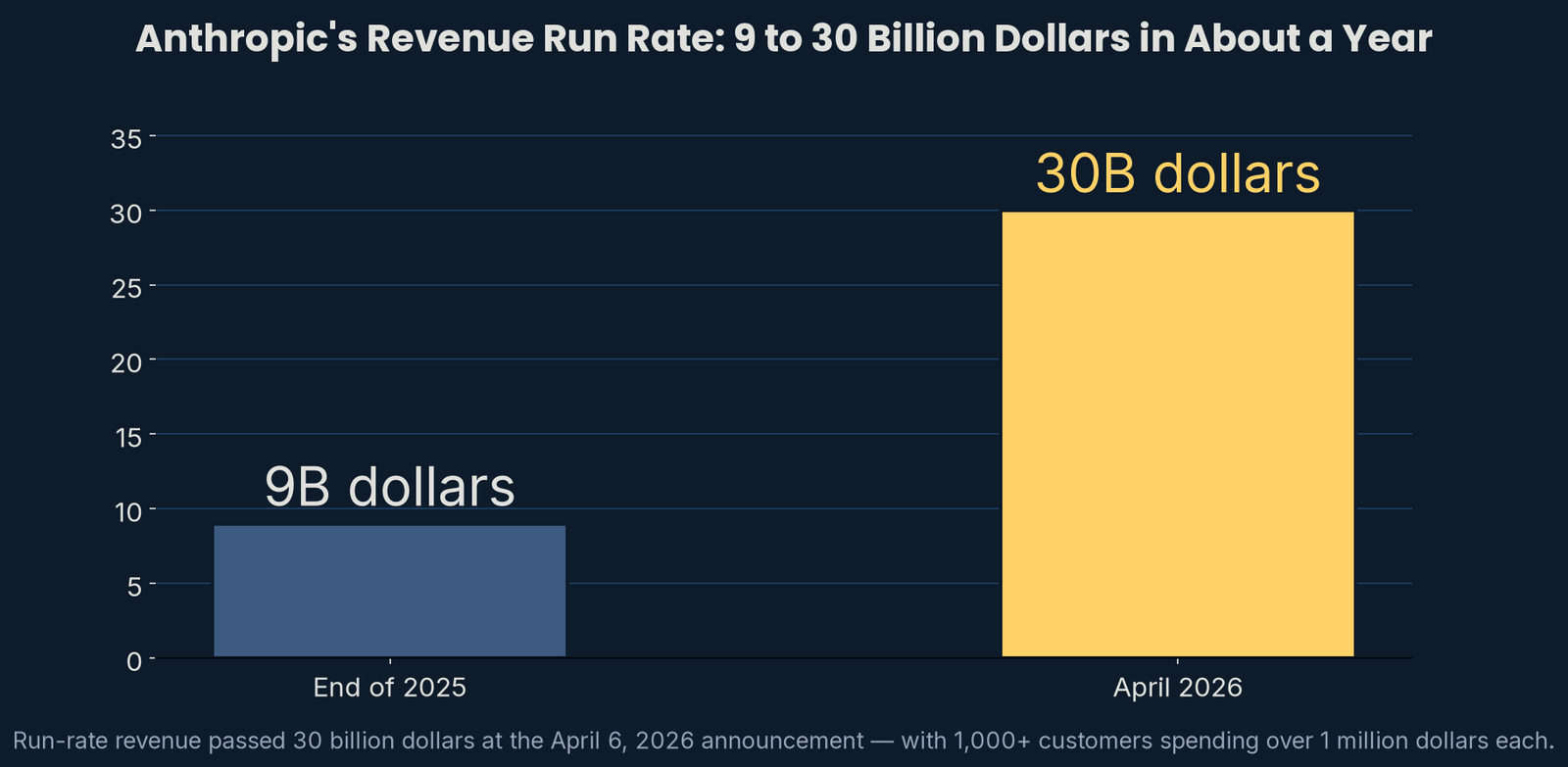
💰 $30 billion run rate: Anthropic’s revenue run rate passed $30 billion in April 2026, up from about $9 billion at the end of 2025 — a threefold jump inside one year.
- 🏭 3.5 gigawatts, contractual: Broadcom’s April 6 filing spelled out roughly 3.5 GW of next-generation Google TPU capacity for Anthropic starting in 2027, with supply agreements running through 2031.
- 🤝 Three-chip strategy: Claude trains and runs on AWS Trainium, Google TPUs and NVIDIA GPUs — Anthropic’s workload-matching bet, with AWS still the primary training partner.
- 📈 1,000 big customers: businesses spending more than $1 million a year crossed 1,000 in April, double the figure from the February Series G announcement two months earlier.
- 🔌 Power is the real constraint: Dario Amodei’s 100-gigawatt-by-2028 industry vision turns chip sourcing into an energy story first.
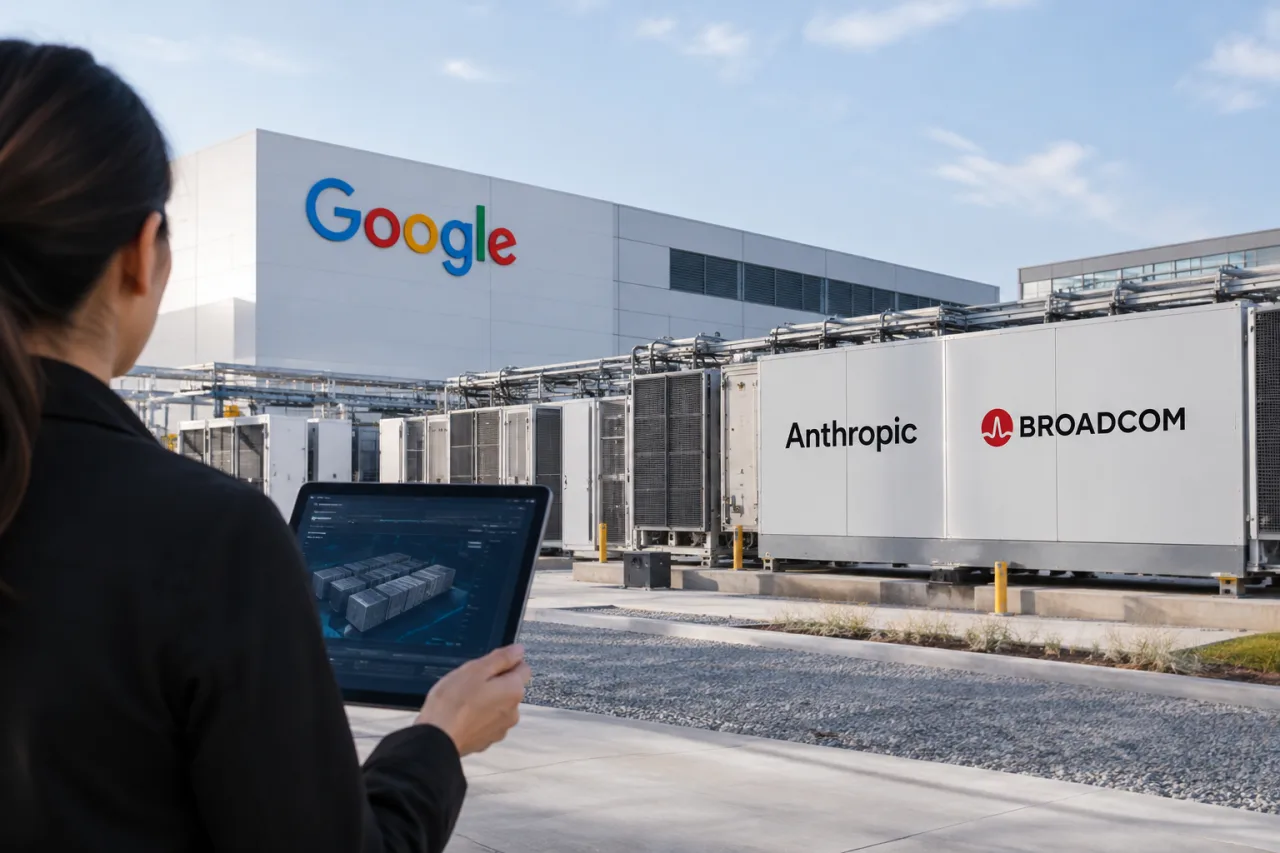
The Anthropic Google Broadcom filings landed on April 6 before most readers had finished their Monday coffee: Anthropic, the company that entered 2026 with roughly $9 billion in revenue run rate, closed the first week of April announcing that the same figure had blown past $30 billion — and that it had secured the chip supply to chase an even bigger number under the Anthropic Google Broadcom pact signed that day. The instrument for the second part is a signed agreement with Google and Broadcom for multiple gigawatts of next-generation TPU capacity, with the first wave expected online starting in 2027 and the contractual architecture reaching through 2031.
The Anthropic Google Broadcom partnership is the clearest look yet at how a frontier AI lab buys compute in 2026 — not a single cloud invoice but a hand-assembled portfolio of chips, clouds and contracts, sized in gigawatts rather than dollars per hour. This guide explains what the deal actually commits to, who pays for what, why Anthropic refuses to marry one chip family, and what the arrangement tells every business that will rent this capacity downstream.
The Google-Broadcom deal, dated and itemized
Start with what is on the record in the Anthropic Google Broadcom record. Anthropic published the partnership announcement on April 6, 2026, alongside Broadcom’s own regulatory filing on the same day. The filing matters because press releases talk in adjectives (“multiple gigawatts”) while filings talk in commitments — and the Broadcom filing committed.
Three specific commitments stand in the Anthropic Google Broadcom record. First, the supply layer: Broadcom agreed to develop and supply Google’s future-generation TPUs, plus the networking and rack components that go around them, with the commercial agreement running through up to 2031. Second, the consumption layer: Anthropic secured access to approximately 3.5 gigawatts of next-generation TPU capacity through Broadcom, beginning in 2027. Third, the plain limit that comes straight from the filing itself: that consumption is conditioned on Anthropic’s continued commercial success — the capacity is Anthropic’s to use as long as the revenue curve that justified it keeps going.
The “multiple gigawatts” language in the announcement and the “approximately 3.5 gigawatts” in the filing are the same deal described at two levels of precision. SiliconRepublic reported the filing figure the following day, and the two documents are consistent. Where the press release says “most significant compute commitment to date,” the filing behind the Anthropic Google Broadcom alliance says 3.5 gigawatts and a date range. Read both and the ambiguity disappears.
Krishna Rao, Anthropic’s Chief Financial Officer, framed the strategy in the announcement: the partnership continues a “disciplined approach to scaling infrastructure,” building capacity for what he called exponential growth in the customer base while Claude defines the frontier of AI development. The word disciplined is doing real work in that sentence — this is a company that grew its run rate 3.3 times in roughly a year, and chose to buy the next tranche of compute under multi-year contracts rather than spot pricing.
Why a three-chip strategy is the actual headline
The deepest line in the Anthropic Google Broadcom announcement is easy to scroll past: “We train and run Claude on a range of AI hardware — AWS Trainium, Google TPUs, and NVIDIA GPUs — which means we can match workloads to the chips best suited for them.”
That sentence describes a workload-routing philosophy that almost no enterprise buyer has yet operationalized. Anthropic treats chips like an airport treats gates: training jobs with specific bottleneck shapes go to AWS Trainium under Project Rainier, its primary cloud relationship with Amazon; inference and burst workloads that fit TPU economics route to Google; and NVIDIA GPUs remain in the mix for the workloads where CUDA’s software gravity still wins. The company’s claim that Claude remains the only frontier model available on all three of the world’s largest cloud platforms — Amazon Bedrock, Google Cloud Vertex AI, and Microsoft Azure Foundry — is both a product fact and the commercial logic underneath the chip portfolio: every cloud is also a channel.
The economics behind the Anthropic Google Broadcom routing are already visible in the market. An AI factory of the scale Anthropic is building is not a uniform hall of identical racks; it is a portfolio of specialized subsystems, each with its own bottleneck — memory bandwidth on one workload class, interconnect on another, input-output throughput on a third. Matching workloads to silicon, instead of forcing every workload through one vendor’s stack, converts that diversity from a procurement headache into a cost lever. The three-chip strategy is Anthropic’s version of the same principle that runs every serious data center: the workload picks the hardware, not the reverse.
There is a resilience argument stacked on the economics. Any single vendor’s allocation, capacity ceiling or pricing change becomes a negotiation rather than an outage. For the customers who depend on Claude for critical work — the more than 1,000 businesses spending seven figures a year — the multi-cloud posture is the product feature.
The demand curve that forced the purchase
The Anthropic Google Broadcom commitment is not a procurement decision; it is a demand response. The April announcement bundled the demand numbers directly into the deal context, and they deserve their own count.
Run-rate revenue: past $30 billion in April 2026, up from approximately $9 billion at the end of 2025. That is a 3.3-times expansion in a single year, at a scale where each doubling is measured in billions. Customer concentration at the top: over 1,000 business customers each spending more than $1 million on an annualized basis as of April — versus “over 500” disclosed with the Series G raise in February. The number doubled in under two months. Series G context: the company announced a $30 billion funding round at a $380 billion post-money valuation in February 2026, and this is the round that bankrolled the compute posture now on view. Market-research context: SiliconRepublic’s report on the deal cited recent data showing Anthropic capturing more than 73 percent of all spending among companies buying AI tools for the first time, with OpenAI at around 27 percent — a first-purchase market that Anthropic currently leads.
Put the demand figures next to the supply commitments behind the Anthropic Google Broadcom pact and the causal chain reads cleanly: a $30 billion run rate with a customer cohort doubling every two months implies inference demand that outstrips any single allocation. The 3.5-gigawatt commitment is the visible footprint of that arithmetic.
The 800-volt rack: what “next-generation TPU” physically means
Capacity measured in gigawatts in the Anthropic Google Broadcom structure has a physical shape, and Google’s TPU program has been public about it. The Ironwood generation that anchors the near-term deployment is Google’s seventh-generation TPU, and Broadcom’s September earnings call quantified its build-out for Anthropic specifically: roughly one gigawatt of Ironwood capacity deployed during 2026, another five gigawatts of the next-generation TPU v8i class expected in 2027, and an incremental ten gigawatts in 2028 on management’s outlook. Those September figures are management expectations — Yahoo Finance’s coverage is explicit that they are not equivalent to the 3.5-gigawatt contractual disclosure in the April filing — but the trajectory they sketch is the same one: the TPU program is ramping toward gigawatt-scale deployment exactly in the window Anthropic’s contract targets.
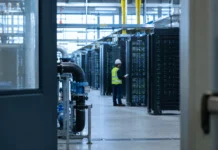
The rack-level engineering behind those numbers follows the pattern the industry has already standardized around. Modern AI racks pair accelerators with high-bandwidth interconnects, liquid cooling, and high-voltage direct-current power distribution — the 800-volt architecture NVIDIA and its partners have talked into production (the rack-level record our Vera Rubin vs Blackwell guide dated) is the same physics Google’s TPU pods chase for the same reason: at multi-hundred-kilowatt rack densities, conversion stages and copper losses eat real percentages of the site’s power budget. When Anthropic says “next-generation TPU capacity,” the deliverable is not a chip in a box; it is powered, networked, cooled floor space in gigawatt increments — which is why the Anthropic Google Broadcom deal’s unit of account is watts and not chips.
The siting is part of the commitment too. Anthropic stated that the vast majority of the new capacity will be sited in the United States, making the partnership an extension of its November 2025 pledge to invest $50 billion in American AI infrastructure. For the policy audience watching the sector’s footprint, that siting clause is the difference between a supply chain that spans three hemispheres and one that concentrates its growth on American grid territory — with everything that implies for local power markets, transmission queues (the same siting math our data-center water usage guide tracks) and the water and siting debates that follow every gigawatt-scale campus.
The 2031 horizon and the risk it prices in
The Anthropic Google Broadcom supply agreement reaching through up to 2031 is a statement about both parties’ confidence — and both parties’ exposure. Broadcom gains long-term supply visibility for its custom-chip franchise: Google’s TPU line is by far the largest custom accelerator program Broadcom serves, and the Anthropic layer adds a second committed buyer on top of the Alphabet relationship. The deal reinforces Broadcom’s position in custom AI silicon and optical networking simultaneously, because a gigawatt-scale TPU deployment is also a gigawatt-scale networking sale.
Google’s logic runs through its cloud. Selling third-party capacity on Vertex is good business; selling own-model advantage on own-silicon is better business. Hosting Anthropic on TPUs puts Google’s most efficient silicon under the workloads of a competitor’s product line — and gets Google paid for the floor space either way. Anthropic’s presence on Vertex turns a potential model-competition story into a capacity-utilization story.
The priced-in risk sits on Anthropic’s side and is named in the filing: consumption depends on continued commercial success. A 3.5-gigawatt commitment against a demand curve that could pause is the classic infrastructure bet of this cycle. The mitigations are visible in the same announcement — the three-chip posture spreads allocation risk; the AWS relationship keeps the primary training partnership independent of the TPU line; the February Series G put the balance sheet under the commitments. But the conditional clause deserves to be read as written: this is a demand-priced contract, and the discipline Rao described is visible exactly here.
What the Anthropic Google Broadcom deal means for enterprise buyers
For the businesses renting the Anthropic Google Broadcom capacity downstream, three practical readings follow from the same facts.
First, pricing: multi-year silicon contracts of this size are how a frontier lab buys the margin headroom to keep frontier pricing stable while competition compresses. Anthropic buying supply in gigawatts, at industrial tenor, is the mechanism behind whatever the API price card does next — and enterprise buyers on Bedrock, Vertex and Foundry will live with the consequences in their renewals.
Second, availability: the only-frontier-model-on-all-three-clouds claim now comes backed by own-supply commitments in the Anthropic Google Broadcom record. A buyer choosing between Claude, competitor models and managed endpoints is effectively choosing capacity postures, and the Anthropic posture is the one with 3.5 gigawatts behind it from 2027. When allocation tightens anywhere in the market, committed supply is the tiebreaker.
Third, sovereignty of stack: the deal is a template. A workload-routing strategy across Trainium, TPUs and CUDA-class GPUs is exactly what enterprises building serious AI operations should be pressure-testing in 2026 budgets — not because everyone needs three vendors’ silicon, but because the routing logic pays wherever the workloads are heterogeneous. The lab version of that logic is documented above; the enterprise version starts with knowing which of your workloads are training-shaped, inference-shaped or burst-shaped.
The gigawatt era, and the bottlenecks behind it
Dario Amodei has put the sector’s destination on the record (we track the sector’s tape weekly alongside the sector tape our White House AI summit coverage tracks): roughly 100 gigawatts of AI compute capacity built industry-wide by 2028, and potentially 300 gigawatts by 2029, with Anthropic contributing a significant share — subject to demand. The Google-Broadcom partnership is the concrete instance of that arithmetic. Reaching those numbers, as the Futurum analysis of the deal puts it, requires solving two simultaneous bottlenecks: chip supply and power infrastructure. The chip half is what the 3.5-gigawatt contract addresses. The power half — grid interconnection queues, transformer lead times, on-site generation, and the cooling water that every gigawatt-scale campus draws — is where the next decade of AI infrastructure arguments will actually live — the same arguments that shaped the sovereign-compute race our sovereign AI guide mapped.
The April-6 Anthropic Google Broadcom filings read, in that light, like the opening of a procurement sequence rather than its conclusion — the first tranche of an Anthropic Google Broadcom era measured in gigawatts. The industry has watched AI data centers cross from megawatt scale to gigawatt scale in three years; the Anthropic pact is the moment a frontier lab put its next three years of growth under contract at that scale, in advance, with the conditioning clause showing the bet in writing. Whatever pauses or accelerates around AI in the quarters ahead, the shape of this deal — multi-vendor silicon, multi-year tenor, gigawatt units, demand-conditioned consumption — is the template the rest of the market will either follow or argue with.
The Google-Broadcom deal for readers in the Philippines and beyond
None of this contract detail stays in Silicon Valley for long, and the on-ramps matter to Filipinos more than the boardroom arithmetic. Claude has been available locally through cloud channels and consumer endpoints for some time, and the multi-cloud posture documented above is why: the same model reachable through Amazon Bedrock, Google Cloud Vertex AI and Microsoft Azure Foundry means a Philippine enterprise choosing a hyperscaler does not have to choose Anthropic or leave it — every door reaches the same frontier. For the country’s fast-growing BPO, software-services and AI-services sector, the practical effect of the TPU deal arrives as capacity at the margins: when global inference demand tightens, the labs with committed, diversified supply are the ones whose APIs stay fast, and Philippine businesses that build on those APIs inherit that stability without owning a single GPU.
The pricing channel is the more direct one. Filipino freelancers, developers and small agencies who run their businesses partly on AI subscriptions already live with dollar-billed tools against peso income; a frontier lab that locks in multi-year silicon at industrial tenor is buying the room to hold its price card steady while the market’s competition compresses it in the opposite direction. Every basis point of that procurement discipline shows up, eventually, in the monthly bill a Cebu agency or a Quezon City startup pays for its team’s AI seats. And for the developers inside the Philippine tech scene building products on Claude’s API, the 2027 capacity wave means the thing they build for — higher rate limits, faster responses, steadier pricing on heavy workloads — has a dated, contractual basis rather than a marketing promise.
There is also the local-grid mirror to keep an eye on. The U.S. siting clause concentrates the growth on American territories for now, but every gigawatt-scale campus anywhere in the world feeds the same global supply chains — chips, transformers, cooling infrastructure — whose prices ripple into every data-center market, including the Southeast Asian builds now filling the region’s industrial parks. Filipinos watching the AI infrastructure story from the outside should read the April filing the way an OFW reads a remittance chart: not as someone else’s books, but as the upstream figure their own bill sits on top of.
How to read the next compute deal like this one
The framework this pact teaches is portable, and it fits in one pass. Read the filing first, the press release second: adjectives live in releases, numbers live in filings. Convert every capacity claim into watts and dates — “multiple gigawatts starting 2027” becomes “approximately 3.5 gigawatts from 2027, tenor to 2031” once the filing is open. Find the conditioning clause and read it twice: demand-priced supply is the cycle’s signature term, and it will be on almost every major deal through the decade. Locate the demand figures that sit behind it — run rate, customer cohort, growth rate — because the supply commitment is only as credible as the curve that justified it. Then check the diversification: one chip family is a vendor relationship; three is a strategy. The next deal someone announces will follow this grammar almost line for line, and a reader who has internalized it will know within minutes whether the announcement is industrial or theatrical.
FAQ
What exactly did the Anthropic Google Broadcom agreement commit Anthropic to?
Anthropic signed an agreement giving it access to approximately 3.5 gigawatts of next-generation Google TPU capacity — supplied through Broadcom — expected to come online starting in 2027. Broadcom’s April 6, 2026 regulatory filing additionally describes agreements to develop and supply Google’s future TPUs along with networking and rack components, with the commercial agreement reaching through up to 2031, and notes that Anthropic’s consumption depends on its continued commercial success.
Why does Anthropic buy capacity through Broadcom instead of directly from Google?
Because Google’s TPU program is a custom-silicon operation and Broadcom is the design, supply and integration partner behind that silicon. The structure splits the roles: Google architects the TPUs, Broadcom develops and supplies the chips and the networking around them, and Anthropic consumes the capacity through the commercial layer that the April filing describes. The arrangement also deepens Anthropic’s standing relationship with Broadcom while keeping Google Cloud — where Anthropic already buys TPU capacity — in its channel set.
How big is Anthropic’s revenue run rate now?
The company’s disclosed run-rate revenue passed $30 billion as of the April 6, 2026 announcement — up from approximately $9 billion at the end of 2025. More than 1,000 business customers each spend over $1 million on an annualized basis, a cohort that doubled in under two months from the “over 500” figure disclosed with the February 2026 Series G round.
Does the TPU deal mean Anthropic is leaving AWS and NVIDIA?
No — and the announcement states the opposite. Anthropic trains and runs Claude across AWS Trainium, Google TPUs and NVIDIA GPUs, treats Amazon as its primary cloud provider and training partner through Project Rainier, and notes that Claude remains the only frontier AI model available on all three of the largest cloud platforms: Amazon Bedrock, Google Cloud Vertex AI and Microsoft Azure Foundry. The TPU commitment adds a supply pillar; it does not replace the others.
When does the new TPU capacity actually come online?
The contractual first wave is expected online starting in 2027. Broadcom’s September 2026 earnings call sketched a more granular management outlook — roughly one gigawatt of Ironwood TPU capacity deployed for Anthropic-type demand during 2026, five more gigawatts of the next-generation class in 2027, and an incremental ten gigawatts in 2028 — with the caveat, stated clearly in market coverage, that those are management expectations rather than the 3.5-gigawatt contractual disclosure.
Where will the new compute capacity be physically located?
Anthropic’s announcement puts the siting plainly: the vast majority of the new capacity lands in the United States, extending the $50 billion American AI infrastructure pledge it made in November 2025. In practice that means the growth concentrates on American grid territory — land, power and cooling all sourced domestically — with the campus-level debates over transmission and water following the same playbook as every gigawatt-scale build before it.
Financial Disclaimer
This article is published for general information and analysis, not as investment advice. Figures cited — revenue run-rate, valuation, capacity commitments and market-share indicators — reflect company disclosures and public reporting as of their publication dates and change without notice. Crypto, AI-infrastructure securities and related instruments carry material volatility and liquidity risk, and none of the companies named has sponsored or endorsed this piece. Assess your own situation and consult a licensed professional before acting on anything here; WorldNgayon accepts no liability for financial decisions taken on the basis of this article.
- anthropic.com/news/google-broadcom-partnership-compute — partnership announcement
- siliconrepublic.com/machines/anthropic-google-broadcom-announce-3-5gw… — SiliconRepublic reported the filing figure
- finance.yahoo.com/technology/ai/articles/broadcom-anthropic-ramp-puts… — Yahoo Finance’s coverage is explicit
- futurumgroup.com/insights/anthropics-gigawatt-scale-tpu-deal-with-bro… — Futurum analysis of the deal
External sources linked in this article, in order of first mention. Spotted an error or a broken link? Tell us.
Cite this pagePublished Nov 6, 2026
Agron, E. (2026, November 6). Anthropic’s Google-Broadcom TPU Deal: the 3.5-Gigawatt Compute Pact, Explained. WorldNgayon. https://worldngayon.com/anthropic-google-broadcom-deal/
Agron, Edmon. “Anthropic’s Google-Broadcom TPU Deal: the 3.5-Gigawatt Compute Pact, Explained.” WorldNgayon, 6 Nov. 2026, worldngayon.com/anthropic-google-broadcom-deal/.
Agron, Edmon. “Anthropic’s Google-Broadcom TPU Deal: the 3.5-Gigawatt Compute Pact, Explained.” WorldNgayon, November 6, 2026. https://worldngayon.com/anthropic-google-broadcom-deal/.
Agron, E. (2026) ‘Anthropic’s Google-Broadcom TPU Deal: the 3.5-Gigawatt Compute Pact, Explained’, WorldNgayon, 6 November. Available at: https://worldngayon.com/anthropic-google-broadcom-deal/.
E. Agron, “Anthropic’s Google-Broadcom TPU Deal: the 3.5-Gigawatt Compute Pact, Explained,” WorldNgayon, Nov. 6, 2026. [Online]. Available: https://worldngayon.com/anthropic-google-broadcom-deal/
@online{agron2026anthropicgoogle,
  author       = {Agron, Edmon},
  title        = {{Anthropic’s Google-Broadcom TPU Deal: the 3.5-Gigawatt Compute Pact, Explained}},
  year         = {2026},
  date         = {2026-11-06},
  organization = {WorldNgayon},
  url          = {https://worldngayon.com/anthropic-google-broadcom-deal/},
  urldate      = {}
}TY - ELEC AU - Agron, Edmon TI - Anthropic’s Google-Broadcom TPU Deal: the 3.5-Gigawatt Compute Pact, Explained T2 - WorldNgayon PY - 2026 DA - 2026/11/06/ UR - https://worldngayon.com/anthropic-google-broadcom-deal/ Y2 - ER -
Cite the version you read; the page may be updated. Zotero and Mendeley can also import this page directly.