
Key Takeaway
The Fable vs Mythos record in one pass: same model, different access arrangements, and each arrangement has its own requirements.
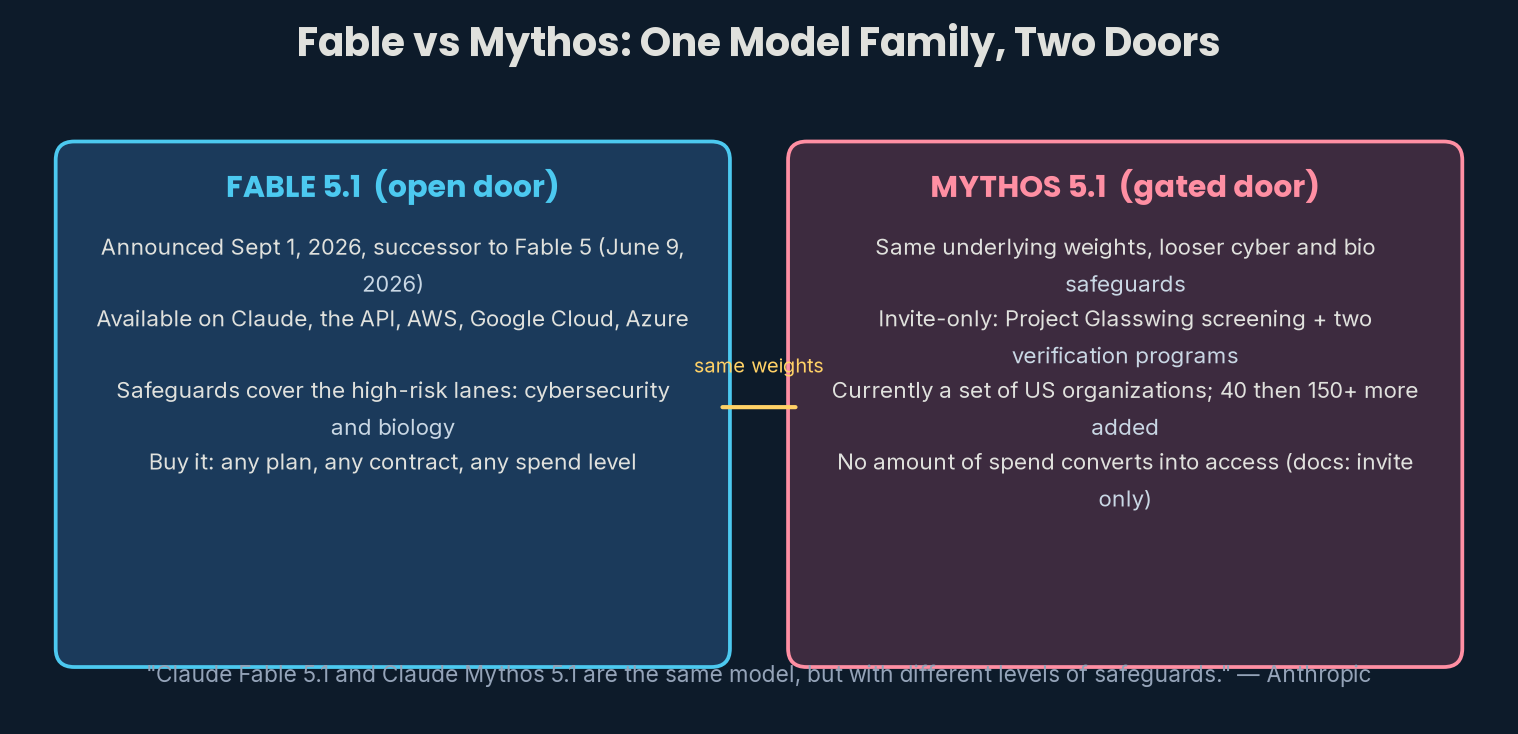
🚪 One model, two versions: Anthropic introduced Claude Fable 5.1 and Claude Mythos 5.1 in the same September 15, 2026 announcement. The company states directly that they are “the same model, but with different levels of safeguards.” Fable 5.1 is generally available; Mythos 5.1 is restricted to approved users.
- 🔓 Fable 5.1, generally available: it sells on every surface, including Claude’s own apps, the public API, AWS, Google Cloud and Microsoft Azure, with standard safeguards covering the high-risk domains of cybersecurity and biology.
- 🔒 Mythos 5.1, restricted access: it loosens selected cybersecurity and biology safeguards for vetted professionals and is available only through Anthropic’s trusted access programs, principally Project Glasswing and the Cyber Verification Program. Anthropic’s documentation states plainly that no subscription, contract or spending level converts into Mythos access on its own.
- 🪜 The expansion record: Mythos-class access moved from an initial cohort of about 40 organizations to roughly 150 across more than 15 countries, reported between April and June 2026, and the model’s availability is committed to at least September 1, 2027. Different sources describe the cohorts at different dates and stages, so the counts should be read as separate dated data points, not as a single continuous measure.
- 🧭 The practical takeaway: Fable 5.1 is the product most organizations can build on today; Mythos access is a reviewed credential. The reliable path is to build on Fable 5.1 now and treat possible Mythos access as a future upgrade, since access cannot be purchased.
The Fable vs Mythos comparison comes down to access: the two models are the same under the hood, and the main difference between Claude Fable 5.1 and Mythos 5.1 is not the underlying model. Anthropic says both versions share the same model but use different safeguards. Fable is generally available, while Mythos is restricted to approved users. In Anthropic’s own words: “Claude Fable 5.1 and Claude Mythos 5.1 are the same model, but with different levels of safeguards.” The distinction that matters is one of access: one version anyone can purchase, the other one an organization must be approved into. This article compares the two versions, explains their access requirements, and examines what the differences mean for developers and organizations considering Anthropic’s models.
The arrangement also answers a question the AI industry has been weighing this quarter: when a model is too capable to sell in an unrestricted form, what does a lab do with it? Anthropic’s answer, now documented, is neither a pause nor a secret test, it is a parallel product line with an approval process.
What each version carries
Fable 5.1 is the general-purpose flagship in the line succeeding Fable 5, which Anthropic announced on June 9, 2026 as its safeguarded broad-use model. The 5.1 keeps the same posture on the two categories the company names, cybersecurity and biology, and sells across every surface: Claude’s own apps, the public API, AWS, Google Cloud and Microsoft Azure. Pricing is covered in our Fable 5.1 explainer (the effective price reduction for typical workloads); the relevant fact here is availability: it can be built on today.
Mythos 5.1 is the same model with selected cybersecurity and biology safeguards loosened, so vetted specialists can use its full capability on genuine offensive-testing and bioscience work. Access runs through Project Glasswing, Anthropic’s controlled-rollout program, plus verification of the organization and the use case. Its documented status is “Active (invite only),” its retirement date is committed no sooner than September 1, 2027, and the access history is public: an initial set of about 40 organizations working on critical infrastructure, later reporting widened it, and per the September announcement Mythos 5.1 is currently available only to a set of US organizations while Anthropic coordinates with the US government on expanding access to domestic and international partners. One precise note: the same announcement describes a new life-sciences access program, developed in partnership with the US government, for Mythos 5.1’s advanced biology capabilities, with enrollment expected to open for scientists soon, so the biology track is a program of its own, not a Glasswing copy.
Primary sources: Anthropic’s Fable 5.1 and Mythos 5.1 announcement (September 2026), the same-model statement, the benchmark table, the pricing, the CVP registration link and the US-organization status; Anthropic’s model announcements index (the September 15, 2026 announcement date and the full release timeline); the Project Glasswing page (the April 7 consortium, the October 6 three-tier Cyber Verification Program, and the Mythos 5.1 model list); and the Fable 5.1–Mythos 5.1 system card, referenced in the announcement for the safeguard details.
How Mythos access actually works
Access to Mythos requires approval through Anthropic’s trusted access programs. Organizations cannot obtain access simply by purchasing a subscription. Three elements appear in the process on the record. First, the organization’s profile: the early cohort was dominated by critical-infrastructure operators, the institutions where cyber or bio capability has public value. Second, credentials: the Cyber Verification Program and the newer life-sciences program check who is asking and what the work is. Third, the terms: access comes with usage expectations the company can enforce, including withdrawal. What does not appear anywhere in the process is a price that purchases the tier: Anthropic’s documentation states directly that no Claude Max plan, no enterprise contract and no amount of API spending converts into Mythos access on its own.
That design is what separates Mythos from the industry’s usual premium tiers. Access reviews, the pattern our access-requirements guide covers in detail, sit on the access side for other labs too, but the Mythos arrangement is stricter in one decisive respect: the company reserves the right to decline a capability request for safety reasons while still selling the same model’s economics through the generally available version. Builders get a product; the public gets a commitment that the most sensitive capabilities ship with an approval process attached.
The timeline both versions sit on
The Fable vs Mythos split is the latest step in a documented sequence. Mythos-class models went to a small vetted set first; expanded access to roughly 150 organizations was reported in May–June 2026; Fable 5 arrived on June 9, 2026 as the safeguarded wide-use line; Opus 5 landed July 24, 2026 as the company’s classic large-tier model; the Opus 4.1 API retirement followed on August 5, 2026; and Fable 5.1 and Mythos 5.1 were announced together on September 15, 2026. The same window carries two operational notes: a July 1, 2026 export-control-related item showed even restricted access responding to policy changes, and a June 12, 2026 incident notice showed the restricted cohort running production workloads rather than demonstrations.
Read as a system: Anthropic offers different models and access arrangements depending on the capabilities involved and the safeguards required, and each step of the sequence ships a working piece of that system.
What the safeguard split says about capability and risk
The unusual part of the arrangement is administrative rather than technical: the same model carries two safeguard sets, which makes the access decision explicit and reversible in a way a single product’s fixed settings are not. A lab that ships one model with fixed safeguards has made one policy; a lab that ships two versions with an approval process between them runs a policy with a record of who holds which set. That is why verification programs rather than payment sit at the access point in the Fable vs Mythos design: enrollment is how the boundary is drawn and documented. This article describes the documented record, who holds which set is knowable from Anthropic’s disclosures, but no independent audit of individual access decisions has been published, and this article makes no such claim beyond it.
The same structure answers the “why not just delay?” question. Shipping both versions keeps the general research benefits flowing to every Fable user, while the most sensitive use is rationed through the approval process instead of by secrecy. The alternative, withholding the model entirely, protects less in expectation: the capability exists either way, and the release puts its use under documented policy.
The Fable vs Mythos comparison frame buyers should use
Benchmark differences between the two versions exist at the margin, Anthropic’s own benchmarks note that Terminal-Bench 4.0 runs 55.8% on Fable 5.1 and 60.9% on Mythos 5.1, with the gap attributed to the earlier cyber safeguards intervening rather than to capability, and with improvements expected to shrink that difference. The practical buying frame looks past those deltas and asks two questions: which access arrangement fits your work, and what does your verification posture require? A penetration-testing firm’s answer differs from a health-data platform’s, and both differ from a content team’s. The product decision behind the Fable vs Mythos split is: which of the two versions is your organization’s working model?
What to build, and how to plan around restricted access
For a developer or an enterprise security team, the planning is concrete. Today’s work: Fable 5.1, on every platform, with the standard safeguards on — and for most workloads, that is also the right capacity. The restricted work: if your organization is critical infrastructure or a life-sciences organization with genuine testing needs, the entry path is Project Glasswing and the verification programs; apply through Anthropic’s channels and expect the vetting to take longer than a procurement cycle. Organizations should avoid making restricted Mythos access essential to their products unless that access has already been approved and its continued availability is sufficiently assured. Build on Fable 5.1 so the product ships regardless, and treat any future Mythos access as an upgrade, not a dependency.
The same planning works in the other direction: do not assume the access rules are permanent. The documented expansion from the initial cohort to roughly 150 organizations is the company’s own precedent, and the committed minimum-availability date of September 1, 2027 gives teams an integration horizon — with the caveat that a model-retirement commitment is not a promise that any particular applicant will be approved.
There is also a commercial dimension worth stating plainly. The two versions support two narratives at once: subscriptions price the generally available model, and restricted access involves enterprise agreements, verification-linked arrangements and the standing that program participation carries — which is why the expansion record matters to business readers as well: each added organization is both an access decision and, in many documented cases, a commercial relationship with Anthropic. The economics and the safety administration sit in the same process, and that combination is the genuinely new element in this release.
A note on vocabulary: terms that once described models now increasingly describe access. “Frontier,” “flagship” and “restricted” describe how a model reaches users. Read announcements this way, and the release season stops blurring together. When evaluating future AI releases, compare three things: what the model can do, who can access it, and how much it costs. These factors provide a practical starting point for choosing a model, and our access-requirements guide and model-drift analysis extend the same framework across releases.
What the Fable vs Mythos split means for teams in the Philippines and beyond
Two implications sit outside the US cohort. Geography: per the September announcement, Mythos 5.1 is currently available only to a set of US organizations, while Anthropic coordinates with the US government to expand access to a broader set of domestic and international partners as quickly as possible — so the position of non-US teams is actively in motion, and teams elsewhere, including Philippine cybersecurity firms and the country’s health-research institutions, should plan on Fable 5.1 today while following the official eligibility pages for changes. Cybersecurity firms and research institutions in the Philippines can prepare for potential access by reviewing Anthropic’s eligibility requirements and strengthening their security and evaluation procedures. The verification pages are public, and they are where any change will appear first.
Second, the market structure: if the most sensitive capabilities ship through an approval process rather than a subscription, then national AI programs, security agencies and research institutions worldwide need the verification pathway, and the professional skills attached to it — evaluation discipline, documented use, auditable processes — become genuinely marketable. Anthropic’s documentation confirms the pathway exists and is public; what it does not yet confirm is any Philippine organization’s membership, and this article makes no such claim.
FAQ
Are Fable 5.1 and Mythos 5.1 the same model?
On the underlying model, yes. Anthropic states the two “are the same model, but with different levels of safeguards.” The difference ships at the safeguard level: Mythos 5.1 loosens selected cybersecurity and biology safeguards for vetted specialist use, while Fable 5.1 keeps them across general-purpose work.
Why is Claude Mythos restricted?
Because the same model without those safeguards can perform capable offensive-cyber and dangerous bioscience work, and Anthropic decided to ship that capability through an approval process rather than an open sale. Mythos 5.1 is available only through trusted access programs (principally Project Glasswing and the Cyber Verification Program), with organization and use-case verification. Per the September announcement, it is currently limited to a set of US organizations.
How does an organization get access to Mythos 5.1?
Through Project Glasswing and the verification programs Anthropic operates (the cyber track via the CVP, and a newer life-sciences track run with the US government whose enrollment opens soon). The documented expansion path: an initial cohort of about 40 critical-infrastructure organizations, later reports of roughly 150 organizations across more than 15 countries. Purchasing does not qualify an organization — Anthropic’s documentation states that no plan, contract or spending level converts into Mythos access on its own.
What is the price difference in the Fable vs Mythos comparison?
Fable 5.1 sells on every plan and platform; the effective pricing is covered in our Fable 5.1 explainer (list rates: $10 per million input tokens and $50 per million output tokens, unchanged from Fable 5, with the price reduction coming from cache-read pricing). Mythos 5.1 is not sold directly: the documentation lists its status as invite-only, with the tier unreachable by spending. One version takes money; the other takes vetting.
When did the Fable vs Mythos split start?
The documented sequence: Mythos-class access went to an initial vetted cohort, with roughly 150 organizations reported across May–June 2026; Fable 5 was announced June 9, 2026; Fable 5.1 and Mythos 5.1 were announced September 15, 2026 (the index date for the announcement; preview access under the Glasswing program began in April). Opus 5 (July 24, 2026) and the Opus 4.1 API retirement (August 5, 2026) sit on the same timeline.
Should I build my product on Mythos-level capability?
Generally no — build on Fable 5.1 so the product ships everywhere on every plan, and treat possible future Mythos access as an upgrade, not a dependency. The model’s committed minimum availability runs to at least September 1, 2027, but its access remains approval-based by design; a product that requires the restricted tier to function cannot ship reliably.
Financial Disclaimer
This article is published for general information and analysis, not as investment advice, and it names no security for purchase. Platform, program and tier decisions described here carry budgetary and operational risk, and details reflect public reporting and documentation as of the dates cited. Assess your own requirements before acting; WorldNgayon accepts no liability for decisions taken on the basis of this article.
- anthropic.com/claude-fable-and-mythos-5-1
- anthropic.com/news/models — Anthropic’s model announcements index
- anthropic.com/glasswing — the Project Glasswing page
- anthropic.com/claude-fable-5-1-mythos-5-1-system-card — the Fable 5.1–Mythos 5.1 system card
External sources linked in this article, in order of first mention. Spotted an error or a broken link? Tell us.
Cite this pagePublished Nov 8, 2026
Agron, E. (2026, November 8). Claude Fable 5.1 vs. Mythos 5.1: What’s Different and Who Can Access Them? WorldNgayon. https://worldngayon.com/fable-vs-mythos/
Agron, Edmon. “Claude Fable 5.1 vs. Mythos 5.1: What’s Different and Who Can Access Them?” WorldNgayon, 8 Nov. 2026, worldngayon.com/fable-vs-mythos/.
Agron, Edmon. “Claude Fable 5.1 vs. Mythos 5.1: What’s Different and Who Can Access Them?” WorldNgayon, November 8, 2026. https://worldngayon.com/fable-vs-mythos/.
Agron, E. (2026) ‘Claude Fable 5.1 vs. Mythos 5.1: What’s Different and Who Can Access Them?’, WorldNgayon, 8 November. Available at: https://worldngayon.com/fable-vs-mythos/.
E. Agron, “Claude Fable 5.1 vs. Mythos 5.1: What’s Different and Who Can Access Them?” WorldNgayon, Nov. 8, 2026. [Online]. Available: https://worldngayon.com/fable-vs-mythos/
@online{agron2026fablevs,
  author       = {Agron, Edmon},
  title        = {{Claude Fable 5.1 vs. Mythos 5.1: What’s Different and Who Can Access Them?}},
  year         = {2026},
  date         = {2026-11-08},
  organization = {WorldNgayon},
  url          = {https://worldngayon.com/fable-vs-mythos/},
  urldate      = {}
}TY - ELEC AU - Agron, Edmon TI - Claude Fable 5.1 vs. Mythos 5.1: What’s Different and Who Can Access Them? T2 - WorldNgayon PY - 2026 DA - 2026/11/08/ UR - https://worldngayon.com/fable-vs-mythos/ Y2 - ER -
Cite the version you read; the page may be updated. Zotero and Mendeley can also import this page directly.