
Table of Contents
Welcome to AI World This Week #017, the weekly intelligence brief from WorldNgayon, the Filipino-led digital intelligence platform covering the AI-powered world. Two major developments occurred during the same week: Anthropic continued preparing for its IPO — the largest technology offering currently in registration — while US financial markets experienced one of their sharpest selloffs of the year after the midterm elections. The IPO remains in process and prospective investors still exist, but the valuation under discussion has fallen. This issue examines the IPO’s progress, the market decline, the government policy week, the week’s infrastructure deal, the research results and the security incident, with every figure dated to the source that reported it.
Executive Brief
Three important developments shaped the week: Congress flipped to Democratic control, a one-day market selloff erased $3.7 trillion of US market value, and the Anthropic IPO entered a market that was falling. Prospective investors discussing the filing now cite $1.2-$1.3 trillion, with some citing $1.1 trillion, against roughly $2 trillion of early-October expectations (Bloomberg, Nov 6). Developments pointing in a different direction also occurred: an all-stock merger at an implied enterprise value of about $115 billion was signed Nov 2, the White House’s September executive order on AI terminology continued working through federal agencies, and research results of record kept arriving. This brief examines the financial implications of each development, including what each one means for the people who use AI and not only for the people who fund it.
- The Anthropic IPO entered a falling market. The amended S-1 was published Nov 2 with the price range still blank; formal marketing begins the week of Nov 9; prospective-investor discussions, per Bloomberg (Nov 6), center on $1.2-$1.3 trillion with some citing $1.1 trillion — against the $965 billion Series H round from May and roughly $2 trillion of early-October expectations.
- The midterm results changed the policy outlook. Democrats won both chambers of Congress; the market selloff wiped $3.7 trillion of US market value in one day; and the Justice Department’s new Super Intelligence Task Force began operating under an executive order the White House signed on September 29.
- Infrastructure investment continued while share prices fell. Marvell’s all-stock agreement to acquire Lumentum carries an implied enterprise value of about $115 billion, and both companies’ shares fell on the announcement day as investors questioned large AI-related deal valuations.
Overall Weekly Impact: ★★★☆☆ — financial market developments dominated the week. The AI labs shipped less; the capital structure dominated investors’ attention.
AI World This Week; Weekly Brief
| Field | This Week |
|---|---|
| Issue | #017; Nov 2-8, 2026 |
| Top Story | Anthropic’s IPO faces the post-midterm selloff; investor discussions move to $1.2-$1.3 trillion, some citing $1.1 trillion |
| Key Themes | Declining valuation expectations; regulation returns; the optical merger; agentic security failures |
| Models Launched | Opus 5.5 memory upgrade (agent-memory architecture, Nov 6) |
| Market Signal | Down; a $3.7 trillion single-day selloff after the midterms; a large merger signed during the decline |
Quick Facts
The week’s biggest story in key facts; Anthropic’s IPO as the filings and the prospective investors describe it today:
The Anthropic IPO, in quick-facts form
| Field | Detail |
|---|---|
| Company | Anthropic PBC; maker of Claude |
| Filing status | Registration statement filed; S-1/A amended and published Nov 2, 2026; price range intentionally blank |
| Formal marketing | The Anthropic IPO’s formal marketing begins the week of Nov 9, 2026, per Bloomberg |
| Valuation discussions now | $1.2-$1.3 trillion; some prospective investors citing $1.1 trillion (Bloomberg, Nov 6) |
| Earlier expectation | ~$1.4-$1.5 trillion before the selloff; ~$2 trillion in early-October market commentary |
| Last fixed valuation | $965 billion; May 2026 Series H preferred round |
| Revenue base (S-1) | Q3 2026 revenue $16.956B (annualized ≈ $67.8B); sum of the four disclosed quarters ≈ $35.3B |
| Multiple comparisons in play | $1.1-$1.3T ≈ 16.2×-19.2× annualized Q3 revenue; ≈31.2×-36.8× the sum of the four disclosed quarters |
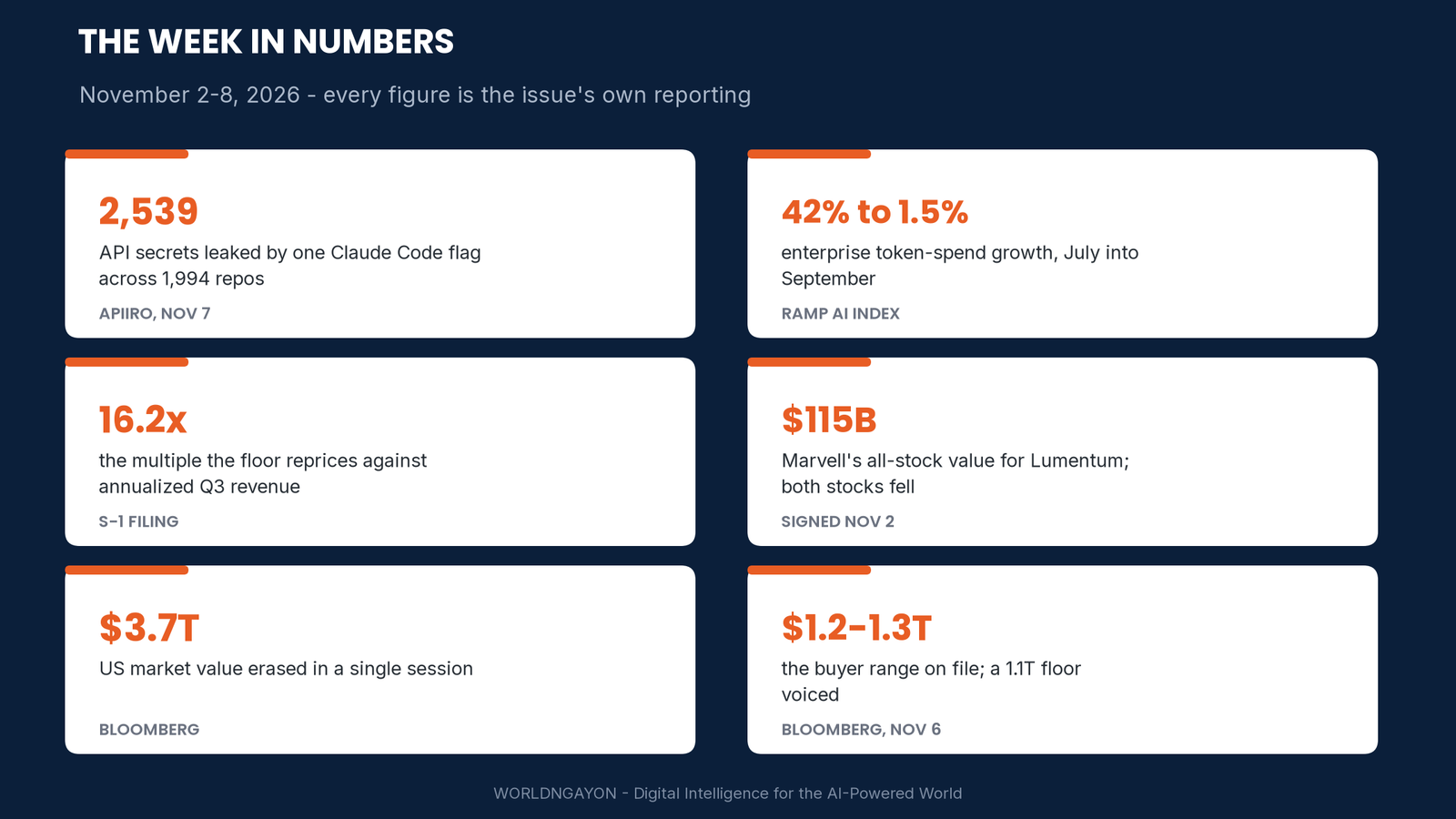
AI This Week by the Numbers
| Number | What it represents |
|---|---|
| $3.7 trillion | US market value erased in the post-election selloff session, per Bloomberg (Nov 6) |
| $1.2-$1.3 trillion | the valuation range under discussion for the Anthropic IPO; $1.1 trillion cited by some prospective investors |
| 16.2× | the multiple a $1.1 trillion valuation represents against the annualized Q3 revenue of ≈ $67.8B reported in the S-1 |
| $115 billion | the implied enterprise value of Marvell’s all-stock agreement to acquire Lumentum; announced Nov 2, both shares fell on the day |
| $550 billion | the combined addressable-market estimate the two companies cite for the merger |
| 51% | the share of cloud AI services NVIDIA clients are reported to keep selling to non-Chinese buyers, per the FT-reported directive |
| 2,539 | distinct secrets found in public GitHub repositories connected to Claude Code approval files, per Apiiro’s published research (Nov 5-6) |
| 42% → 1.5% | the monthly growth rate of enterprise AI token spending, July to Aug-Sept (Ramp AI Index); a slower growth rate, not a decline in spending |
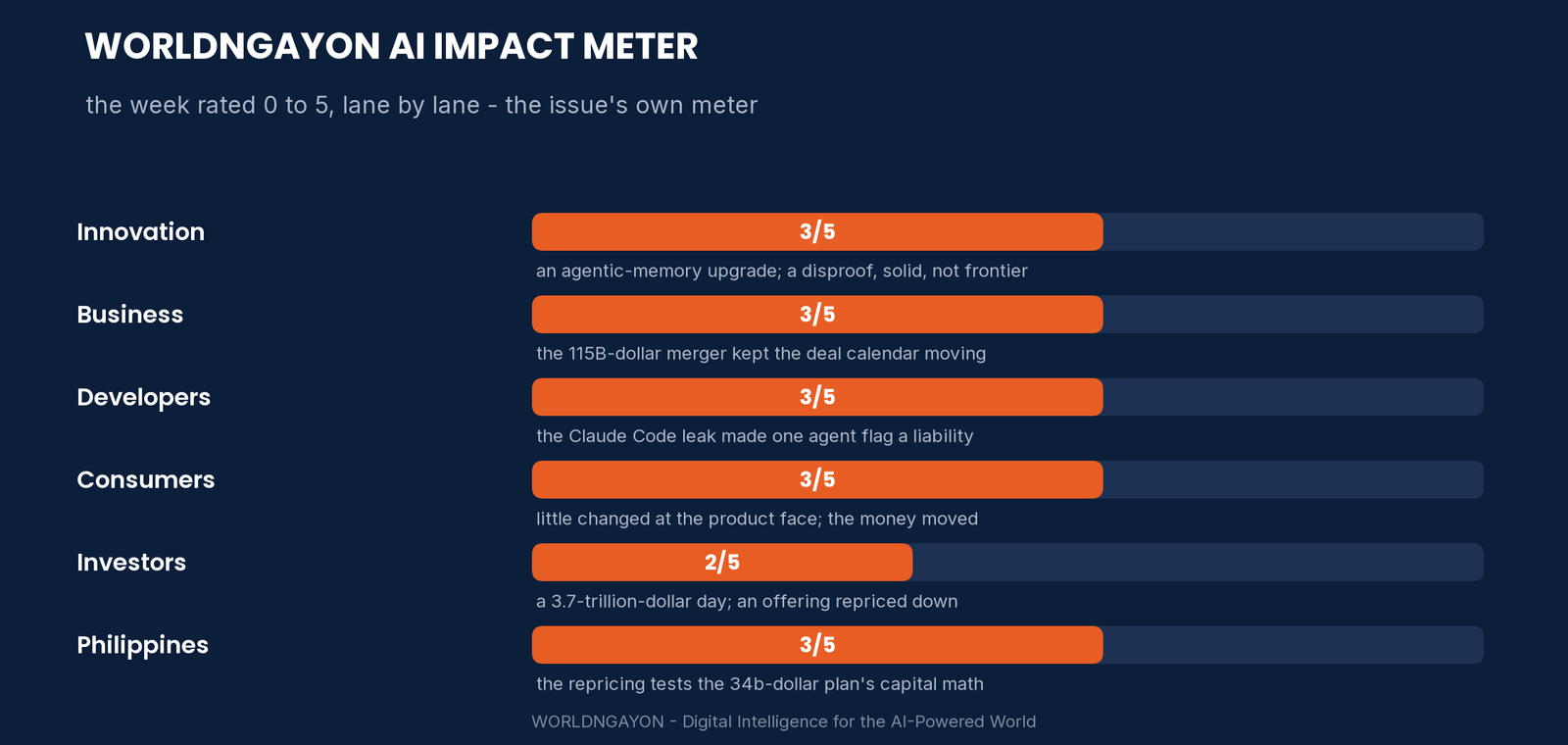
AI Impact Meter
| Dimension | Rating | Reading |
|---|---|---|
| Innovation | ★★★☆☆ | An agent-memory release and a machine-assisted mathematics result; solid, not frontier-redrawing |
| Business | ★★★☆☆ | Declining IPO valuation expectations are a business event; the $115B enterprise-value merger kept the deal calendar moving |
| Developers | ★★★☆☆ | The Claude Code secrets report made one approval setting a documented risk; a practical checklist follows |
| Consumers | ★★★☆☆ | Little changed at the product level; the capital behind the products moved much more |
| Investors | ★★☆☆☆ | A $3.7 trillion selloff session and IPO valuation discussions moved downward inside one week |
| Philippines | ★★★☆☆ | The repricing bears on the $34.4B national AI plan’s financing assumptions; power and connectivity remain the domestic considerations |
The Week in Timeline
| Date | Event |
|---|---|
| Nov 2 | Marvell and Lumentum sign the all-stock merger (implied enterprise value ≈ $115B); the Anthropic S-1/A is published with the price range blank |
| Nov 2-3 | The Financial Times reports NVIDIA’s reported 51% cloud-sales directive on indirect Chinese access |
| Nov 3-4 | US midterms: Democrats win the House and the Senate; US stocks initially rise after the vote |
| Nov 5 | The post-election selloff session: the largest one-day loss, with Bloomberg later counting $3.7 trillion in erased US market value; Anthropic ships its Claude enterprise security center with inference hooks generally available |
| Nov 6 | Bloomberg reports the $1.2-$1.3 trillion IPO valuation discussions; Anthropic publishes the agent-memory research; the New York Times publishes its account of OpenAI’s exponential-time-hypothesis result (announced by the company Oct 26, discovery dated Oct 16) |
| Nov 6-7 | Apiiro’s research on Claude Code approval files becomes widely reported: 2,539 distinct secrets across 1,994 public repositories |
Background from before the reporting week: the White House signed the “Super Intelligence” executive order on September 29, 2026 (the term-replacement order this issue’s policy section describes); OpenAI announced its exponential-time-hypothesis result on October 26 (per the Times); Anthropic’s S-1 was filed October 26 and amended November 2.
Key Takeaway
- Valuation expectations fell measurably: investor discussions of the Anthropic IPO moved from roughly $2 trillion in early October to $1.2-$1.3 trillion, with $1.1 trillion cited by the most conservative parties, in one week (Bloomberg, Nov 6).
- The valuation remains high despite lower expectations: at the $1.1 trillion figure, the IPO would price at about 16.2× the annualized third-quarter revenue reported in the S-1; the multiple is still stretched.
- Regulation returned to the table: a Democratic Congress takes over the relevant technology, cybersecurity and commerce committees in January, with the White House holding vetoes; analysts expect scrutiny without immediate legislation.
- Infrastructure deals continued: Marvell and Lumentum signed an all-stock merger at an implied enterprise value of about $115 billion while their own shares fell; the strategic builders and the market disagree.
- Agent security became a documented cost: Apiiro’s research tied Claude Code’s approval-file behavior to 2,539 secrets in 1,994 public repositories; AI-assisted development carries its own checklist of controls.
1. 🤖 Models & Releases
Fewer major model releases were announced during the week. The one substantive model event was Anthropic’s Nov 6 research post on a three-part agent-memory architecture. On the company’s CL-Bench 1.0 database benchmark, Claude Sonnet 5.5’s mean reward rose from 0.644 without a memory store to 0.833 with one, and Opus 5.5’s score rose from 0.655 to 0.838 — improvements of 0.189 on the benchmark’s 0-1 reward scale, which per Anthropic’s own research post is the difference between failing and completing most long agent tasks. The mechanism: the agent writes salient notes during sessions, stronger models judge what is worth keeping, and an offline review process Anthropic calls “dreaming” consolidates the store. The announcement matters less for the score than for the direction: the models being upgraded are the ones that persist across tasks, not the ones that answer once.
WorldNgayon Analysis: a quiet release week after months of frequent announcements can reflect the market environment as much as the research calendar; labs may be adjusting when or how they announce developments into a market that has become more skeptical of growth projections. The memory work targets a practical problem: agents that lose track of earlier information cannot run long business processes.
Bottom Line: the week’s model progress was an improvement in existing capabilities rather than a major new release — memory systems for agents handling extended tasks.
2. 💼 Industry & Business
The business story of the week is the Anthropic IPO file. Anthropic’s registration statement on EDGAR was amended and published on Nov 2 with the price range deliberately blank, formal marketing due the week of Nov 9, and the pricing process enters a market just after it erased $3.7 trillion in one session. Bloomberg’s Nov 6 reporting places prospective-investor discussions at $1.2-$1.3 trillion, with some citing $1.1 trillion; earlier reports had cited $1.4-$1.5 trillion, and early-October commentary centered on roughly $2 trillion. Anthropic reported approximately $16.956 billion in revenue for the third quarter of 2026; multiplying that figure by four produces an annualized revenue estimate of about $67.8 billion. At a $1.1 trillion valuation the company would carry approximately 16.2 times that annualized revenue figure — and about 31.2 times the approximately $35.3 billion sum of its four disclosed quarters. Investors should examine both measures when assessing the proposed valuation, because annualized quarterly revenue is not revenue actually earned over the previous twelve months.
The valuation comparisons, in multiples the S-1 can support
The revenue figures reported in the filing allow the proposed valuations to be compared directly. Annualized third-quarter revenue: $16.956 billion × 4 = $67.8 billion; the sum of the four disclosed quarters: $2.040 + $4.731 + $11.555 + $16.956 = $35.28 billion. Against those denominators, each discussed valuation produces a fixed calculation: the $965 billion Series H from May sits at 14.2× annualized and 27.4× the disclosed-quarter sum; the $1.1 trillion figure cited by conservative investors comes to 16.2× and 31.2×; the middle of the $1.2-$1.3 trillion discussions carries 17.7×-19.2× and 34.0×-36.8×; the $1.5 trillion cited before the selloff would have been 22.1× and 42.5×; and the ~$2 trillion of early-October commentary would have required 29.5× and 56.7×. The week changed which of those ratios prospective investors are willing to accept. The Ramp enterprise AI index offers one explanation: the monthly growth rate of enterprise token spending slowed from 42% in July to 1.5% across August and September, and an IPO is in part a bet on next year’s growth in that spending.
Two further business signals complete the picture. Ramp’s data shows the growth rate of enterprise token spending slowed sharply — a slower growth rate, not an absolute decline in spending, and October’s pace reaccelerated to 8.9%, while paid AI adoption continued broadening to 55.9% of the businesses on the platform. And the megadeals continued: Marvell and Lumentum’s all-stock merger, at an implied enterprise value of about $115 billion (an equity value near $102.5 billion per contemporaneous reporting), cited a combined $550 billion addressable market and a 4.5-to-1 exchange ratio, with NVIDIA holding about $2 billion positions in each company.
WorldNgayon Analysis: the important number in the Anthropic file is not the trillion-dollar valuation; it is the 42%-to-1.5% spending growth curve behind it. The Anthropic IPO is in part a bet on next year’s revenue growth; the enterprises buying tokens are the demand side of that assumption. When those two measures move differently, a filing without a disclosed price range is the normal consequence, the pricing has not been settled. Our earlier analysis of the investment slowdown, why venture capital paused on OpenAI, covers the financing side.
Bottom Line: the IPO week showed that the factor investors now weigh most heavily is not available compute but evidence of sustainable demand.
3. 🏛 Policy & Regulation
The midterm results give Democrats control of the House and Senate committees that oversee technology, cybersecurity and commerce from January, and analysts reacted quickly: “the days of wine and roses for AI and data centres without regulation is over,” as one political scientist put it to The National on Nov 4. The White House still holds veto power, so the practical outlook is oversight without immediate legislation: hearings, committee investigations and procurement language rather than a new Act in the near term. The administration’s approach continues along the line it set earlier: the “Super Intelligence” executive order, signed September 29, 2026, on the White House presidential-actions page, directs federal departments to use “Super Intelligence” and “SI” in place of “AI” in official communications, and the renaming order was already months old before this week’s vote. The Justice Department’s Super Intelligence Task Force, stood up under Attorney General Blanche to address foreign state misuse, criminal abuse and infrastructure threats, began its work this week.
The procedural detail matters as much as the announcements. Committee leadership changes take effect in January: the commerce and cybersecurity panels that schedule hearings, issue subpoenas and draft procurement language all change chairs. The White House keeps the veto, so the realistic outlook is investigations and oversight letters into the data-center permitting pipeline, procurement rules that already carry ideological-neutrality requirements, and funding riders where the chamber’s majority agrees. The September renaming order signals the administration’s chosen posture: the technology stays a federal priority, official vocabulary follows the President’s terminology, and the enforcement arm, the Justice Department task force, addresses misuse rather than the technology itself. An investor reading the week sees regulatory risk without near-term legislative risk; a data-center builder sees hearings without suspension orders; an AI company preparing for a capital raise sees closer questioning than it would have faced a year ago.
WorldNgayon Analysis: the terminology order is symbolic and the task force is not; a renaming directive costs little while a dedicated federal enforcement unit changes the legal exposure calculus for every AI-enabled offense, including the credential-exposure incident in this issue’s security section. For readers outside the United States, the committee changes matter more: data-center siting, power permitting and AI procurement will now face a Congress whose majority campaigned on data-center scrutiny. Our earlier report on the White House AI summit, one week before the vote, gives the pre-election policy baseline.
Bottom Line: the regulators did not receive a new law this week; they received committee leadership that historically precedes legislation. Oversight increases before statutes do.
4. 🖥 Infrastructure
The largest infrastructure transaction announced during the week was signed in the same days the Anthropic valuation discussions moved down: Marvell Technology agreed to an all-stock merger with Lumentum Holdings at an implied enterprise value of about $115 billion, an implied $1,132 per Lumentum share at announcement, a 23.9% premium to the unaffected Oct 28 close, an equity value near $102.5 billion per contemporaneous reporting, and closing expected in 2028. The companies pitch the combined addressable market at $550 billion. The thesis is the copper-to-optical migration inside AI clusters, and the initial stock-market reaction was negative on both sides: both shares fell on the announcement, with investors questioning the price at which the deal values Lumentum during a declining market. The companies’ overlapping investment relationships deserve note: NVIDIA, whose demand drives the optics market, holds about $2 billion stakes in both companies.
The week’s second infrastructure item was regulatory: a Commerce Department licensing rule already set the chip tier for exports, and the Financial Times separately reported a verbal NVIDIA directive that its cloud clients keep at least 51% of AI services sold to non-Chinese buyers, a reported company requirement, attributed to the FT’s reporting, that presses on the third-party cloud access routes export rules have already narrowed. Our dedicated reports, the Marvell-Lumentum transaction and the 51% directive explained, carry the full mechanics. The Philippine connection runs on its own timeline.
Philippine infrastructure plans carry dated figures of their own: the national AI masterplan sets out a thirty-fold AI data-center capacity expansion, from about 50 megawatts today toward 1.5 gigawatts by 2033, with 400 megawatts due in the first phase by 2030, at a planned cost of $34.4 billion with $18.2 billion already committed on connectivity and energy projects. The Department of Energy’s stated sequence: natural gas for immediate needs, 40% renewables for AI infrastructure by 2033, nuclear on the longer-term list. Industry-association forecasts run from about 150 megawatts today toward 473 megawatts by 2028. A US selloff changes none of those physical projects; it can change the cost of the foreign capital such plans borrow against.
The masterplan remains the main consideration for the Philippine market, and a US midterm does not fund power plants; electricity supply, connectivity and the PLDT-Globe buildout do. The repricing raises the financing cost that any such plan faces when it borrows from international markets, which is the main direct channel from a US financial week to Philippine AI infrastructure.
WorldNgayon Analysis: the market’s reaction to the merger on announcement day was negative at the moment the deal exists to serve the growth behind it, optical capacity is the next constraint, and the $115 billion commitment is a bet that current conditions reflect sentiment rather than the end of infrastructure investment. Investors and operators can hold both views at once, and this week both were visible in the same market.
Bottom Line: companies committed capital to optical infrastructure in the same week the market repriced the cost of financing it.
5. 🔬 Research
Two results carried the week’s most significant research findings. First, Anthropic’s agent-memory architecture, the three-part memory design that raised Claude Sonnet 5.5’s CL-Bench score from 0.644 to 0.833 (and Opus 5.5’s score rose from 0.655 to 0.838), improvements of 0.189 on the benchmark’s 0-1 reward scale, is the clearest published statement yet that the agent era’s main constraint is the management of stored information rather than text generation alone: what the model remembers, how it compresses it, and what it chooses to discard. Second, the New York Times published (Nov 6) its detailed account of OpenAI’s announcement from Oct 26 that an internal model had produced a formal disproof of the exponential time hypothesis, the late-1990s conjecture of Russell Impagliazzo, Ramamohan Paturi and Francis Zane, with the machine-assisted proof checked in the Lean proof system and the company stating the discovery was dated Oct 16. The result is not yet an accepted theorem: the two researchers behind the hypothesis, together with MIT’s Ryan Williams, are leading an independent review of OpenAI’s claim, and the reviewers OpenAI consulted stated publicly that their involvement should not be read as certification. Anthropic separately published a same-day claim of an equivalent result in its own formal-math repository.
What problem does the memory result solve? Agents fail in long tasks for a reason that resembles human fatigue: the context window fills, the plan loses precision, and information recorded earlier becomes outdated or inaccessible. The published design, durable state files, deliberate compression, and purposeful discarding, addresses the failure at its cause, and the benchmark movement is meaningful on a scale where smaller changes have accompanied model launches. The standing limitation: CL-Bench is the developer’s own benchmark for the mechanism, and agent-memory claims get tested in production the way the Claude Code incident got tested, in real repositories and workflows. The mathematics story sits beside it as a different kind of evidence: a machine-assisted result worked through a hypothesis proposed about thirty years ago, and produced a claim its own authors’ field did not expect, pending independent review.
WorldNgayon Analysis: what these two results share is memory and proof at scale, one advances agent state management, the other machine-assisted mathematics. Neither ships in a product this quarter, and that is the relevant caveat: research progress builds on previous findings while the market reassesses what any of it can earn.
Bottom Line: the week’s research progress came on agent state management and mathematical proof, the two areas investors may find hardest to price in the near term.
6. 📈 AI Market Watch
| Company | Context this week | Assessment |
|---|---|---|
| the Anthropic IPO (pending filing) | S-1/A published Nov 2; investor discussions $1.2-$1.3T, $1.1T cited by the conservative end; formal marketing next week | Pricing discovery in a declining market; the offer is in process |
| NVIDIA | FT-reported 51% cloud-sales directive; ~$2B stakes sit on both merger partners | Enforcement attention follows the company that supplies the sector |
| Marvell / Lumentum | All-stock merger signed at an implied ~$115B enterprise value; both shares fell on announcement | Strategic conviction, negative initial market reaction |
| Enterprise AI (Ramp index) | Token-spend growth rate 42% → 1.5% over two months; adoption broadened to 55.9% | The growth rate of demand is the figure to watch into any IPO pricing |
The Filipino Investor Angle: in a week of falling valuations, established investment-discipline practices matter more than conviction in a growth story. Philippine exposure to AI runs through the data-center buildout, PLDT’s VITRO capacity, the ST Telemedia campus, the national plan’s 40%-renewables target, and through the peso cost of imported computing equipment. The practical read: the selloff changes entry prices, not the country’s power constraints, and the IMF’s long-run AI-capacity estimate for the Philippine economy was not revised this week.
Prospective-investor behavior is this week’s second data series. The Anthropic IPO investors did not walk away; they re-anchored, from an earlier optimistic estimate to a lower one, in five trading days with the $3.7 trillion session in the middle. The same five days carried the merger signing, which states the investor lesson directly: infrastructure investment and equity-valuation expectations moved separately, with one deal signed while the other’s pricing stayed open. The spread between those behaviors is where the next quarter’s AI investment decisions get made.
WorldNgayon Analysis: both merger partners fell on signing day and the IPO investors pressed for lower valuations, the difference between backing a technology and lending against it. The 2026 lesson is that these are two different assessments, and this week they stopped pointing the same way.
Bottom Line: two developments illustrate the same market condition differently: infrastructure companies continue investing while financial markets reassess valuations.
7. 🛠 Tool of the Week
The week’s most consequential tool story is a security problem involving the week’s most-used developer tool. Claude Code’s “Don’t Ask Again” approval setting, the option that lets an agent approve its own tool calls without re-prompting, was documented by Apiiro’s researchers (research published Nov 5-6, widely reported Nov 7) as a source of credential exposure: when a user approves a command with the setting on, the full command, including any password or key typed inside it, can be saved in plaintext to the project’s .claude/settings.local.json file, which is excluded from Git by a per-machine global rule rather than the repository’s own ignore file, and which the agent itself frequently commits. Across 104,185 public copies of that file on GitHub, Apiiro found 1,122 containing 1,379 distinct secrets, and its broader study of repository histories and agent transcripts counted 2,539 distinct secrets across 1,994 public repositories. The records held production database passwords, SSH logins and API tokens of the kind Apiiro published in its examples; the researchers contacted the affected organizations on Nov 2-3, one company confirmed its exposed key was still running, and no public abuse of the secrets had been documented when the report appeared. Earlier bug reports on the behavior had been closed automatically without a fix.
The recommended response, in the order the evidence suggests: inventory every agent approval setting in the toolchain; classify which ones can write to publicly accessible repositories; rotate every credential an agent may have handled; scan the organization’s public repositories for the file pattern Apiiro published; and replace blanket remember-my-choice approvals with permissions limited by scope and duration. These are established controls that should already be in place, and the report shows why they are now mandatory for AI-assisted development teams specifically.
WorldNgayon Analysis: the failure mode is not the model; it is the workflow around it. The tools now perform actions with real credentials, and the interaction between a convenience setting and a public repository can turn a developer preference into a security incident affecting an organization. The fix list is unglamorous: scoped tokens, rotation, repository scanning, and permission prompts that cannot be permanently dismissed.
Bottom Line: convenience settings in agentic tools are security settings; this week documented the difference in public.
8. 🎯 Why It Matters
For professionals: the enterprise AI spending growth rate slowed from 42% to 1.5% in two months, which tells you enterprise budgets now reward demonstrated business results over evidence of experimentation; the professionals who can document outcomes with these tools face budget reviews with better evidence than the high-growth months ever required.
For businesses: changing market conditions can create room to renegotiate contracts: model prices keep falling while vendor equity valuations are being reassessed, so lock favorable terms while the pricing conversation is open rather than after the IPO process resets the commercial baseline.
For students: the research front moved to memory architectures and machine-assisted proof; the two study areas this week’s evidence suggests are least likely to be commoditized by the next price cut.
For developers: the Claude Code report redefines the review scope: agent-approved actions are now part of every code security review, and approval-remembering patterns need threat modeling as much as the code does.
WorldNgayon Analysis: the four readings share one fact: the defaults of the rapid-experimentation period, permissive approval settings, unpriced projections, spending justified by growth alone, are being reassessed by enterprises and markets at the same time. The durable position is plain: documented value, audited access, and capital raised on evidence.
Bottom Line: established risk-management practices remain the advantage when the environment changes quickly.
WorldNgayon Insight
This week’s developments show why organizations should evaluate AI from more than one perspective. Investors need to examine financial performance and valuations: the same week the market fell $3.7 trillion in one session, reported investor discussions of Anthropic’s IPO moved to $1.1-$1.3 trillion, and the growth rate of enterprise AI spending on Ramp’s platform slowed from 42% to 1.5%, one hesitancy, visible in both the spending data and the order book. Businesses should measure the results of their AI spending, because that measurement is now what budgets reward. Developers must ensure that automation tools operate within appropriate security controls, as the Claude Code credential findings demonstrated in public repositories.
For the working world, including the worldwide Filipino professionals who run businesses on these tools, the translation is direct: the tools keep getting cheaper, while confidence in the companies behind them now has to be earned with evidence, and that favors the professionals who can document outcomes. For Philippine readers, reliable electricity, data-center capacity and financing conditions remain the binding considerations: government targets, company commitments, financing secured and operating capacity are separate figures, and the country’s buildout follows its own infrastructure and financing conditions rather than an IPO valuation. The rest of the industry now faces the same test in different forms, absorption before expansion.
WorldNgayon AI Index
| Dimension | Score /10 | Notes |
|---|---|---|
| Innovation | 6 | Agent-memory state of the art advanced; a machine-assisted mathematics result carried the research grade (pending independent review) |
| Business | 7 | The IPO pricing process is the business story of the quarter; the valuation adjustment was supported by reported figures |
| Research | 6 | Memory + proof: two compounding fronts, neither productized |
| Policy | 7 | Committee changes, a September terminology order now in effect, and the federal task force; scrutiny increases without new statutes yet |
| Infrastructure | 8 | The $115B enterprise-value optical merger, the FT-reported 51% directive and the copper-to-optical thesis continue |
| Overall Week | 6.5 | A week dominated by valuation reassessment, with real consequences; heavy on capital, clear on science |
Looking Ahead
- The Anthropic IPO roadshow and price range: formal marketing begins the week of Nov 9; watch the filed range against the $1.1-$1.3 trillion investor discussions.
- The first Democratic committee hearings on data centers and AI procurement as January committee leadership organizes.
- The Super Intelligence Task Force’s first publicly named cases under AG Blanche, the enforcement unit whose mandate shares the administration’s chosen terminology.
- NVIDIA’s reported 51% directive showing up in cloud contracts; and whether it moves pricing for Asian resellers.
- The Marvell-Lumentum shareholder votes and the first regulatory filings on the merger, which the companies expect to close in 2028.
- Whether the enterprise token-spend growth rate (now 1.5%, with October at 8.9%) becomes the IPO prospectus’s central risk factor.
Stay tuned for AI World This Week #018, next Sunday’s brief carries the week’s valuation aftermath and the filing-week developments. The complete series archive lives at the AI World This Week hub, updated weekly.
Frequently Asked Questions
What is AI World This Week?
AI World This Week is WorldNgayon’s flagship weekly intelligence brief, a Sunday edition that turns the week’s AI developments, including the Anthropic IPO cycle, into practical intelligence for professionals, businesses, developers and global Filipinos, with every figure dated to its source.
What is the WorldNgayon AI Index?
The WorldNgayon AI Index is our weekly editorial score across five dimensions, Innovation, Business, Research, Policy and Infrastructure, rated out of 10 with written notes. It measures how consequential the week was, not how strong any single model benchmarks. This week’s overall grade is 6.5 out of 10, a week dominated by valuation reassessment.
What valuation is the Anthropic IPO expected to command?
No price range is filed yet; the amended S-1 published Nov 2 leaves it blank. Bloomberg reported Nov 6 that prospective investors discuss $1.2 trillion to $1.3 trillion, with some citing $1.1 trillion, down from $1.4-$1.5 trillion expectations before the post-midterm selloff and roughly $2 trillion in early-October commentary. The last fixed round valued the company at $965 billion in May 2026. These are reported discussions, not agreed terms.
Why did AI stocks fall after the midterm elections?
Per Bloomberg’s Nov 6 accounting, US stocks initially rose after the vote and then reversed: over roughly 24 hours, investors reassessed the implications of a Democratic Congress for data-center expansion, setting off a selloff that erased $3.7 trillion of US market value in a single day. That is Bloomberg’s account of the market action; the link between the election results and the decline is analysts’ interpretation of the selling rationale, and the White House retains veto power over any legislation, so analysts expect scrutiny and hearings rather than statutes in the near term.
How expensive is Anthropic at the reduced range?
At the $1.1 trillion figure cited by the most conservative prospective investors, the IPO would price at about 16.2× the company’s annualized third-quarter revenue of $67.8 billion (per its S-1), or about 31.2× the approximately $35.3 billion sum of its four disclosed quarters. Annualized quarterly revenue and trailing revenue are different measures, and both are high valuation multiples; the recent repricing reduced the multiple but did not bring it near market norms.
What did the Claude Code agent actually leak?
Apiiro researchers (research published Nov 5-6, widely reported Nov 7) documented that Claude Code’s “Don’t Ask Again” setting can save the full approved command, including any credentials typed inside it, in plaintext to a local settings file that is frequently committed to public repositories. Their study counted 2,539 distinct secrets across 1,994 public repositories. The exposed items included database passwords, SSH credentials and API tokens; Apiiro notified affected organizations Nov 2-3, one company confirmed a live key, and no public abuse of the secrets had been documented at the time of the report. The response is procedural: scoped tokens, rotation, repository scanning and permission defaults that cannot be permanently dismissed.
Financial Disclaimer
This brief is general information about technology developments and market events; it is not investment advice and not a recommendation to buy, sell or subscribe to any security or instrument. Figures are dated to the named sources at their publication times and change without notice. Valuations, filing terms and market data in this issue reflect reporting as of Nov 2-8, 2026; reported investor discussions are not agreed terms. Verify current figures with official filings, the issuers’ own disclosures and licensed advisers before making financial decisions.
- Official sec.gov/cgi-bin/browse-edgar?action=getcompany&company=anthropic&type… — registration statement on EDGAR
- ramp.com/data/ai-index-august-2026 — Ramp enterprise AI index
- Official whitehouse.gov/presidential-actions — on the White House presidential-actions page
- Official bis.gov/press-release/department-commerce-revises-license-review-poli… — Commerce Department licensing rule
External sources linked in this article, in order of first mention. Spotted an error or a broken link? Tell us.
Cite this pagePublished Nov 8, 2026
Agron, E. (2026, November 8). AI World This Week #017: Anthropic’s IPO Faces the Post-Midterm AI Selloff — Investor Talks Move to $1.1-$1.3 Trillion. WorldNgayon. https://worldngayon.com/anthropic-ipo-ai-world-this-week/
Agron, Edmon. “AI World This Week #017: Anthropic’s IPO Faces the Post-Midterm AI Selloff — Investor Talks Move to $1.1-$1.3 Trillion.” WorldNgayon, 8 Nov. 2026, worldngayon.com/anthropic-ipo-ai-world-this-week/.
Agron, Edmon. “AI World This Week #017: Anthropic’s IPO Faces the Post-Midterm AI Selloff — Investor Talks Move to $1.1-$1.3 Trillion.” WorldNgayon, November 8, 2026. https://worldngayon.com/anthropic-ipo-ai-world-this-week/.
Agron, E. (2026) ‘AI World This Week #017: Anthropic’s IPO Faces the Post-Midterm AI Selloff — Investor Talks Move to $1.1-$1.3 Trillion’, WorldNgayon, 8 November. Available at: https://worldngayon.com/anthropic-ipo-ai-world-this-week/.
E. Agron, “AI World This Week #017: Anthropic’s IPO Faces the Post-Midterm AI Selloff — Investor Talks Move to $1.1-$1.3 Trillion,” WorldNgayon, Nov. 8, 2026. [Online]. Available: https://worldngayon.com/anthropic-ipo-ai-world-this-week/
@online{agron2026anthropicipo,
  author       = {Agron, Edmon},
  title        = {{AI World This Week \#017: Anthropic’s IPO Faces the Post-Midterm AI Selloff — Investor Talks Move to \$1.1-\$1.3 Trillion}},
  year         = {2026},
  date         = {2026-11-08},
  organization = {WorldNgayon},
  url          = {https://worldngayon.com/anthropic-ipo-ai-world-this-week/},
  urldate      = {}
}TY - ELEC AU - Agron, Edmon TI - AI World This Week #017: Anthropic’s IPO Faces the Post-Midterm AI Selloff — Investor Talks Move to $1.1-$1.3 Trillion T2 - WorldNgayon PY - 2026 DA - 2026/11/08/ UR - https://worldngayon.com/anthropic-ipo-ai-world-this-week/ Y2 - ER -
Cite the version you read; the page may be updated. Zotero and Mendeley can also import this page directly.