
Key Takeaway
The Anthropic Run Rate record is below in one figure, two ledgers and six dated marks — every number sourced.
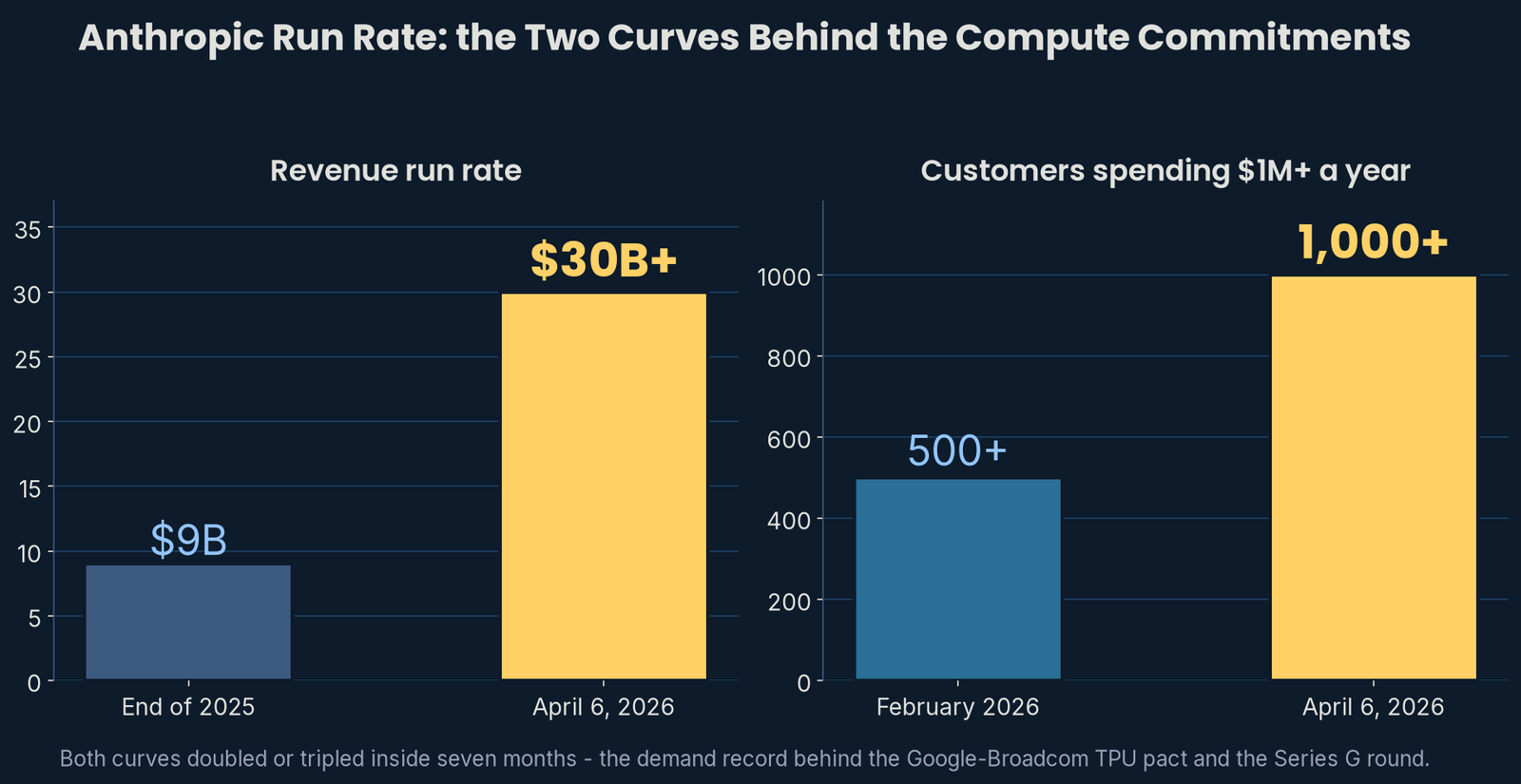
📈 9 to 30 in a year: the run-rate revenue passed $9 billion at the end of 2025 and $30 billion at the April 6, 2026 announcement — a threefold jump in roughly a single quarter.
- 🧾 First dollar to $30 billion in under 3 years: Anthropic says its first dollar of revenue came within the last three years, which makes the curve steeper than any big-tech subscription business on the same span.
- 🏦 $1,000 customers: the cohort of businesses spending over $1 million a year crossed 1,000 in April, double the “over 500” count from the February Series G announcement.
- 💰 $30 billion raised at $380 billion: the February round — led by GIC and Coatue, with Microsoft’s and NVIDIA’s earlier investments rolled in — bankrolled the compute posture that followed.
- 🏆 First-purchase leadership: recent data cited in deal coverage put Anthropic at more than 73 percent of spending among first-time buyers of AI tools — the segment where habits form.
The Anthropic Run Rate is the single number that moves everything else in this industry: revenue growth, doubled and tripled on the record. On April 6, 2026, Anthropic disclosed that its run-rate revenue had passed $30 billion. Seven months before that, at the end of 2025, the same figure stood near nine billion. This guide walks the whole Anthropic Run Rate curve, dated and sourced, the way an analyst would read it: the run-rate records, the customer cohort that doubled in two months, the funding that paid for the compute, and the deployment count that shows where the revenue actually comes from (the connectors layer we covered in the enterprise agents guide).
The Anthropic Run Rate matters because it prices the industry’s biggest commitments. The same April 6 announcement carried the company’s largest compute deal — the multi-gigawatt Google-Broadcom pact, in which a separate Broadcom filing spelled out roughly 3.5 gigawatts of next-generation TPU capacity beginning 2027. A $30 billion revenue curve is what makes that contract a rational purchase instead of a leap. Reading the two ledgers side by side is how to understand where this market is going.
The run-rate record, dated
Three dated anchors are on the record. At the end of 2025, run-rate revenue stood at approximately $9 billion. On February 24 — with the Series G round — the company disclosed that more than 500 business customers were each spending over $1 million on an annualized basis. On April 6, 2026, the run rate passed $30 billion and the same customer cohort passed 1,000 — “doubling in less than two months,” in the words of the announcement.
Two context points sharpen the Anthropic Run Rate curve. Anthropic noted in the Series G release that it had earned its first dollar of revenue less than three years earlier, so the curve compresses a decade of the usual subscription ramp into roughly 36 months. And the enterprise deployment numbers show the revenue is not a consumer bubble: KPMG’s Digital Gateway reaches 276,000 professionals, PwC is certifying 30,000 staff on the platform, and TCS is giving 50,000 employees access — the same enterprises counted in the cohort figures above.
The $30 billion round that bankrolled it
The Series G round closed in February 2026: $30 billion raised, at a $380 billion post-money valuation, led by GIC and Coatue, and co-led by D. E. Shaw Ventures, Dragoneer, Founders Fund, ICONIQ and MGX. The investor list runs from Accel and Sequoia through Fidelity, BlackRock-affiliated funds and JPMorganChase — and the round includes a portion of the investments Microsoft and NVIDIA had already announced. The company’s CFO, Krishna Rao, framed the round directly: the message from customers, he said, is that Claude is increasingly critical to how businesses work.
The round’s purpose is visible in what the company did with the two Anthropic Run Rate months that followed: the March and April compute commitments — from the TPU pact to the $50 billion American-infrastructure program it extends — are the spending that a $30 billion round was raised to stand behind. Market reports by October placed the valuation conversation still higher; AI Magazine reported figures near $965 billion, a number that reflects how quickly the demand curve re-prices the whole company.
Where the revenue is coming from
The deployment ledger names the customers behind the run rate. KPMG built its Digital Gateway on Microsoft Azure — the rollout that reaches all 276,000 professionals — and Anthropic named the firm a preferred consulting partner in private equity. PwC’s certification program reaches hundreds of thousands of staff with 30,000 certified so far. TCS is putting 50,000 employees on the platform. Barclays expanded a strategic collaboration to bring enterprise-grade systems across its global operations as of October 1, 2026, and the company opened a Singapore office with a government memorandum on responsible adoption as of October 14, 2026.
The first-purchase market is the more telling number. SiliconRepublic’s deal coverage cited recent data showing Anthropic capturing more than 73 percent of spending among companies buying AI tools for the first time, with the runner-up near 27 percent. The first-purchase market is where habits and integration choices form, and the lead there compounds: an enterprise’s first agent integration tends to define who the second one goes through.
The demand curve also explains the Anthropic Run Rate’s compute posture. The February investor ledger and the April 3.5-gigawatt TPU agreement are two halves of one arithmetic: the revenue grows, the cohort doubles, so the capacity commitment is a hedge against the company’s own growth — the compute race we mapped in the sovereign AI guide. An Anthropic Run Rate that grows threefold does not slow the compute purchase down — it is the reason the compute purchase accelerates.
What a run rate is — and what it is not
Because the Anthropic Run Rate number will recur in headlines all year, the definition deserves its own paragraph. A run rate is the most recent month’s revenue multiplied out to a full year — a straight-line projection, nothing more. It is the number a company quotes when growth is the story, because a growing company’s yesterday is always smaller than its tomorrow. It is not booked revenue, not billed cash, and not a contract: a customer who signed a July order already counted is different from a monthly figure that assumed it. None of that makes the number dishonest; it makes it directional — and the discipline is to read it with its companions: bookings, retention, and the cohort counts above.
The same paragraph explains why the cohort matters as much as the total. A run rate can jump on one large deal; a cohort of a thousand businesses each spending seven figures cannot be manufactured by a single contract. When the cohort and the total move together — as they did between February and April — the curve is broad-based. When they ever diverge, the headline is a concentration story, and the reading changes accordingly. That pairing check takes two minutes and answers the question every reader of a growth number should ask: is the demand wide or deep, and is that the same thing this time?
What the curve says about the next 12 months
Three readings of the Anthropic Run Rate are on the record, and each one moves a different line. First, the cohort: two doublings inside two months implies an enterprise rollout pattern where multi-seat deployment is the default motion, so the Anthropic Run Rate watch-list starts with the certification programs and the seat counts of the Big Four-class partners — the visible proxies for cohort growth. Second, the compute ledger: capacity that comes online starting in 2027 is being sold against a curve measured in months; if the curve holds, the 2027 allocation is already spoken for, which is what the conditioning clauses in the supply contracts quietly assume. Third, the talent pipeline: the $100 million Frontier Academy is training ten thousand deployment engineers by the end of 2027, with cohorts from Accenture, Bain, Deloitte, McKinsey, Morgan Stanley and Novo Nordisk already underway — the company converting its revenue into an ecosystem that reinforces the run rate. Fourth, the price card: a market leader with $30 billion of committed demand carries pricing power that consumer-facing rivals cannot match — the enterprise motion funds the frontier model, which is the part of the stack that keeps the lead.
The risk line runs through the same curve: a demand-priced supply contract means the commitments reprice if the growth pauses. That is the bet the Anthropic Run Rate curve has named in its own filings, and it is why the demand ledger — not the technology — is the number to watch.
What the Anthropic Run Rate curve means for businesses watching from the Philippines and beyond
The curve reaches Filipino readers through three channels. First, the employer channel: the Big Four-class deployments above operate in the country’s service centers, and the seat counts behind them include Philippine teams — the demand curve is what keeps the tools those teams use fast and priced. Second, the cost channel: local agencies and startups running enterprise AI on dollar billing carry the same FX exposure every dollar-priced tool brings; a run rate this size is ultimately what funds the price stability those monthly bills depend on. Third, the market channel: a first-purchase split of 73 to 27 means the choices Philippine enterprises make in their first agent integration tilt where the market already goes — and for the developers inside those teams, being fluent in the platform the market chose is the credential the next contract asks for.
There is a fourth channel that shows the industry’s ground truth about Philippine talent: the $100 million Frontier Academy program — cohorts from Accenture, Bain, Deloitte, McKinsey, Morgan Stanley and Novo Nordisk already underway — is building a profession of deployment engineers because enterprises keep demanding them. The demand curve is not only about revenue; it is about where a decade of AI infrastructure careers will sit, and the Philippine services sector is inside that addressable market.
How to read the next Anthropic Run Rate announcement
The grammar this guide has used is the reading kit for every future Anthropic Run Rate post: date the anchors, convert every adjective to numbers, find the cohort figure and the customer count, price the compute against the curve, and name the deployment rolls that carry the revenue. The next disclosure will be read the same way here, and the Anthropic Run Rate comparisons the record makes possible — cohort-to-run-rate, revenue-to-capacity, quarter-to-quarter — are the ones that separate a growth story from a spending story. When the next number lands, the first question to ask is not how big the curve has become; it is whether the cohort behind it still doubles.
Financial Disclaimer
This article is published for general information and analysis, not as investment advice, and it does not recommend buying or selling any security. Anthropic is a private company; the valuation and run-rate figures cited reflect company disclosures and public reporting as of their dates and can change without notice. Private-company valuations are negotiated marks, not exchange-settled prices, and they carry liquidity and reassessment risk. Consult a licensed professional before making financial decisions; WorldNgayon accepts no liability for decisions taken on the basis of this article.
FAQ
What is Anthropic’s revenue run rate in 2026?
The company disclosed that its run-rate revenue passed $30 billion at the April 6, 2026 announcement, up from approximately $9 billion at the end of 2025. The company also noted it had earned its first dollar of revenue less than three years earlier, which frames how steep the curve has been over that span.
What is the Anthropic Run Rate behind the Series G valuation?
The $30 billion financing closed at a $380 billion post-money valuation in February 2026, led by GIC and Coatue. The round priced both the $9 billion run rate at the time and the demand curve behind it — the same curve that doubled the million-dollar customer cohort to over 1,000 within two months of the round.
How fast are Anthropic’s big customers growing?
Business customers each spending more than $1 million on an annualized basis crossed 1,000 as of April 6, 2026 — double the “over 500” figure the company gave with the Series G announcement two months earlier. In the same window, run-rate revenue more than tripled.
Is the run rate mostly enterprise or consumer revenue?
The deployments on the record are enterprise-weighted: KPMG’s Digital Gateway reaches 276,000 professionals, PwC is certifying 30,000 staff, TCS is giving 50,000 employees access, and Barclays brought enterprise-grade systems across its global operations in October 2026. Coverage of the deal also cited first-purchase data showing Anthropic leading that market at more than 73 percent of spend.
What does the Anthropic Run Rate mean for its compute deals?
The demand curve justifies them. A run rate growing threefold in a year is what makes a multi-gigawatt TPU commitment — approximately 3.5 gigawatts through Broadcom’s filing, beginning 2027 — a rational purchase, and the supply contracts price consumption to the company’s continued commercial success, which the filings say plainly.
Is Anthropic public, and can investors buy its run-rate story?
Anthropic is a private company; the $380 billion post-money figure is a round price, not a traded market price. Investors get exposure indirectly — through the listed enterprises deploying the platform or the public tech companies invested in it. Any valuation marks that appear in later reporting are estimates of private-market pricing, not settled market values.
- anthropic.com/news/google-broadcom-partnership-compute — run-rate revenue had passed $30 billion
- anthropic.com/news/anthropic-raises-30-billion-series-g-funding-380-b…
- aimagazine.com/news/anthropic-claude-enterprise-ai-agents-and-965bn-v… — AI Magazine reported figures near $965 billion
- siliconrepublic.com/machines/anthropic-google-broadcom-announce-3-5gw… — SiliconRepublic’s deal coverage cited recent data
External sources linked in this article, in order of first mention. Spotted an error or a broken link? Tell us.
Cite this pagePublished Nov 6, 2026
Agron, E. (2026, November 6). Anthropic’s Run Rate: from 9 to 30 Billion in a Year, the Demand Curve Explained. WorldNgayon. https://worldngayon.com/anthropic-run-rate/
Agron, Edmon. “Anthropic’s Run Rate: from 9 to 30 Billion in a Year, the Demand Curve Explained.” WorldNgayon, 6 Nov. 2026, worldngayon.com/anthropic-run-rate/.
Agron, Edmon. “Anthropic’s Run Rate: from 9 to 30 Billion in a Year, the Demand Curve Explained.” WorldNgayon, November 6, 2026. https://worldngayon.com/anthropic-run-rate/.
Agron, E. (2026) ‘Anthropic’s Run Rate: from 9 to 30 Billion in a Year, the Demand Curve Explained’, WorldNgayon, 6 November. Available at: https://worldngayon.com/anthropic-run-rate/.
E. Agron, “Anthropic’s Run Rate: from 9 to 30 Billion in a Year, the Demand Curve Explained,” WorldNgayon, Nov. 6, 2026. [Online]. Available: https://worldngayon.com/anthropic-run-rate/
@online{agron2026anthropicrun,
  author       = {Agron, Edmon},
  title        = {{Anthropic’s Run Rate: from 9 to 30 Billion in a Year, the Demand Curve Explained}},
  year         = {2026},
  date         = {2026-11-06},
  organization = {WorldNgayon},
  url          = {https://worldngayon.com/anthropic-run-rate/},
  urldate      = {}
}TY - ELEC AU - Agron, Edmon TI - Anthropic’s Run Rate: from 9 to 30 Billion in a Year, the Demand Curve Explained T2 - WorldNgayon PY - 2026 DA - 2026/11/06/ UR - https://worldngayon.com/anthropic-run-rate/ Y2 - ER -
Cite the version you read; the page may be updated. Zotero and Mendeley can also import this page directly.