Air-Traffic Ransomware Is Here: What the ATNS Incident Teaches Every Traveler and Every Business
Key Takeaway
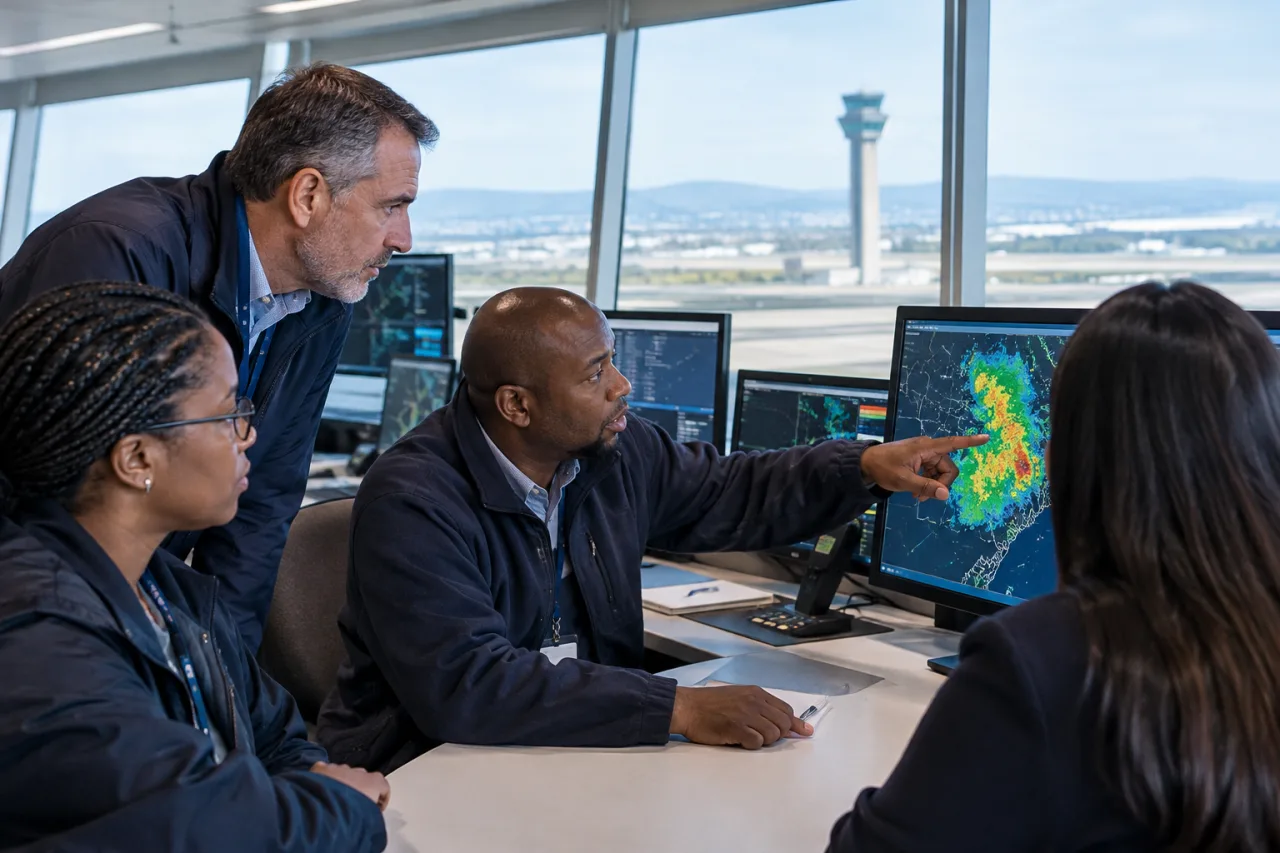
✈️ Air traffic ransomware arrived in the most boring room of the airport: South Africa’s ATNS — the state-owned operator managing roughly 10% of global airspace — found ransomware-linked malware inside its operational-technology network supporting weather services, not in the flight systems the headlines imagine; the contained incident is the sector’s clearest OT lesson yet.
🌦️ The attack vector was weather, not radar: the compromise surfaced in facilities at Port Elizabeth and potentially East London, with preliminary findings pointing to data exfiltration to external IP addresses in China — the aviation sector’s ransomware reality rising sixfold in 2025, aimed at the support infrastructure that keeps everything flying safely.
🛫 The traveler takeaway is not panic, it’s preparation: the incident was contained with no flight disruptions reported — and the traveler-ready checklist (airline push alerts on, rebooking rules known, the two-hour buffer, offline confirmations) is the same disruption readiness sea and rail operators’ incidents have been teaching all along.
🏢 The business takeaway is the boring-device doctrine: attackers reach operational and support systems (weather feeds, CCTV, HVAC, signage) precisely because nobody checks them — the same principle every edge-device guide in this series preaches, now proven on a national aviation network.
🧯 The recovery lesson runs two directions: ATNS’s own response — containment first, forensics second, transparency as the case proceeds — matches the discipline the incident-response playbooks run on any scale, and the investigation’s outcome (root cause, extent, remaining risk) becomes the sector’s template for what operational containment actually looks like.
Table of Contents
air traffic ransomware is now a documented thing, and the ATNS air traffic ransomware incident arrived exactly where the security textbooks said it would: not in the radar room, but in the operational-technology edges that nobody watches — weather-service systems supporting air-traffic control at South Africa’s ATNS, the state-owned operator responsible for roughly 10% of the world’s airspace. The incident was contained, flights were not disrupted, and the investigation continues — but the lesson set is complete enough to teach: why OT networks (not the IT systems everyone already protects) are this decade’s aviation targets, what the boring-device doctrine means for airports and for your home office alike, the traveler’s disruption checklist the incident validates, and the recovery discipline every operator at every scale can copy from ATNS’s playbook. This guide works the whole lesson stack — because the incident’s real value is the checklist it handed every traveler and every business that depends on infrastructure that has an operator somewhere behind it.
What OT Means: the Layer You Never See and the One That Moves Planes
The terminology is worth one paragraph, because the whole lesson lives in it. IT — information technology — is the office layer: email, payroll, the ticketing systems the security industry has spent thirty years reinforcing. OT — operational technology — is the run-the-thing layer: the sensors, controllers, and feeds that make physical processes actually work, from a factory’s line to an airport’s weather ingestion. The layers meet almost nowhere and that’s exactly the strategy: OT runs on equipment built before the internet, patched on industrial lifecycles measured in years, and connected to monitoring that stops where the machine hall begins. The air traffic ransomware incident found its home precisely in that gap — the weather-feed systems that support control but aren’t the control room itself. The lesson generalizes to every operation (factory, hotel, grocery chain, clinic): map the OT layer, because the organization’s real exposure is usually one forgotten subnet away from where the security budget goes.
The air traffic ransomware era also adds the traveler-facing frame the IT-only lens missed: every one of these systems is the difference between a normal Tuesday and an airport’s worst day, and the public reporting of the ATNS case — contained, transparent, preliminary-flagged — is the first time travelers got to see an OT incident handled the way the textbooks always described. The case is worth studying at every level of the stack: the operator (containment that held), the sector (the sixfold rise these years priced), and the traveler (the checklist whose readiness no disruption can outpace).
Air Traffic Ransomware: the ATNS Incident in Plain Terms
Why Operational Technology Is the New Aviation Target
OT — the operational-technology layer running weather feeds, building controls, CCTV, signage, and the thousands of non-ticket devices an airport depends on — is targeted for reasons the guide series has documented at every scale: these systems were built before the internet, run for decades between updates, and sit behind access nobody reviews. The ATNS incident adds the strategic layer: the disruption potential (grounded or degraded air traffic) gives the attack a visibility value that pure data theft never carries, and the preliminary exfiltration findings show the intelligence-collection value riding the same compromise. The sixfold rise in aviation ransomware lives on exactly this asymmetry — the defender’s patch backlog (decades of OT updates) meets the attacker’s price motivation (a headline per successful hit) — and the boring-device doctrine, which home offices meet in the edge-device security guide and the router-password piece, is the same lesson at domestic scale: the forgotten device is the door, whether it’s your CCTV or a national weather feed.
The Traveler’s Disruption Checklist: What OT Incidents Mean for Your Trip
The air traffic ransomware lesson for travelers needs no technical layer at all — just the readiness habits every disruption scenario rewards. The alert layer: airline and booking-app push notifications ON (the first official word of delays reaches your phone before the departure-board queues do), and the airline’s rebooking rules known in advance — the same readiness the travel-lane guides teach at departure — the flexible-rebooking tiers most carriers sell now exist precisely because operational disruptions happen for reasons passengers never control. The time layer: the buffer habit (connections that survive a two-hour system failure are the ones that survive OT incidents too), and the offline layer: the booking confirmation screenshot and the local copy of the itinerary, the same evidence-pack habit the scam guides teach for a better reason — when systems degrade, the air traffic ransomware era’s travelers who hold their own records rebook in minutes. The mindset layer: no panic buys for “airport cybersecurity problems” (the incident class doesn’t sell you things), and no social-media forwarding of unverified “airport hacked” posts — the confirmed sources first, the rumor mill never. The ATNS case stayed contained; the checklist exists for the one that doesn’t.
The Business Layer: Every Operator Is Somebody’s Infrastructure
The air traffic ransomware lesson for business readers from ATNS is the operator’s own checklist, scaled down but never scaled out of relevance. The OT inventory first: the systems your operation runs that “nobody checks” — building controls, cameras, signage, the service feeds your customers experience as your reliability — inventoried, networked consciously, and updated on their own lifecycle. The segment layer: OT and IT networks run segmented (the containment that kept ATNS’s incident to meteorological workflows is the architecture lesson — a compromise in one zone must never mean a compromise in every zone). The vendor layer: OT platforms come with the same third-party access the MSP-breach guides dissect — standing connections that need the same MFA, scoping, and patch-velocity vetting. And the rehearsal layer: the incident-response playbook’s containment-first discipline, run as tabletop before the day it’s needed — ATNS’s own response sequence (contain, then forensics, then investigation transparency) is the template every scale copies.
The Recovery Discipline: What ATNS Got Right, and What Remains
The air traffic ransomware response sequence in the reporting deserves its own reading, because it’s the part every operator can copy today. Containment FIRST: the technical team’s immediate containment of the malware before the forensics firms arrived — the order of operations that decides whether an incident is an event or a career. Forensics SECOND: external cyber-forensics brought in to investigate root cause, extent of compromise, and remaining risk — the humility that internal “we’re sure” never delivers. Transparency THROUGHOUT: the operator’s own public acknowledgment that investigation continues, with data-exfiltration findings named as preliminary until the forensics confirm them — the disclosure standard the vendor-breach guides preach. What remains open in the case — root cause, exfiltration’s full extent, the China-IP finding’s significance — is exactly what the template predicts: an OT incident’s real story takes months, and the discipline that survived the first week is the discipline that carries the case.
The dates matter to the record: the compromise surfaced in late October 2026 per the security press that covered it, the containment statement came from the operator’s own technical team before external forensics were engaged, and the air traffic ransomware investigation itself continues with root-cause, exfiltration-extent, and remaining-risk questions open — the timeline that every following OT case will be measured against, and the reason the traveler checklist in this guide is written for the years of incidents the sector’s curve says are coming.
The dates matter to the record: the compromise surfaced in late October 2026 per the security press that covered it, the containment statement came from the operator’s own technical team before external forensics were engaged, and the air traffic ransomware investigation itself continues with root-cause, exfiltration-extent, and remaining-risk questions open — the timeline that every following OT case will be measured against, and the reason the traveler checklist in this guide is written for the years of incidents the sector’s sixfold curve says are coming.
Frequently Asked Questions
What Happened in the ATNS Air Traffic Ransomware Incident?
South Africa’s ATNS — the state-owned air-traffic and weather-operations company managing roughly 10% of global airspace — discovered ransomware-linked malware inside its operational-technology network in systems supporting weather services. The technical team contained it, no flight disruption was reported, and cyber-forensics firms are investigating possible data exfiltration toward IP addresses in China, scoped around Port Elizabeth and potentially East London facilities. The incident’s significance: the first high-visibility proof of where aviation cyber-attacks actually live — the boring OT layer.
Did the Air Traffic Ransomware Incident Affect Flights?
No — the reported containment picture shows operational disruption limited to degraded meteorological-data workflows, with no flight disruptions reported and no evidence of active encryption in the flight-critical zone. That containment is the incident’s own headline: OT segmentation and a fast technical response kept a weather-feed compromise from becoming an airspace event. The traveler lesson is preparation, not alarm.
What Should Travelers Do About Airport Cyber Attacks?
The four-layer readiness: airline push alerts on (delays reach your phone first), rebooking rules known in advance, the connection buffer sized for system failures, and your own offline copies of confirmation and itinerary. Add the rumor discipline — confirmed sources only, no forwarding of unverified “airport breached” posts — and the traveler posture costs nothing while covering every operational-disruption scenario, cyber-caused or otherwise.
Why Do Hackers Target Operational Technology and Weather Systems?
Because the OT layer holds the asymmetry: systems built pre-internet, updated rarely, monitored less, and connected to disruption potential no data-theft target carries. The weather-feed vector in the ATNS case is the example — the compromise surfaced exactly where nobody was watching, with value in both the disruption-visibility and the exfiltration findings. The same doctrine explains every edge-device compromise this series documents: the forgotten device is the cheapest door.
What Can My Business Learn From the ATNS Air Traffic Ransomware Response?
The template runs four steps at any scale: contain first (the incident is an event or a career depending on this), bring external forensics second (internal certainty is not a finding), keep disclosure honest and preliminary-flagged (the trust standard the regulator-facing playbooks preach), and let the investigation run as long as it needs (root cause and extent are month-scale questions). The incident-response guide’s rehearsal turns the template into muscle before the day it’s needed — the single difference between operators whose incidents stay contained and the ones whose incidents become headlines.
Financial Disclaimer
This article provides general security-information guidance and does not constitute financial, legal, or professional advice. Incident details, investigation findings, and security guidance change as cases proceed; verify against official operator statements and cybersecurity authorities before acting. The author and publisher disclaim any liability for actions taken based on this information.
External sources linked in this article, in order of first mention. Spotted an error or a broken link? Tell us.
Cite this pagePublished Nov 2, 2026
APA 7
Agron, E. (2026, November 2). Air-Traffic Ransomware Is Here: What the ATNS Incident Teaches Every Traveler and Every Business. WorldNgayon. https://worldngayon.com/air-traffic-ransomware/
MLA 9
Agron, Edmon. “Air-Traffic Ransomware Is Here: What the ATNS Incident Teaches Every Traveler and Every Business.” WorldNgayon, 2 Nov. 2026, worldngayon.com/air-traffic-ransomware/.
Chicago
Agron, Edmon. “Air-Traffic Ransomware Is Here: What the ATNS Incident Teaches Every Traveler and Every Business.” WorldNgayon, November 2, 2026. https://worldngayon.com/air-traffic-ransomware/.
Harvard
Agron, E. (2026) ‘Air-Traffic Ransomware Is Here: What the ATNS Incident Teaches Every Traveler and Every Business’, WorldNgayon, 2 November. Available at: https://worldngayon.com/air-traffic-ransomware/.
IEEE
E. Agron, “Air-Traffic Ransomware Is Here: What the ATNS Incident Teaches Every Traveler and Every Business,” WorldNgayon, Nov. 2, 2026. [Online]. Available: https://worldngayon.com/air-traffic-ransomware/
BibTeX
@online{agron2026airtraffic,
  author       = {Agron, Edmon},
  title        = {{Air-Traffic Ransomware Is Here: What the ATNS Incident Teaches Every Traveler and Every Business}},
  year         = {2026},
  date         = {2026-11-02},
  organization = {WorldNgayon},
  url          = {https://worldngayon.com/air-traffic-ransomware/},
  urldate      = {}
}
RIS
TY  - ELEC
AU  - Agron, Edmon
TI  - Air-Traffic Ransomware Is Here: What the ATNS Incident Teaches Every Traveler and Every Business
T2  - WorldNgayon
PY  - 2026
DA  - 2026/11/02/
UR  - https://worldngayon.com/air-traffic-ransomware/
Y2  -
ER  -
Cite the version you read; the page may be updated. Zotero and Mendeley can also import this page directly.