

Table of Contents
Key Takeaway
- 📷 The signal exists: every Meta camera-glasses generation carries a Capture LED that blinks during capture, visible out to about 12 feet outdoors and 24 feet indoors: but services that disable it exist, and the display model keeps the same light. That hardware signal is one of the four pillars of smart glasses privacy, next to the account settings, the wiretap patchwork and plain room courtesy.
- ⚖️ The law is old: no statute addresses smart glasses by name; wearers inherit wiretap law. The federal baseline is one-party consent, thirteen states require all-party consent for private audio, and Louisiana added a specific smart-glasses notification duty in August 2026.
- 🎙️ Your voice: in the US, Meta stores AI voice recordings by default with no off switch, only deletion; the EU version of the notice still offers the off toggle.
- ⚙️ Six settings matter: wake word off, voice-log purge, visual-data storage off, Cloud media off, Share additional data off, and a Download-your-information audit.
- 🤝 The courtesy rule: the strongest smart glasses privacy defense in real rooms is saying it out loud before the lens opens.
Camera glasses crossed from gadget to mainstream this year. The Ray-Ban Meta line went first, and the $799 Meta Ray-Ban Display arrived in US stores in September 2025 with a 600-by-600 in-lens display, a 12-megapixel camera and an EMG wristband for silent control, expanding to Canada, France, Italy and the UK by early 2026. Smart glasses privacy entered the mainstream conversation the same year a wearable that photographs, records and asks AI about what it sees started selling at $799. It fits into a ray-ban silhouette, and the questions that follow it into gyms, offices and bars are smart glasses privacy questions. The visual layer rhymes with the tracking layer: our browser fingerprinting guide covers what software already sees, and here the lens is the sensor. what the camera captures, what the maker stores about you, what the law actually requires of the wearer, and what a stranger can reasonably expect when a lens points their way.
What the Camera Sees, and When It Tells You
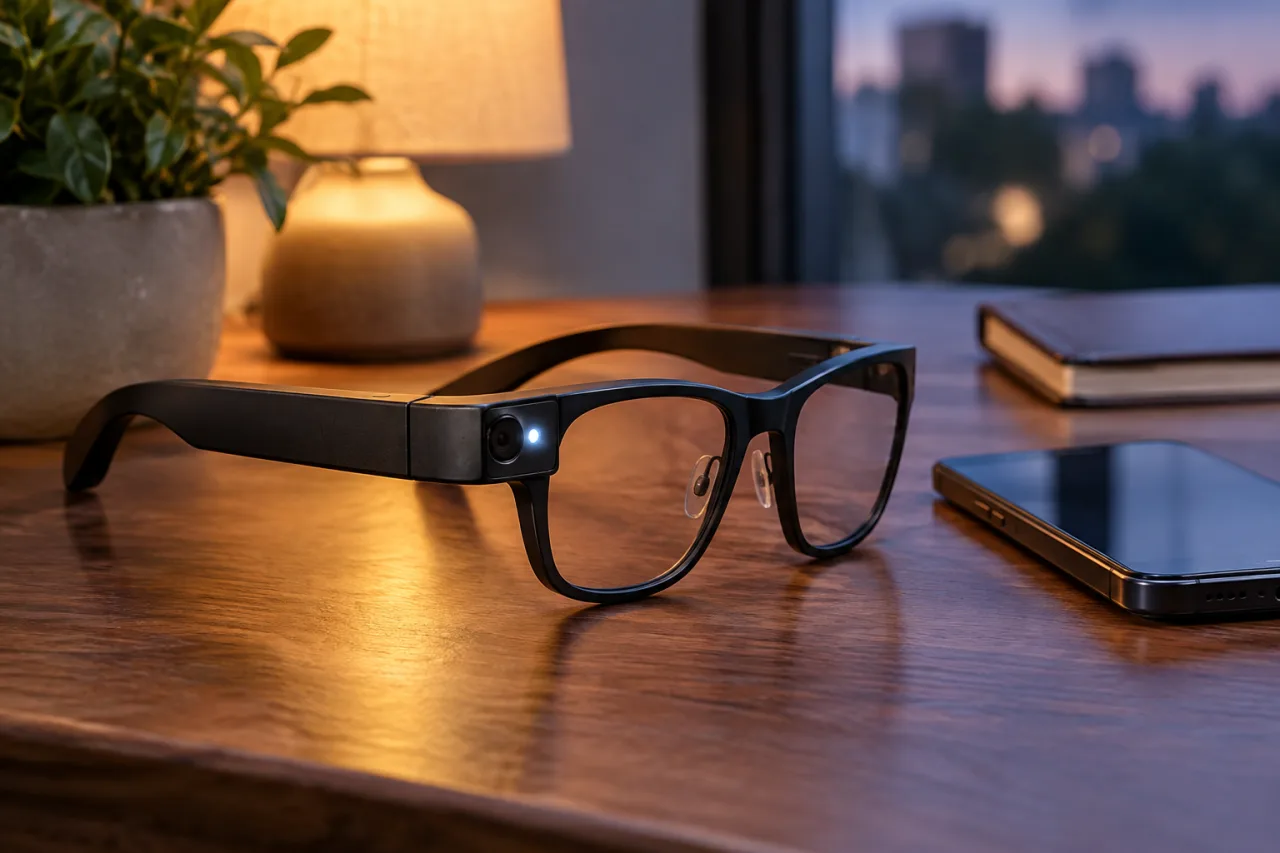
Meta’s own privacy page is direct about the hardware: each pair carries a bright white Capture LED that blinks when the camera is capturing for your gallery (Meta AI glasses privacy). The Display model keeps the same light. Independent guides cite Meta’s numbers: visible at a minimum of roughly 12 feet outdoors and 24 feet indoors (ConnectSafely Ray-Ban Meta guide).
That is the design intent, not a guarantee. Reports through 2026 document services on Facebook Marketplace offering to disable the recording light, and users drilling out the LED on Display units. The indicator travels with the device; its power travels with the wearer. When the light is tampered with, the person standing in front of the lens has no cue of any kind, which is exactly the condition the next section’s law struggles with.
The camera also does things besides deliberate capture. Live AI can process what you are looking at, the display glasses can run captions and translation on speech directed at you, and the microphones support calls. Each of those paths sends something to Meta: images, background sound, or both, governed by the privacy notice described below. Voice, in particular, has a documented abuse side: our voice-cloning scams guide shows how a few seconds of speech turn into a clone, which is the reason the upstream storage rules below matter beyond product choice.
Smart Glasses Privacy on the Account Trail: Voice and Visual Paths
The Capture LED answers one question; the account answers another. Since April 2025, Meta’s US Voice Controls Privacy Notice treats voice recordings as stored-by-default: transcripts and audio from voice interactions are kept for up to a year, reviewed by trained reviewers on pitch-shifted audio, and deletable from the Voice activity log. False activations are deleted within 90 days. The notice’s EU editions still read differently: they present storage as a choice, which means the region where you configured the glasses decides whether the off toggle exists at all.
Visual data has its own path. Asking Meta AI about what you are looking at sends images upstream; a toggle added in September 2026, Store visual data from AI experiences, stops future images from being stored, used in training or sent for human review. It does not cover voice, and it does not cover metadata, which includes machine-written descriptions of the image. The metadata carve-out is worth knowing before assuming a deleted image deletes everything around it.
Smart Glasses Privacy and the Law: the Patchwork
Smart glasses privacy questions reach law faster than any other kind of wearable question, because the camera points at other people. No statute in the US addresses camera glasses as a category. A wearer inherits a patchwork written for earlier technology, and the analysis splits cleanly by what the lens collects.
Audio. The federal Wiretap Act is the floor: recording a private conversation is lawful when one party consents, and a wearer who is part of the conversation generally qualifies (18 U.S.C. 2511(2)(d) analysis). Thirteen states demand all-party consent for private audio instead: California, Connecticut (for telephone and electronic communications), Delaware, Florida, Illinois, Maryland, Massachusetts, Montana, New Hampshire, Oregon, Pennsylvania, Washington, and Michigan (as narrowed by courts). Boundary cases matter: Oregon’s in-person rule is stricter than its electronic one, and Nevada has been read as all-party for calls. Audio is the axis most of these statutes turn on; silent video often escapes wiretap law entirely, which leaves the recording-etiquette question to other bodies of law.
Private places. Several states forbid recording devices in places where people expect to be left alone (dressing rooms, restrooms, private homes), and Hawaii’s structure is typical of that layer. A gym changing area or a coworking suite falls here before any conversation begins.
The first device-specific law. Louisiana’s smart-glasses statute took effect August 1, 2026: a wearer must notify others when camera glasses are in use, with carve-outs for the wearer’s home, workplace or personal vehicle. It is the cleanest signal yet of where device-specific regulation is going, and it arrived a year after the display glasses hit the shelves.
The EU layer. The bloc’s data-protection board has written the bystander problem down: valid consent from people in the frame is hard for a wearer to collect, and using bystander data for model training is harder still to justify (EDPB position, summarized in guide form). The practical result for EU-configured glasses is that the user carries duties GDPR attaches to controllers, which is why Meta’s European voice notice still hands the storage switch to the wearer by default.
The Six Settings That Change the Account Trail
The LED tells the room who is capturing. Smart glasses privacy on the settings side runs the other way: The following switches tell Meta what to keep. Most sit in the Meta AI app under the glasses’ device settings, and the list runs in the order of impact (walkthrough verified by Engadget).
- Turn off “Hey Meta” if you do not need hands-free. The wake word keeps the microphones listening for two specific words; the touchpad still summons the assistant without them.
- Purge the Voice activity log. US storage cannot be turned off, only deleted; a monthly purge is the only schedule that keeps the archive short.
- Turn off Store visual data from AI experiences on each pair you own. It applies forward only.
- Turn off Cloud media unless you use voice-controlled sharing and autocapture; your photos then live only on the phone you import them to.
- Turn off Share additional data to stop usage analytics feeding product development; essential operating data continues.
- Run Download Your Information once to export and verify what actually remains, then repeat after each purge.
The account side of smart glasses privacy is therefore a maintenance habit, not a single toggle: the defaults favor the platform, the region decides the switch set, and the deletions are the only part fully in the wearer’s control.
Smart Glasses Privacy in Real Rooms: Workplace, Gym, Bar, School
Workplaces. Two problems run in opposite directions: employees wearing camera glasses, and employees using them to record each other. An employer’s no-recording policy can collide with federal labor law in narrow ways, and health facilities must satisfy medical-privacy rules regardless of state wiretap analysis. The quiet resolution in most policies: devices that capture stay in the pocket or locker in defined zones, announced rather than assumed.
Gyms and private-places statutes. Locker rooms sit inside every state’s private-places layer. Camera glasses, LED on or LED tampered, have no reason to cross that line, and the Louisiana notification duty plus Hawaii-style private-place rules make the same point from two directions.
Bars, parties and schools. These are all-party-consent zones in the thirteen states above and social-contract zones everywhere else. The federal one-party baseline makes a wearer’s recording lawful in most rooms; it makes nothing about it expected. A visible light, a spoken heads-up, or an agreed arrangement beats a silent lens in every case that law leaves open, and it pairs with the same discipline as our call-blocking guide: defaults first, then the individual exceptions.
Smart glasses privacy in practice is mostly a two-sentence habit: say what the device is, and let the room decline. The wearer who announces the glasses loses an image or two; the wearer who does not may gain a legal problem that no setting panel answers.
Reading a room takes three seconds and covers most exposure. Watch for the zones where expectations harden into rules: changing areas and restrooms, where private-places statutes operate before any conversation starts; offices and clinics, where policy and medical-privacy rules carry their own lines; and any room in the thirteen all-party states, where a wearer’s consent is not enough the moment audio starts. Etiquette and law point the same way in those rooms, which is rare and useful.
Spotted or worn, the tampered light deserves a direct mention. Marketplace LED-disable services and drilled-out capture lights exist, and there is no software fix a bystander can deploy. The practical screen is conversational: ask the wearer, and read the answer. A transparent owner explains the glasses in one sentence; an owner who deflects about a visible white light has told you what your options are, which start with distance and end at management.
Parents and schools fall somewhere between all the categories above. Camera glasses on campus face the same audio rules as everywhere else, plus whatever the school’s own device policy reads, which in most districts already treats always-on cameras as a restricted item. The move that keeps everyone clear is the same two-sentence announcement before the lens opens, practiced rather than improvised.
What to Do Now: Five Moves
- Set the account before the first wear. The six settings above take under ten minutes in the Meta AI app, and the voice-log purge decides how long your kitchen conversation lives upstream.
- Buy the LED, never the removal. Tampering services and drilled lights are the fastest route from a gadget to a legal problem, and they void the design argument that protects the wearer.
- Keep a spoken heads-up on tap. One sentence before capture covers thirteen states’ all-party rule and the social rule everywhere else.
- Clean the archive monthly. The Voice activity log, the phone’s photo backups for imported media, and a quarterly Download Your Information run.
- Know your state’s line. One-party or all-party decides whether the wearer’s own consent suffices for audio; the private-places statutes govern rooms where nobody should hold a camera at all.
Frequently Asked Questions
Do smart glasses record without telling anyone?
Not by design: the Capture LED blinks during capture on every current Meta model, indoors out to about 24 feet. The open door is tampering, documented through Marketplace services and drilled-out LEDs on Display units. If the light is defeated, the only remaining cue is the wearer.
Is it legal to record conversations with camera glasses?
The audio rule decides. Federally, a participant may record (one-party consent), and thirteen states require all-party consent for private audio instead. Silent video often falls outside wiretap law but inside private-places statutes, and Louisiana now adds a notification duty for smart glasses specifically as of August 2026.
Does Meta store my voice recordings, and can I turn that off?
In the US, yes to the first and no to the second: voice interactions are stored by default for up to a year, deleted sooner from the Voice activity log, and the storage off-switch was removed for US users in April 2025. EU-configured accounts still get the storage toggle, which is the sharpest regional divergence in the whole notice.
What smart glasses privacy settings matter most first?
The three with real reach: turn off “Hey Meta” if hands-free is not needed, turn off Store visual data from AI experiences, and purge the Voice activity log. Cloud media and Share additional data come next; Download Your Information tells you what actually remains after all of it.
Can people in the frame stop a wearer from recording?
The law reaches the audio layer, not much else, unless a state’s private-places statute applies or the room is an all-party-consent state. Practically, the request to whoever wears the lens is the fastest enforcement there is, and the EDPB’s position on bystander data is reshaping what European wearers can justify.
Are the display glasses different on privacy?
The hardware story is the same Capture LED plus an in-lens display with minimal light leakage; the account story is the same voice and visual paths. The difference is exposure: a device people wear all day indoors multiplies both sides.
The Quiet Ledger
Smart glasses privacy does not resolve into one setting or one statute. The device keeps its word with a light; the platform keeps far more than you might guess through defaults that differ by region; and the law mostly shows up after something has gone wrong rather than before the shutter opens. What stands between those layers is the courtesy a wearer carries: the announced lens, the spoken heads-up, the settings run the day the box opens. Smart glasses privacy is the ledger those moves write in, and the technology moved from demo video to a $799 consumer product in a year; the habits that make it acceptable are still set by the person wearing it, one room at a time.
Sources: Meta AI glasses privacy page (Capture LED) and Meta Ray-Ban Display product pages (launch, pricing); Meta Voice Controls Privacy Notice, US and Irish editions (voice storage, retention, regional split); Engadget settings walkthrough and ConnectSafely guide (settings, LED distance); Dickinson Wright wiretap analysis (18 U.S.C. 2511(2)(d), all-party states); Louisiana smart-glasses statute (effective August 1, 2026); EDPB bystander-data position via EU privacy guidance summaries.
- meta.com/ai-glasses/privacy — Meta AI glasses privacy
- connectsafely.org/rayban — ConnectSafely Ray-Ban Meta guide
- meta.com/legal/ai-glasses/voice-controls-privacy-notice — Voice Controls Privacy Notice
- meta.com/ie/legal/ai-glasses/voice-controls-privacy-notice — whether the off toggle exists at all
- dickinson-wright.com/news-alerts/blog-jodka-smart-glasses-in-the-work… — 18 U.S.C. 2511(2)(d) analysis
- privacygear.nl/en/guides/camera-glasses-privacy-guide — EDPB position, summarized in guide form
- engadget.com/2293112/meta-ray-ban-settings-change-before-wearing — walkthrough verified by Engadget
External sources linked in this article, in order of first mention. Spotted an error or a broken link? Tell us.
Cite this pagePublished Nov 22, 2026
Agron, E. (2026, November 22). Smart Glasses Privacy: What the Camera Sees, Records and Shares. WorldNgayon. https://worldngayon.com/smart-glasses-privacy/
Agron, Edmon. “Smart Glasses Privacy: What the Camera Sees, Records and Shares.” WorldNgayon, 22 Nov. 2026, worldngayon.com/smart-glasses-privacy/.
Agron, Edmon. “Smart Glasses Privacy: What the Camera Sees, Records and Shares.” WorldNgayon, November 22, 2026. https://worldngayon.com/smart-glasses-privacy/.
Agron, E. (2026) ‘Smart Glasses Privacy: What the Camera Sees, Records and Shares’, WorldNgayon, 22 November. Available at: https://worldngayon.com/smart-glasses-privacy/.
E. Agron, “Smart Glasses Privacy: What the Camera Sees, Records and Shares,” WorldNgayon, Nov. 22, 2026. [Online]. Available: https://worldngayon.com/smart-glasses-privacy/
@online{agron2026smartglasses,
  author       = {Agron, Edmon},
  title        = {{Smart Glasses Privacy: What the Camera Sees, Records and Shares}},
  year         = {2026},
  date         = {2026-11-22},
  organization = {WorldNgayon},
  url          = {https://worldngayon.com/smart-glasses-privacy/},
  urldate      = {}
}TY - ELEC AU - Agron, Edmon TI - Smart Glasses Privacy: What the Camera Sees, Records and Shares T2 - WorldNgayon PY - 2026 DA - 2026/11/22/ UR - https://worldngayon.com/smart-glasses-privacy/ Y2 - ER -
Cite the version you read; the page may be updated. Zotero and Mendeley can also import this page directly.