Table of Contents
Key Takeaway
- 🎓 The Policy: UP College of Law banned all AI tools and electronic devices (phones, laptops, tablets, smart watches) in first-year Juris Doctor core subjects starting Academic Year 2026-2027 — the first such policy in the Philippines.
- 📝 What’s Banned: Generative AI for any part of research and writing (including editing and grammar checks), AI-dependent research databases, and all digital devices during onsite classes and assessments.
- ⚠️ The Penalty: Mere possession of a digital device during assessments is considered an offense against academic integrity — triggering formal disciplinary action.
- 📖 Why: UP Law observed a “considerable decline in the quality of reasoning and argumentation” among students who used AI, with employer feedback confirming graduates are “AI-dependent, not just AI-literate.”
- 🌍 The Precedent: UP Law references UC Berkeley Law and University of Chicago Law School as models — this is part of a global movement in legal education to reassert fundamental skills before AI tools are introduced.
UP Law AI ban — three words that made headlines across the Philippines in August 2026. The University of the Philippines College of Law adopted a policy that banned all AI tools and electronic devices in first-year Juris Doctor core subjects. No laptops. No phones. No tablets. No smart watches. No AI. For a generation that has never taken notes with pen and paper, the UP Law AI ban is not a minor adjustment — it is a fundamental rewiring of how they learn law.
The policy, titled “Philippine Legal Education in the Time of Artificial Intelligence I: Recommitting to the Fundamentals of Legal Analysis,” is the first formal AI restriction by any Philippine educational institution. It is also one of the strictest in the world — stricter than UC Berkeley Law’s AI policy, which the UP Law faculty cites as a reference. The policy applies to all first-year core subjects — those traditionally tested in the Philippine Bar Exam — starting Academic Year 2026-2027. For the broader context of Philippine AI regulation, see our feature on how Congress and UP Law are racing to govern AI. For the House bills, see our what we know about House Bill 7396 (AIDA) and our what we know about House Bill 9448 (labor protection). For the Senate’s approach, see our what we know about Senate Bill 25. For the rights-focused approach, see what we know about House Bill 10362 (Diokno AI Governance Act).
What the Policy Actually Says — In Plain Language
The UP Law AI ban has three main components, each addressing a different way that AI and technology enter the law school classroom:
Component 1: Core subjects go fully offline. First-year core subjects — the foundational courses tested in the Philippine Bar Exam — shall be taught fully onsite. No online classes, no hybrid formats, no Zoom.
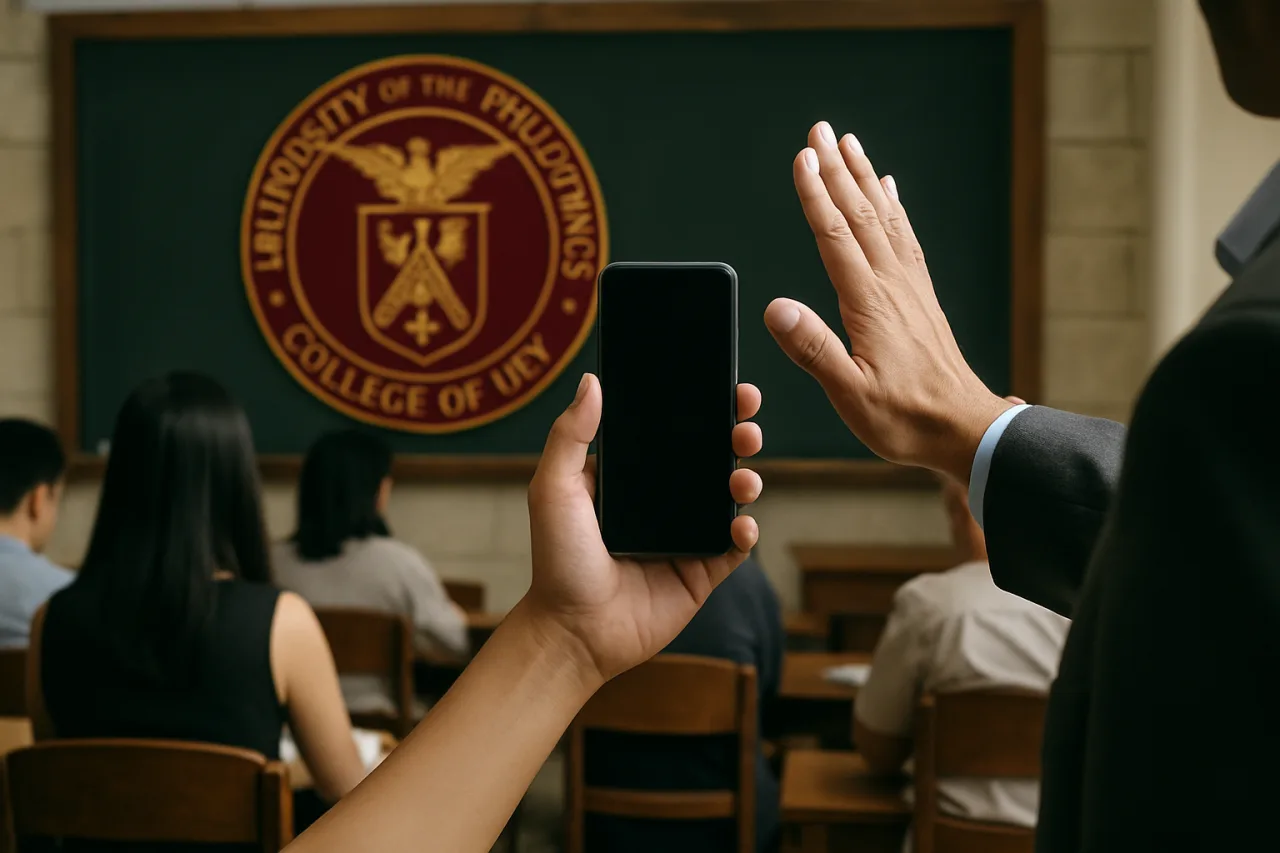
Within those onsite classes, the use of digital or electronic devices is prohibited for any purpose, including notetaking. Phones, laptops, tablets, smart watches, smart glasses, and recorders are all banned. The only exception is when an instructor specifically allows a device for a class activity (like a presentation) or in emergencies. Major assessments — midterms and finals — must be conducted individually (not group work), offline, and onsite.
Component 2: Writing assignments ban all AI involvement. For academic papers, legal memos, and research assignments, students are prohibited from using generative AI for any part of the research and writing process. “Any part” means from conceptualization to writing to finalization — including editing and grammar checks.
This means you cannot use ChatGPT to brainstorm ideas, Grammarly’s AI features to polish your prose, or any AI-powered research database to find cases. The Legal Research Cluster will prepare a list of approved non-AI databases that students must use. Faculty can introduce AI tools only after students have been taught and assessed on research fundamentals — and only with active supervision and mandatory disclosure of AI use in all drafts.
Component 3: Device possession during assessments is an integrity violation. This is the strictest provision. If you are caught with a digital device on your person during an assessment — even if you are not using it — you face formal disciplinary action. The policy treats the mere presence of a device as an offense against academic integrity, equivalent to cheating. This is stricter than most university policies, which typically require evidence of actual use before imposing penalties.
Why UP Law Decided to Ban AI — The Evidence
The UP Law AI ban is not a reflexive rejection of technology. It is based on direct observation of how AI has affected UP Law students, as reported by GMA News Online. The faculty documented specific evidence, and the full policy text is published on the UP College of Law website:
“A considerable decline in the quality of reasoning and argumentation.” UP Law faculty observed that students who regularly used AI for case briefing, answering questions during class, and research produced weaker legal arguments. The reasoning was shallower. The analysis was less original. The connection between legal doctrine and social context — the skill that separates good lawyers from competent ones — was missing.
Employer feedback confirms AI dependency. The law school received feedback from employers of its recent graduates confirming that many new lawyers are “not just AI-literate but AI-dependent.” They reach for AI tools before they attempt to reason through a legal problem. They cannot draft a legal memo without AI assistance. They struggle when AI is unavailable — in courtrooms, in client meetings, in situations where pulling out a laptop to consult ChatGPT is not an option.
The policy statement’s core concern: “We are gravely concerned that their use by lawyers without a strong grasp of legal fundamentals risks not only malpractice but the dehumanization and misapplication of law and its divorce from the social condition.”
This is the key insight. UP Law is not saying AI is bad. It is saying that lawyers who use AI without first mastering legal fundamentals are dangerous — to their clients, to the justice system, and to society. The ban is not anti-technology. It is pro-fundamentals. The policy explicitly states: “We acknowledge the pervasiveness of AI technologies and our responsibility to prepare our students for their ethical use. However, we believe that these tools at best supplement strong analytical skills.”
What Students Must Master Without AI
The policy’s philosophical foundation is a set of skills that AI cannot replace. The UP Law faculty identifies these as the core competencies that first-year students must develop before they are allowed to use AI tools:
Deriving legal arguments from language and social context. AI can find cases and summarize doctrines, but it cannot read the social context in which a law operates. A Filipino lawyer must understand how a statute affects a jeepney driver in Manila differently from a corporate executive in Makati. That understanding comes from reading, listening, and thinking — not from prompting an AI.
Finding or creating law in its interstices. The most valuable legal work happens in the gaps — the areas where the law is unclear, contradictory, or silent. AI is trained on existing law, which means it is worst at the boundaries where new law is created. A lawyer who cannot navigate uncertainty cannot create new legal arguments.
Transposing arguments to actual cases. Legal theory must connect to real people with real problems. AI can generate plausible-sounding legal analysis, but it cannot interview a client, read a courtroom, or adapt an argument based on a judge’s reaction. These are human skills that require human practice.
Being comfortable in uncertainty. “Whereas the task-oriented logic of generative AI presents immediate responses for any prompt, we envision students who can be comfortable in uncertainty and patient with the arduousness and rigors of serious inquiry,” the policy states. AI provides answers. Law requires questions. The skill of formulating the right question — not generating the quickest answer — is what the UP Law faculty wants to protect.
The Public Debate — What People Are Saying
When UP Law posted the UP Law AI ban policy on its Facebook page, it sparked immediate and passionate debate — a microcosm of the national conversation about AI in education. The debate centers on a fundamental tension:
The argument for the ban: Law is a profession where fundamental reasoning matters more than information retrieval. AI can find a case citation in seconds, but it cannot construct a legal argument that persuades a judge. If law students never develop that skill because AI does their thinking for them, the legal profession suffers. The ban ensures that first-year students build the cognitive foundation before they get the AI tools — like teaching a child arithmetic before giving them a calculator.
The argument against: The legal profession already uses AI. The Supreme Court of the Philippines has announced that the Judiciary E-Library will use AI technology for legal research. Banning AI in law school produces graduates who are unprepared for the tools they will use daily in practice. A lawyer who has never used AI for research will be less efficient than one who has — and in a competitive legal market, efficiency matters.
UP Law’s response to this tension: The UP Law AI ban applies only to first-year core subjects. Higher-year subjects will have a separate policy “to be released in due course.” This means the UP Law AI ban is not a total prohibition on AI for the entire law program — it is delaying AI introduction until students have mastered fundamentals. The policy calls this “AI-resilient pedagogy” — teaching students to be resilient without AI so they can use it wisely when they eventually do.
How UP Law Compares to Global Precedents
UP Law is not alone in restricting AI. The policy explicitly references international precedents:
University of Chicago Law School published “Rethinking Legal Education in the AI Era” in July 2026, which the UP Law policy cites as a foundational reference. UC Berkeley Law has an Artificial Intelligence Policy that restricts AI use in certain courses. The UP Law policy is stricter than both — UC Berkeley allows AI for some purposes with disclosure, while UP Law prohibits it entirely for first-year core subjects.
Globally, law schools are divided. Some, like Harvard Law School, have integrated AI into their curriculum, teaching students how to use AI ethically and effectively. Others, like UP Law, have chosen to restrict AI until fundamentals are mastered. Both approaches recognize the same problem — AI is changing legal education — but they respond differently. The UP Law approach is more conservative, prioritizing foundational skills over technological fluency.
What This Means for Philippine Education Beyond Law School
UP Law’s policy is a signal for the entire Philippine education system. If the country’s premier law school is banning AI in first-year classes through the UP Law AI ban, other universities are watching. Several Philippine universities are reportedly considering similar measures, though none have formalized policies as of August 2026.
The implications extend beyond law. If medical schools restrict AI in anatomy and diagnosis courses, if engineering schools restrict AI in structural design courses, if journalism schools restrict AI in writing courses — the pattern is the same. Master the fundamentals first. Use AI later. The question for Philippine education is whether this approach produces graduates who are better prepared for an AI-saturated workforce, or graduates who are artificially disadvantaged because they trained without tools their competitors use freely.
For Filipino students and parents, the UP Law policy raises a practical question: will other universities follow? If they do, the Philippine education system will produce a generation of professionals who trained without AI — entering a workforce that uses it daily. The gap between training and practice will be the defining challenge for Philippine professional education in the AI era. For practical guidance on building AI skills that complement rather than replace fundamentals, see our guide to using AI agents for work.
Frequently Asked Questions About the UP Law AI Ban
What did UP College of Law ban exactly?
The UP Law AI ban prohibits all AI tools and electronic devices (phones, laptops, tablets, smart watches, smart glasses, recorders) in first-year Juris Doctor core subjects starting Academic Year 2026-2027. Generative AI is prohibited for any part of research and writing, including editing and grammar checks. The UP Law AI ban was adopted on August 4, 2026.
Why did UP Law ban AI?
UP Law observed a “considerable decline in the quality of reasoning and argumentation” among students who regularly used AI. Employer feedback confirmed that recent graduates are “AI-dependent, not just AI-literate.” The faculty concluded that lawyers who use AI without mastering legal fundamentals risk malpractice and the “dehumanization of law.”
Does the UP Law AI ban apply to all law students?
No. The policy applies only to first-year core subjects — those traditionally tested in the Philippine Bar Exam. Higher-year subjects will have a separate policy “to be released in due course.” The ban is specifically designed for first-year students who need to build foundational skills before using AI tools.
Can UP Law students use Grammarly or other AI editing tools?
No. The policy prohibits “relying on generative AI for any part of the research and writing process, from conceptualization to writing and finalization, including editing and grammar checks.” This means AI-powered editing tools like Grammarly’s AI features are banned for first-year writing assignments.
What happens if a student is caught with a phone during an exam?
Mere possession of a digital device during assessments is considered an offense against academic integrity and subjects the student to formal disciplinary action. The student does not need to be caught using the device — having it on their person is enough for disciplinary proceedings.
Is UP Law the first university to ban AI in the Philippines?
Yes. The UP Law AI ban is the first formal AI restriction by any Philippine educational institution. The policy references UC Berkeley Law and University of Chicago Law School as international precedents, making the UP Law AI ban part of a global movement in legal education.
Does the UP Law ban mean AI is bad for legal education?
No. The policy explicitly states that AI tools “at best supplement strong analytical skills” and acknowledges the school’s “responsibility to prepare our students for their ethical use.” The ban is not anti-AI — it is pro-fundamentals. UP Law wants students to master reasoning skills first, then use AI wisely in higher years and professional practice.