Table of Contents
Key Takeaway
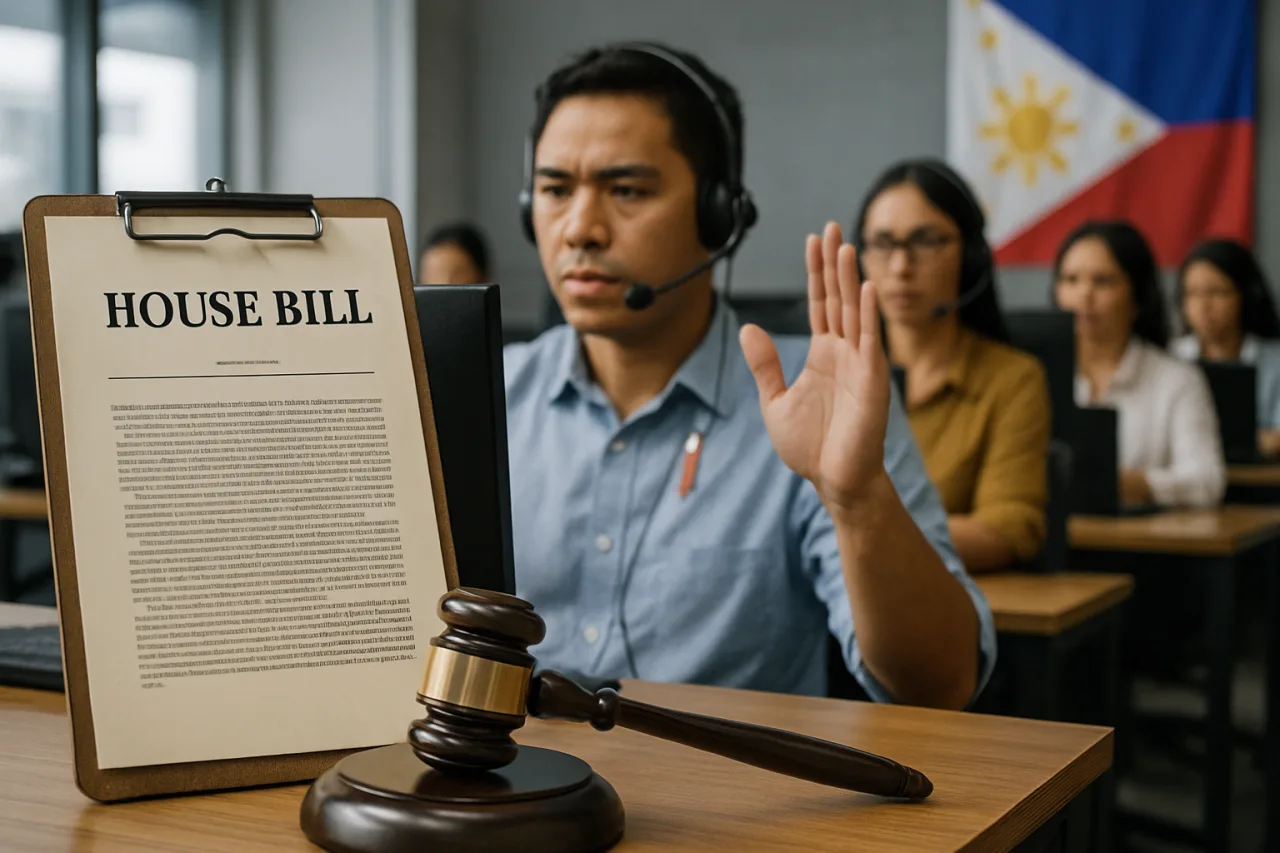
- 👷 The Bill: House Bill 9448, filed by Representative Juan Carlos “Arjo” Atayde, prohibits companies from using AI or automation to replace human workers unless they provide equivalent alternative employment to those displaced.
- 🚫 What It Bans: AI-only hiring decisions, AI-only termination decisions, and AI-based worker evaluations without human oversight — a human must always be in the loop when a person’s job is at stake.
- ⚖️ Worker Rights: Employees would have the right to object to AI-based evaluations and refuse AI systems that they believe are dehumanizing or unfair.
- 🏭 Who It Protects: The bill specifically targets protection for the Philippines’ 1.3 million BPO workers, plus manufacturing, transport, and service workers facing automation displacement.
- 🏢 Employer Requirements: Companies using AI would need to adopt an AI Governance Policy, notify workers when AI is used in employment decisions, and comply with Department of Labor and Employment (DOLE) oversight.
House Bill 9448 asks a question that every Filipino worker is thinking but few legislators have been willing to put into law: what happens to your job when AI can do it? Filed by Quezon City First District Representative Juan Carlos “Arjo” Atayde on November 7, 2023, the Protection of Labor Against Artificial Intelligence Automation Act is the only pending Philippine AI bill that focuses squarely on the workforce. While Senate Bill 25 and House Bill 7396 create regulatory bodies to govern AI systems generally, House Bill 9448 directly addresses the fear that has made AI adoption controversial in the Philippine workplace — that companies will replace humans with machines to cut costs, leaving workers without jobs.
The bill’s core provision is simple: if a company uses AI or automation to replace human workers, it must provide equivalent alternative employment to the workers it displaces. This is not a suggestion — it is a legal requirement. A company cannot simply fire its call center agents because a chatbot can handle customer queries. It must either find those agents comparable jobs within the organization or face legal consequences. For the 1.3 million Filipinos working in the BPO industry — the sector most directly threatened by AI-powered chatbots and robotic process automation — this bill, if passed, would be the most significant labor protection since the Labor Code itself. For the broader context of Philippine AI regulation, see our feature on how Congress and UP Law are racing to govern AI. For the institutional approach, see our what we know about House Bill 7396 (AIDA). For the Senate’s enforcement-focused approach, see our what we know about Senate Bill 25. For the rights-focused approach, see what we know about House Bill 10362 (Diokno AI Governance Act). For the education sector’s response to AI, see our what we know about the UP Law AI ban.
What House Bill 9448 Prohibits — In Plain Language
The bill establishes four clear prohibitions that every Filipino employer and employee should understand:
1. No AI replacement without equivalent alternative employment. If a company replaces human workers with AI or automation — whether through termination, non-renewal of contracts, or involuntary transfer — it must provide the displaced workers with equivalent alternative employment. “Equivalent” means comparable compensation (salary and benefits at least equal to the previous position), similar job security (same employment status and tenure rights), equivalent working conditions, and positions that match the worker’s skills and experience. The Department of Labor and Employment (DOLE) would define the specific criteria for what counts as “equivalent” through implementing regulations.
2. No AI-only hiring decisions. A company cannot use AI alone to decide who gets hired. A human must be involved in every hiring decision. This means that AI can screen resumes or rank candidates, but a human manager must make the final call. The bill recognizes that AI hiring tools can embed bias — screening out candidates based on age, gender, or ethnicity without the candidate ever knowing why they were rejected.
3. No AI-only termination decisions. Similarly, a company cannot use AI alone to decide who gets fired. AI can flag performance issues, but a human must review and confirm before any termination. This prevents scenarios where an algorithm fires an employee based on metrics that may not capture the full context of their performance.
4. No dehumanizing AI evaluations. Workers have the right to object to AI-based evaluations that they believe are unfair, biased, or dehumanizing. If an AI system scores an employee’s performance based on surveillance data — keystroke tracking, mouse movement monitoring, webcam attention checks — the employee can refuse that evaluation and demand a human review.
Who the Bill Protects — and Why
House Bill 9448 is not abstract legislation. It responds to specific threats facing specific Filipino workers:
BPO workers (1.3 million Filipinos): The BPO industry is the Philippines’ largest private sector employer, generating $35 billion in annual revenue. AI-powered chatbots and robotic process automation tools can already handle many customer service tasks that Filipinos currently perform. If BPO companies deploy AI without worker protections, the displacement could be massive — and the economic impact would ripple through the entire Philippine economy, from real estate to retail to remittances.
Manufacturing workers: Industrial robotics and AI-powered quality control systems are replacing assembly line workers across electronics, automotive, and food processing. The Philippines’ manufacturing sector employs approximately 3 million workers, many in export processing zones where automation adoption is accelerating.
Transport workers: Autonomous vehicles and AI-powered ride-hatching optimization could displace Filipino drivers. While full autonomous driving is not yet deployed in the Philippines, the bill anticipates future displacement by including transport in its scope.
Service workers: AI-powered ordering systems, automated checkouts, and robotic food preparation are reducing labor needs in retail and food service. These sectors employ millions of Filipinos in roles that AI can increasingly perform.
The bill’s approach is not to ban AI in these sectors — it explicitly allows companies to “adopt AI that is useful or beneficial in the workplace,” as reported by the Digital Policy Alert. Instead, it requires that the benefits of AI adoption do not come exclusively at the expense of workers’ livelihoods. For context on how AI is reshaping the Philippine workforce more broadly, see our analysis of AI’s P1.8 trillion economic impact.
What Employers Would Need to Do
If House Bill 9448 passes, every Philippine employer using or planning to use AI in the workplace would need to take specific actions:
1. Adopt an AI Governance Policy. Every employer using AI must create a formal policy that specifies how AI is used in the workplace, what decisions AI informs, what oversight mechanisms exist, how workers are notified when AI is used, and how disputes are resolved. This policy must be documented and available for DOLE inspection.
2. Notify workers when AI is used. Employees must be informed when AI systems are used in decisions that affect their employment — hiring, promotions, performance evaluations, terminations. Workers cannot be evaluated by AI without knowing it.
3. Maintain human oversight. All employment decisions made with AI assistance must have a human in the loop. AI can inform decisions, but a human must make them. This is consistent with the “human oversight” principle in the BSP’s STARS framework for banks, which we documented in our guide to BSP AI governance.
4. Provide equivalent alternative employment. If AI or automation displaces workers, the employer must provide those workers with comparable jobs — same pay, same security, similar conditions. If no equivalent position is available, DOLE regulations would determine the employer’s obligations.
5. Comply with DOLE oversight. DOLE would have authority to review employer AI governance policies, investigate worker complaints, audit AI systems used in employment, and enforce compliance through penalties and sanctions.
The Debate: Protecting Workers vs. Stifling Innovation
House Bill 9448 has generated significant debate, and the tensions it exposes are worth understanding:
The case for the bill: Philippine workers are disproportionately vulnerable to AI displacement. The BPO industry, which employs over 1.3 million Filipinos, is built on labor arbitrage — companies hire Filipinos because they are cheaper than workers in developed countries. AI eliminates that cost advantage. Without legal protections, companies could deploy AI to replace Filipino workers with no obligation to those workers. The bill ensures that the cost of AI adoption is borne by the company benefiting from it, not by the worker losing their job.
The case against: Critics argue that requiring equivalent alternative employment could make Philippine companies less competitive. If a competitor in India or Vietnam can deploy AI to cut costs without the same obligation, Philippine companies face a disadvantage. The requirement could also discourage AI adoption — companies might avoid AI entirely to avoid the obligation of finding equivalent jobs for displaced workers, which could leave Philippine businesses behind global competitors who are already automating.
The UP Law critique: The UP College of Law faculty has noted that House Bill 9448 defines AI based on methodologies — machine learning, deep learning, data access — and also puts automation under the same regulatory regime. “Automation is defined as ‘the use of technology and machinery to perform tasks or processes with minimal human intervention,'” the UP Law analysis notes. This broad definition could capture technologies that have nothing to do with modern AI — like a conveyor belt or an automatic door — potentially creating regulatory overreach.
How House Bill 9448 Compares to Global AI Labor Protection
House Bill 9448 is one of the most aggressive AI labor protection bills in the world. Most countries have taken softer approaches:
The EU AI Act classifies AI used in employment as “high-risk” and requires transparency, documentation, and human oversight — but it does not require equivalent alternative employment for displaced workers. The United States has no federal AI labor protection law. Singapore encourages companies to use AI responsibly but relies on voluntary guidelines. The Philippines, through House Bill 9448, would be among the first countries to make worker replacement without alternative employment explicitly illegal.
This aggressive stance reflects the Philippine economic context. The BPO industry is not just an economic sector — it is a pillar of the Philippine economy that supports millions of families, including OFW dependents. If AI displaces BPO workers en masse without protections, the social and economic consequences would be severe. House Bill 9448 treats AI labor displacement as a social policy issue, not just a business efficiency issue.
What Filipino Workers Should Know
House Bill 9448 has not been passed into law, but if it does pass, Filipino workers should know their rights under it:
You cannot be replaced by AI without alternative employment. If your company deploys AI to do your job, they must find you an equivalent position — same pay, same security, similar conditions.
You cannot be hired or fired by AI alone. A human must make the final decision. If you are rejected for a job or terminated from one, you have the right to know that a human reviewed your case, not just an algorithm.
You can object to AI evaluations. If your performance is being evaluated by an AI system that you believe is unfair or dehumanizing, you can refuse that evaluation and request a human review.
Your employer must tell you when AI is used. You have the right to know when AI is involved in decisions about your employment — hiring, promotions, evaluations, terminations.
DOLE is your enforcement body. If you believe your employer has violated these protections, you can file a complaint with the Department of Labor and Employment, which would investigate and enforce compliance.
Frequently Asked Questions About House Bill 9448
What is House Bill 9448 in simple terms?
House Bill 9448, filed by Representative Juan Carlos “Arjo” Atayde, is a proposed law that prohibits companies from using AI or automation to replace human workers without providing equivalent alternative employment. It also bans AI-only hiring and termination decisions and gives workers the right to object to AI-based evaluations.
Who would House Bill 9448 protect?
The bill protects all Filipino workers, with particular focus on the 1.3 million BPO workers most vulnerable to AI displacement, plus manufacturing, transport, and service workers facing automation. Any employee whose employer uses AI in employment decisions would be covered.
Can a company fire me and replace me with AI under House Bill 9448?
No — not without providing you with equivalent alternative employment. If the bill passes, a company that replaces human workers with AI must find those workers comparable jobs with the same pay, security, and conditions. If no equivalent position is available, DOLE would determine the employer’s obligations.
Can AI decide whether I get hired or fired?
Not alone. House Bill 9448 prohibits AI-only hiring and termination decisions. AI can screen candidates or flag performance issues, but a human must make the final decision. You have the right to know that a human reviewed your case.
Has House Bill 9448 been passed into law?
No. As of August 2026, the bill is still pending in Congress. It was filed on November 7, 2023, and has been undergoing committee review. The timeline for passage depends on legislative priorities and stakeholder consultations.
How is House Bill 9448 different from other Philippine AI bills?
House Bill 9448 is the only pending Philippine AI bill focused specifically on labor protection. While House Bill 7396 creates a regulatory agency (AIDA) and Senate Bill 25 creates a commission (NAIC) with penalties for AI content non-disclosure, House Bill 9448 directly addresses the fear of AI-driven job displacement.
Would House Bill 9448 make Philippine companies less competitive?
This is the main debate. Supporters argue it protects workers from unfair displacement. Critics argue it could make Philippine companies less competitive against countries without similar obligations. The bill allows companies to adopt beneficial AI — it just requires that workers are not left without livelihoods when AI replaces them.