Table of Contents
Key Takeaway
- 📜 The Bill: House Bill 10362, filed by Akbayan Rep. Chel Diokno on August 7, 2026, proposes the AI Governance Act — a rights-first framework that includes an AI Bill of Rights, worker protection provisions, and environmental compliance for AI facilities.
- 👷 Worker Rights: Employers must give 6 months advance notice before deploying high-impact AI, provide reskilling and upskilling for affected workers, and cannot use AI alone to evaluate or discipline employees without meaningful human review.
- ⚖️ AI Bill of Rights: Guarantees transparency in high-impact AI systems, safeguards privacy including the right to be forgotten, and protects Filipinos from discriminatory AI decisions.
- 🌱 Environmental Rules: AI data centers and facilities must comply with environmental assessments, disclose annual energy and water consumption, and consult affected communities.
- 🔒 Penalties: Imprisonment of 6 months to 6 years for unlawful AI use, with public officials facing disqualification from holding public office.
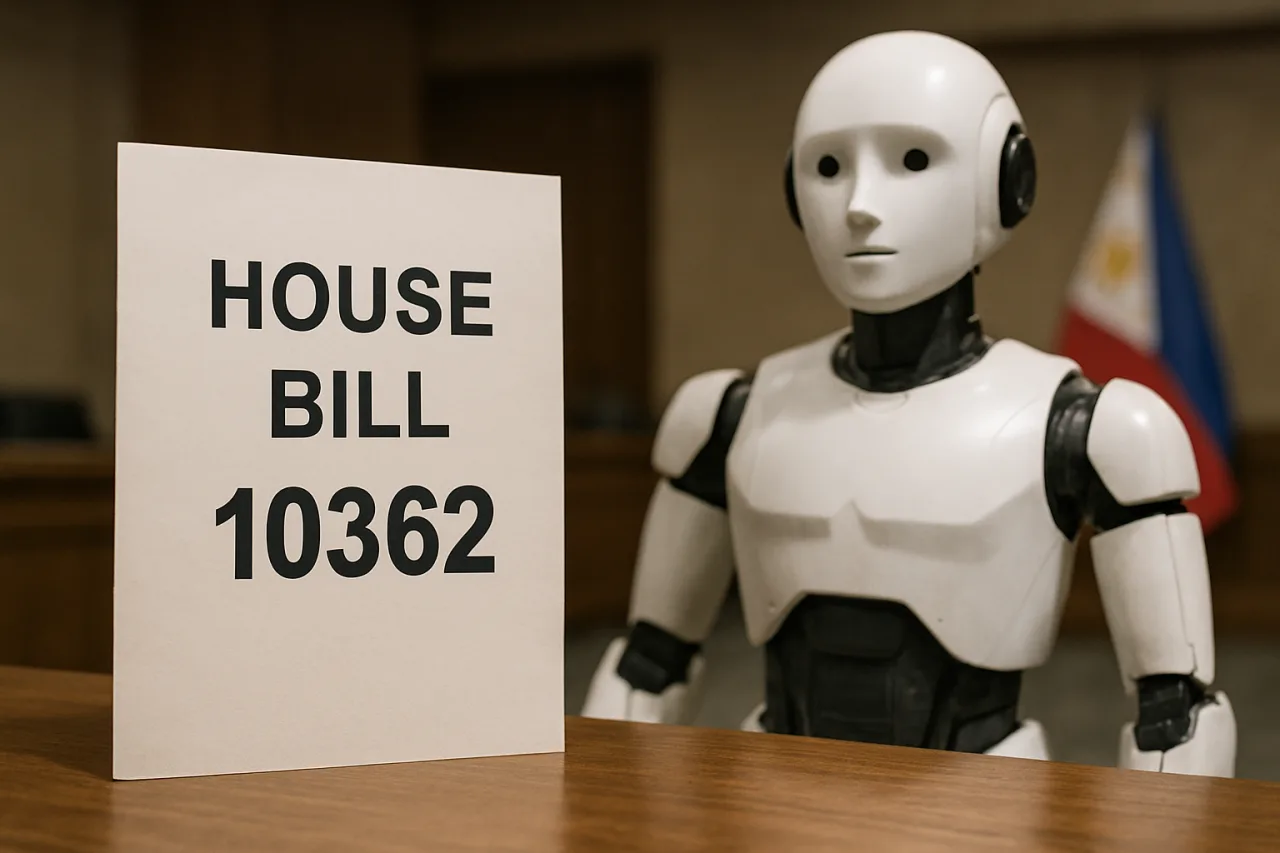
House Bill 10362, filed by Akbayan Party-list Representative Chel Diokno on August 7, 2026, is the newest and most rights-focused AI regulation bill in the Philippine Congress. Co-authored by fellow Akbayan Reps. Perci Cendaña and Dadah Ismula, and Dinagat Islands Rep. Kaka Bag-ao, the proposed AI Governance Act does something that no other pending AI bill does: it puts rights first. While House Bill 7396 creates a regulatory agency, Senate Bill 25 creates an enforcement commission, and House Bill 9448 protects workers from displacement, House Bill 10362 establishes an AI Bill of Rights — a set of fundamental protections that every Filipino would have against AI systems that affect their lives.
Diokno filed the bill to open the second regular session of the 20th Congress, arguing that the Philippines cannot afford to wait. “At present, there is no unified national framework that establishes safeguards against harmful AI systems, protects workers from AI-driven displacement, guarantees transparency in automated decision-making, promotes AI literacy, establishes accountability standards, or creates institutional mechanisms for AI governance,” Diokno said, as reported by the Manila Bulletin. He cited the Philippine AI Report 2025, which found that more than 92 percent of surveyed Philippine organizations have adopted AI in some capacity, while 54 percent have used generative AI tools for over a year. For the broader context of Philippine AI regulation, see our feature on how Congress and UP Law are racing to govern AI.
What House Bill 10362 Proposes — In Plain Language
House Bill 10362 has five main components that distinguish it from every other AI bill pending in Congress:
1. An AI Bill of Rights. This is the bill’s signature provision. Just as the Philippine Bill of Rights in the Constitution protects fundamental liberties against government overreach, the AI Bill of Rights would protect Filipinos against AI overreach. It guarantees transparency in the use of high-impact AI systems — meaning you have the right to know when AI is making decisions about you. It safeguards privacy and personal data, including the right to be forgotten — meaning you can demand that an AI system delete your data. It protects people from discriminatory AI decisions — meaning an AI system cannot reject your loan application, job application, or insurance claim based on bias against your gender, age, region, or ethnicity. And it provides safeguards against other forms of AI misuse that the implementing rules would specify.
2. Worker protection with 6 months notice. House Bill 10362 takes a different approach to labor protection than House Bill 9448. Instead of prohibiting AI replacement outright, it requires employers to give affected employees and their representatives at least six months advance notice before deploying high-impact AI systems. The notice must describe the purpose and scope of the AI system, the affected business processes or job functions, and the expected impact on work assignments. During those six months, the employer must provide reskilling and upskilling opportunities, workforce redeployment, labor market transition support, and social protection. Workers also have the right to meaningful participation in decisions involving AI adoption. For comparison with the other labor-focused bill, see what we know about House Bill 9448.
3. No AI-only discipline. Employers are prohibited from relying solely on AI-generated outputs to evaluate employee performance or discipline workers without meaningful human review. They also cannot use AI to circumvent labor laws — particularly security of tenure, minimum wage, employee benefits, and the right to self-organization. This means a company cannot use an AI system to fire workers, cut wages, or bust unions by claiming the AI made the decision.
4. Environmental compliance for AI facilities. This provision is unique among all pending AI bills. Data centers and AI facility operators would be required to comply with environmental assessment and Environmental Compliance Certificate (ECC) requirements, consult affected communities, disclose annual energy and water consumption and sustainability plans, and comply with AI infrastructure standards set by the DICT, DENR, and DOE. This recognizes that AI has a physical footprint — the data centers that train AI models consume massive amounts of electricity and water, and communities near these facilities deserve protection.
5. A Multi-Stakeholder Advisory Council. The bill creates an AI Multi-Stakeholder Advisory Council composed of representatives from government, academe, labor, civil society, media, youth organizations, and the technology sector. This council would help guide national AI policy — ensuring that AI regulation is not written by technologists alone but by a broad coalition of stakeholders who represent the people affected by AI. No other pending AI bill creates this kind of multi-sector advisory body.
How House Bill 10362 Compares to the Other AI Bills
With Diokno’s bill, there are now five distinct AI regulation proposals pending in the Philippine Congress. Each takes a different approach:
| Bill | Author | Core Approach | Unique Feature |
|---|---|---|---|
| HB 7396 | Rep. Barbers | Institutional — creates AIDA agency | National AI Strategy, licensing |
| SB 25 | Sen. Cayetano | Enforcement — creates NAIC commission | ₱2M fines for undisclosed AI content |
| HB 9448 | Rep. Atayde | Labor — prohibits AI replacement without equivalent jobs | Bans AI-only hiring and firing |
| HB 10362 | Rep. Diokno | Rights — AI Bill of Rights, worker participation | 6 months notice, environmental rules, advisory council |
| HB 7627 | Rep. Lacson | Comprehensive — National AI Code | Holds corporations liable for criminal AI use |
House Bill 10362 is the only bill that combines rights protection, worker participation, and environmental compliance in a single framework. It is also the only bill that mandates advance notice before AI deployment — giving workers time to prepare, retrain, or negotiate before AI affects their jobs. For the Senate’s approach, see what we know about Senate Bill 25. For the institutional approach, see what we know about House Bill 7396 (AIDA).
The AI Bill of Rights Explained
The AI Bill of Rights is the heart of House Bill 10362, and it is worth understanding in detail. Here is what each right would mean in practice:
Right to transparency: When a high-impact AI system makes a decision about you — approving or denying a loan, screening your job application, scoring your performance, recommending a medical treatment — you have the right to know that AI was involved. The system must be explainable: you can ask why the decision was made and receive an answer that a non-technical person can understand.
Right to privacy and the right to be forgotten: AI systems that process your personal data must comply with the Data Privacy Act of 2012 and additional AI-specific privacy rules. The right to be forgotten means you can demand that an AI system delete your data — your training data, your behavioral profiles, your biometric information — when it is no longer necessary for the purpose it was collected.
Right to non-discrimination: AI systems cannot make decisions that discriminate against you based on protected characteristics — gender, age, religion, ethnicity, region, disability, or socioeconomic status. If an AI credit scoring system systematically denies loans to people from Mindanao more than people from Metro Manila, that is algorithmic discrimination, and the AI Bill of Rights would make it illegal.
Right to human review: When AI makes a decision that significantly affects you, you have the right to request human review. A human must be able to override the AI’s decision if the AI was wrong, biased, or operating outside its intended scope.
What the 6-Month Notice Rule Means for Filipino Workers
The 6-month advance notice requirement is House Bill 10362’s most practical provision for Filipino workers. Here is how it would work:
If a BPO company decides to deploy an AI chatbot that will handle customer queries currently managed by 500 Filipino agents, the company must notify those agents and their representatives at least 6 months before the AI goes live. The notice must explain what the AI will do, which job functions are affected, and how work assignments will change. During those 6 months, the company must provide reskilling and upskilling opportunities — training the affected agents in AI supervision, quality assurance, or other roles that the AI creates rather than eliminates.
This is a softer approach than House Bill 9448’s outright prohibition on replacement without equivalent employment. House Bill 10362 does not ban AI replacement — it manages it. The 6-month window gives workers time to adapt, negotiate, or find alternative employment before the AI arrives. It also gives DOLE and labor unions time to assess the impact and advocate for affected workers.
The bill also ensures “meaningful worker participation in decisions involving the adoption of AI” — meaning workers or their representatives have a seat at the table when a company decides whether and how to deploy AI. This is not just consultation after the fact; it is participation in the decision itself.
Why Environmental Compliance for AI Matters
House Bill 10362 is the only pending Philippine AI bill that addresses the environmental impact of AI. This matters more than most people realize:
Training a large AI model like GPT-4 consumes thousands of megawatt-hours of electricity — enough to power thousands of Filipino homes for a year. The data centers that host AI models require massive cooling systems that consume millions of gallons of water daily. A single large AI data center can consume as much water as a small city.
In the Philippines, where energy costs are among the highest in Southeast Asia and water security is a recurring crisis in Metro Manila, the environmental footprint of AI is not an abstract concern. If tech companies build AI data centers in the Philippines without environmental oversight, the impact on local communities — higher electricity demand, water competition, carbon emissions — would be real and immediate.
House Bill 10362 requires AI facility operators to comply with environmental assessments, disclose their energy and water consumption, and consult affected communities before building. The DICT, DENR, and DOE would jointly set infrastructure standards. This provision aligns Philippine AI regulation with growing global recognition that AI has an environmental cost that must be governed alongside its digital risks.
What Filipino Professionals Should Watch
House Bill 10362 was filed just days ago, which means it is at the very beginning of the legislative process. Here is what to watch:
1. Committee referral. The bill will be referred to the House Committee on Information and Communications Technology, likely alongside the other pending AI bills. Watch for committee hearings where stakeholders present their positions.
2. Consolidation with other bills. With five AI bills now pending, Congress may consolidate them into a single comprehensive AI law. If that happens, the final law could combine Diokno’s AI Bill of Rights with Barbers’ AIDA, Cayetano’s NAIC, and Atayde’s labor protections — creating the most comprehensive AI regulation in Southeast Asia.
3. Worker participation provisions. The 6-month notice and meaningful worker participation requirements are the provisions most likely to face pushback from business groups. Watch how these provisions survive the legislative negotiation process.
4. Environmental compliance enforcement. If this provision survives, it would make the Philippines one of the first countries to regulate AI’s environmental impact — ahead of the EU, which addresses AI energy consumption in the AI Act but does not require community consultation for AI facilities.
For the education sector’s response to AI, see what we know about the UP Law AI ban. For the BSP’s existing AI governance framework for banks, see our proven guide to the STARS principles.
Frequently Asked Questions About House Bill 10362
What is House Bill 10362 in simple terms?
House Bill 10362, filed by Akbayan Rep. Chel Diokno, is a proposed law that would establish an AI Bill of Rights, require 6 months advance notice before employers deploy high-impact AI, prohibit AI-only discipline of workers, and require environmental compliance for AI data centers. It is the most rights-focused AI bill pending in the Philippine Congress.
Who filed House Bill 10362?
Akbayan Party-list Rep. Chel Diokno filed House Bill 10362 on August 7, 2026, with co-authors Reps. Perci Cendaña, Dadah Ismula, and Kaka Bag-ao. Diokno is a human rights lawyer and the son of the late Senator Jose “Chino” Diokno.
What is the AI Bill of Rights in House Bill 10362?
The AI Bill of Rights guarantees transparency in high-impact AI systems, safeguards privacy including the right to be forgotten, protects Filipinos from discriminatory AI decisions, and provides the right to human review of AI decisions. It applies the concept of fundamental rights to the AI context.
How does House Bill 10362 protect workers?
The bill requires employers to give 6 months advance notice before deploying high-impact AI, provide reskilling and upskilling for affected workers, ensure meaningful worker participation in AI adoption decisions, and prohibits using AI alone to evaluate or discipline workers without human review.
What are the penalties under House Bill 10362?
Violators face imprisonment of 6 months to 6 years, depending on the offense. Public officials who violate the law may also be disqualified from holding public office — a penalty unique among the pending AI bills.
How is House Bill 10362 different from the other AI bills?
House Bill 10362 is the only bill that includes an AI Bill of Rights, a 6-month advance notice requirement, environmental compliance for AI facilities, and a multi-stakeholder advisory council. While other bills focus on creating agencies (HB 7396), enforcement (SB 25), or labor displacement (HB 9448), Diokno’s bill focuses on rights and participation.
Has House Bill 10362 been passed into law?
No. The bill was filed on August 7, 2026, making it the newest AI bill in Congress. It is at the beginning of the legislative process and has not yet been heard in committee. With five AI bills now pending, Congress may consolidate them before any become law.