Table of Contents
Key Takeaway
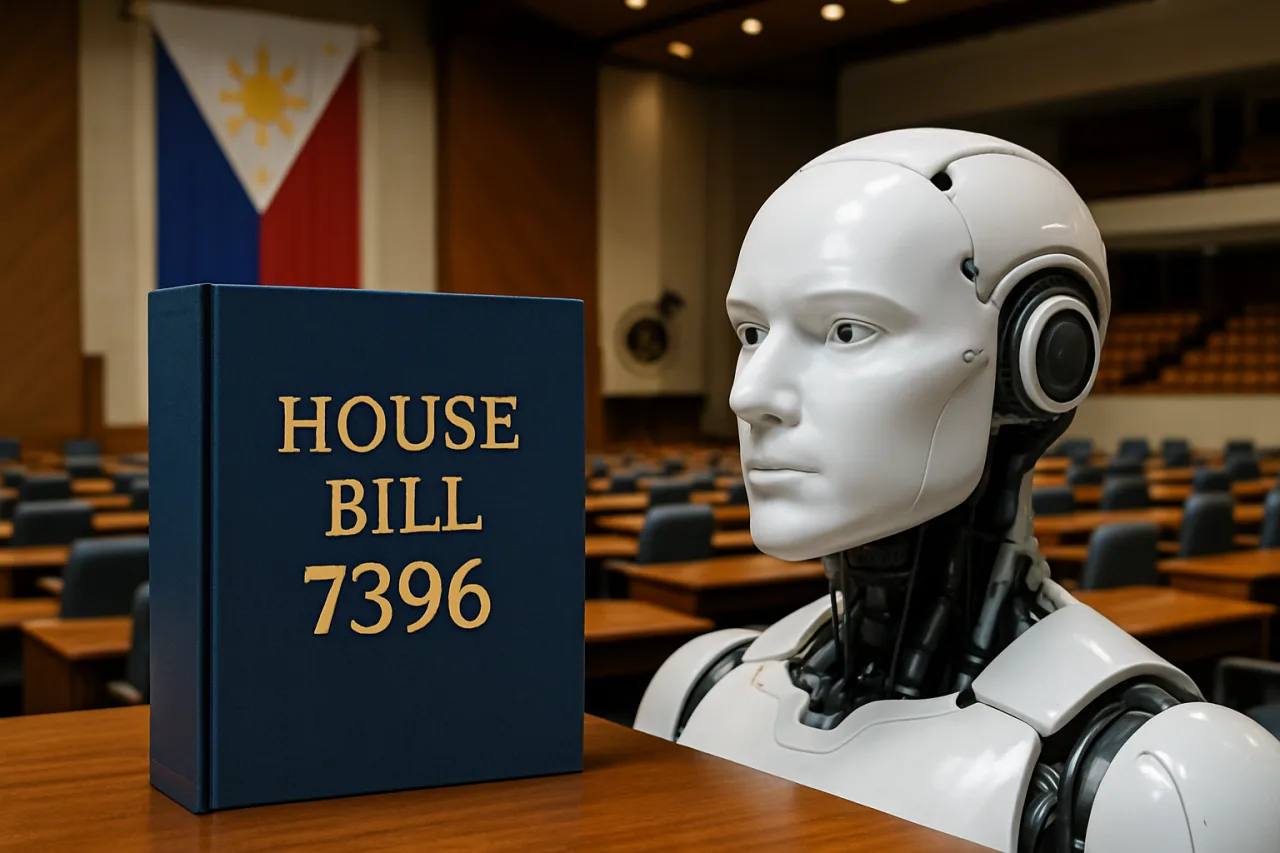
- 🏛️ The Bill: House Bill 7396, filed by Representative Robert Ace Barbers, creates the Artificial Intelligence Development Authority (AIDA) — a new government agency under the Office of the President that would oversee all AI development and use in the Philippines.
- 📋 What AIDA Would Do: AIDA would write the rules for AI in the Philippines — technical standards, ethical guidelines, licensing requirements for high-risk AI, and a national AI strategy that prioritizes Filipino needs.
- 🏢 Who It Affects: Anyone who builds AI (developers, tech companies) or uses AI in their business (banks, hospitals, schools, government agencies) would need to register their AI systems with AIDA and comply with its standards.
- 💰 The Penalties: Fines from ₱100,000 to ₱10 million for violations, suspension of AI operations, license revocation, plus existing criminal laws (Data Privacy Act, Cybercrime Prevention Act) apply if AI is used to commit crimes.
- 📅 The Timeline: If passed, AIDA would be set up within 6 months, rules published within 12 months, voluntary compliance within 18 months, and full enforcement within 3 years — a phased approach that gives businesses time to prepare.
House Bill 7396 is the Philippine Congress’s most ambitious attempt to regulate artificial intelligence. Filed by Representative Robert Ace Barbers of Surigao del Norte in March 2023, the bill proposes creating a brand-new government agency — the Artificial Intelligence Development Authority, or AIDA — that would sit under the Office of the President and have authority over every AI system developed or used in the Philippines. In plain terms, this bill says: if you build AI or use AI in the Philippines, you will eventually answer to a government agency that sets the rules for how that AI must work.
The bill is still pending in Congress — it has not been passed into law. But it has gone through committee hearings and stakeholder consultations, and it represents the most detailed framework for Philippine AI governance currently on the legislative table. For Filipino professionals, developers, and business owners who use AI tools — from ChatGPT to fraud detection systems to customer service chatbots — understanding House Bill 7396 is essential, because the rules it would create will shape how AI is used in the Philippines for years to come. For the broader context of Philippine AI regulation, see our feature on how Congress and UP Law are racing to govern AI. For the Senate’s approach, see our what we know about Senate Bill 25. For the labor protection bill, see our what we know about House Bill 9448. For the rights-focused approach, see what we know about House Bill 10362 (Diokno AI Governance Act). For the education sector’s response, see our what we know about the UP Law AI ban.
What House Bill 7396 Actually Says — In Plain Language
The bill is long and technical, but its core structure is straightforward. Here is what it does, step by step:
1. It creates AIDA. The Artificial Intelligence Development Authority would be a new government agency attached to the Office of the President. An Administrator appointed by the President would lead it, with Deputy Administrators for Technology Standards, Legal and Ethical Compliance, Industry Development, and International Cooperation. Think of AIDA as the SEC for AI — just as the Securities and Exchange Commission oversees financial markets, AIDA would oversee the AI market.
2. It defines who is covered. The bill applies to two groups: “AI Developers” — people or companies that design, create, train, or modify AI systems (think OpenAI, Google, local AI startups) — and “AI Deployers” — organizations that put AI systems into use (think banks using AI for credit scoring, hospitals using AI for diagnostics, schools using AI for grading). If you build AI, you are a developer. If you use AI in your business, you are a deployer. Most Filipino companies would fall into the deployer category.
3. It requires AI system registration. Under the bill, organizations would need to register their AI systems with AIDA. This creates a national database of what AI is being used where, for what purpose, and by whom. AIDA would use this information to prioritize which AI systems need the most oversight — a system that recommends movies needs less scrutiny than one that approves loans.
4. It creates licensing for high-risk AI. AI systems that could significantly affect health, safety, or fundamental rights — medical diagnostics, financial credit scoring, law enforcement tools, critical infrastructure management — would need a license from AIDA. To get that license, the organization would need to prove its AI meets technical, ethical, and safety standards. Low-risk AI systems would face lighter requirements.
5. It sets ethical rules. AIDA would require transparency (people should know when AI is making decisions about them), accountability (someone must be responsible when AI goes wrong), fairness (AI must not discriminate against groups of people), human oversight (critical AI decisions must have a human in the loop), and inclusive design (AI should benefit all Filipinos, not just those in cities). These principles align with the BSP’s STARS framework for banks, as we documented in our guide to BSP AI governance principles.
What AIDA Would Actually Do Day-to-Day
If House Bill 7396 passes, AIDA would have six main jobs:
| Job | What It Means in Practice |
|---|---|
| National AI Strategy | Write a plan for how the Philippines will develop and use AI — identifying priority areas, addressing the digital divide, setting timelines for AI adoption across sectors. |
| Technical Standards | Set rules for AI security, reliability, safety, and performance. These would be based on international standards (ISO, IEEE, NIST) but adapted for Philippine conditions. |
| Ethical Standards | Define what “responsible AI” means in the Philippine context — transparency, fairness, accountability, human oversight, and inclusive design. |
| Licensing and Certification | Issue licenses for high-risk AI systems. An organization using AI for medical diagnosis would need AIDA certification before deploying it. |
| Compliance Monitoring | Audit AI systems, investigate complaints, and require organizations to submit annual reports on their AI usage, incidents, and risk management. |
| International Coordination | Align Philippine AI rules with international frameworks like the EU AI Act, OECD AI Principles, and UNESCO AI ethics recommendations. |
AIDA would also coordinate with existing agencies. The National Privacy Commission would still handle data privacy. The BSP would still regulate AI in banks. The Department of Health would still oversee AI in healthcare. AIDA’s role would be to set the overarching framework and fill the gaps where no agency currently regulates AI — such as AI in education, media, employment, and consumer products.
How the Phased Rollout Works — and Why It Matters
One of the most practical aspects of House Bill 7396 is its phased implementation timeline. The bill does not demand instant compliance. Instead, it gives businesses and developers time to prepare:
Phase 1 (Months 1-12): Setting up AIDA. The agency gets established — leadership appointed, staff hired, offices set up. No enforcement happens during this phase. AIDA focuses on building capacity, not policing AI.
Phase 2 (Months 6-18): Writing the rules. AIDA conducts consultations with industry, civil society, academia, and government to draft the actual implementing regulations — the specific technical standards, ethical requirements, and licensing procedures. This is when the details get filled in.
Phase 3 (Months 12-24): Voluntary compliance. Organizations can voluntarily register their AI systems and test compliance with draft regulations. This is a pilot phase — AIDA learns what works, businesses learn what is expected.
Phase 4 (Months 24-30): Mandatory registration. All AI systems meeting specified thresholds must register with AIDA. High-risk AI systems must obtain licenses. Enforcement begins, but focused on education and correction rather than punishment.
Phase 5 (Months 30-36): Full enforcement. The complete regulatory framework is operational. Non-compliance results in penalties. AIDA conducts audits, investigates complaints, and sanctions violations.
This phased approach means that if the bill passes today, full enforcement would not begin for three years. That gives Filipino businesses time to build AI governance practices, train staff, and prepare for compliance — but it also means that AI will continue to develop in the Philippines without formal regulation for at least three more years.
What Happens If You Break the Rules
House Bill 7396 gives AIDA the power to impose penalties, though the specific amounts would be set in implementing regulations. Based on the bill’s framework and analysis by Regulations.AI, the penalties would likely include:
Formal warnings for minor or first-time violations where the organization shows good faith effort to comply. These go on public record.
Monetary fines ranging from ₱100,000 to ₱10 million, depending on the severity of the violation and the size of the organization. Larger corporations face higher fines; small businesses and startups face lower ones.
Suspension of operations for specific AI systems that pose immediate risks. AIDA can order an organization to stop using a particular AI system until it is fixed and recertified.
License revocation for serious or repeated violations. An organization that repeatedly fails to comply could lose its AIDA license entirely, prohibiting it from operating AI systems in the Philippines.
Beyond AIDA’s administrative penalties, existing laws still apply. If AI is used to violate the Data Privacy Act of 2012, the penalties include imprisonment of one to three years and fines of ₱500,000 to ₱4 million. If AI is used for cybercrime — fraud, identity theft, cyberattacks — the Cybercrime Prevention Act of 2012 applies, with penalties including imprisonment of six months to twelve years. AIDA does not replace these laws; it adds a layer of AI-specific oversight on top of them.
How House Bill 7396 Compares to Other Countries
House Bill 7396 is modeled partly on the European Union’s AI Act, which is the world’s first comprehensive AI law. Like the EU AI Act, HB 7396 uses a risk-based approach — high-risk AI faces stricter requirements than low-risk AI. Like the EU, it creates a dedicated regulatory body (the EU has its European AI Office; the Philippines would have AIDA).
However, the Philippine bill is more framework-oriented than the EU Act. The EU Act specifies detailed requirements for specific AI use cases — biometric identification, critical infrastructure, education, employment. House Bill 7396 leaves most specifics to AIDA’s implementing regulations, which gives flexibility but also creates uncertainty — businesses will not know the exact requirements until AIDA writes them, which could take 12-18 months after the law passes.
The bill also aligns with the OECD AI Principles, to which the Philippines is a signatory, and UNESCO’s Recommendation on the Ethics of Artificial Intelligence. This international alignment matters for Filipino companies that operate across borders — if Philippine AI standards are compatible with EU and OECD standards, compliance in the Philippines makes compliance elsewhere easier.
What This Means for Filipino Professionals
If House Bill 7396 passes, here is what it would mean for different groups of Filipino professionals:
For software developers and AI engineers: You would need to ensure that the AI systems you build meet AIDA’s technical standards. If you build high-risk AI — for healthcare, finance, or law enforcement — you would need to obtain AIDA certification before deployment. Start building documentation of your AI development process now: training data sources, testing procedures, bias testing results, and security measures.
For business owners: If you use AI in your business — chatbots, fraud detection, credit scoring, customer analytics — you would need to register your AI systems with AIDA. For high-risk applications, you would need a license. Start by inventorying every AI tool your business uses and assessing its risk level.
For consumers: The bill’s transparency requirements mean you would have the right to know when AI is making decisions about you — loan applications, job screenings, medical diagnoses. If you believe an AI system treated you unfairly, you could file a complaint with AIDA.
For students and educators: While House Bill 7396 does not directly regulate AI in education, AIDA’s standards would eventually apply to AI tools used in schools and universities. The UP College of Law’s AI ban, which we cover separately, shows that the education sector is already acting before the law catches up.
Frequently Asked Questions About House Bill 7396
What is House Bill 7396 in simple terms?
House Bill 7396 is a proposed law that would create a new government agency called AIDA (Artificial Intelligence Development Authority) to regulate all AI development and use in the Philippines. AIDA would set technical standards, ethical rules, and licensing requirements for AI systems, similar to how the SEC regulates financial markets.
Who filed House Bill 7396?
House Bill 7396 was filed by Representative Robert Ace Barbers of Surigao del Norte. It was introduced in the House of Representatives on March 1, 2023, and has been undergoing committee review and stakeholder consultations since then.
Who would AIDA regulate?
AIDA would regulate two groups: AI Developers (people or companies that build or train AI systems) and AI Deployers (organizations that use AI in their operations). This covers everyone from global tech companies like OpenAI to local banks using AI for fraud detection.
What are the penalties under House Bill 7396?
Penalties would include formal warnings, fines from ₱100,000 to ₱10 million, suspension of AI operations, and license revocation. Existing laws like the Data Privacy Act (imprisonment of 1-3 years, fines up to ₱4 million) and Cybercrime Prevention Act (imprisonment of 6 months to 12 years) would also apply if AI is used to commit crimes.
Has House Bill 7396 been passed into law?
No. As of August 2026, the bill is still pending in Congress. It has gone through committee hearings and consultations but has not been voted on by the full House or Senate. If passed, full enforcement would begin approximately three years after enactment.
Would House Bill 7396 affect small businesses using AI?
Yes, but with proportionate requirements. The bill uses a risk-based approach — low-risk AI (like a chatbot answering FAQs) faces lighter requirements than high-risk AI (like a system approving loans). Fines for small businesses and startups would be lower than for large corporations.
How is House Bill 7396 different from the EU AI Act?
Both use a risk-based approach and create a dedicated regulatory body. However, the EU AI Act specifies detailed requirements for specific AI use cases, while House Bill 7396 leaves most specifics to AIDA’s implementing regulations. This gives the Philippines more flexibility but also more uncertainty until AIDA writes the rules.