Table of Contents
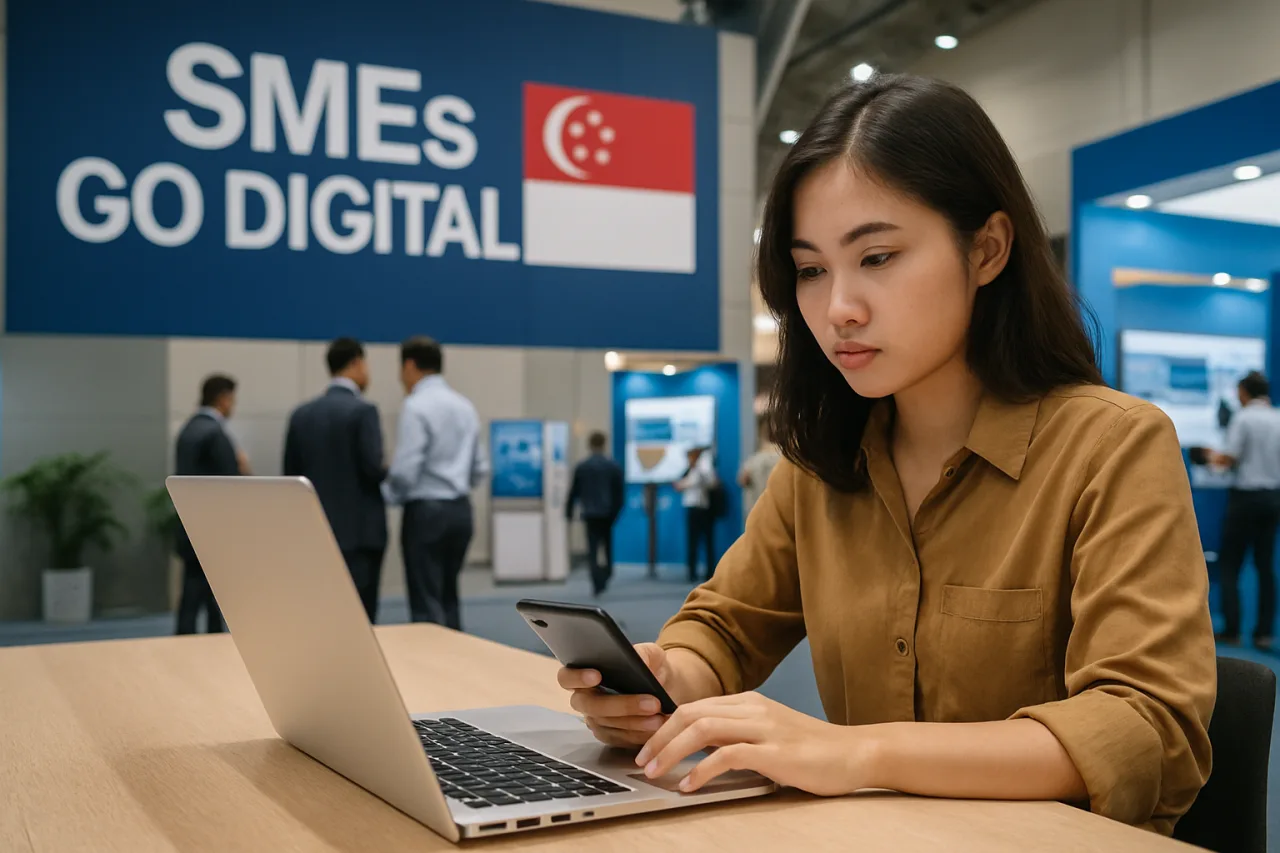
📱 THE BOARD — Thursday, October 1, 2026 → Events Intelligence: SMEs Go Digital Day Singapore (Oct 13): IMDA’s free one-day SME digitalization show at Suntec — 250+ pre-approved solutions, 20+ tech talks, PSG subsidy context · the artifact: the benchmark read — what a mature government MSME-digitalization program funds, and how the Philippine side (DICT’s ASEAN AI Tech Stack) compares tool-by-tool · kw: SMEs Go Digital
Related: Singapore Cyber Landscape 2025/2026: The Infection Spike Behind the Sc
Key Takeaway
- 🗓️ The event in one line: SMEs Go Digital Day 2026 runs October 13, 09:00-18:00, at Suntec Singapore (Halls 401-403), organized by IMDA — free admission with registration — and it is Singapore’s flagship annual floor for small-business digital tooling.
- 🛠️ What’s on the floor: 250+ digital solutions across every business function (accounting, HR, retail, marketing, cybersecurity), 20+ tech talks, AI use-case showcases, and vendor booths — all pre-approved under the SMEs Go Digital programme, most eligible for up to 50% Productivity Solutions Grant (PSG) support.
- 🇵🇭 Why a Philippine reader should care — the benchmark: Singapore shows what a mature, ten-figures-invested MSME digitalization program looks like at operating level: subsidy-qualified tool categories, adoption rates, and the small-business AI stack — a precise pre-view of what DICT’s ASEAN MSME AI Tech Stack (launched Oct 6-7) will curate toward.
- 🧳 The diaspora angle: Filipino entrepreneurs and employees IN Singapore attend free; Filipino MSME owners at home use the published session recordings and solution catalogue as their benchmark document — cross-border intelligence this register specializes in.
- 📋 The artifact: this piece converts the event into a comparison sheet — Singapore’s PSG-funded tool categories vs. the Philippine MSME stack’s launch instruments — plus the five categories a Filipino small business should treat as “basic infrastructure” whether or not a subsidy exists.
SMEs Go Digital Day 2026 opens October 13 at Suntec Singapore — IMDA’s free annual floor where the city-state’s small businesses meet 250+ pre-approved digital solutions, sit 20+ tech talks, and watch AI use-case showcases — and this register treats it as the benchmark event of the quarter (episode #008 of nine). Not because Filipino MSMEs apply for Singapore grants — they don’t (the PSG’s up-to-50% support is Singapore-side) — but because the event’s tool catalogue IS the region’s clearest picture of which digital capabilities governments now classify as small-business infrastructure: the categories Singapore pre-approves and co-funds are the same categories the Philippines’ own program-in-formation (DICT’s ASEAN MSME AI Tech Stack, launched in the same quarter at the ASEAN AI Summit) will curate toward, with a funding and adoption lag this piece measures. For the Filipino entrepreneur, the freelancer selling digitalization services, and the professional watching ASEAN digital integration, Singapore’s floor is the answer key printed a few years early. The comparison follows — category by category, subsidy by subsidy, with the honest gaps priced.
The SMEs Go Digital Machine — How Singapore Runs MSME Digitalization
The SMEs Go Digital programme’s design deserves the read because it operationalizes three things the Philippine system usually keeps separate. First — curation before subsidy: only pre-approved solutions enter the catalogue (business-function-vetted tools across accounting, HR, retail management, digital marketing, cyber-security); the SME buys with confidence that someone already tested the category, and the vendor builds to a government-standard compliance bar — the trust layer that makes small owners move. Second — co-funding that targets the adoption gap: the Productivity Solutions Grant supports up to 50% of qualifying pre-approved tools (with higher support historically aimed at emerging categories like AI solutions), which mathematically converts a “nice-to-have” software line-item into a marginal-cost decision; the PSG’s design intent is exactly the gap the PIDS data says the Philippines has — firms that stall at the first-tool decision. Third — an annual show floor that makes the catalogue tangible: October 13’s Suntec event puts the pre-approved vendors in one hall with tech talks (the organizer’s schedule runs AI use cases and SME success stories), which is where abstract “digital transformation” becomes a priced, touchable purchase. The cumulative machine design — curate, subsidize, exhibit — explains the adoption statistics Singapore’s MSME sector posts, and it is the reference architecture every ASEAN digitalization program now benchmarks against; the Philippine side is building the same three layers with the ASEAN MSME AI Readiness Framework (the diagnostic) and Tech Stack (the curated suite) — the October 6-7 summit’s instruments — followed by the subsidy layer that remains the structural gap this register’s money coverage tracks.
Bottom Line: Curate → subsidize → exhibit: the three-layer machine Singapore runs, and the exact template the Philippine stack is assembling — with the subsidy layer the difference to watch.
SMEs Go Digital’s Five Infrastructure Categories — the Filipino MSME Sheet
Walk the Suntec catalogue category by category and a clear hierarchy emerges — the five capabilities Singapore pre-approves at scale, and their Philippine-side translation for the reader’s own business. 1 — Digital accounting and finance: cloud bookkeeping invoicing-payroll suites are PSG staples; the Philippine translation: BIR-compliant cloud accounting exists locally at affordable tiers, and the MSME that digitizes invoicing first gets the cleaner credit data that banks’ MSME lending (the LANDBANK AI partnership this site covered) increasingly requires — the accounting tool is a financing key, not admin. 2 — Retail and payments integration: POS-loyalty-inventory suites dominate the floor; the Philippine parallel: QR-PH payments plus marketplace integrations turned retail tooling into a survival layer post-2023 — inventory-sync between Shopee/Lazada/walk-in remains the biggest local time-saver. 3 — Digital marketing and CRM: adoption-sequenced tiers (social management first, CRM second); Filipinos already run the audience side (the most social-country-in-the-world statistic), the gap is the CRM layer that converts followers into a owned customer list — the distinction our magnet-and-newsletter coverage institutionalizes. 4 — Cybersecurity basics: the PSG catalogue’s security row (endpoint protection, secure-email, backup) is the category the Philippines most needs and least adopts — the SMB breach economics this site’s cyber coverage prices (SMBs are the quiet majority of breach victims) make this the benchmark’s most important import: a three-tool minimum (vault, backup, endpoint) before ANY growth tooling. 5 — the AI row (2026’s expansion): Singapore’s AI-solutions subsidies (adopting AI through national programs) forecast the Tech Stack’s trajectory — the Filipino MSME that experimentally adopts one AI workflow this quarter (the prepaid AI-packs class makes that a ₱49-149 experiment locally) positions for the stack-era discounts when they arrive.
Bottom Line: Accounting-as-financing-key, inventory-sync, owned-CRM, a security minimum, and one AI experiment — the five-category sheet, with or without a subsidy.
Cross-Border Lessons — What to Watch When the PH Stack Deploys
The comparison sheet’s forward layer: three Singapore-machine metrics that forecast the ASEAN MSME AI Tech Stack’s Philippine trajectory, watchable without attending. Adoption depth per category: Singapore’s mature categories (accounting, retail) show near-saturation in its SME base while newer AI categories climb — the adoption curve’s shape forecasts which Philippine categories hit scale first (retail-payments leads locally; accounting follows the credit-data pull; the AI row rides the ₱49-₱149 entry pricing). Subsidy design changes: watch the PSG’s support-level shifts each year (Singapore periodically re-tunes sector caps as maturity arrives — the signal of WHICH solutions became commodity); the Philippine Tech Stack’s eventual subsidy layer will copy one of three designs (PSG-style co-pay, bundled gov-subsidized licenses, or procurement catalogs) — each implies different vendor economics for the Filipino solution-provider readers this register writes for. Show-floor composition: October 13’s exhibitor mix — how many LOCAL (Singapore-built) vs. global tools occupy the pre-approved catalogue — forecasts how the ASEAN stack balances regional champions against hyperscalers: a balance that decides whether Filipino-built AI tools gain the same runway (the local-vendor opportunity angle this site’s startup coverage tracks, tied to the GCash-ecosystem MSME integrations). For the OFW-side reader building a Philippines-based business for return or retirement: this benchmark sheet IS the due-diligence template for the family business plan — adopt the five categories on the local equivalents, budget at Philippine price points, and watch the government stack for the subsidy moment when it prices tools down; the business that enters 2027 with the security minimum and one AI workflow already running will ride that moment instead of chasing it.
Bottom Line: Adoption curves, subsidy redesign, and vendor mix — the three Singapore metrics that forecast the Philippine stack’s next moves; adopt the sheet now, ride the subsidy when it lands.
The Filipino Professional’s Three Routes Into the SMEs Go Digital Week
The benchmark converts to personal strategy through three route types this register prices. Route 1 — attend (the diaspora and consultant lane): Filipino professionals working IN Singapore (the tech-sales, product, and operations community our Singapore coverage tracks) register free and walk the floor with one export-orientation brief: which solution categories are pre-approved, which vendor segments dominate, and which Philippine-market gaps their own products or services fill — the cross-border SaaS-and-services conversation is exactly the opportunity shape Singapore’s regional openness enables, and October 13’s hall compresses six months of market research into a day. Route 2 — the remote benchmark (the MSME-owner lane): owners at home don’t need the ticket — they need the two follow-on artifacts the machine publishes: the pre-approved solution catalogue (the real-time answer to “which tools does a mature market consider infrastructure”) and the tech-talk recordings (SME success stories carry the adoption patterns, including the unglamorous ones — how a retailer’s inventory-sync decision preceded its marketing stack); the artifact work: one afternoon mapping the five categories against local tools and Philippine pricing, producing the family-business sheet this piece’s five-category section pre-drafts. Route 3 — the vendor/service-provider lane (the opportunity read): Filipino SaaS founders, agencies, and consultants selling digitalization services should study the PRE-APPROVAL mechanic itself — the curated-catalogue model (curate → subsidize → exhibit) is the region’s go-to-market template, and the ASEAN Tech Stack’s eventual curation process becomes the Philippines’ own pre-approval contest; a Filipino vendor positioning its tool for the Tech Stack’s selection criteria (affordable, MSME-ready, multilingual — the launch materials’ stated bar) rides a government channel that no private marketing budget can buy — the wedge our startup coverage has tracked since the YCO-class hardware debates. Three routes, one shared note: the value of Singapore’s floor to this audience is never the free ticket — it is always the printed answer key of what to build, buy, or benchmark next.
Bottom Line: Attend with an export brief, run the catalogue benchmark remotely, or position a product for the ASEAN stack’s pre-approval contest — pick the route that matches your desk, and run it before the ASEAN stack’s subsidy moment prices the field.
Frequently Asked Questions
When and where is SMEs Go Digital Day 2026?
October 13, 2026 (Tuesday), 09:00-18:00, at Suntec Singapore Convention & Exhibition Centre (Halls 401-403) — organized by IMDA, free admission with registration through IMDA’s official channels; exhibit halls feature 250+ pre-approved digital solutions and 20+ tech talks.
Can Filipinos attend SMEs Go Digital Day?
The event is free for registered visitors (Singapore’s business community gets priority by design); Filipinos working in Singapore attend like any participant, and Filipino MSME owners at home use the event’s published sessions and pre-approved solution catalogue as the benchmark document — attendance is the bonus, the catalogue is the artifact.
What is the Productivity Solutions Grant?
Singapore’s PSG co-funds up to 50% of qualifying pre-approved digital tools for local SMEs (with sector- and solution-specific caps), making software adoption a marginal-cost decision; it is the subsidy layer of the SMEs Go Digital machine — the layer the Philippine MSME digitalization build currently lacks.
What should a Philippine MSME copy from the Singapore benchmark?
The five-category sheet: cloud accounting (BIR-compliant — it feeds bank credit data), marketplace-integrated POS-inventory, an owned CRM on top of social presence, a three-tool security minimum (vault, backup, endpoint), and one prepaid AI workflow experiment — adopt in that order, priced locally, ahead of the ASEAN Tech Stack’s subsidy moment.
How does this connect with the ASEAN AI Summit?
As the benchmark twin: the ASEAN AI Summit (Oct 6-7, free and online — our update covers it) launches the ASEAN MSME AI Readiness Framework and Tech Stack under DICT curation, while Singapore’s October 13 floor shows the machine end-state the instruments build toward — read together, they form the region’s full MSME-digitalization picture this quarter.
Financial Disclaimer: This article is for general information and education, not investment or financial advice. Grant terms and event details change; verify with official government sources before acting. WorldNgayon.com is not a financial adviser and may hold affiliate relationships with tools or services mentioned.