Table of Contents
📱 THE BOARD — Thursday, October 1, 2026 → Events Intelligence: PSECE 2026 (Oct 26-28): the 21st Philippine Semiconductor and Electronics Convention and Exhibition lands at SMX Manila — 320+ companies, 6,000+ delegates, the industry that is 59% of Philippine exports · the artifact: the two-way map — where the $110B chip roadmap creates Filipino careers by 2030, and what OFW engineers should price about returning to it · kw: PSECE 2026
Related: Japanese Semiconductor Facility Planned at LIMA Estate: What the 20-He
Key Takeaway
- 🏭 The scale is the signal: PSECE 2026 (October 26-28, SMX Convention Center Manila) convenes the country’s biggest export industry — semiconductor and electronics — with over 320 participating companies and 6,000+ expected delegates across three days, hosted by SEIPI.
- 📈 The $110B roadmap frames every booth: the government’s Semiconductor and Electronics Industry roadmap targets $110 billion in annual exports by 2030 ($70B semiconductors + $40B electronics), a five-year program to train 128,000 professionals, and a march up the value chain from packaging toward IC design — PSECE is where that roadmap’s hiring and supply decisions actually transact.
- 🔗 The OFW-relevant economy is real and near: the industry already runs roughly three million Filipino jobs (~59% of exports), and the President’s June 2026 directive to fast-track semiconductor and AI investments — the Luzon Economic Corridor, the Semiconductor Advisory Council, the 4,000-acre Pax Silica AI-native hub at New Clark City with 50+ interested investors — signals the domestic high-value career layer OFW engineers watch for.
- 🧭 Read it as investment intelligence: unlike the career-facing SOFTCON next door, PSECE is the quarter’s cleanest window into PH industrial policy — attendees (and watchers) learn which segments (advanced packaging, IC design labs, facility services) get the next wave of capital.
- 🇺🇸 The geopolitical read matters: the US-Japan Luzon Economic Corridor and Texas Instruments’ 40-year Clark presence tie PSECE’s agenda to global supply-chain re-routing — the same force our World Investment Watch tracks in trade data.
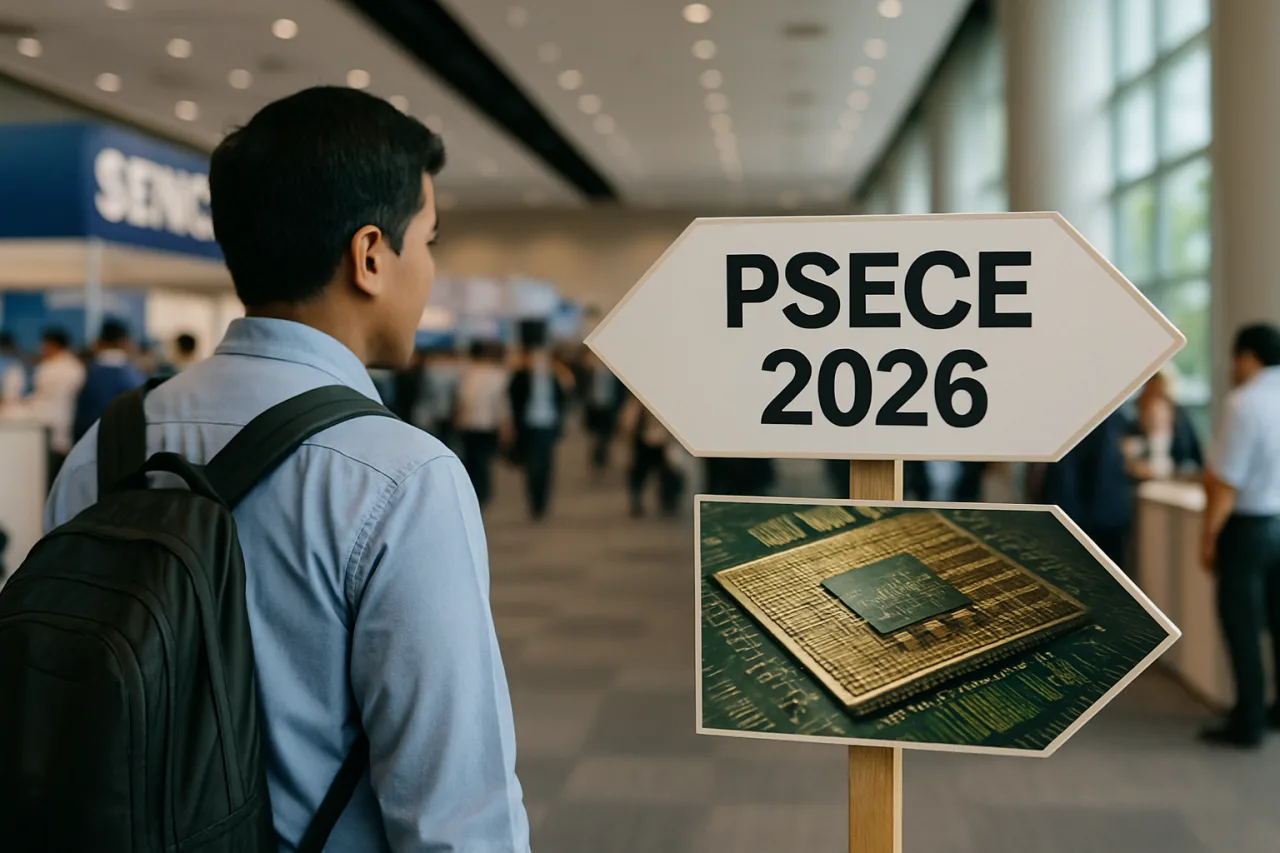
PSECE 2026 — the 21st Philippine Semiconductor and Electronics Convention and Exhibition — opens October 26 at the SMX Convention Center Manila, and PSECE 2026 is the quiet heavyweight of the quarter’s events board: not a consumer expo, not a hiring fair, but the annual transaction floor of the industry that produces roughly 59% of everything the Philippines exports and employs about three million Filipinos. Hosted by the Semiconductor and Electronics Industries in the Philippines Foundation (SEIPI), the three-day convention gathers over 320 local and international companies and 6,000+ expected delegates — chip designers, packaging engineers, test-equipment vendors, facility builders, and the government officials who write the incentive rules. This board — episode #005 of the Oct-Dec tech events register — runs PSECE through the intelligence standard, and the honest framing first: this is NOT a ticket-in-the-WhatsApp event like the free ASEAN summit; it is industry intelligence most useful read as a map. The two maps that matter: where the $110B roadmap creates Filipino careers by 2030, and which segments of the semiconductor value chain are expanding vs. plateauing — the difference between an engineer’s next five years and a stagnant one. Here’s the full read.
PSECE 2026’s Industry Context — the Sector That Pays the Country’s Bills
The Philippine electronics industry’s structure explains what happens at PSECE’s booths: 73% Semiconductor Manufacturing Services (the back-end side — IC packaging, test, and assembly) and 27% Electronics Manufacturing Services (full-product assembly, PCB fabrication), concentrated in Metro Manila, CALABARZON, Luzon economic zones, and Cebu — the geography where this industry’s three million jobs actually live. The export arithmetic gives the sector its national weight: cumulative electronics exports run at or near SIXTY percent of total Philippine exports (about $12.9 billion as of the 2023 YTD benchmark SEIPI last published, with 2026 monthly performance reports continuing on its site), flowing top-destinations Hong Kong, China, the USA, Singapore, and Japan. The strategic shift the roadmap formalizes: for decades the Philippines ran the industry’s stable-but-limited back end (packaging, test, assembly); the $110B-by-2030 roadmap — $70B semiconductors, $40B electronics — moves the sector up the chain into advanced packaging, integrated-circuit design, and eventually front-end manufacturing, backed by a five-year program to train and upskill 128,000 professionals and a plan for up to three national laboratories (fabrication, R&D, talent development). The government’s execution machinery: the Semiconductor and Electronics Industry Advisory Council (chaired by Executive Secretary Recto — itself a signal of priority), the Luzon Economic Corridor with the US and Japan (Subic-Clark-Manila-Batangas), and the June 2026 presidential directive to fast-track semiconductor and AI investment incentives — the policy package that PSECE’s October floor displays in corporate form. For the reader deciding whether this event matters: every peso of that 128,000-person training program is a Filipino career decision — PSECE is where the industry’s 320 companies signal what skills they’ll buy next.
Bottom Line: 73% back-end manufacturing moving up the value chain, $110B target, 128,000 careers funded — PSECE is the annual check on that plan’s pulse.
The Two-Way Map — Careers by 2030 and Segments to Watch
Map 1 — the career route. The roadmap’s value-chain climb allocates specific, billable career lanes: IC design engineers (the segment moving from near-zero local capacity toward a real industry — companies like the multinational design centers already in Manila expand first), advanced-packaging specialists (the high-value transition of the existing back-end workforce — the most realistic 2027-2030 upgrade path for the three million already inside the industry), test and validation engineers (as AI-chip complexity rises, test becomes the bottleneck discipline), and the facility-and-equipment layer (HVAC-grade cleanroom construction, precision-machinery maintenance — the trades’ version of the semiconductor boom, relevant to the technical-vocational readers this site writes for). The OFW engineer’s angle is the map’s sharpest point: a Filipino engineer in a Gulf or Singapore semiconductor-adjacent role prices the domestic pull differently in 2026 than in 2023 — with Pax Silica (the US-led 4,000-acre AI-native industrial hub at New Clark City, >50 interested investors including hyperscale data-center and AI-infrastructure players) and the LEC’s incentive machinery coming online, the return-home calculus gains a first time real domestic runway to senior high-value roles; PSECE’s exhibitor list is the recruiting surface to watch (multinationals’ Philippine HR teams use the convention for exactly that). Map 2 — the segments. Watch at and after the convention: advanced-packaging announcements (the near-term value climb), IC-design-lab investments (the roadmap’s three national labs’ first tranche), equipment-vendor expansion (Applied Materials-class players sizing Philippine service centers — the strongest leading indicator of manufacturing commitment — and the signal our World Investment Watch tracks weekly), and the power-infrastructure contracts (fab-adjacent energy demand is the sector’s silent constraint). Both maps compose the same conclusion: the October 26-28 floor is the country’s clearest window into whether the $110B ambition is deploying or drifting — and the official event page carries the exhibitor and agenda updates that keep this piece’s maps current.
Bottom Line: Careers: IC design, advanced packaging, test, facilities. Segments: labs, equipment vendors, power contracts — the booth list IS the deployment report.
For the Filipino Desk — Three Reads This Month
Read 1 — the engineer’s calendar test (10 minutes): if you or a family member works in electronics, semiconductors, or a technical trade, cross-reference PSECE’s exhibitor list against your current employer/skill — the segments expanding (packaging upgrade programs, test engineering, design centers) name where the 128,000-person training wave pays; applications and internal-upgrade requests timed to a company’s roadmap announcement beat unsolicited ones. Read 2 — the OFW return-math refresh (30 minutes): rerun the homecoming arithmetic you ran in 2023 — with LEC incentives, Pax Silica hiring phases, and the roadmap’s training budget, the domestic senior-engineer compensation trajectory changed; PSECE week is when the multinationals’ Philippine teams publish capacity news, and one LinkedIn hour that week re-prices the return option without a ticket. Read 3 — the investor’s watch (ongoing): semiconductors are the country’s largest export industry with a formal government roadmap — the listed and subsidiary players exposed to it (electronics exporters, industrial landlords, power producers serving the zones) re-price as deployment milestones land; the discipline stays the one this site runs in the PSE Watch: track the roadmap’s stated deadlines, not the headlines’ enthusiasm. The next episode in this register returns to the free-tier floor: the IoT Conference Philippines + AI Philippines Expo on November 10-11 — the consumer-scale side of the same technology wave PSECE prices industrially.
Bottom Line: Engineer: time moves to the roadmap. OFW: rerun the return-math at PSECE week. Investor: watch deployment, not ambition.
The OFW Engineer’s Return Map Inside PSECE 2026 Week
For the engineer reading this abroad, the PSECE week homework is one focused hour, and it runs like this. Minute 0-15 — the exhibitor skim: open the PSECE 2026 exhibitor list on the official SEIPI page and tag the ten companies that match your stack — multinationals with existing Philippine plants (the Texas Instruments and analog-chip class), the EMS players expanding test capacity, and any design-center names you don’t recognize yet (those are the roadmap’s newest bets). Minute 15-30 — the announcement sweep: during and right after October 26-28, run one search per tagged company plus “Philippines” — capacity news posted during convention week is the fastest-expiring signal on the Philippine industrial calendar, and it is exactly how the roadmap’s 128,000-training allocation begins converting into recruiting funnels. Minute 30-45 — the compensation re-baseline: pull three domestic senior-engineer postings in your discipline from the tagged companies and compare against your current host-country package with the remittance equation inverted — home compensation buys different things (the same math behind our remittance calculator comparison, applied to salary) when rent, schooling, and the family’s cost structure shift to peso denominations; this is the same discipline of our remittance calculators for OFWs, applied to the salary line instead of the wire. Minute 45-60 — the corridor check: if the stack is AI-infrastructure-adjacent (data-center electrical, thermal, network engineering), read the week’s Pax Silica and Luzon Economic Corridor updates — 4,000 acres of AI-native industrial buildout is the largest single domestic demand event for exactly the skills the diaspora carries; a 2027 hiring wave priced now beats one discovered after the contracts sign. The honest counterweight, because this register never sells a return: host-country experience still carries a premium, Gulf tax structures still beat peso compensation on the raw line, and the roadmap’s execution risk is real (“paper with ambition printed on it,” as the council’s own chair put it) — the hour’s purpose is re-pricing the option, not exercising it automatically.
Bottom Line: One hour at PSECE week — skim, sweep, re-baseline, corridor check — turns the return-home option from a feeling into a number.
Frequently Asked Questions
When and where is PSECE 2026?
The 21st Philippine Semiconductor and Electronics Convention and Exhibition runs October 26-28, 2026 at the SMX Convention Center Manila (Mall of Asia Complex, Pasay), hosted by SEIPI — the industry foundation of the country’s largest export sector.
How big is PSECE 2026?
Over 320 participating local and international companies and 6,000+ expected delegates across the three days — the biggest annual gathering of the Philippine semiconductor and electronics industry, spanning chip packaging, PCB assembly, test, equipment, and services rows.
Can ordinary professionals or students attend PSECE?
PSECE is a B2B industry convention — the delegate mix skews company representatives, engineers, and government; students and academics enter through SEIPI’s academe channels, and non-industry readers follow the event as intelligence via exhibitor announcements and the roadmap’s public milestones rather than floor attendance.
What is the Philippine semiconductor roadmap’s goal?
The government-industry roadmap targets $110 billion in annual electronics exports by 2030 ($70B semiconductor, $40B electronics), upskilling 128,000 professionals, up to three national laboratories, and a value-chain climb from packaging toward IC design and eventually front-end manufacturing — coordinated through the Semiconductor Advisory Council and the US-Japan Luzon Economic Corridor.
Why should OFWs care about PSECE?
The semiconductor push is the Philippines’ most credible high-value-domestic-careers program — for OFW engineers and technical professionals, it changes the return-home calculus (senior roles, incentive-backed expansion, Pax Silica’s AI infrastructure), and PSECE week is when that expansion becomes visible in exhibitor and hiring announcements.
Financial Disclaimer: This article is for general information and education, not investment or financial advice. Event dates, program details, and market projections change; verify with official sources before making career or investment decisions. WorldNgayon.com is not a financial adviser and may hold affiliate relationships with tools or services mentioned.
The technician-and-trades lane deserves its own line in the careers map, because it is the widest door in the building: the semiconductor expansion plan's workforce program targets roles across the credential ladder — from machine operators and quality inspectors (entry, train-to-hire pipelines through TESDA partnership courses) to equipment technicians and facilities engineers (the cleanroom-maintenance class whose certifications transfer globally). Readers running family education budgets should note the asymmetry: semiconductor-adjacent credentials (mechatronics, industrial electronics, precision instrumentation) compound with the roadmap's decade-long horizon — the training pipeline a student enters in 2027 matures into the senior-technician layer exactly as the $110B target year arrives, which is the kind of timeline alignment education decisions rarely get.
>
Related reading: the Philippines’ semiconductor roadmap in the national compute era.