Table of Contents
Key Takeaway
- AI coding agents are rewriting how software is built: Tools like Devin, Cursor, and GitHub Copilot Workspace can now autonomously generate, test, and deploy code — a capability that did not exist 18 months ago.
- Physical AI and software AI are converging: The same agent architectures powering coding tools are being adapted to control robots, blurring the line between digital and physical automation.
- OFW IT professionals must adapt: Routine coding jobs are the most exposed to agent automation. Filipino developers working abroad need to move up the value chain toward architecture, review, and AI oversight roles.
- Agents need human verification: Even the best AI coding agents produce errors in 15-30% of generated functions — human review is not optional, it is the critical safety layer.
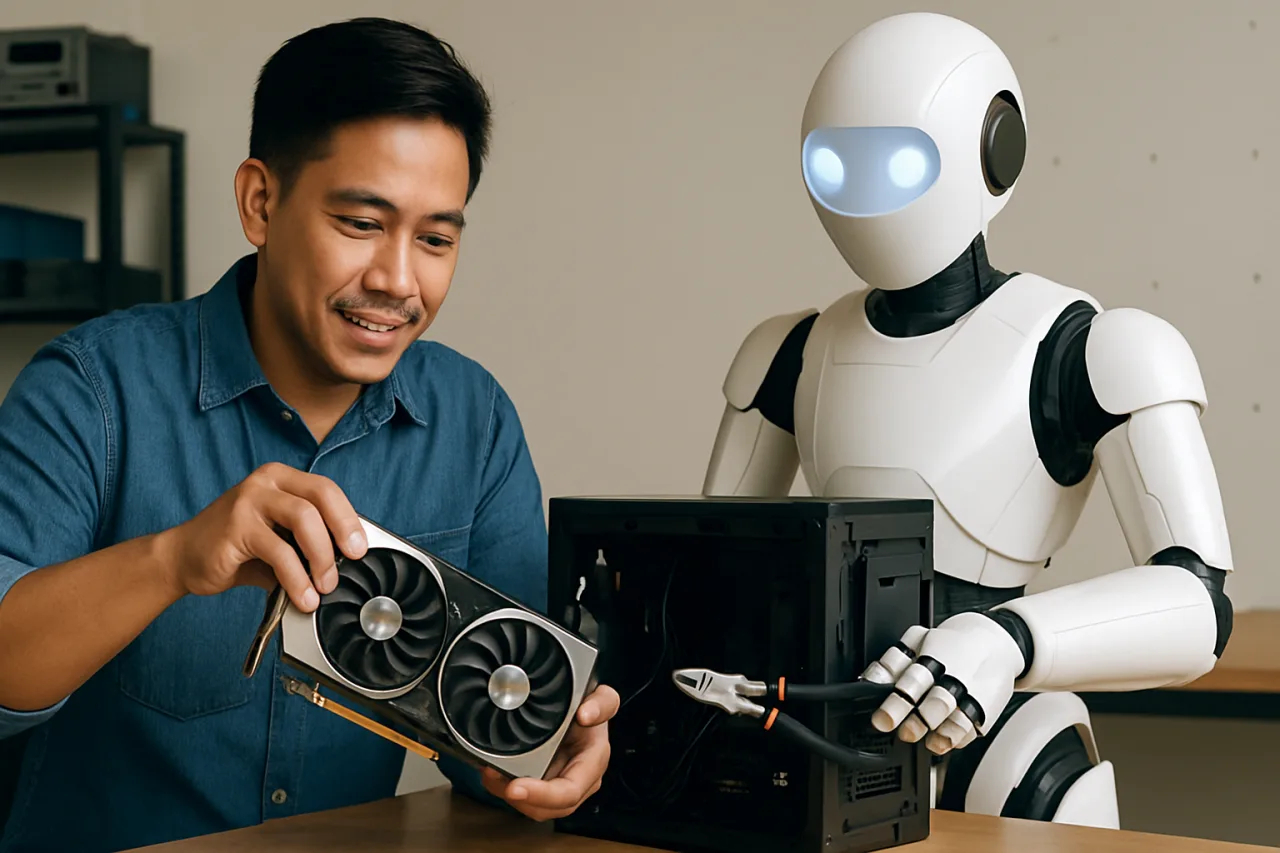
🤖 AI-Powered Robots: Nvidia’s self-improvement program uses AI coding agents to teach robots how to install GPUs, cut zip ties, and perform complex physical tasks autonomously.
💡 Why OFWs Should Care: As AI coding agents advance, they will reshape manufacturing, logistics, and tech industries where millions of OFWs work.
🌍 The Philippines Angle: The country’s manufacturing and tech sectors will be directly impacted by advances in robotics and autonomous programming.
AI Coding Agents Taught Robots How to Install GPUs and Cut Zip Ties
Nvidia’s self-improvement program for robots has achieved a remarkable milestone: AI coding agents have taught robots how to install GPUs, cut zip ties, and perform complex physical tasks autonomously, according to an Ars Technica report published June 17, 2026. The program enlists teams of AI coding agents to direct robot training, marking a significant step toward fully autonomous robot learning.
For Overseas Filipino Workers, the rise of autonomous programming in robotics has profound implications. Millions of OFWs work in manufacturing, logistics, and tech industries where robots could soon become commonplace. Understanding this technology helps OFWs prepare for the future of work.
“Nvidia’s self-improvement program for robots enlists teams of AI coding agents,” the Ars Technica report states. These agents write code, debug errors, and iteratively improve robot performance — tasks that previously required human engineers.
How AI Coding Agents Work in Robotics
AI coding agents are artificial intelligence systems that can write, test, and debug code autonomously. In Nvidia’s program, these agents are tasked with teaching robots to perform physical tasks — from installing delicate GPU components to cutting zip ties and assembling parts.
The process works like this: the agents generate code to control robot movements, test the code in simulation, analyze failures, and iteratively improve the code until the robot can perform the task reliably. This cycle of code generation, testing, and improvement happens autonomously, without human intervention.
The implications are significant. Traditionally, programming robots to perform new tasks required teams of engineers writing thousands of lines of code over weeks or months. With autonomous agents, the same tasks can be accomplished faster, cheaper, and with fewer human resources.
What makes Nvidia’s approach particularly notable is the use of multiple agents working in parallel. Rather than a single agent trying to solve every problem, the program employs teams of agents that collaborate, compete, and cross-check each other’s work — much like a human engineering team would.
Why OFWs Should Pay Attention to Autonomous Robot Programming
The Philippines is a major hub for manufacturing and tech services, with millions of OFWs working in sectors that robotics and autonomous programming are poised to transform. From factory workers in East Asia to software developers in the Middle East, OFWs are directly in the path of this technological shift.
The Bangko Sentral ng Pilipinas (BSP) has previously noted that technological disruption is a key risk factor for the Philippine economy. As autonomous programming becomes more capable, the demand for certain types of labor may decline, while new opportunities in AI-related fields will emerge.
OFWs who understand this technology can position themselves on the right side of this shift. Those who develop skills in AI supervision, robotics maintenance, or AI-adjacent services will find growing demand. Those who ignore the trend risk being displaced by the very technology they did not prepare for.
The manufacturing sector is particularly vulnerable. Many OFWs work in electronics assembly, semiconductor manufacturing, and other precision manufacturing roles — exactly the kind of tasks that Nvidia’s robots are learning to perform. As the cost of robotic automation declines, the economic case for human workers in these roles weakens.
What You Don’t Know: The Hidden Impact on OFW Livelihoods
What most OFWs do not realize is that autonomous robot programming is already being deployed in industries where they work. Manufacturing facilities in China, Japan, South Korea, and other countries that employ large numbers of OFWs are increasingly using robots for tasks that were previously done by human workers.
The speed of adoption is accelerating. What was once a gradual process of automation is now being compressed into months rather than years, thanks to advances in autonomous programming. Robots that once required months of manual programming can now be trained in days.
There is also a software development dimension. Many OFWs work as software developers, QA engineers, and IT professionals. As autonomous programming tools become more capable, the demand for certain types of software development work may decline. OFWs in tech roles need to understand which skills will remain valuable and which are at risk of automation.
The Department of Information and Communications Technology (DICT) has been working to position the Philippines as a technology hub. Initiatives to develop AI talent aim to help Filipino workers transition to AI-adjacent roles. For more, see our coverage of DICT’s push for stricter digital regulation.
How OFWs Can Prepare for the Autonomous Robotics Era
1. Develop AI-adjacent skills. Learn about robotics, AI supervision, and related fields. OFWs who can work alongside automated systems — rather than compete with them — will be in high demand. Read our guide on why tech literacy matters for OFW investors.
2. Stay informed about automation in your industry. Understand how robotics and autonomous programming are being adopted in your specific sector. This knowledge will help you anticipate changes and adapt accordingly.
3. Build a diverse skill set. Do not rely on a single skill or job function. The OFWs who will thrive in the automation era are those who can adapt, learn, and pivot as the job market evolves.
4. Consider the investment angle. The robotics and automation industry is growing rapidly. Companies developing robotic systems, AI training platforms, or automation services represent potential investment opportunities for informed OFW investors.
5. Connect with tech communities. Join online communities, attend webinars, and follow developments in robotics and autonomous programming. The more informed you are, the better decisions you will make.
The Bigger Picture: Autonomous Programming in 2026
The milestone achieved by Nvidia’s program is part of a broader trend toward autonomous programming in robotics. As these systems become more capable, the cost of automating physical tasks will decline, accelerating the adoption of robotics across industries from manufacturing to healthcare to logistics.
For the Philippines — a country that sends millions of workers abroad and is actively trying to position itself as a technology hub — the implications are profound. The decisions made by companies and governments about robotics and automation will shape the job market for decades to come.
The OFWs who understand this technology and prepare for its impact will be the ones who thrive. Those who ignore it risk being left behind by the most significant technological shift since the internet.
Frequently Asked Questions
What are AI coding agents?
AI coding agents are artificial intelligence systems that can write, test, and debug code autonomously. In robotics, they generate code to control robot movements and iteratively improve performance without human intervention.
How do AI coding agents teach robots?
They generate code to control robot movements, test it in simulation, analyze failures, and improve the code until the robot can perform the task reliably. Multiple agents work in parallel, collaborating and cross-checking each other’s work.
Why should OFWs care about autonomous robot programming?
Autonomous programming is being deployed in manufacturing, logistics, and other sectors where millions of OFWs work. Understanding this technology helps OFWs prepare for changes in the job market and make smarter career decisions.
Will robots replace OFW manufacturing jobs?
Robots are increasingly capable of performing manufacturing tasks, but the full impact will depend on adoption speed and cost. OFWs who develop skills in robotics supervision, maintenance, or AI-adjacent fields will be better positioned.
What is Nvidia’s role in robot training?
Nvidia’s self-improvement program uses teams of AI coding agents to autonomously train robots to perform physical tasks. Nvidia provides the hardware (GPUs) and software platforms that power both the training and the robots themselves.
Disclaimer: This article is for informational and educational purposes only. It does not constitute professional career or investment advice. The technology landscape is evolving rapidly. worldngayon.com is not affiliated with Ars Technica, Nvidia, or any organization mentioned in this article.