
Table of Contents
Key Takeaway
- 🔒 Default encryption: Signal, WhatsApp, and Messenger all encrypt personal chats end to end by default in 2026, so the real difference is not the message bubble, it is the backups and the metadata, the two layers any privacy comparison must weigh.
- 💾 The backup gap: WhatsApp backs up to the cloud once you switch on end-to-end encrypted backup, Messenger shares the same protection layer, and Signal refuses cloud backups entirely, which means losing a Signal phone means losing the history.
- 🧾 Metadata is the tiebreaker: All three platforms can see who you talk to and when. The difference is how much they keep and why: Signal runs on donations, while the Meta apps sit inside an advertising company.
- 🇵🇭 The practical pick: For most Filipino users, WhatsApp lands the best balance today: default encryption, optional encrypted backups, and the strongest OFW corridor coverage in the Gulf and Europe.
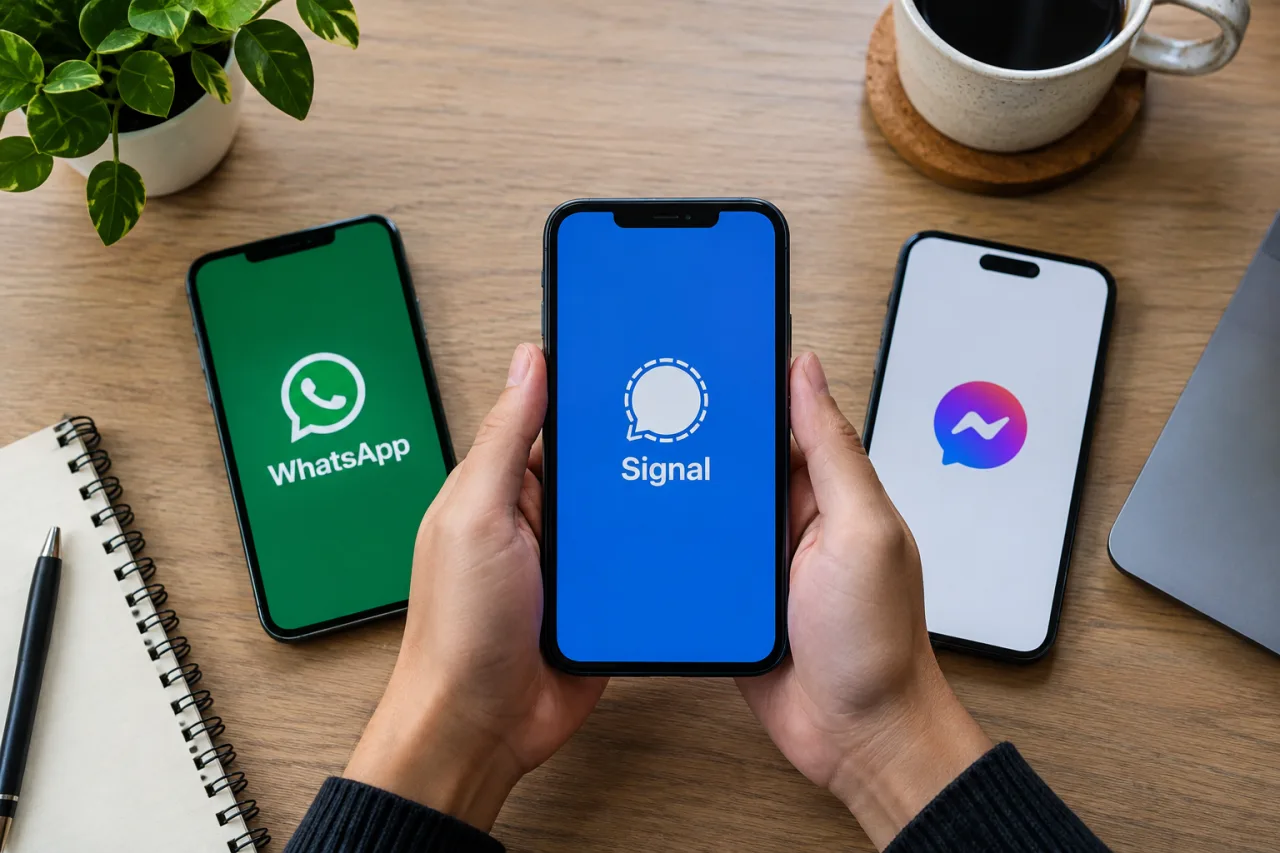
Signal vs WhatsApp is the privacy question that actually matters for a Filipino professional’s daily life, because Messenger, WhatsApp, and Signal carry different answers on the three things that decide whether a private conversation stays private: the encryption of the chats, the encryption of the backups, and the company’s appetite for your metadata. The message bubbles look identical in 2026, and all three apps now scramble personal chats end to end by default. The differences hide one layer below, in the settings menus and the server policies, and this privacy comparison maps them all so the choice takes two minutes instead of two research projects.
One fact up front before the details: every platform in this comparison protects message content strongly. The Electronic Frontier Foundation’s comparison of encrypted chat backups notes that when end-to-end encryption is working, the people running the platform cannot read your messages, but they can still see the who, where, and when around them. That metadata, plus what happens to your chat history when you change phones, is where the privacy comparison genuinely gets decided.
The Encryption Baseline: Identical Where It Counts
Signal, WhatsApp, and Messenger all deliver personal messages, calls, and media under end-to-end encryption by default, a state where nobody outside the conversation, not even the platform running it, can read the contents. WhatsApp states this directly: every personal message, call, and document is protected by default, using the Signal Protocol that the Signal app itself pioneered. Meta has rolled the same default across Messenger personal chats and calls. Signal, the original, has run this way since before it was fashionable.
Two caveats belong in the baseline. Business and merchant conversations in the Meta apps can run through cloud tooling that does not carry the same personal-chat guarantee, so a support chat with a brand is a different animal from a chat with your mother. And encryption never protects the copy the other person makes: a screenshot defeats every cipher. We covered the deeper mechanics of the protection itself in our end-to-end encryption explainer, including the attacks that still work against an encrypted channel.
The Backup Gap: Where the Three Apps Diverge
This is the setting most users never open, and in any privacy comparison it is the single most consequential difference between the three services.
| Dimension | Signal | Messenger | |
|---|---|---|---|
| Default chat encryption | End to end, always | End to end by default | End to end by default (personal chats) |
| Cloud backup exists | No cloud backup at all | Yes, optional end-to-end encrypted backup | Yes, same encrypted-backup infrastructure |
| Backup protection | Manual device-to-device transfer only | Password, 64-digit key, or passkey | Recovery code in Meta’s hardware key vault |
| Lose your phone | History likely unrecoverable | Restorable if encrypted backup was on | Restorable if encrypted backup was on |
| Metadata posture | Minimal, no ads, donation-funded | Collected; platform is part of Meta | Collected; platform is part of Meta |
| Best known for | Maximum privacy | The OFW corridor and global reach | Philippine family groups at scale |
Signal does not offer cloud backups anywhere, as a hard design choice backed by the EFF’s write-up: your message history never sits on any server, and the official app’s only transfer path is a manual process between devices. Lose or break the phone, and the history is most likely gone. For a journalist, an activist, or anyone whose history must never exist on someone else’s disk, that is the correct trade. For a parent whose phone just fell into the sea at a resort, it is a heartbreaking surprise.
WhatsApp takes the opposite corner: backups to your Google Account or iCloud are optional, and once you switch on end-to-end encrypted backup, the stored history is locked under your password, a 64-digit key, or a passkey, with the key protected in hardware security modules that neither WhatsApp nor the storage provider can open. WhatsApp’s own help center adds a blunt warning you should carry with you: lose that password or key, and even WhatsApp cannot help you recover the backup. In 2026 Meta also began rolling out its own WhatsApp Cloud Storage option outside Europe, with backups stored under end-to-end encryption from the start, 2 GB free, and paid tiers above that.
Messenger sits closest to WhatsApp on this layer. Meta’s engineering team built the same hardware-backed key vault for Messenger’s encrypted backups, and the security write-ups describe fleet-level protections that Facebook says even Meta can be cryptographically prevented from opening.
The Privacy Comparison Tiebreaker: Metadata
Content encryption hides what you say, but every privacy comparison has to look past it. It does not hide that you said something, to whom, how often, or from where, and that traffic picture is called metadata. The EFF frames it plainly: the platform running an encrypted chat cannot read the contents but does have access to some of the who, where, and when, and retention policies differ. Signal’s design minimizes what it keeps, the app runs no ads, and the nonprofit behind it lives on donations. WhatsApp and Messenger live inside Meta, a company whose revenue model depends on knowing audiences, so their metadata posture serves that machine, even while the message contents themselves stay sealed.
For a working professional running a personal privacy comparison, the practical read is this: if your threat model is strangers or criminals intercepting your words, all three apps hold. If your concern is a large advertising company building a picture of who you contact and when, the Meta apps still leak that silhouette while Signal leaks very little. We mapped what a wrong-number scam on WhatsApp looks like in practice, and the recovery path after a WhatsApp account actually gets hacked, which shows how the login, not the cipher, is where most real losses happen.
The Settings That Change the Answer by Tonight
Any privacy comparison written in prose becomes actionable only when it names the exact toggles. Here is the same-day checklist, per app.
On WhatsApp, open Settings, then Chats, then Chat backup, and switch on end-to-end encrypted backup, choosing a passkey, a password, or the 64-digit key. Store that credential in a password manager, not in your photo gallery. If the new WhatsApp Cloud Storage option is available on your account, backups there are end-to-end encrypted by design, with 2 GB free and paid tiers beyond it. On Messenger, confirm the encrypted backup for personal chats and keep the recovery code somewhere safer than the phone it protects. On Signal, decide the opposite thing: that there will be no cloud copy, and that the manual transfer routine between devices is the price.
The scam-season context makes these toggles more urgent than they look. The largest documented losses among Filipino users in these apps come from attacks on the account itself, not broken encryption: stray wrong-number texts that turn into investment pitches, and verification-code scams where a trickster asks for the six digits just sent to your phone. Our wrong-number scam breakdown and the WhatsApp recovery guide walk through both in detail. Encryption protects the conversation; the backup setting and the account settings protect your history and your login. A complete privacy comparison treats all three layers as one system, and it should include the people you talk to. Your own encrypted backup protects your copy of a conversation, but the other side of the thread may still be writing your words into an unencrypted backup of theirs, which is why security teams keep repeating the group rule: a sensitive thread is only as protected as the least careful participant’s settings.
The Privacy Comparison Verdict: Which Chat App to Assign
The privacy comparison lands most Filipino professionals on an assignment strategy, not a migration: keep the app each circle already uses, and change the settings that protect history. Keep Messenger for the family groups where the whole barangay already lives, because its scale in the Philippines is unmatched and its personal chats are now encrypted by default, provided the encrypted-backup setting is on. Make WhatsApp the default for cross-border life: it dominates Gulf and European corridors, its optional encrypted backups balance privacy against phone-loss risk, and its account-recovery guide is documented and practiced. Install Signal for the conversations that must outrun metadata: sensitive client files, family money matters you would rather not show up in an ad profile, or anything where you simply prefer a tool funded by donations instead of attention.
Two settings deserve a same-day visit whichever apps you keep. First, open Chat Backup on WhatsApp and Messenger and switch on end-to-end encryption for the backup, then store the key or password in a password manager rather than a screenshot folder. Second, accept the Signal trade-off consciously: decide whether your most sensitive threads outrank your phone’s survival in a flooding event, because on Signal, one of those two things gets left behind.
What Changes Next Year
Three currents will move this comparison. WhatsApp Cloud Storage is expanding outside Europe with encryption built in from the start, which quietly removes the biggest historical reason security-conscious users distrusted WhatsApp backups. Meta keeps hardening the same infrastructure for Messenger, which narrows the technical gap between its two chat apps on privacy grounds, though not on the metadata question. And Signal keeps gaining ground as the institutional recommendation, appearing in more corporate and government guidance each year. The 2026 baseline is already a win for users: the worst option among the three, chosen tonight, is better than the best option from five years ago. The privacy comparison itself will keep moving, and the settings menus above are where the movement shows up first, so re-check yours after each major app update rather than trusting the defaults you set last year.
Frequently Asked Questions About Signal vs WhatsApp
Is Signal actually more private than WhatsApp?
In a privacy comparison limited to message contents, no meaningful difference exists, because both run the same Signal Protocol encryption. For privacy in the wider sense, yes: Signal keeps near-minimal metadata, runs no ads, and is funded by donations, while WhatsApp sits inside an advertising company that collects the traffic pattern around your chats.
Does WhatsApp share my chats with Meta?
Your personal messages, calls, and files are end-to-end encrypted, so neither WhatsApp nor Meta can read them, by their own help-center documentation. Metadata and account information are a different story and are governed by WhatsApp’s privacy policy, which is worth reading if metadata matters to you.
What happens if I lose my phone on each app?
On WhatsApp and Messenger, you can restore from backup, as long as you had switched on end-to-end encrypted backup and kept your password, key, or passkey. On Signal there is no cloud backup at all, so a lost phone usually means the local history is gone, a deliberate privacy trade-off.
Are Messenger chats really encrypted now?
Personal chats and calls on Messenger are end-to-end encrypted by default after Meta’s multi-year rollout. Some exceptions remain, including certain business and marketplace conversations and older interoperability cases, so sensitive matters still deserve the apps whose encryption you have verified.
Which app is best for OFWs talking to family back home?
WhatsApp serves the widest OFW corridors, including the Gulf and much of Europe, with free international calls and optional encrypted backups that survive a lost phone. Many OFW families end up running WhatsApp for calls alongside Messenger for the Philippine group chats, since each ecosystem dominates a different part of the conversation web.
Do encrypted chat apps protect me from scams?
Only partially, and this is where any privacy comparison needs a warning label of its own. Encryption protects the content of a conversation from third parties; it does nothing against a scammer you willingly text with. Investment pitches from strangers, verification-code requests, and wrong-number openers all arrive inside perfectly encrypted bubbles. The defenses live in account settings: never share the six-digit code, verify unfamiliar contacts through a second channel, and use the recovery guides we published for the wrong-number and hacked-account cases before money moves.
Should I move every conversation to Signal?
No. Signal works best when both sides want maximum privacy and accept the no-backup trade-off. A quiet, effective pattern is to keep daily-life apps where your communities already are and switch to Signal for the threads where the metadata footprint itself is the concern.
External sources linked in this article, in order of first mention. Spotted an error or a broken link? Tell us.
Cite this pagePublished Nov 19, 2026
Agron, E. (2026, November 19). Signal vs WhatsApp vs Messenger: the Privacy Comparison That Picks Your Next Chat App. WorldNgayon. https://worldngayon.com/signal-vs-whatsapp-privacy-comparison/
Agron, Edmon. “Signal vs WhatsApp vs Messenger: the Privacy Comparison That Picks Your Next Chat App.” WorldNgayon, 19 Nov. 2026, worldngayon.com/signal-vs-whatsapp-privacy-comparison/.
Agron, Edmon. “Signal vs WhatsApp vs Messenger: the Privacy Comparison That Picks Your Next Chat App.” WorldNgayon, November 19, 2026. https://worldngayon.com/signal-vs-whatsapp-privacy-comparison/.
Agron, E. (2026) ‘Signal vs WhatsApp vs Messenger: the Privacy Comparison That Picks Your Next Chat App’, WorldNgayon, 19 November. Available at: https://worldngayon.com/signal-vs-whatsapp-privacy-comparison/.
E. Agron, “Signal vs WhatsApp vs Messenger: the Privacy Comparison That Picks Your Next Chat App,” WorldNgayon, Nov. 19, 2026. [Online]. Available: https://worldngayon.com/signal-vs-whatsapp-privacy-comparison/
@online{agron2026signalvs,
  author       = {Agron, Edmon},
  title        = {{Signal vs WhatsApp vs Messenger: the Privacy Comparison That Picks Your Next Chat App}},
  year         = {2026},
  date         = {2026-11-19},
  organization = {WorldNgayon},
  url          = {https://worldngayon.com/signal-vs-whatsapp-privacy-comparison/},
  urldate      = {}
}TY - ELEC AU - Agron, Edmon TI - Signal vs WhatsApp vs Messenger: the Privacy Comparison That Picks Your Next Chat App T2 - WorldNgayon PY - 2026 DA - 2026/11/19/ UR - https://worldngayon.com/signal-vs-whatsapp-privacy-comparison/ Y2 - ER -
Cite the version you read; the page may be updated. Zotero and Mendeley can also import this page directly.