Table of Contents
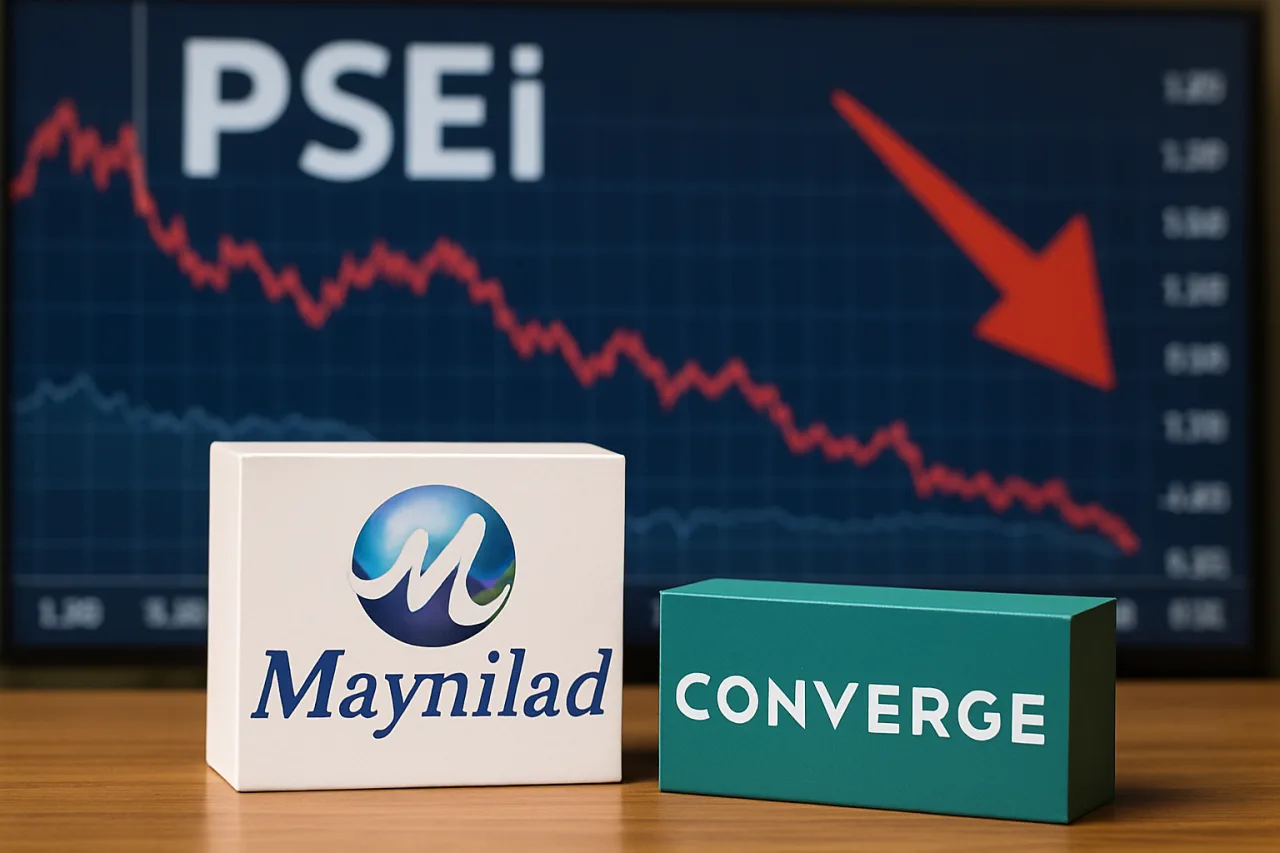
The Philippine Stock Exchange index (PSEi) undergoes its August 2026 rebalancing today, August 3, with Maynilad Water Services Inc. (MYNLD) joining the benchmark index and Converge ICT Solutions Inc. (CNVRG) exiting after falling below the market cap threshold. The PSEi rebalancing is the most significant index reshuffle of the year for Filipino investors, affecting institutional fund flows, passive index-tracking portfolios, and the visibility of both companies among domestic and foreign investors. PSE President and CEO Ramon S. Monzon confirmed the changes, noting that Maynilad is only the third company to qualify for early PSEi inclusion since the exchange introduced the rule in 2021.
Key Takeaway
- Maynilad (MYNLD) joins the PSEi effective August 3, 2026. The west zone water concessionaire qualified for early inclusion after its post-IPO share price surged approximately 49 percent, lifting it to 22nd place by full market cap among listed firms.
- Converge ICT (CNVRG) exits the PSEi. The fiber internet provider ranked last among index constituents by market value and will slide into the PSE MidCap index, where Philex Mining Corp. will also enter while Asia United Bank exits.
- Institutional flows will shift. PSEi-tracking funds and exchange-traded funds must rebalance their portfolios to match the new index composition, creating buying pressure on Maynilad and selling pressure on Converge in the days following August 3.
- Multiple sector indices also change. The Industrial, Financials, Holding Firms, Mining and Oil, Property, and Services indices all see membership changes in this review cycle.
- Next review uses new criteria. The January-to-December 2026 review period will use revised index criteria that prioritize stock liquidity over pure market capitalization, potentially reshaping future PSEi rebalancing outcomes.
What Is the PSEi Rebalancing and Why It Matters
The PSEi is the Philippine Stock Exchange’s benchmark index, composed of 30 of the country’s most traded and highly capitalized listed firms. It is the equivalent of the Dow Jones Industrial Average in the United States or the Nikkei 225 in Japan — the single number that news anchors cite when they say “the Philippine stock market went up today.”
Every six months, the PSE reviews the index composition through a process called rebalancing. The exchange evaluates all listed companies based on market capitalization (the total value of all shares) and liquidity (how actively the stock is traded). Companies that have grown large enough and liquid enough enter the index. Companies that have shrunk below the threshold exit. This ensures the PSEi accurately reflects the current state of the Philippine economy — not the economy of five years ago.
The PSEi rebalancing matters for three reasons. First, institutional investors — mutual funds, pension funds, insurance companies — that track or benchmark against the PSEi must adjust their portfolios to match. When a stock enters the index, these funds must buy it. When a stock exits, they must sell. This creates predictable buying and selling pressure. Second, inclusion in the PSEi increases a company’s visibility among foreign investors who screen Philippine stocks by index membership. Third, the PSEi is the performance benchmark that fund managers are measured against. A stock’s inclusion or exclusion affects whether fund managers view it as a core holding or a peripheral bet.
According to First Metro Securities, which analyzed the rebalancing in a note dated May 4, 2026, Maynilad’s entry was “highly probable” months before the official announcement. Mark Angeles, First Metro Securities head of research, noted that the stock had rallied nearly 50 percent since its November 2025 IPO and ranked within the top 20 percent in median daily traded value over the preceding eight months. The PSE confirmed this analysis in its official announcement on July 28.
Maynilad: From IPO to PSEi in Nine Months
Maynilad Water Services Inc. is the water concessionaire serving the west zone of Metro Manila, covering approximately 9.8 million consumers across 17 cities and municipalities. The company conducted its initial public offering (IPO) in November 2025, listing on the PSE at a price that valued the company at approximately P46.4 billion. The stock surged approximately 49 percent in the nine months following the IPO, driven by strong demand from institutional investors and the company’s solid financial performance.
Maynilad’s rapid ascent to PSEi inclusion is notable. Since the PSE introduced its early inclusion rule in 2021 — which allows companies to join the index before completing the standard 12-month minimum trading requirement if they meet market cap and liquidity thresholds — only three companies have qualified. Maynilad is the third. PSE President Monzon highlighted this rarity: “Maynilad’s stellar post-IPO share price growth and the demand for its stock allowed the company to easily meet the market cap and liquidity criteria for index membership.”
The company’s inclusion in the PSEi places it alongside the Philippines’ largest listed firms, including SM Investments, Ayala Land, BDO Unibank, and ICTSI. For Filipino investors, Maynilad’s entry into the benchmark index means the stock will now be included in PSEi-tracking funds, potentially increasing demand and liquidity further. The water utility sector, traditionally considered a stable defensive investment, now has direct representation in the benchmark index.
Converge ICT: What the Exit Means for Investors
Converge ICT Solutions Inc. exits the PSEi after ranking last among index constituents by market value. The fiber internet provider, which joined the PSEi in 2021 following its own strong post-IPO run, has seen its market cap decline relative to other listed firms despite remaining a profitable business with a substantial subscriber base. Converge will not disappear from the exchange — it slides into the PSE MidCap index, which tracks mid-sized listed companies.
For investors holding Converge shares, the PSEi rebalancing does not change the fundamentals of the company. Converge still operates the largest fiber-to-the-home network in the Philippines, with over 2 million subscribers as of mid-2026. What changes is the stock’s institutional positioning. PSEi-tracking funds that are required to hold only index constituents will sell Converge shares, which could create short-term downward pressure on the stock price. However, MidCap-tracking funds will need to buy it, partially offsetting the selling pressure. For guidance on managing your investment portfolio during market changes, see our personal equity and retirement account guide.
First Metro Securities estimated in May that Converge faced a 40 percent probability of removal — the highest among the three at-risk candidates, which also included ACEN Corp. and DigiPlus Interactive Corp. The final determination depended on price performance and trading activity through June 2026, and Converge ultimately fell below the cutoff.
The practical advice for Converge shareholders is to distinguish between index-driven selling and fundamental deterioration. If the company’s earnings, subscriber growth, and cash flow remain strong, the price dip caused by index rebalancing may represent a buying opportunity rather than a signal to sell. For a deeper understanding of how to evaluate Philippine telecom and tech stocks, see our PSE blue chip stocks guide.
Full List of Index Changes Effective August 3, 2026
The PSEi rebalancing extends beyond the headline Maynilad-for-Converge swap. Multiple sector indices see membership changes in this review cycle, reflecting shifts in the Philippine corporate landscape.
| Index | Stocks Added | Stocks Removed |
|---|---|---|
| PSEi (Main Index) | Maynilad Water Services (MYNLD) | Converge ICT (CNVRG) |
| PSE MidCap | Converge ICT (CNVRG), Philex Mining Corp. | Asia United Bank |
| PSE Dividend Yield | Aboitiz Equity Ventures Inc. | — |
| Industrial | Basic Energy Corp., Maynilad, Top Line Business Development Corp. | Concepcion Industrial Corp., Pryce Corp., Vitarich Corp. |
| Financials | Bank of Commerce, National Reinsurance Corp. of the Philippines | — |
| Holding Firms | Lopez Holdings Corp. | — |
| Mining and Oil | The Philodrill Corp. | — |
| Property | — | Vista Land and Lifescapes Inc., VistaREIT Inc. |
| Services | — | AllDay Marts Inc., AllHome Corp. |
The Industrial index sees the most changes, with three new members entering and three exiting. The Property and Services indices each lose two members with no replacements, reflecting the continued challenges in those sectors. Robinsons Retail Holdings Inc. (RRHI) was removed from the PSE MidCap and PSE DivY indices effective July 16, after its public float fell below the PSE’s minimum public ownership requirement following the completion of its tender offer and privatization.
What Filipino Investors Should Do Now
The PSEi rebalancing creates specific actions for different types of investors. Understanding these actions — and acting deliberately rather than reactively — is the difference between profiting from the rebalancing and being hurt by it.
For PSEi index fund investors: You do not need to do anything. Your fund manager will automatically adjust the portfolio to match the new index composition. The transition typically occurs over several trading days around August 3 to minimize market disruption. Expect slightly higher tracking error during the transition period as the fund rebalances.
For direct stock investors holding Maynilad: The PSEi rebalancing is positive for your position. Inclusion in the benchmark index increases institutional demand, analyst coverage, and foreign investor attention. However, do not assume the price will automatically rise — much of the expected inclusion may already be priced in given the strong post-IPO rally. Consider whether your original investment thesis still holds at the current price.
For direct stock investors holding Converge: The immediate effect is negative due to index-driven selling. But the fundamentals of the business have not changed. If you believed in Converge’s growth story before the rebalancing, the price dip may be an opportunity to add to your position at a lower entry point. Monitor the company’s quarterly earnings and subscriber growth to confirm the thesis remains intact.
For investors considering new positions: The rebalancing creates short-term price dislocations that can be exploited. Maynilad may experience a short-term dip if early profit-taking accelerates after inclusion, creating a potential entry point. Converge may be oversold if index-driven selling overshoots, creating a value opportunity. In both cases, base your decision on fundamentals, not on index mechanics alone. For a broader view of Philippine stock market opportunities, see our analysis of PSEi market trends.
The Bigger Picture: PSE’s Index Modernization
The August 2026 rebalancing is the last review under the PSE’s existing index policy. The next review, covering the January-to-December 2026 period, will use revised index criteria that the PSE announced in July 2026 as part of what the exchange called its “biggest index overhaul in 15 years.”
The key change: the new criteria will put a premium on the liquidity of a stock — how actively it trades — rather than relying primarily on market capitalization. This shift aligns the PSEi with global index standards, where liquidity is considered a better measure of a stock’s relevance to investors than sheer size. A company can be large but rarely traded, making it difficult for funds to buy and sell without moving the price. The new criteria will favor companies with high trading volumes over companies that are large but illiquid.
For Filipino investors, this means future PSEi rebalancing may produce different outcomes than past reviews. Companies with strong trading activity but moderate market caps may enter the index, while large but thinly traded firms may exit. The PSE’s move toward liquidity-based criteria is a positive development for market efficiency — it ensures the benchmark index reflects stocks that investors can actually buy and sell, not just stocks that exist on paper.
The PSE also recently announced plans to open the door to global stocks, bonds, and crypto in an ETF market reboot, signaling a broader modernization push under Monzon’s leadership. These changes, combined with the revised index criteria, suggest the Philippine Stock Exchange is positioning itself for a more dynamic and globally competitive future.
Frequently Asked Questions
What is the PSEi rebalancing?
The PSEi rebalancing is the Philippine Stock Exchange’s semi-annual review of the 30 companies that make up its benchmark index, the PSEi. The exchange evaluates all listed companies based on market capitalization and liquidity, adding companies that have grown large enough and removing companies that have fallen below the threshold. The August 2026 rebalancing takes effect on August 3, 2026.
Why is Maynilad joining the PSEi?
Maynilad Water Services Inc. (MYNLD) qualified for early PSEi inclusion because its post-IPO share price surged approximately 49 percent, lifting it to 22nd place by full market cap among all listed firms. It also met the liquidity requirement by ranking within the top 20 percent in median daily traded value. Maynilad is only the third company to qualify for early inclusion since the PSE introduced the rule in 2021, according to PSE President and CEO Ramon S. Monzon.
What happens to Converge ICT shares after the PSEi rebalancing?
Converge ICT (CNVRG) moves from the PSEi to the PSE MidCap index. The stock remains listed and tradable on the Philippine Stock Exchange — only its index membership changes. PSEi-tracking funds will sell Converge shares to match the new index composition, which may create short-term downward price pressure. However, MidCap-tracking funds will need to buy it, partially offsetting the selling.
Should I buy or sell stocks because of the PSEi rebalancing?
The PSEi rebalancing creates short-term price movements, but investment decisions should be based on company fundamentals, not index mechanics. If you hold Converge and your investment thesis is intact, the price dip from index-driven selling may be a buying opportunity. If you are considering Maynilad, much of the positive expectation may already be reflected in the post-IPO price rally. Consult a licensed financial advisor before making investment decisions based on index changes.
How often does the PSEi rebalancing occur?
The PSE reviews and rebalances the PSEi every six months. The current review covers the July 2025 to June 2026 period. The next review, covering January to December 2026, will use revised index criteria that prioritize stock liquidity over pure market capitalization — the biggest change to index methodology in 15 years.
Disclaimer: This article is for informational and educational purposes only and does not constitute financial or investment advice. References to specific companies and stocks are based on publicly available information as of August 3, 2026. Readers should consult qualified financial advisors before making investment decisions. The author and publisher disclaim any liability for actions taken based on this information.