Table of Contents
Key Takeaway 🏥 The Veradigm breach is now formally a pattern: for the second time in 21 months, patient data left the health-tech company on a credential the company did not control. A vendor’s API key this time, a client’s storage credential before that — and The Gentlemen ransomware crew claims 3.5 million patient records with SSNs in between. Two incidents, same architecture, one lesson healthcare still refuses to learn: the credential your partner holds is the breach your patients suffer.
What the Veradigm breach 8-K actually says
The disclosure is an SEC Form 8-K signed September 8, 2026, filed under Item 8.01 — “other events” — rather than Item 1.05, the reserved box for material cybersecurity incidents.
Veradigm states it “does not believe that this incident is reasonably likely to have a material impact.” The substance, cross-confirmed across the filing and healthcare security coverage: an unauthorized party obtained credentials from a third-party vendor’s environment; those credentials opened a Veradigm API that the vendor used to serve Veradigm customers; the attacker used them to download copies of patient personal data including Social Security numbers in some cases. No clinical or medical data, the company says. No operational disruption. Law enforcement notified, credit monitoring offered where applicable.
The vendor is unnamed. Neither the company nor the filing describes the count of affected individuals. The Gentlemen’s leak-site post — logged on ransomware trackers in the days before the 8-K — claims roughly 3.5 million patient records: full names, home addresses, SSNs, emails, phone numbers, guarantor details. That number is a claim, not a fact; no regulator filing or notification index has corroborated it, and Veradigm has not confirmed any count. History counsels caution on ransomware math: in Veradigm’s own prior incident, a crew’s inflated figure was later corrected downward by a third when the legal settlement paperwork fixed the real number at 2,672,036 people.
Item 8.01 placement is itself information. Companies use the softer classification when they assess the incident as contained and financially contained as well. Whether a patient whose SSN now sits in a leak-site archive agrees that a few affected “customers” add up to non-material is a different calculus — and it is the calculus regulators made when they built the 60-day notification clocks that healthcare keeps testing the limits of.
Twenty-one months, two credentials, same Veradigm breach lesson
The 2024-25 Veradigm breach started with a credential a client had leaked elsewhere. It opened a data-migration storage account holding other customers’ protected health information: names, contact details, birthdates, insurance claims, payment data, Social Security numbers, driver’s licenses. Discovered roughly seven months after the fact during another party’s investigation. Veradigm agreed to a $10.5 million settlement fund.
The 2026 Veradigm breach starts with a credential a vendor held. It opened a customer-service API. Patient PII went out with SSNs. Discovered by… nobody has said how, exactly — the leak-site claim preceded the company’s public acknowledgment.
Side by side: a client’s credential opened storage then; a vendor’s credential opens APIs now. The outsider changed; the architecture did not. Veradigm’s business runs on third parties exchanging keys with each other to reach patient data, and the access each party grants becomes the attack surface every party inherits. That is not one company’s weak control — it is healthcare’s entire integration economy refusing to adopt the authentication discipline banking settled a decade ago: short-lived tokens, scoped access, mutual verification, and the assumption that any standing credential is a standing risk.
The pattern generalizes past healthcare. The Bitget exchange breach on Oct 3 went in through a security vendor’s own zero-day. The Pentagon personnel breach that broke this week ran nine months through an unencrypted file-sharing system nobody watched. Large organizations keep being breached by systems they do not run directly — and each time, the public conversation focuses on the victim’s size rather than the access path’s shape. The Veradigm breach keeps the focus where it belongs: on the credential that was standing when the attacker arrived.
The Filipino healthcare angle: your records, someone else’s key
Filipino patients meet this pattern through employment. Hundreds of thousands work in health process outsourcing — medical transcription, claims processing, telehealth support — and the sector’s clients are exactly the US health platforms that hold records like Veradigm’s. A Veradigm breach patient record with a name, address, SSN, and guarantor details is also, functionally, a social-engineering kit against the family: the caller knows the hospital, the dates, the responsible party. Filipino families have absorbed that script already — the GenSan Doctors Hospital breach confirmation this month has the same anatomy — and health-record leaks keep being more expensive than financial ones because the data never rotates: a birthdate and diagnosis history are permanent.
For the BPO and health-information workers themselves, the incident is a two-sided warning. Companies that grant you standing API access are trusting your environment as much as your intent; credential rotation and scoped tokens are your job’s quiet insurance. And the career reality: when a breach letter cites a vendor credential, the vendor’s name lands in the next audit wave, and the workers closest to that integration — not the executives — inherit the remediation weekends.
What a healthcare CISO should demand after the Veradigm breach
The post-incident review list writes itself, and none of it is exotic. First: inventory every credential any third party holds that touches patient systems, then ask for each one — what data can it reach, how long has it existed, when was it last rotated? Second: kill standing API keys in favor of short-lived, scoped tokens where the vendor supports them;
where it does not, that refusal is itself the finding. Third: behavioral monitoring on service accounts — a credential used from a new ASN, downloading at volume, deserves a page, not a dashboard note. Fourth: canary records. A decoy patient row that pages someone when touched is the cheapest tripwire healthcare security has. Fifth: contract language that makes credential-hygiene attestation a renewal condition, because procurement is the only place most health systems have leverage.
None of that requires a budget increase; it requires treating each Veradigm breach as a mirror. The company touched by this pattern twice is not uniquely careless — it is early. Every health platform that exchanges keys with vendors and clients is running the same architecture, and 21 months is the interval at which the internet has now demonstrated the failure mode twice, on one company’s name. The next credential walkout will be on someone else’s brand and the same shape. The question each CISO should answer tonight: which of the standing keys in my environment opens patient data, and who outside my walls can still use it?
The disclosure machine learns the same lesson twice
Worth noting how each Veradigm breach became public. The 2024-25 incident surfaced through another party’s fraud investigation — seven months after the exposure began — and the settlement disclosures fixed the count at 2,672,036. The 2026 incident surfaced through a ransomware crew’s leak-site post, in the days before the company’s own 8-K. Both times, the outside world learned from an adversary’s infrastructure before it learned from the disclosure apparatus.
In the first case the messenger was a fraud investigation; in the second it was The Gentlemen. Neither came from Veradigm’s own detection. For a company whose core product is health data infrastructure — the very pipes that keep patient records flowing between providers, payers, and patients — that is the uncomfortable headline underneath the count debate.
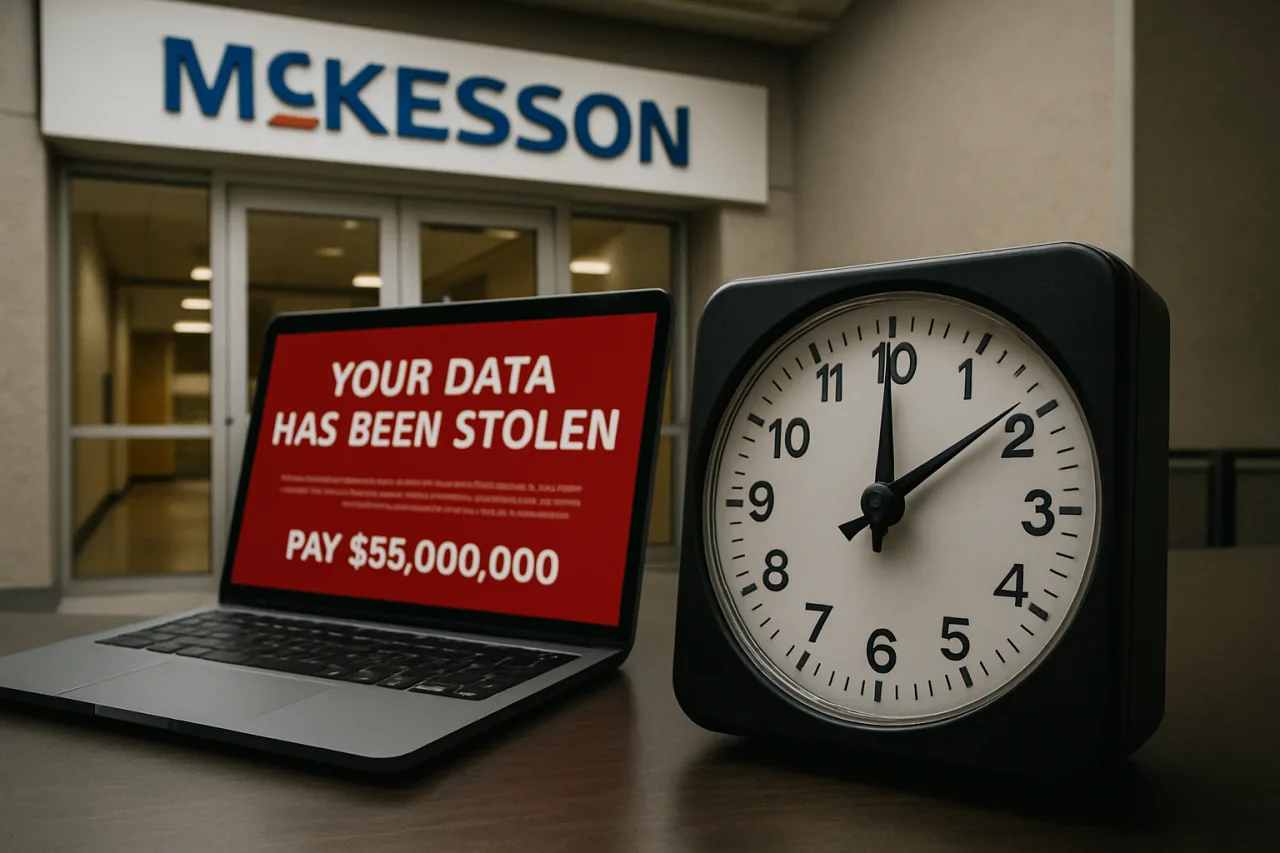
The McKesson claim lands in the same week and same sector, with ShinyHunters claiming 6.4 million unique addresses carrying names, addresses, phone numbers, patient IDs, birthdates, health insurance details, medical records, billing data, and Social Security numbers. As with The Gentlemen’s tally, the figures are claims until filings corroborate them — ShinyHunters has burned that bridge before, and ransomware crews inflate. But two concurrent healthcare-adjacent claim events in one week, following the FBI jobs-site breach and the Pentagon personnel letters, sketch the month’s economics: identity data at scale is the product, healthcare is a preferred supplier, and credential abuse is the logistics network.
For health-data workers in the Philippines the McKesson angle is practical rather than distant. ShinyHunters’ play — steal a database, sell or extort — depends on someone somewhere having left a service account standing. The verification question that beats it is the same one the Veradigm breach poses: if this credential moved to a different network tomorrow, would anything notice by the end of the day? Teams that cannot answer yes are not managing credentials; they are hosting them for the next claim post.
The contract angle deserves its own paragraph, because it is where the Veradigm breach will actually change behavior. Health systems negotiate vendor agreements annually; almost none read the security annex with the same attention they give pricing. After a second credential walkout in 21 months, the renewal question writes itself: which specific credentials does this vendor hold against our systems, what is their rotation schedule, who is notified when they move to a different network, and does the vendor indemnify the exposure their own staff creates? A vendor who cannot answer in one page is telling you the answer already — the same way the 8-K answered Item 1.05 with Item 8.01.
Behavioral monitoring is the other half. Service accounts do not sleep, but they also do not change behavior without cause: a reporting API that suddenly downloads at 3 a.m. from a hosting provider’s address range is not a scheduled job running late — it is the Veradigm breach playbook executing on some other company’s patient table.
Detection rules for credential-download volume, novel ASN sign-ins, and mass-read patterns exist in every commercial EDR and SIEM already; the gap is that service-account traffic is almost always allowlisted by habit. Un-allowlisting the accounts that touch patient data is a one-day task that converts the next credential walkout from a 21-month surprise into a 21-minute page.
Key questions, answered directly
What happened in the 2026 Veradigm breach? An unauthorized party obtained credentials from a third-party vendor’s environment and used them against a Veradigm API that the vendor used to serve customers, downloading patient personal data including Social Security numbers in some cases. Veradigm says no clinical data and no operational disruption; the 8-K was filed Sept 8, 2026.
How many patients were affected in the Veradigm breach? Unconfirmed. The Gentlemen ransomware group claims about 3.5 million patient records; no regulator filing or notification index has corroborated that figure and Veradigm has not confirmed a count. Its prior incident settled at 2,672,036 people after a crew claim was corrected downward.
Is this Veradigm’s first credential breach? No. In 2024-25, a client’s leaked credential opened a data-migration storage account and exposed other customers’ PHI including SSNs and driver’s licenses, ending in a $10.5 million settlement. Two incidents in 21 months, both opened by someone else’s credential.
What should patients do after a Veradigm breach letter? Enroll in the offered credit monitoring immediately, place a fraud alert or freeze with credit bureaus, watch for healthcare-impersonation scams — callers citing real hospital details — and treat any call asking to “verify” guarantor payment details as hostile until proven otherwise.
Why file the 2026 Veradigm breach under Item 8.01 instead of Item 1.05?
Because the company judged it not material: Item 1.05 is reserved for incidents reasonably likely to have a material impact. The filing signal matters for investors and for patients alike — it is Veradigm’s formal position that a patient-data walkout on a vendor credential does not move its financials. Read it beside the 2024-25 settlement and the interval tells you how materiality calibrates slowly against repetition.