Table of Contents
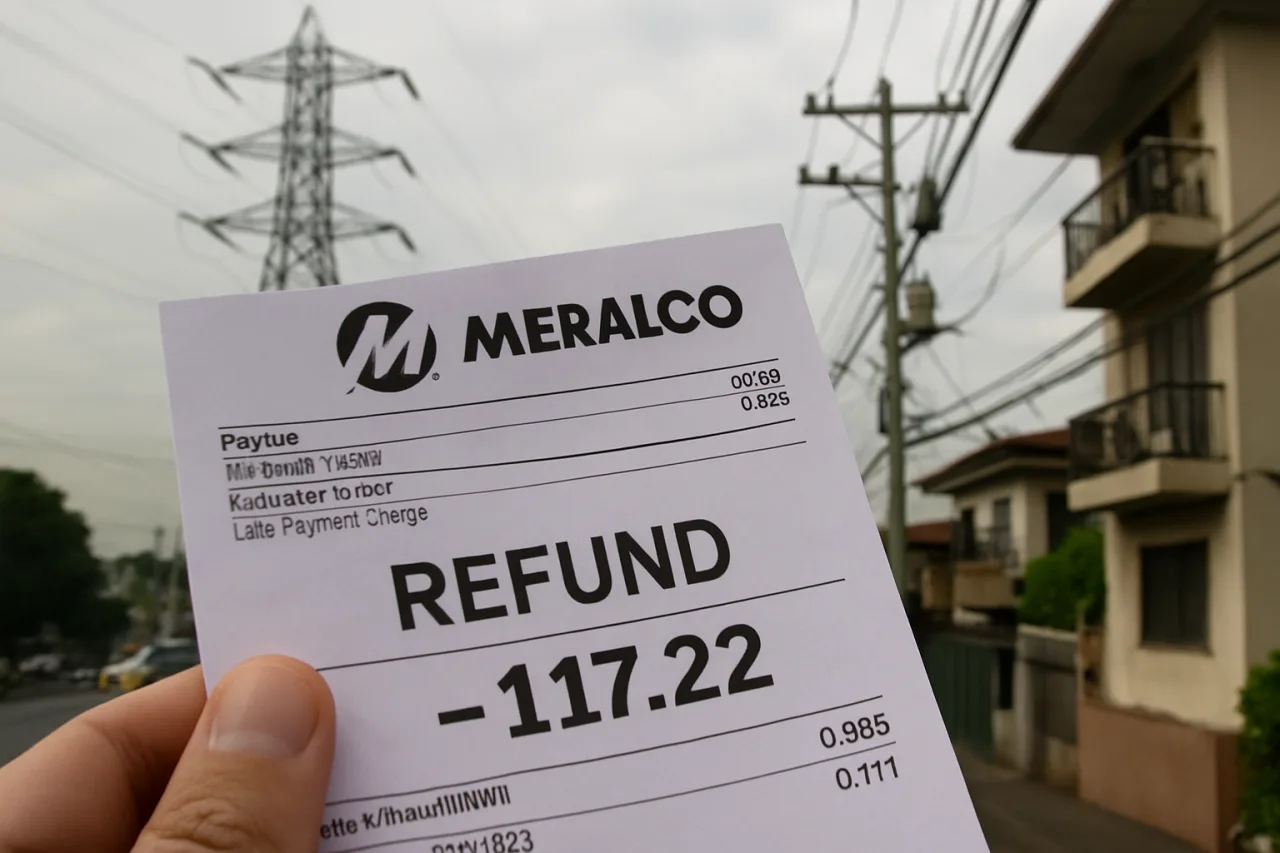
The Energy Regulatory Commission (ERC) has ordered Manila Electric Company (Meralco) to refund P9.51 billion to more than 8 million customers after the utility collected more than its approved tariff during the January to December 2025 period. The Meralco refund, announced on August 2, 2026, will appear as a separate line item in electricity bills over six months, with residential customers receiving a reduction of P0.5861 per kilowatt-hour (kWh) consumed. For a typical household consuming 200 kWh per month, the Meralco refund translates to approximately P117.22 in monthly savings — a modest but tangible reduction at a time when Philippine electricity rates remain among the highest in Southeast Asia.
Key Takeaway
- The Meralco refund totals P9.51 billion. The ERC ordered Meralco to return P9,506,566,556 collected above the approved tariff from January to December 2025, including interest costs for the over-recovery period.
- Residential customers get P0.5861 per kWh. The refund appears as a line item labeled “AWAT (Refund)/Collect” in electricity bills over six months. A household using 200 kWh monthly saves approximately P117.22 per month.
- Over 8 million customers are eligible. The refund applies to all Meralco customer classes — residential, commercial, and industrial — with the average refund rate at P0.3448 per kWh across all categories.
- Meralco has agreed to comply. The utility stated it “will comply with the most recent directive of the ERC” and supports “initiatives to provide relief to consumers.”
- A separate rate-reset decision is coming. The ERC is evaluating Meralco’s distribution charge application, with a decision expected by late August or September that could raise or lower base rates.
Why the Meralco Refund Is Happening
The refund stems from a regulatory reconciliation process. The ERC compares Meralco’s actual weighted average tariff (AWAT) — the average distribution rate collected across different customer classes — against its approved tariff. When the AWAT exceeds the approved level, Meralco has collected more than authorized, and the excess must be returned to customers.
In this case, Meralco filed two separate applications for refund in 2025 and early 2026. The ERC’s decision, dated July 31 and made public on August 2, found that residential consumption accounted for a larger share of electricity sales than expected during the January to December 2025 period. This pushed the weighted average tariff above the approved level, resulting in Meralco collecting P9.51 billion more than authorized. The ERC included interest costs in the refund calculation, noting that “Meralco collected the over-recovery during the regulatory years covered by the lapsed period.”
This is not the first Meralco refund in recent years. The ERC has ordered similar over-recovery refunds in previous regulatory cycles, making the process a routine but important consumer protection mechanism. The ERC’s role is to ensure that regulated utilities do not permanently retain revenues collected above approved rates — a safeguard that directly benefits Filipino households and businesses.
How Much You Will Save: By Customer Type
The Meralco refund rate varies by customer class because the over-recovery affected different categories differently. The ERC set the following refund rates:
| Customer Type | Refund Rate (per kWh) | Monthly Savings (200 kWh) |
|---|---|---|
| Residential | P0.5861 | ~P117.22 |
| Commercial | Varies by class | Calculated on actual consumption |
| Industrial | Varies by class | Calculated on actual consumption |
| All Classes (Average) | P0.3448 | ~P68.96 |
The residential rate of P0.5861 per kWh is higher than the average across all classes (P0.3448) because residential consumption was the primary driver of the over-recovery. For a household consuming 300 kWh monthly — a common level for a family of four with air conditioning — the savings would be approximately P175.83 per month, or about P1,055 over the six-month refund period.
For businesses, the refund calculation depends on their specific customer classification and consumption volume. A small business consuming 500 kWh monthly would receive approximately P172.40 per month at the average rate. Large industrial consumers, who use significantly more electricity, will see proportionally larger refund amounts on their bills.
Who Qualifies for the August 2026 Meralco Refund — and When It Appears
Eligibility is broad and mechanical: the August 2026 Meralco refund covers over 8 million customers across every customer class — residential, commercial, and industrial — because the overcollection being returned came from charges all of them paid. You qualify if your service address sat inside Meralco’s franchise area during the overcollection period and your account was active; closed accounts with credit balances are processed through the claim route rather than the bill line item. Timing follows the same logic: the refund was announced on August 2, 2026, and appears as a separate line item on bills over the following six-month period, so the appearance date depends on your billing cycle, not on any application you file. The three checks that confirm your share: find the refund line item on this month’s bill; compare the amount against your average consumption class; and flag any bill where the credit fails to appear after two consecutive cycles — that is the moment to call Meralco’s customer service with your account number ready. No form, no application, no fixer: eligibility does the work, the bill does the confirming.
How to Spot the Refund on Your Bill
The Meralco refund will not arrive as a separate check or bank deposit. It will appear as a line item reduction in your monthly electricity bill. According to Meralco and the ERC, the refund will be labeled “AWAT (Refund)/Collect” as a separate line item, making it visible and transparent.
Here is what to do:
Step 1: Check your Meralco bill starting from the billing period after the ERC order takes effect. Look for a line item labeled “AWAT (Refund)/Collect” or similar wording indicating the refund.
Step 2: The refund amount is calculated based on your actual kWh consumption for that billing period. If you consumed 200 kWh, your refund deduction should be approximately P117.22. If the amount does not match the expected calculation (consumption x P0.5861 for residential), contact Meralco’s customer service.
Step 3: The refund runs for six months. After the six-month period, the line item should disappear from your bill. If it continues appearing beyond the expected period, verify with Meralco whether the refund period has been extended or if a different adjustment is being applied.
Step 4: If you use Meralco’s online bill payment or a digital wallet (GCash, Maya) to pay your electricity bill, the refund will be automatically reflected in the total amount due. You do not need to take any separate action to claim it.
What This Means for Filipino Households and Businesses
The Meralco refund is modest in per-household terms — approximately P117 per month for a typical residential customer — but it matters in several ways. First, it is a direct financial benefit that requires no action from the consumer beyond paying attention to the bill. Second, it demonstrates that the ERC’s regulatory framework is functioning: when utilities over-collect, the excess is returned. Third, it provides a small but real reduction in electricity costs at a time when Philippine power rates remain a significant burden on household budgets and business operating costs.
Philippine electricity rates are among the highest in Southeast Asia. According to data from the Department of Energy, the average residential electricity rate in Metro Manila exceeds P12 per kWh, significantly higher than rates in neighboring countries like Vietnam (approximately P5.50/kWh) or Malaysia (approximately P6.50/kWh). The Meralco refund of P0.5861 per kWh represents approximately a 4.9 percent reduction on a P12 per kWh base rate — not transformative, but meaningful for households struggling with monthly bills.
For businesses, especially small and medium enterprises (SMEs) operating on thin margins, the refund provides a small cost reduction that accumulates over six months. A restaurant consuming 1,500 kWh monthly would receive approximately P518 per month, or about P3,108 over the refund period — enough to cover minor operational expenses. For broader guidance on managing business finances in the Philippine economic environment, see our stablecoin salary Philippines guide for cross-border payment optimization.
The refund also intersects with the broader policy debate over electricity reform. President Ferdinand Marcos Jr. has revived proposals to amend the Electric Power Industry Reform Act (EPIRA) and has floated the possibility of removing system loss charges from consumer bills entirely. Energy Secretary Sharon Garin has said that removing system loss charges “will really take time,” while Meralco Chairman and CEO Manuel V. Pangilinan has questioned who will absorb the financial burden of such reforms. The Meralco refund, while separate from the EPIRA debate, highlights the financial impact that electricity rate adjustments have on millions of Filipino consumers.
The EPIRA, enacted in 2001, was designed to restructure the Philippine electric power industry by unbundling generation, transmission, distribution, and supply. More than two decades later, the law faces growing criticism for failing to deliver on its promise of lower electricity rates. Senator Raffy Tulfo has urged electric firms to cooperate on removing system loss charges — the portion of electricity that is lost during transmission and distribution but still billed to consumers. For many Filipino households, system loss charges add P0.50 to P0.80 per kWh to their monthly bills, a cost that disproportionately affects low-income families.
The Meralco refund process also demonstrates the importance of the ERC as an institution. Without an active regulator conducting reconciliation reviews and ordering refunds, over-recoveries would simply be retained by the utility. The ERC’s decision to include interest costs in the refund calculation is particularly notable — it ensures that customers are compensated not just for the over-collected amount but for the time value of the money that was held by Meralco rather than in consumers’ pockets. For more on managing utility costs and household finances, see our PSEi rebalancing guide for Filipino investors.
What Comes Next: The Rate-Reset Decision
The Meralco refund is a one-time adjustment for the 2025 over-recovery. A more significant decision is pending: the ERC is evaluating Meralco’s rate-reset application, which determines the utility’s distribution charges for the next regulatory period. A decision is expected by late August or September 2026.
The rate-reset outcome could either raise or lower Meralco’s base distribution charges, which would have a permanent impact on monthly bills — far larger than the one-time refund. If the ERC approves a rate increase, the P0.5861 per kWh refund could be offset by higher base charges. If the ERC approves a rate decrease, consumers would benefit from both the refund and the lower base rate simultaneously.
For Filipino investors, the rate-reset decision also affects Meralco’s parent company, Metro Pacific Investments Corp. (MPIC), and its listed subsidiaries. Meralco is one of the Philippines’ largest companies by market capitalization and a constituent of the PSEi. Regulatory decisions that affect its revenue and profit margins have direct implications for shareholders. For broader investment context, see our PSE blue chip stocks guide.
Consumers and investors should watch for the ERC’s rate-reset announcement in the coming weeks. The decision will be published on the ERC website and reported in major business news outlets. If you want to stay informed, checking the ERC official website and Meralco’s corporate announcements page is the most reliable way to get accurate information directly from the source.
Frequently Asked Questions
How much is the Meralco refund?
The total Meralco refund is P9.51 billion (P9,506,566,556), ordered by the Energy Regulatory Commission on July 31, 2026. The refund covers over-recoveries collected by Meralco from January to December 2025. For residential customers, the refund rate is P0.5861 per kWh, meaning a household consuming 200 kWh monthly will save approximately P117.22 per month.
When will the Meralco refund appear on my bill?
The refund will appear as a line item labeled “AWAT (Refund)/Collect” in electricity bills over a six-month period. Meralco has stated it will comply with the ERC directive. The exact start date depends on Meralco’s billing cycle implementation, but customers should look for the line item starting from the first billing period after the ERC order takes effect.
Do I need to apply for the Meralco refund?
No. The refund is automatic. It will appear as a reduction in your monthly electricity bill based on your actual kWh consumption. You do not need to file an application, call Meralco, or visit any office. If the refund line item does not appear on your bill within the expected timeframe, contact Meralco customer service to verify.
Why did Meralco overcharge customers?
Meralco did not intentionally overcharge. The over-recovery occurred because residential consumption accounted for a larger share of electricity sales than expected during the January to December 2025 period. This pushed the actual weighted average tariff above the ERC-approved level. The ERC’s reconciliation process detected the discrepancy and ordered the excess to be returned to customers, including interest.
Will the Meralco refund affect future electricity rates?
The refund is a one-time adjustment for the 2025 over-recovery. It does not directly change future base rates. However, the ERC is separately evaluating Meralco’s rate-reset application, with a decision expected by late August or September 2026. That decision will set Meralco’s distribution charges for the next regulatory period and could raise or lower base rates permanently — a far more significant change than the one-time refund.
Disclaimer: This article is for informational and educational purposes only and does not constitute financial or legal advice. The refund amounts and rates cited are based on publicly available information from the Energy Regulatory Commission and Meralco as of August 2, 2026. Readers should verify refund details on their actual electricity bills and consult the ERC or Meralco directly for specific questions about their accounts. The author and publisher disclaim any liability for actions taken based on this information.
For the investor side of the same story — the pending ₱532B rate reset that decides 2027 — see Meralco Rate Reset Watch.