Table of Contents
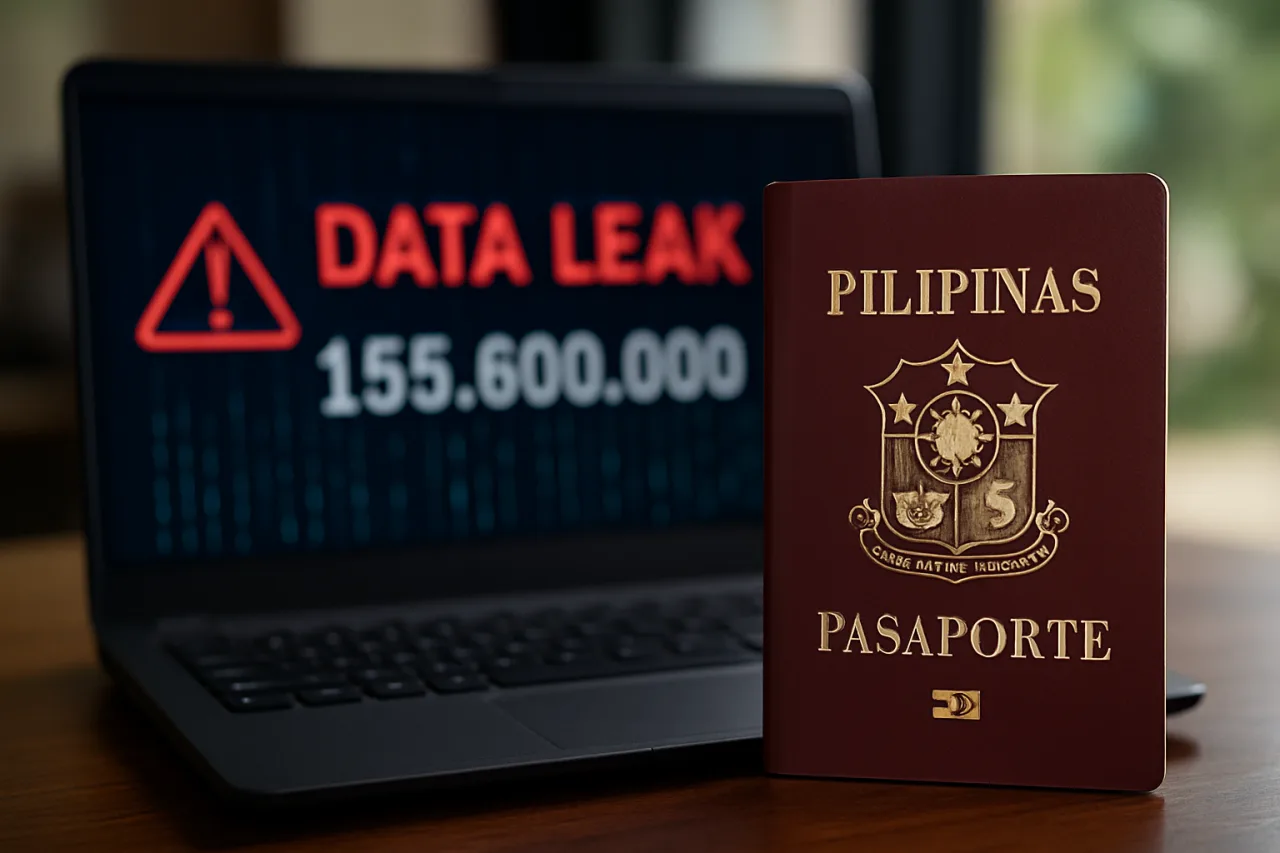
Philippine data leak incidents have pushed the country’s compromised accounts to 155.6 million, with 216,700 more accounts leaked in the second quarter of 2026 alone, according to cybersecurity firm Surfshark. The figure places the Philippines as the second most-affected country in Southeast Asia since 2004 — a sobering reminder that every Filipino professional, overseas worker, and digital citizen is a potential target.
Key Takeaway
- 📊 Scale: The Philippine data leak has reached 155.6 million compromised accounts cumulatively since 2004, with 216,700 new accounts leaked in Q2 2026 alone.
- 🌍 Global Rank: The Philippines ranked 25th worldwide for data breaches in 2025, with 11 breached accounts per 1,000 residents — matching Indonesia’s exposure rate.
- 🔑 Password Exposure: An estimated 79.6 million Filipino passwords and 57.4 million unique email addresses have been exposed since 2004, creating cascading identity-theft risks.
- 🏛️ Government Response: The National Cybersecurity Plan 2.0, AFP Cyber Command, and the Digital Bayanihan Chain represent the government’s multi-layered defense strategy.
- 🛡️ Action Steps: Filipino professionals can reduce exposure by using password managers, enabling two-factor authentication, monitoring breach databases, and limiting data sharing online.
What the Philippine Data Leak Numbers Actually Mean
The headline figure — 155.6 million compromised accounts — represents the cumulative total of Philippine data leak incidents tracked since 2004 by Surfshark, a Netherlands-based cybersecurity company. This is not a single breach. It is the aggregate of nearly two decades of exposures across government databases, private-sector platforms, social media networks, and financial institutions.
In the first quarter of 2026, the Philippines recorded 624,400 leaked accounts, according to Surfshark data reported by BusinessWorld on April 28, 2026. The second quarter saw a significant decline to 216,700 — a 65 percent drop quarter-over-quarter. While that improvement is notable, the quarterly figure still means roughly 2,380 Filipino accounts were compromised every day during Q2 2026, or about 99 every hour.
The longer historical view is more alarming. According to an analysis published by The Straits Times on February 13, 2026, three Filipino user accounts were compromised every minute throughout 2025, totaling 1.3 million breached accounts for the year. The third quarter of 2025 was the worst single period, with 477,700 accounts compromised in just three months — more than a third of the annual total.
Tomas Stamulis, Chief Security Officer at Surfshark, said in a statement on February 11, 2026: “We must stop treating breaches as singular, explosive events and start seeing them as a permanent feature of our digital environment. They are a constant threat, and your data is likely already exposed.”
How the Philippine Data Leak Compares Globally
Globally, 425.7 million user accounts were compromised in 2025 — the equivalent of 13.5 accounts every second. The United States accounted for 142.9 million of those, or 34 percent of the global total, followed by France, India, Germany, and Russia. The Philippines ranked 25th worldwide.
Within Southeast Asia, the Philippines holds the unenviable position of being the second most-affected country since 2004, behind only Indonesia. In 2025, Indonesia recorded 3.2 million compromised accounts — higher in absolute terms — but both countries saw the same breach density: 11 accounts per 1,000 residents. This means that on a per-capita basis, Filipinos face the same level of exposure as Indonesians, despite Indonesia’s larger population.
For Filipino professionals working across the ASEAN region, this comparison matters. A separate investigation into the ASEAN data breach landscape found that government databases across Southeast Asia face coordinated attacks from state-sponsored actors. The Philippine data leak is not an isolated problem — it is part of a regional pattern that demands regional solutions.
Why the Philippine Data Leak Keeps Growing
A March 2026 report by CYFIRMA, a cybersecurity intelligence firm, identified several structural factors driving the Philippine data leak crisis. The report, titled “Philippines Evolving Cyber Threat Landscape 2025-2026,” found that rapid digital adoption has outpaced security maturity across government, businesses, and critical services.
According to CYFIRMA, cyber activity in the Philippines has evolved from isolated technical breaches into large-scale, automated, and increasingly AI-driven campaigns targeting trust, identity, and service continuity. The healthcare, financial services, and critical infrastructure sectors are the most affected, with systemic weaknesses amplified by legacy systems, supply-chain dependencies, and expanded online services.
Specific incidents in 2026 illustrate the breadth of the problem:
- Senate website defacement (June 2026): Hackers defaced the Philippine Senate’s website, though the Senate said no sensitive data was compromised.
- LTO system concerns (May 2026): A coalition aired concerns about the Stradcom-led Land Transportation Office system and possible data breaches.
- Government website hacks (June 2026): The South China Morning Post reported a wave of Philippine government website hacks, raising alarm over weak cybersecurity defenses.
- Military data leak (March 2026): Reuters reported that Philippine resupply mission data was leaked to Chinese intelligence, according to a security official.
- Resupply mission compromise (March 2026): The same Reuters report revealed that sensitive military operational data was exposed through a breach that security officials attributed to state-sponsored espionage linked to West Philippine Sea tensions.
Regional geopolitical tensions have further compounded the Philippine data leak problem. The CYFIRMA report noted that sustained cyber-espionage and pre-positioning activity against sensitive national sectors has increased, intersecting with broader national security concerns. This means that the Philippine data leak is not just a criminal issue — it has intelligence and national security dimensions that require a coordinated government response.
What the Government Is Doing About the Philippine Data Leak
The Philippine government has implemented several measures to address the data breach crisis, though experts say the response remains uneven. Key initiatives include:
National Cybersecurity Plan (NCSP) 2.0: The updated plan adopts a risk-based approach to Critical Information Infrastructure (CII) and established the National Cybersecurity Inter-Agency Committee (NCIAC) to coordinate defense across agencies. This represents a shift from reactive incident response to proactive risk management of critical systems.
AFP Cyber Command: The Armed Forces of the Philippines has stood up a dedicated Cyber Command, and the Philippine National Police’s Anti-Cybercrime Group (PNP-ACG) has launched “White Hat” bug bounty programs to crowdsource vulnerability discovery. The AFP is also actively recruiting AI and cybersecurity experts to strengthen its defensive capabilities.
Digital Bayanihan Chain: In a global first, the Philippines integrated blockchain technology into the 2026 General Appropriations Act (GAA) to enhance transparency and tamper-resistance in government financial data. However, CYFIRMA cautioned that the initiative must be “more than a high-tech filing cabinet” for PDF hashes to ensure true transparency.
National Privacy Commission (NPC): The NPC has issued reminders about consent requirements under the Data Privacy Act, including warnings that taking and uploading content without consent may violate privacy laws. The NPC has also streamlined its breach notification process, though a June 2026 study by Newsbytes.PH found that overlapping cybersecurity agencies still create confusion for breach victims.
The CyberSecPhil Conference 2026 brought together 400 security leaders to address exactly this coordination gap, uniting government and industry on national cyber resilience.
How to Protect Yourself From a Philippine Data Leak
While the government works on systemic defenses, Filipino professionals and overseas workers must take individual action. The 79.6 million exposed passwords since 2004 mean that credential reuse — using the same password across multiple platforms — is the single biggest risk multiplier. A single leaked password can cascade into account takeovers, identity theft, and financial fraud across every service where that credential was reused.
Here are seven practical steps that every Filipino professional should take:
- Use a password manager: Generate and store unique passwords for every account. This prevents a single breach from cascading into account takeovers across multiple platforms. Popular options include Bitwarden, 1Password, and LastPass.
- Enable two-factor authentication (2FA): Even if your password is in a breach database, 2FA blocks unauthorized access. Use an authenticator app (Google Authenticator, Authy) rather than SMS codes, which can be intercepted through SIM-swapping attacks.
- Check breach databases: Use free tools like Have I Been Pwned to check if your email address appears in known breach databases. If it does, change the affected passwords immediately.
- Limit data sharing: Reduce the personal information you share on social media, e-commerce platforms, and app registrations. Every piece of data you share is a potential leak vector that could end up in a Philippine data leak.
- Monitor financial accounts: Set up transaction alerts on your bank and e-wallet accounts. Report unauthorized transactions within 72 hours to limit liability under BSP regulations.
- Use a VPN on public Wi-Fi: Avoid accessing banking or work accounts on unsecured public networks. A VPN encrypts your connection and prevents interception by attackers on the same network.
- Be skeptical of phishing attempts: AI-driven phishing campaigns are increasingly sophisticated, using deepfake voice and text to impersonate colleagues, banks, and government agencies. Verify sender addresses, check for urgency tactics, and never click links from unknown sources.
For Filipino professionals who have experienced a data breach, the rising ransomware threat compounds the risk. Stolen credentials from one breach are often sold on dark-web markets and used to launch targeted ransomware attacks against businesses and individuals. The connection between the Philippine data leak problem and ransomware is direct: breached credentials are the fuel for ransomware campaigns.
The Economic Cost of the Philippine Data Leak
The financial impact of data breaches extends beyond individual victims. A TransUnion study released on May 20, 2026 found that Filipinos face widespread digital fraud exposure despite reporting lower financial losses than in previous years. Philstar reported on May 24, 2026 that online scam risk in the Philippines remains above the global average, with parcel delivery fraud emerging as a new attack vector.
For businesses, the cost of a Philippine data leak includes regulatory fines from the National Privacy Commission, reputational damage, lost customer trust, and the expense of remediation. Under the Data Privacy Act of 2012, organizations that fail to implement reasonable security measures face penalties of up to PHP 5 million per violation, plus imprisonment for responsible officers.
The Philippines’ growing digital economy — projected to contribute significantly to GDP growth alongside AI demand, according to AMRO’s July 2026 quarterly update — makes robust data protection an economic imperative, not just a security one. The parcel delivery boom in the Philippines has also created new fraud vectors, according to ABS-CBN reporting on June 25, 2026. As more Filipinos shop online, scammers exploit delivery notifications to launch phishing attacks, adding another layer to the Philippine data leak ecosystem.
The United Nations Office on Drugs and Crime (UNODC) reported on April 27, 2026 that the Philippines is cracking down on online fraud centers with international support, signaling growing recognition that the Philippine data leak problem has transnational dimensions requiring cross-border law enforcement cooperation.
Philippine Data Leak: What Comes Next
The 65 percent quarter-over-quarter decline from Q1 to Q2 2026 (624,400 to 216,700 leaked accounts) suggests that awareness and defensive measures may be having an effect. However, cybersecurity experts caution against complacency. The CYFIRMA report warns that AI-driven threats are outpacing Philippine readiness, and the normalization of data exposure means that every new digital service creates new attack surfaces.
The Philippine government’s assumption of the ASEAN chairmanship in 2026, with a commitment to promote ethical AI use, offers an opportunity to strengthen regional cybersecurity cooperation. As the country with the second-highest cumulative data leak total in Southeast Asia, the Philippines has both the motivation and the regional platform to lead on digital protection standards.
For Filipino professionals worldwide, the message is clear: your data is likely already exposed. The question is not whether you will be affected by a Philippine data leak, but whether you have taken the steps to limit the damage when it happens. Start with a password manager, enable 2FA on every account, and check your exposure on breach databases today.
Frequently Asked Questions
What is the Philippine data leak total for 2026?
As of Q2 2026, the Philippines has 155.6 million cumulatively compromised accounts since 2004, with 216,700 new accounts leaked in Q2 2026 and 624,400 leaked in Q1 2026, according to Surfshark data.
How does the Philippines rank globally for data breaches?
The Philippines ranked 25th worldwide for data breaches in 2025, with 1.3 million breached accounts. It is the second most-affected country in Southeast Asia since 2004, behind Indonesia.
How many Filipino passwords have been exposed?
An estimated 79.6 million passwords and 57.4 million unique email addresses belonging to Filipino accounts have been exposed in data breaches since 2004, according to Surfshark analysis.
What should I do if my data was leaked in a Philippine data breach?
Change your passwords immediately, enable two-factor authentication, check your email on breach databases like Have I Been Pwned, monitor your financial accounts for unauthorized transactions, and report identity theft to the National Privacy Commission.
Is the Philippine data leak getting better or worse?
Q2 2026 saw 216,700 leaked accounts, a 65 percent decline from Q1 2026’s 624,400. However, the cumulative total continues to grow, and AI-driven threats are outpacing defensive capabilities, according to CYFIRMA’s 2026 report.
What is the government doing to address the Philippine data leak?
The government has implemented the National Cybersecurity Plan 2.0, established the National Cybersecurity Inter-Agency Committee, created the AFP Cyber Command, launched bug bounty programs, and integrated blockchain into the 2026 national budget through the Digital Bayanihan Chain initiative.
Sources: Surfshark data breach statistics; The Straits Times (February 13, 2026); CYFIRMA “Philippines Evolving Cyber Threat Landscape 2025-2026” (March 2, 2026); BusinessWorld (April 28, 2026); Interaksyon (July 28, 2026); TransUnion (May 20, 2026); Newsbytes.PH (June 24, 2026); UNODC (April 27, 2026).
Disclosure: WorldNgayon may earn a commission if you purchase through links in this article. Full details on our disclaimer page.