Table of Contents
Reading Time: 8 minutes
Key Takeaway
- 🚨 The government website defacement wave hit 19 sites in the September 21 protest wave — four national agencies (ARTA, Bureau of Customs, DICT itself, DEPDev) plus local government units — while over 1.4 million failed breach attempts hammered government systems.
- 🛡️ DICT’s verified finding: no evidence of data exfiltration — the defacements hit presentation layers, the eGov PH App’s core stayed intact, and the compromised EComplaints component is a third-party system, not the app itself.
- 🔍 The practical skill this wave teaches: verify-before-you-visit. Defacement waves are followed by fake portals and lookalike links — typing the official URL yourself beats every search result, sponsored or not.
- 🗂️ The EComplaints lesson is data minimization: government complaint forms integrated with third-party systems deserve the minimum data needed, not your full identity set — share what the service requires, nothing more.
- 📋 Five service-protection moves inside: URL discipline, the verified-channel rule, MFA on government logins, data minimization on forms, and transaction documentation — the checklist that keeps a defacement wave from becoming a personal breach.
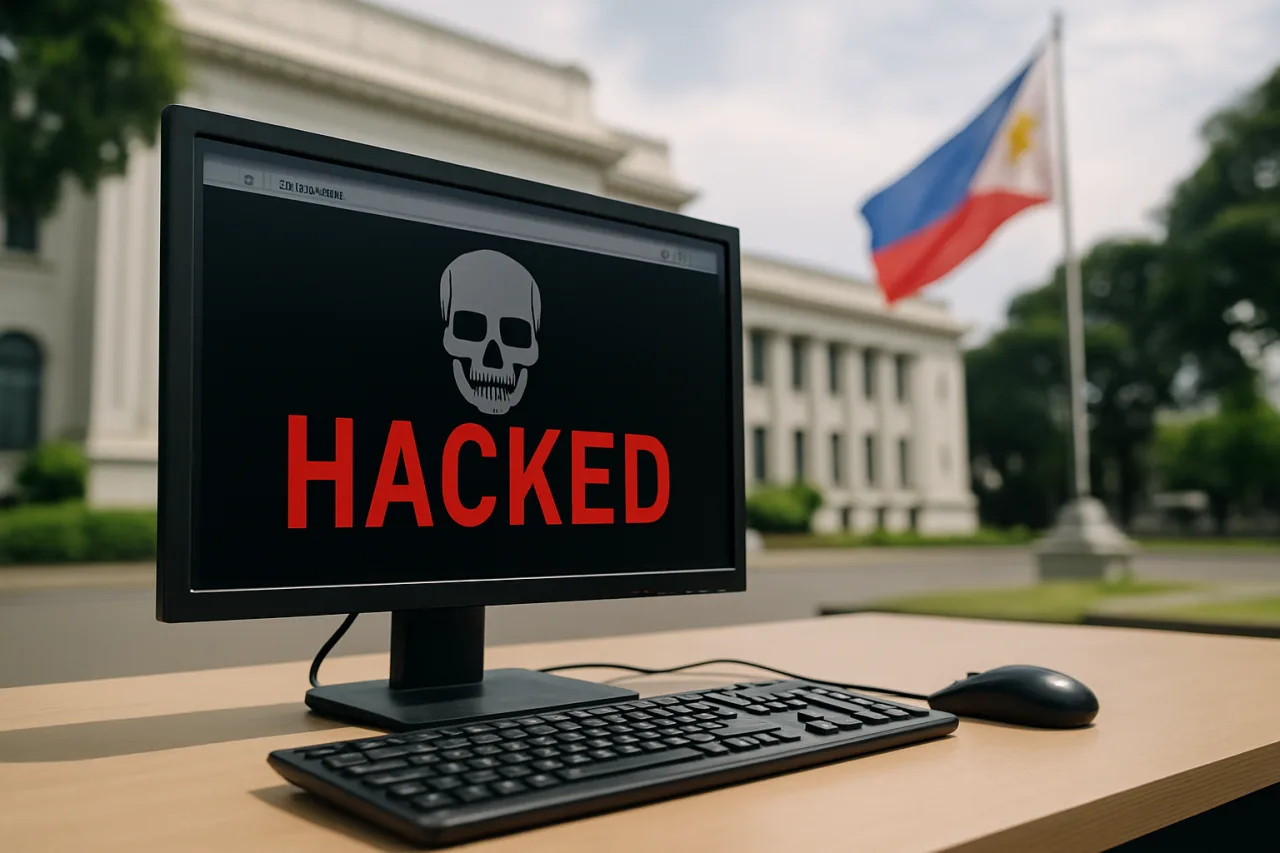
Nineteen government websites went down in a single day. The government website defacement wave of September 21 is the third mass incident to hit Philippine systems this month, after the claimed DMW intrusion and the DOLE host modification. DICT Secretary Henry Aguda faced the Palace press corps Monday with the count and the finding: four national government agencies — the Anti-Red Tape Authority, the Bureau of Customs, the DICT itself, and the Department of Economy, Planning and Development — plus a larger set of local government unit sites were hacked and defaced amid the corruption-protest actions of September 21, alongside distributed denial-of-service attacks and more than 1.4 million failed breach attempts. His verdict deserves quoting precisely: “To date, wala pa kaming verified report of exfiltration. So wala pa personal information na nawala” — no verified report of data leaving, no personal information lost. For the Filipino professional and the OFW whose records flow through these systems, the intelligence question is not whether the defacements were staged for the cameras — it is what a wave like this changes about how you use government digital services tomorrow morning. The answer below: the verify-before-you-visit discipline, the data-minimization rule the EComplaints incident just demonstrated, and the five moves that keep a defaced website from becoming a defaced identity.
Related: Blockchain Government Spending: Marcos EO 126 institutionalizes DBM CO
The Government Website Defacement Wave, Verified: What Actually Happened on September 21
Strip the noise and the incident report is precise. The attack window was the September 21 protest actions against corruption — a date chosen for its symbolism, which tells you the motive was message-sending, not theft. The method was two-pronged: website defacements (content replaced with attackers’ pages) and distributed denial-of-service floods, wrapped around 1.4 million failed intrusion attempts. The success rate tells the defense story: of all those attempts, four national agency websites got through — ARTA, the Bureau of Customs, the DICT, and DEPDev — plus LGU sites, and even those four lost what Aguda characterized as training modules and complaint platforms, “inconsequential” systems, fixed immediately. The Cybercrime Investigation and Coordinating Center, the DICT’s Cybersecurity Bureau, the National Computer Emergency Response Team and law enforcement worked the wave; Aguda’s public count was that only four penetrated of the vast majority stopped. The government website defacement was real, visible, and — on current evidence — cosmetic rather than extractive. That distinction matters enormously for what you should do next, because a defacement wave and a data breach call for different responses: defacement attacks the government’s credibility surface; breach attacks your identity. September delivered the first kind, so far, in all 19 cases.
Related: Cyber Watch #011: One Hundred Days After the SMS OTP Deadline — What…
WorldNgayon Analysis: The defacement wave is best read as a stress test that passed expensively — systems held, but the pattern (protest-timed, opportunistic, volume-based) returns with every national moment, and each return is another chance for one agency’s luck to run out.
Bottom Line: 19 defacements, 1.4 million attempts, four penetrated, zero verified exfiltrations — the wave damaged pride and uptime, not identities, on the evidence DICT has verified so far.
Why a Government Website Defacement Still Matters When No Data Was Taken
The “no data breach” finding is genuinely reassuring and completely insufficient — both at once. Here is what a government website defacement actually signals: that someone demonstrated write-access to a government web property, publicly, with political timing. A government website defacement may be vandalism at the surface, but the capability it proves is an entry ticket, and the follow-on risks arrive in three forms. Fake-portal seeding: when citizens hear “government sites were hacked,” scam operators register lookalike domains — the natural next step for crime groups that already run PHP phishing kits against GCash and bank logins — and harvest credentials from citizens trying to “re-verify” after the news. Service-reliability doubt: the affected systems (a complaint platform, training modules) being offline pushes users toward informal channels — Facebook pages, WhatsApp groups, anonymous “fixers” — precisely the environments where personal data gets harvested. Third-party exposure: the government website defacement that reached the EComplaints integration DICT singled out is the structural lesson: integrations managed by third parties are the soft surface of any government platform, and every Filipino who filed a complaint there just learned which layer leaked first when the wave came. None of this requires the breached data to exist. It requires only that citizens react to the news without a verification discipline — which is why the checklist below is the actual government website defacement countermeasure — the intelligence product of this story.
Bottom Line: A defacement wave steals attention and confidence first; the identity theft follows only if your reaction routes through the attacker’s channels.
The Verify-Before-You-Visit Discipline
One habit neutralizes most of the post-defacement scam surface: never navigate to a government service through a link someone else gave you. The mechanics: type the official domain yourself — gov.ph domains, the eGov PH App from your phone’s official app store, the agency site whose address you already have on file; bookmark the real ones today, while nothing is on fire, so the bookmark — not a search result — becomes your path tomorrow; the device side of the same habit lives in the 20-minute stolen-phone lockdown, treat search-engine ads as hostile territory during incident weeks, because ad auctions for “DICT complaint” and “BOC verification” are exactly where lookalike domains buy their traffic; check the certificate padlock and the exact domain spelling before entering anything — a defaced or spoofed site almost always trips one of those two checks. The discipline costs five seconds per visit and it is the difference between reading about a defacement wave and becoming its collateral. This is the same URL-hygiene layer the BER-months scam defense teaches for bank and e-wallet phishing — the threat actor changes, the reflex does not.
Bottom Line: Official domains, bookmarked by you, typed by you — the five-second habit that turns a defacement wave into someone else’s problem.
The EComplaints Lesson — Data Minimization on Government Forms
The wave’s most instructive detail was the one that held: the eGov PH App’s core infrastructure stayed intact while the EComplaints system — a third-party integration — was what got compromised. Every Filipino who files digital complaints learned the same lesson banks learned years ago: the integration layer is the attack surface. The practical government website defacement countermeasure is data minimization, applied to every form that touches a third-party system: provide what the service requires to function, withhold what it merely collects. A complaint about a fixer at an agency needs the incident, the office, and your callback preference — not your full birthdate, mother’s maiden name, and ID numbers unless the form legally demands them for that transaction. Where a service offers a logged-in portal path versus an email attachment path, the portal path usually carries less exposed data than a document email that forever forwards. And where a form asks why you need a service at all, the answer travels — keep it factual, not personal. The Data Privacy Act gives Filipinos the right to ask what data a system holds; the defacement wave gives the reason to exercise it sparingly on the way in.
Bottom Line: Third-party integrations are where government systems bend — feed them the minimum the transaction legally needs, and a compromised complaint platform gets a defaced form instead of your identity.
The Five-Move Service-Protection Checklist
The checklist, sequenced for one sitting: Move one — bookmark the official domains for every government service you actually use (eGov PH, SSS, PhilHealth, Pag-IBIG, DMW, BOC), typed by hand from the agency’s official channel — five minutes, done once. Move two — turn on MFA for every government-linked account that offers it; the DICT-CICC advisory after the DMW incident made MFA on privileged accounts the government’s own first priority, and the citizen version is the same move on your logins. Move three — apply data minimization on third-party-integrated forms per the EComplaints lesson above; full identity sets belong in transactions that legally require them, nowhere else. Move four — follow the verified channels during incident weeks: DICT and CICC publish confirmed findings and separate them from preliminary assessments; their pages and official briefings are the feed — not Facebook reposts, not group chats, not the “advisory” screenshot from a cousin-of-a-cousin. Move five — document your transactions: reference numbers and confirmation screenshots for every government filing, stored where you store important records, because when a service goes offline for forensics — as DMW and DOLE sites did — the documented transaction is your proof the filing happened on your side — the same records discipline the DMW breach protection playbook teaches. Five moves, one evening, and the next government website defacement wave finds you pre-positioned instead of reactive.
WorldNgayon Analysis: The state’s own 24-hour readiness order after the DMW incident asked every agency for a one-page risk assessment; this checklist is the citizen’s version — the same discipline, scaled to one person, deliverable in one sitting.
Bottom Line: Bookmark, MFA, minimize, verify, document — the citizen-grade version of the same readiness framework the government just ordered itself to complete.
What This Wave Predicts About the Next One
The September 21 pattern — protest-timed, volume-based, presentation-layer focused — fits a category security watchers have tracked globally: hacktivist waves that follow national moments, probing for whichever systems were left exposed, content-swapping where they land. The Philippine count will keep rising with each national event until two structural fixes land: the government’s own readiness order (the green-amber-red assessments DICT and CICC demanded from every agency after the DMW wave) converts from paper to patched systems, and third-party integrations across the eGov ecosystem get the same access-control scrutiny as core infrastructure. Until then, every national moment carries a defacement-wave forecast, and the citizen government website defacement playbook stays the same: verify channels, minimize inputs, document transactions. The one number worth watching in the coming weeks is DICT’s own promise — verified public updates separating confirmed findings from preliminary assessments, delivered as the DMW and DOLE forensics conclude. If the exfiltration finding for all 19 sites holds at zero, September’s wave becomes the case study for defacement response done mostly right — and the checklist above becomes the standing posture between waves.
Bottom Line: Expect the pattern to return with the next national moment — the posture above is the version of readiness that does not wait for a Palace briefing to matter.
Frequently Asked Questions
Which government websites were defaced in the September 21 attack?
Nineteen sites total per DICT Secretary Henry Aguda’s Palace briefing: four national government agencies — the Anti-Red Tape Authority, Bureau of Customs, DICT, and the Department of Economy, Planning and Development — plus multiple local government unit sites. The compromised content was training modules and complaint platforms, described as inconsequential; the eGov PH App core was not compromised.
Was personal data stolen in the government website defacement wave?
DICT’s verified position as of the September 22 briefing: no verified report of exfiltration and no personal information lost. Note the precision — that is the current verified finding, not a permanent clearance; DICT committed to publishing verified updates as forensics conclude, and the DMW intrusion from the same period remains under investigation.
What should I do if a government website I use looks defaced?
Stop using it, do not enter any credentials on the defaced page, and switch to the official alternate channel — the agency’s verified domain typed by hand, the official app, or the agency’s posted alternative. Report defacements to the CICC’s official reporting channels, and watch DICT’s verified channels for restoration notices rather than third-party reposts.
How do I know a government website is real and not a fake portal?
Three checks: the domain ends in the official gov.ph hierarchy you expect (typed or bookmarked, never clicked from a search ad or message), the connection is certificate-protected (padlock, correct domain spelling), and the service path matches the official one — during incident weeks, search-engine ads for government services are where lookalike domains buy their traffic.
Is the eGov PH app safe to use after the defacement?
Per DICT’s statement, the eGov PH App itself was not compromised — the affected EComplaints system is a third-party integration managed separately from the app’s core infrastructure, and all personal information in the app “remains secure, encrypted, and protected” under the Data Privacy Act — the full text lives at the National Privacy Commission. Keep the app updated from the official store, keep MFA on any linked accounts, and apply data minimization on integrated forms.
Financial Disclaimer: This article is for general information and education, not legal or cybersecurity advice. Incident details reflect DICT and CICC public statements and official reporting as of September 28, 2026, and investigations remain ongoing. WorldNgayon.com is not a cybersecurity service provider; verify incident updates through official DICT and CICC channels.