Table of Contents
Key Takeaway
- 🚨 What Happened: A threat actor dubbed “OperationDawn” surfaced on dark web forums claiming to have exfiltrated sensitive ASEAN government files, including preparatory documents for the Philippines’ ASEAN 2026 chairmanship — prompting an active DICT and PNP investigation.
- 🔍 DICT Assessment: The Department of Information and Communications Technology confirmed a limited unauthorized leak of preparatory and administrative documents but stated no classified materials, official deliberations, or ASEAN systems were compromised.
- 🌐 Regional Pattern: The ASEAN data breach fits a broader 2025-2026 pattern of state-aligned threat actors — including CL-STA-1062, Amaranth-Dragon, and Autumn Dragon — targeting Southeast Asian government and diplomatic entities.
- 🇵🇭 Philippine Exposure: The Philippines ranked among the most breached countries globally in 2026, with 155.6 million compromised accounts since 2004 and over 216,000 leaked in Q2 2026 alone, according to Surfshark data.
- 🛡️ What Professionals Should Do: Filipino professionals in government, BPO, and critical infrastructure should adopt zero-trust security practices, monitor credential exposure, and follow DICT and NPC advisory channels for real-time threat updates.
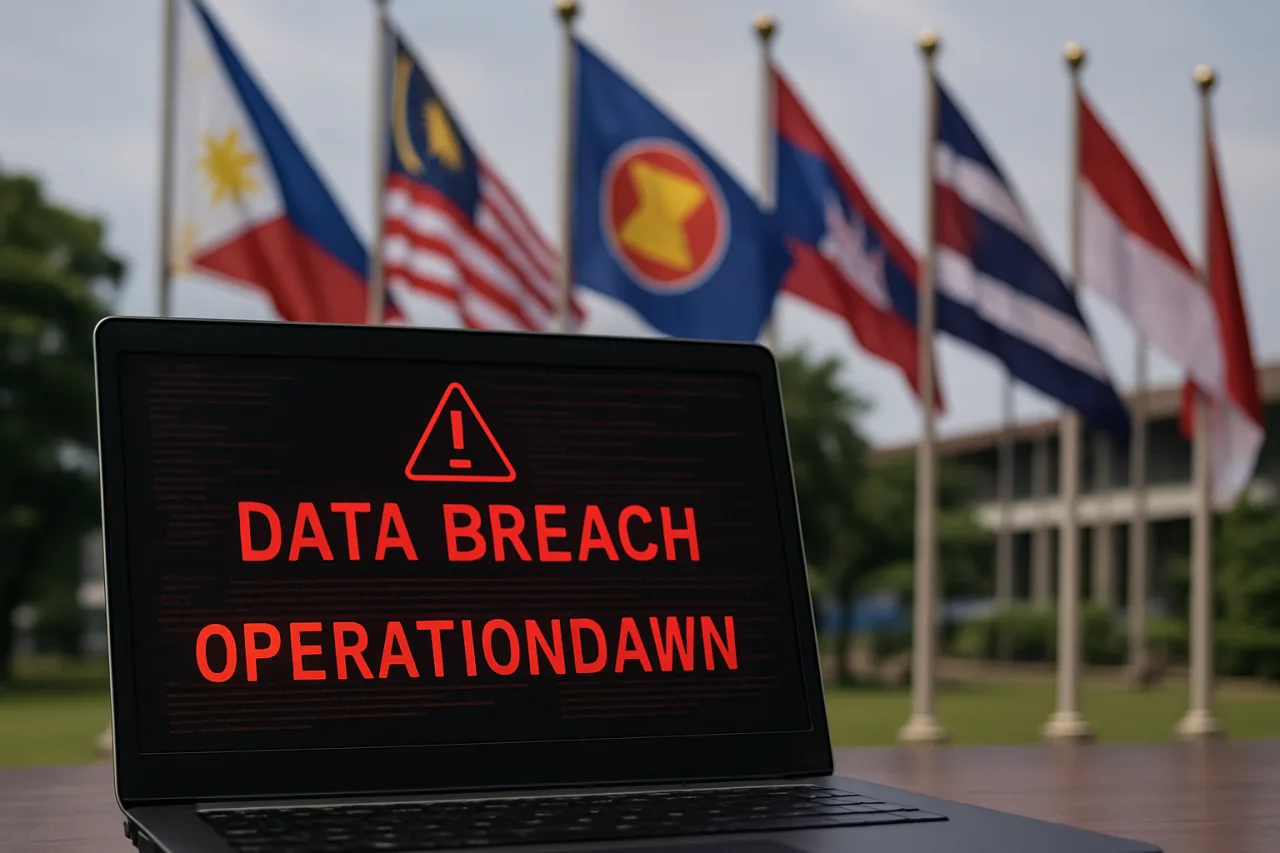
The ASEAN data breach incident that emerged in January 2026 has resurfaced in cybersecurity discussions after a threat actor identified as “OperationDawn” claimed to have exfiltrated sensitive government files from Southeast Asian institutions, including preparatory documents tied to the Philippines’ ASEAN 2026 chairmanship. The Department of Information and Communications Technology (DICT) confirmed the unauthorized disclosure on January 16, 2026, launching a coordinated investigation with the Philippine National Police (PNP) and intelligence agencies. While the DICT assessed the leaked materials as preparatory and administrative — not classified — the incident underscores a persistent and escalating cyber threat environment facing Philippine government infrastructure and the broader ASEAN region.
The ASEAN Data Breach: What OperationDawn Claimed
The ASEAN data breach first drew public attention when posts appeared on dark web forums and social media platforms, including a report on Reddit’s r/PhilippineMilitary community, alleging that a threat actor operating under the name “OperationDawn” had obtained and was offering sensitive ASEAN government documents. The claims included references to security planning materials and administrative files related to the Philippines’ preparations for hosting ASEAN 2026 activities.
A Facebook page monitoring dark web activity, Deep Web Konek, posted an alert about an “alleged cache of sensitive documents linked to the Philippines’ preparations for ASEAN 2026” that had “surfaced on a dark web forum, raising concerns over a potential exposure of national-level security planning.” The post noted that the breach reportedly contained a significant volume of records, though independent validation of the claims remained ongoing.
Cybersecurity researchers emphasized that threat actor claims on dark web forums require careful verification. Posts on underground marketplaces frequently exaggerate the scope and sensitivity of stolen data to inflate the seller’s reputation or drive up prices. However, the Philippine government took the reports seriously enough to launch a formal investigation.
DICT Response: Limited Leak, No Classified Compromise
On January 16, 2026, the DICT issued a formal statement acknowledging the unauthorized leak. According to both the GMA News Online report by Jiselle Anne C. Casucian and coverage from the Daily Tribune, the DICT’s initial assessment was definitive: the leaked documents were “preparatory and administrative in nature and do not include substantive ASEAN agenda papers, official deliberations, or policy discussions.”
The DICT further stated: “There is currently no indication that ASEAN systems, platforms, or classified deliberative materials were compromised.” This distinction is critical. Preparatory documents — logistical arrangements, venue planning schedules, administrative correspondence — while sensitive in timing, do not contain the diplomatic negotiating positions, security protocols, or classified intelligence assessments that would represent a true national security catastrophe.
However, the DICT did not dismiss the incident. The agency confirmed that the Philippine National Police, in coordination with relevant law enforcement and intelligence agencies, was conducting an active investigation to determine the circumstances surrounding the leak. The DICT described its role as supporting “ongoing forensic, containment, and monitoring efforts.”
Why the ASEAN Data Breach Matters for Philippine Cybersecurity
The ASEAN data breach may not have exposed classified materials, but it exposed something equally concerning: the vulnerability of Philippine government digital infrastructure during a high-stakes international event. The Philippines assumed the ASEAN chairmanship in 2026, making it the focal point for diplomatic communications, security coordination, and high-level summits across the region. Any breach — even of administrative documents — carries diplomatic and operational consequences.
The incident also fits a well-documented pattern. According to cybersecurity research from Palo Alto Networks’ Unit 42, a Chinese-speaking threat actor tracked as CL-STA-1062 has been running persistent operations across East Asia since at least March 2022, shifting focus to Southeast Asian government entities and state-owned critical energy infrastructure. Check Point Research separately identified “Amaranth-Dragon,” a previously untracked threat actor conducting highly targeted cyber espionage campaigns against government and law enforcement agencies across the ASEAN region throughout 2025. Singapore’s IMDA also reported on “Autumn Dragon,” a threat actor targeting Southeast Asian government and media sectors.
These are not isolated incidents. They represent a sustained, coordinated campaign of cyber espionage against Southeast Asian governments — and the Philippines, as ASEAN 2026 chair, sits squarely in the crosshairs.
The Philippine Data Breach Landscape in 2026
The ASEAN data breach is not an anomaly in the Philippine cybersecurity landscape. It is part of a documented escalation. According to data from cybersecurity firm Surfshark, the Philippines had accumulated 155.6 million compromised user accounts since 2004, with over 216,000 accounts leaked in the second quarter of 2026 alone. While this represented a decrease from the 624,400 leaked accounts recorded in Q1 2026, the cumulative total places the Philippines among the most breached countries in Southeast Asia.
In March 2026, a separate incident involved a threat actor on a monitored hacker forum announcing the “free” leak of a comprehensive Philippine government employee database in PDF format — described by cybersecurity monitoring firm Brinztech as a “Sovereign & Civil Service” data exposure. This attack targeted government personnel records, potentially exposing employee names, positions, and departmental assignments.
The National Privacy Commission (NPC) has also documented a sharp rise in cybersecurity incidents. As previously reported by WorldNgayon, NPC-recorded cybersecurity incidents doubled, reflecting both increased attack volume and improved reporting compliance. The NPC’s data showed that Philippine organizations across government, financial services, and IT-BPM sectors faced mounting pressure from credential stuffing, phishing, and ransomware campaigns.
OperationDawn in Context: State-Aligned Threat Actors Targeting ASEAN
The “OperationDawn” moniker fits the naming convention of state-aligned advanced persistent threat (APT) groups that cybersecurity researchers track across the Asia-Pacific region. While the DICT did not publicly attribute the ASEAN document leak to a specific state sponsor, the broader threat landscape provides important context.
Security Affairs reported that CL-STA-1062, a Chinese-speaking APT, expanded its attacks on Southeast Asian critical infrastructure, targeting government entities and state-owned energy companies. The Hacker News documented a related campaign deploying a custom backdoor called “TinyRCT” against government entities in Southeast Asia. Hunt Intelligence separately reported that SideWinder, one of South Asia’s most persistent state-sponsored threat actors, launched “Operation SouthNet,” weaponizing legitimate platforms like Netlify and GitHub Pages for command-and-control infrastructure.
The common thread: Southeast Asian government digital infrastructure is under sustained, sophisticated, state-aligned attack. The ASEAN data breach — whether orchestrated by OperationDawn specifically or part of a broader campaign — represents one visible instance of a much larger, ongoing shadow war in cyberspace.
What the DICT Is Doing About It
Following the ASEAN data breach, the DICT outlined specific measures being taken to strengthen cybersecurity for the event and beyond:
- Strengthening ASEAN 2026 venue security: Cybersecurity measures for all ASEAN 2026 venues, government digital infrastructure, and inter-agency coordination mechanisms are being reinforced.
- Coordinated investigation: The PNP, working with intelligence agencies, is conducting forensic analysis to determine the source and method of the leak.
- Inter-agency coordination: The DICT is coordinating with ASEAN counterparts through official channels, ensuring regional partners are briefed on the incident.
- National cyber resilience: The agency framed its response as part of the government’s broader efforts to “enhance national cyber resilience and ensure the secure conduct of major international events hosted by the Philippines.”
The DICT stated it would not discuss operational details given the ongoing investigation and the sensitivity of the matter, but confirmed that “appropriate briefings are being held through official channels with relevant stakeholders, including ASEAN counterparts.”
What Filipino Professionals Should Learn From This Incident
The ASEAN data breach offers several lessons for Filipino professionals working in government, IT-BPM, financial services, and critical infrastructure sectors:
1. No organization is too small to be targeted. The threat actors targeting ASEAN governments use the same tools and techniques — phishing, credential harvesting, supply chain compromise — that target private sector organizations. If state-aligned APTs can breach government infrastructure, they can breach corporate networks. Filipino professionals should review their organization’s incident response plans and ensure they align with DICT and NPC guidelines.
2. Credential exposure is the primary attack vector. With 155.6 million compromised Philippine accounts, credential stuffing and password reuse remain the most common entry points for attackers. Professionals should use unique passwords for every account, enable multi-factor authentication wherever available, and monitor breach notification services for their email addresses.
3. Phishing remains the gateway. As WorldNgayon documented, the Philippines experienced a surge of 16,619 phishing attacks — and these campaigns are often the precursor to more sophisticated intrusions. The ASEAN document leak likely began with a successful phishing email or credential compromise that granted initial access to government systems.
4. The Philippines is a high-value target. As ASEAN 2026 chair, the Philippines processes diplomatic communications, summit logistics, and security coordination across all member states. This makes Philippine government systems a high-value target for intelligence collection. Professionals in adjacent sectors — BPO companies handling government contracts, financial institutions processing ASEAN-related transactions, IT vendors supporting government infrastructure — should assess their own exposure.
5. Cybersecurity is a shared responsibility. The DICT’s response emphasized a “whole-of-government approach to cybersecurity.” For the private sector, this means the same: security is not solely an IT department function. Every employee, from entry-level to executive, represents a potential entry point. Regular security awareness training, phishing simulations, and clear reporting protocols are essential.
The Broader Cybersecurity Philippines Landscape
The ASEAN data breach exists within a larger context that WorldNgayon has been tracking throughout 2026. The Cybersecurity Philippines 2026 pillar guide documents the full spectrum of threats facing the country: from ransomware campaigns targeting hospitals and local government units to AI-powered deepfake scams targeting OFW remittances.
The Philippine government has been building its defensive capacity. The DICT has been strengthening the National Computer Emergency Response Team (NCERT), the NPC has increased its enforcement of the Data Privacy Act of 2012, and the government has invested in cybersecurity training programs for public sector IT personnel. But the gap between offensive capability and defensive readiness remains wide.
According to the PSA Intelligence report cited in DuckDuckGo search results, “an active cyberespionage campaign targeting government and diplomatic entities in Southeast Asia underscores growing regional risk. State-aligned threat actors increasingly target critical infrastructure, fueled by rising geopolitical competition across the Asia Pacific region.” This assessment, from a threat intelligence provider, frames the ASEAN data breach not as a one-off event but as a symptom of structural geopolitical competition.
Risks and Considerations for the Philippines
Several specific risks emerge from the ASEAN data breach and the surrounding threat landscape:
- Diplomatic exposure: Even administrative documents can reveal logistical patterns, meeting schedules, and communication protocols that intelligence services can exploit for future operations. The leak of ASEAN 2026 preparatory materials, while not classified, provides adversaries with a roadmap of Philippine diplomatic activity.
- Reputational damage: As ASEAN chair, the Philippines is expected to demonstrate cybersecurity leadership. A breach of event preparatory documents — even administrative ones — undermines confidence in the country’s ability to secure high-level diplomatic engagements.
- Precedent for future attacks: Successful breaches, even of low-sensitivity materials, embolden threat actors to escalate. If OperationDawn or similar actors perceive Philippine government systems as vulnerable, they will likely return with more sophisticated intrusion attempts targeting classified systems.
- Supply chain vulnerability: Government events rely on contractors, vendors, and IT service providers. A breach at any point in the supply chain — a catering vendor’s email system, a logistics provider’s scheduling platform — can expose government operational data. The DICT’s investigation will need to examine the full supply chain, not just government-owned systems.
- Workforce preparedness: The Philippines’ IT-BPM sector, which handles sensitive data for global clients, faces collateral risk. If Philippine government systems are perceived as vulnerable, multinational clients may question the security posture of Philippine-based service providers. The IT-BPM sector’s 2026 challenges already include AI-driven revenue projection cuts — a cybersecurity crisis would compound those pressures.
Recommendations for Filipino Professionals and Organizations
Based on the ASEAN data breach incident and the broader threat landscape, Filipino professionals should take the following steps:
For government and public sector professionals: Review access controls on all systems handling event-related or diplomatic data. Implement least-privilege access principles — no user should have access to documents beyond their immediate role. Ensure all communication channels use end-to-end encryption, and conduct a full audit of third-party vendor access to government systems.
For IT-BPM and private sector professionals: Conduct a security posture assessment aligned with the DICT’s national cybersecurity framework. Verify that your organization’s incident response plan includes notification procedures for the NPC under the Data Privacy Act. Train staff on recognizing spear-phishing campaigns, which are the primary initial access vector for state-aligned threat actors.
For cybersecurity professionals: Monitor threat intelligence feeds for indicators of compromise (IOCs) associated with CL-STA-1062, Amaranth-Dragon, Autumn Dragon, and similar ASEAN-targeting groups. Implement network segmentation to limit lateral movement if an initial breach occurs. Deploy endpoint detection and response (EDR) solutions across all critical infrastructure.
For all professionals: Use a password manager with unique credentials for every account. Enable multi-factor authentication on all work and personal accounts. Subscribe to breach notification services. Report suspicious emails to your IT security team immediately — speed of reporting is the single most important factor in limiting breach impact.
Frequently Asked Questions
What is the ASEAN data breach of 2026?
The ASEAN data breach refers to the unauthorized leak of preparatory and administrative documents related to the Philippines’ hosting of ASEAN 2026 activities. A threat actor dubbed “OperationDawn” claimed responsibility on dark web forums. The DICT confirmed the leak on January 16, 2026, but stated that no classified materials, official deliberations, or ASEAN systems were compromised. The PNP launched an active investigation in coordination with intelligence agencies.
Was any classified information compromised in the ASEAN data breach?
No. According to the DICT’s initial assessment, the leaked documents were “preparatory and administrative in nature” and did not include substantive ASEAN agenda papers, official deliberations, or policy discussions. The DICT stated there was no indication that ASEAN systems, platforms, or classified deliberative materials were compromised. However, the investigation is ongoing, and the full scope of the breach has not been definitively established.
Who is OperationDawn?
OperationDawn is the name used by a threat actor who surfaced on dark web forums claiming to have exfiltrated sensitive ASEAN government files. The identity, affiliation, and state sponsorship of OperationDawn have not been publicly confirmed by Philippine authorities. The name fits the convention used by state-aligned advanced persistent threat (APT) groups tracked by cybersecurity researchers across the Asia-Pacific region, but attribution remains under investigation.
How does the ASEAN data breach affect Filipino professionals?
The breach highlights the vulnerability of Philippine government digital infrastructure and the broader risk to organizations connected to government operations. Filipino professionals in IT-BPM, financial services, and critical infrastructure should review their security posture, as state-aligned threat actors targeting ASEAN governments use the same techniques — phishing, credential harvesting, supply chain compromise — that target private sector networks. The Philippines’ 155.6 million compromised accounts since 2004 underscore the scale of credential exposure.
What is the DICT doing about the ASEAN data breach?
The DICT is strengthening cybersecurity measures for all ASEAN 2026 venues, government digital infrastructure, and inter-agency coordination mechanisms. The PNP is conducting an active investigation with intelligence agencies for forensic, containment, and monitoring efforts. The DICT is coordinating with ASEAN counterparts through official channels and has committed to a whole-of-government approach to cybersecurity.
How common are cyber attacks on Southeast Asian governments?
Cyber attacks on Southeast Asian governments are frequent and escalating. Multiple state-aligned APT groups — including CL-STA-1062, Amaranth-Dragon, Autumn Dragon, and SideWinder — have been documented conducting sustained cyber espionage campaigns against government and diplomatic entities across the ASEAN region throughout 2025 and 2026. The geopolitical competition in the Asia-Pacific region has made Southeast Asian government infrastructure a persistent target for intelligence collection.
What should organizations do to protect against similar breaches?
Organizations should implement zero-trust security architecture, enforce least-privilege access controls, deploy endpoint detection and response solutions, conduct regular security awareness training, and maintain incident response plans aligned with DICT and NPC guidelines. Credential hygiene — unique passwords, multi-factor authentication, and breach monitoring — is the single most effective defense against the initial access techniques used by state-aligned threat actors.
Disclaimer
This article is for informational purposes only and does not constitute professional cybersecurity advice. The details of the ASEAN data breach and the OperationDawn threat have been verified against primary sources including DICT statements and GMA News reporting. However, the cybersecurity threat landscape evolves rapidly, and readers should consult official government advisories and certified security professionals for specific guidance on protecting their organizations and personal data.