OFW contract verification is the step that decides whether a Filipino worker’s departure — or next deployment — proceeds on time: a contract the Department of Migrant Workers or its overseas offices has not verified produces no OEC, no exit clearance, and no legally protected deployment. The process changed fast in the last eighteen months, and this guide gives the worker the current fee and step list per country — Dubai’s online contract verification system on the DataFlow portal with its September simplified process, Singapore’s appointment-and-SGD 15 route, Abu Dhabi’s AED 50 counter, and Manila-side verification at DMW for workers still in the Philippines — plus the document checklist, the rejection patterns that cost workers their flights, and the advisory numbers to watch when fees or rules move again.
Key Takeaway
- 📄 The rule: OFW contract verification confirms a Filipino worker’s employment contract before deployment or rehiring — no verification, no OEC; no OEC, no lawful exit clearance.
- 💻 Dubai’s path: the online OFW contract verification system (OECVS) via dmw.dataflowgroup.com — AED 40 verification fee plus AED 21.50 convenience fee, about three working days, all online.
- 🇸🇬 Singapore’s path: book an OFW contract verification appointment under Labor Services at go.mwosingapore.online, bring documents in person, pay SGD 15 cash only, leave with the verified contract and official receipt.
- 🇵🇭 Manila’s path: DMW-side contract verification at ₱200 (GCash/Maya/bank) for workers still in the Philippines; e-registration is free at onlineservices.dmw.gov.ph.
- 🚫 The fix-it list: unnotarized contracts, visa-destination mismatches, and employer-name/license inconsistencies cause most rejections — corrected before submission, not after a missed flight.
What OFW contract verification is — and why it controls your flight
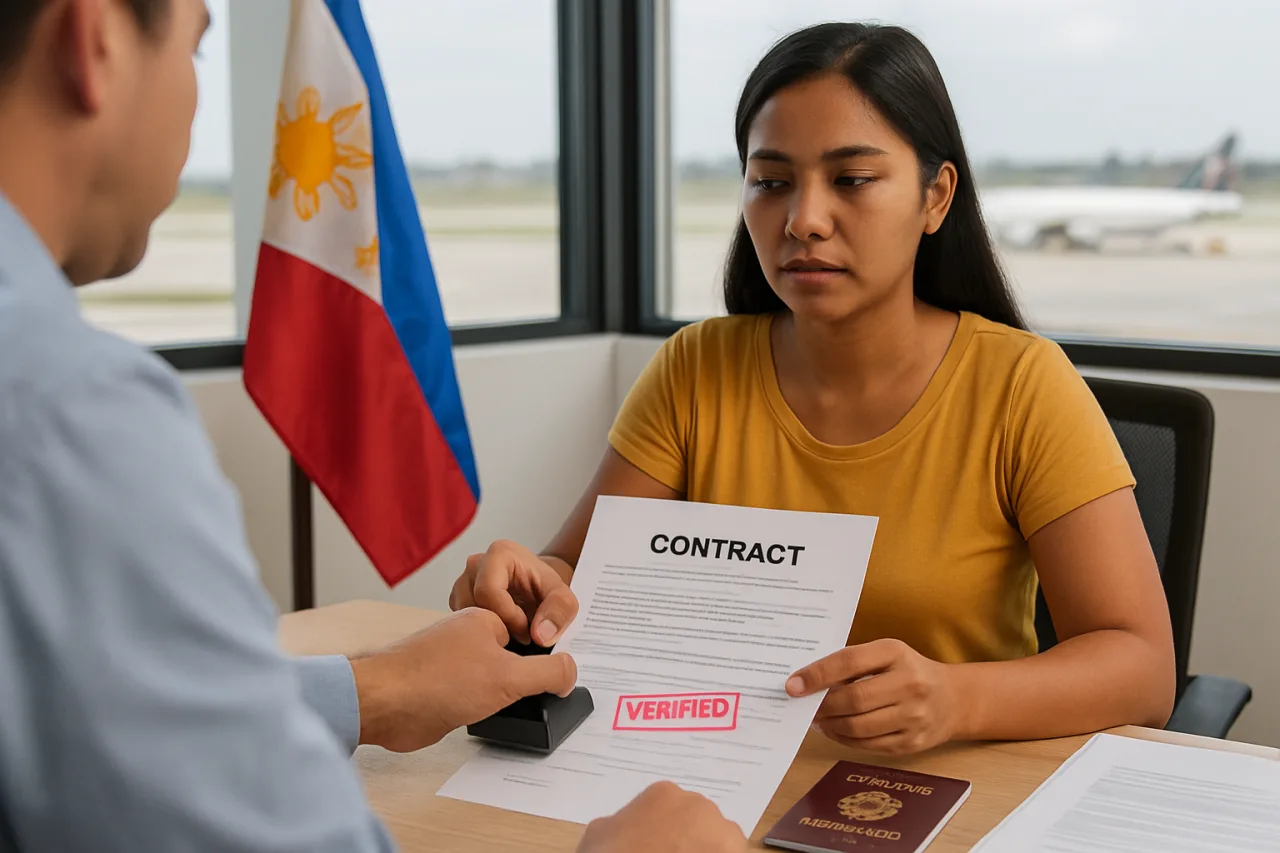
OFW contract verification is the government’s confirmation that a Filipino overseas worker’s employment contract is genuine, complete, and enforceable — checked against Philippine rules on wages, working conditions and employer legitimacy before the worker boards a plane. The Migrant Workers Office abroad (MWO — the renamed POLO) or the DMW in Manila conducts it. OFW contract verification exists because the contract is the worker’s legal shield: the document that names salary, hours, employer obligations, and repatriation promises — and the anchor of every claim OWWA and DMW services can support later, from assistance cases to benefits claims. A worker whose contract was never verified is deploying without the state having seen the terms; that worker cannot complete an OEC, and without the OEC (or its successor, the OFW Pass) the airport cannot lawfully clear the departure.
The verification system also serves the state’s enforcement side. Verified contracts bind the recruiting agency and the employer to the terms Philippine law recognises, which is why the paperwork discipline matters beyond the flight: a verified contract is what turns a salary dispute into a documented welfare case. And the online era made verification the front door of the whole rehire flow — Dubai’s online system alone handled roughly fifty thousand approved contracts in its first three years, before the pilot online system’s full rollout.
Dubai and the Northern Emirates: the online OECVS route
Dubai and the Northern Emirates (Sharjah, Ajman, Fujairah, Ras Al Khaimah, Umm Al Quwain) run the region’s most developed online route — the Online Employment Contract Verification System (OECVS), built by DMW with DataFlow Group. The system went from a July 2025 pilot to the simplified process launched in September — automated compliance checks, clearer notification flow, faster turnaround; MWO-Dubai’s own announcement describes it as the standard path: Simpler. Faster. Clearer.
How the Dubai online route runs: submit at dmw.dataflowgroup.com — scan the employment contract, passport copy, visa, and the OWWA membership certificate; pay the AED 40 verification fee plus the AED 21.50 convenience fee; processing takes about two to four working days; verified contracts download from the system, and the worker proceeds to the OEC stage through the DMW portal. The convenience fee’s honest label, per MWO-Dubai’s FAQ: it goes to DataFlow for system maintenance and validation — it is not a government tax, and the total online cost is AED 61.50, not AED 40. Where does the walk-in queue stand: essentially retired — the standard path is online, and VFS Global appointment-based processing remains a Balik-Manggagawa option for workers who prefer an in-person booking layer.
Singapore: the appointment route
MWO Singapore runs verification as a booked, in-person, same-day-output service — the cleanest counter experience on the map. Step one: set the OFW contract verification appointment under Labor Services via the MWO’s official booking gateway (go.mwosingapore.online). Step two: create or update the worker’s details on the DMW e-registration portal — onlineservices.dmw.gov.ph — which is free. Step three: bring the documentary requirements on the appointment day. Step four: pay the SGD 15 verification fee — cash only. Step five: collect the verified contract and the official receipt — the MWO’s published six-step process — and check every detail before leaving the counter. Workers with previous records receive the generated OEC by email — valid sixty days — and workers without records set the post-arrival appointment at their nearest DMW office in Manila.
Singapore’s route has two nuance rules worth flagging because they save workers an appointment. A simple company name change does not require verification when the UEN (the company registration number) carries over unchanged — though the worker should carry the ACRA name-change certificate for the OEC stage. A promotion or position change DOES require the appointment, with the promotion letter or any company-issued document showing the new position and benefits.
Abu Dhabi and the rest of the MWO map
Abu Dhabi’s POLO/MWO processes contracts at AED 50, with the booking layer published on its own channel and walk-in preserved mainly for urgent cases — the advisory pattern asks workers to book first and call ahead for emergencies. Beyond the Gulf and Singapore, every host country with a significant Filipino workforce runs its MWO’s own verification rhythm — appointment systems, fees in local currency, and processing windows published through the MWO’s advisory channels. The pattern for the worker: the home country’s fee is the lower-cost option when available (Manila’s ₱200 undercuts every offshore counter), and the MWO abroad handles the cases Manila cannot — in-country employer changes, attestation chains, and the emergency lanes.
The fee map workers should remember: Dubai AED 61.50 all-in online · Singapore SGD 15 · Abu Dhabi AED 50 · Manila ₱200. Currency-converted against the peso, the offshore counters in the Gulf cluster together, and Manila remains the cheapest route for workers deployed through the Philippines-side pipeline.
Still in the Philippines: the DMW route
Workers whose contracts are still being processed in Manila run OFW contract verification through DMW direct: register the e-registration account, select contract verification under the OFW services layer — the ₱200 OFW contract verification route that undercuts every offshore counter, upload the scanned contract plus supporting documents, pay the ₱200 verification fee (GCash, Maya, or bank transfer), and receive the confirmation and verified document through the account — typically within a couple of working days, with counter pickup as the fallback. The Manila route is the natural one for new deployments handled through licensed agencies (whose job orders carry the accreditation trail) and for first-time workers completing the full pre-departure stack — e-registration, the pre-employment orientation, the medical from an accredited clinic, and the contract verification that unlocks the OEC.
The document checklist
The document set that satisfies verification across the map — with the honesty label that exact country pages govern: the original employment contract signed by employer and worker; the passport data-page copy (valid well beyond the deployment start); OWWA membership proof; the visa copy matching the contract’s destination; the DMW e-registration printout or account reference; the employer-accreditation trail for agency deployments (the agency’s PEOS/compliance copies); and the payment receipt for the verification fee itself. In-country cases add the change documents: promotion letter, employer-transfer documentation, or the merger/acquisition papers showing the employer’s continuity.
Why contracts get rejected — and how to fix each pattern
Rejections cluster into four fixable patterns, and each costs a flight when discovered late. Pattern one: the unnotarized or unattested contract. Certain hiring routes require attestation or notarization steps before verification — fixed before submission by completing the attestation chain at the Philippine embassy or consulate when no MWO exists in-country. Pattern two: the destination mismatch. The visa copy says one country and the contract another — a rejection trigger and, in some cases, a red flag on the offer itself; the fix is a corrected contract issued for the actual destination (or the visa corrected — the mismatch is a warning the worker checks, not hides). Pattern three: name and license inconsistencies. The employer’s name or license details vary between contract, visa, and agency accreditation; fix by aligning documents to one employer identity and carrying the agency’s accreditation copies. Pattern four: the salary-line error — contract terms that undercut the country’s published floors or the agency’s promised package; the fix is a corrected contract, and the honest note to the worker is that the verification step exists to stop exactly this pattern, so the rejection letter is the system protecting the terms they will live under.
Workers building their pre-departure stack should also run the offer itself through the verification ladder before any OFW contract verification submission — the fake-joboffer pipeline that ends in contract problems at the airport is covered step-by-step in our overseas job scams guide, and the third-country recruitment trap we documented from Dubai shows how a legally-held contract still hides a dangerous offer.
What to watch when fees and rules move
Verification is a moving-target service — fees and process versions change by advisory. The watch list: the MWO-Dubai advisory series (the simplified OECVS launch carried its own announcement and follow-on advisories governing Ramadan hours, VFS alternatives, and emergency lanes); the MWO-Singapore booking portal’s service articles (where fees, cash-policy and process steps are republished when they change); POLO Abu Dhabi’s booking channel; and the DMW portal’s own service pages for Manila-side fees. Each fee change in this guide’s table carries an update trigger — when an advisory changes a currency line or a processing promise, this article updates, because a stale fee map is a wasted trip.
FAQ
How much does OFW contract verification cost per country?
The verified map: Dubai online AED 40 plus AED 21.50 convenience fee (about AED 61.50 all-in), Singapore SGD 15 cash only, Abu Dhabi AED 50, and the Philippines-side DMW route at ₱200 via GCash, Maya or bank transfer. Fees change by MWO advisory — check the latest before booking.
How long does OFW contract verification take?
Dubai’s online OECVS: roughly two to four working days from complete submission. Singapore: same-day at the appointment. Manila-side: typically a couple of working days online. Emergency cases follow the local MWO’s published lanes.
Can I run OFW contract verification online from anywhere?
OFW contract verification runs through country-specific systems: Dubai’s OECVS serves workers under the Dubai and Northern Emirates offices; Singapore’s booking is for workers in its jurisdiction; workers in other host countries use their own MWO’s channels; and workers still in the Philippines use the DMW portal. There is no single global online counter.
What documents do I need for contract verification?
The core set: the signed original employment contract, passport data-page copy, OWWA membership proof, the visa copy matching the contract destination, your DMW e-registration reference, employer-accreditation documents for agency deployments, and the fee payment receipt. Country pages may add items — carry the checklist above to any counter.
Why was my contract rejected?
The four common patterns: missing notarization or attestation, a visa-destination mismatch with the contract, employer name or license inconsistencies across documents, and contract terms that undercut the destination’s salary rules. Each is fixable — correct the documents and resubmit before booking any non-refundable flights.
Is contract verification the same as the OEC?
No. Verification confirms the contract’s terms and legitimacy; the OEC (or its successor, the OFW Pass) is the exit clearance issued after eligibility completes. Verification feeds the OEC: without a verified contract, most workers cannot receive their clearance.