Table of Contents
Key Takeaway

- 🛂 Two machines, one decision: the single exit reentry visa covers one trip at SAR 200 for up to two months; the multiple covers unlimited trips at SAR 500 for up to three months.
- 📈 The ladder is linear: single visas add SAR 100 per extra month (a full year runs SAR 1,200); multiples add SAR 200 per extra month (a year runs SAR 2,300).
- ⚠️ Extending from abroad doubles everything: each extra month costs SAR 200 on a single visa and SAR 400 on a multiple while you are outside the Kingdom, per the fee schedule published this year.
- 👔 For workers, the employer pays: Article 40 of the Saudi Labor Law puts exit reentry visa costs on the employer alongside iqama and work-permit fees; dependents ride on the sponsor’s bill.
- 📊 The machine operates at scale: about 2.8 million exit reentry visas get processed in Saudi Arabia yearly, and around 78 percent of status checks now run through the online platforms.
The plane home was the easy part. The exit reentry visa is what decides whether the seat back gets you home every time, because the paper is the only permission that lets a Saudi resident leave the Kingdom and walk back in on the same residency. Get the type wrong, misjudge the window, or assume an extension is as cheap abroad as it was at home, and the mistake surfaces at the airport counter when it is most expensive. This guide collects the verified fee ladder, the issuance conditions Jawazat actually applies, and the extension arithmetic OFWs keep getting caught by.
Exit Reentry Visa: the Two Types That Matter
Everything hangs on one fork. A single exit reentry visa permits one exit and one return inside its window: the OFW flies out, comes back on the agreed dates, and the visa is spent. A multiple exit reentry visa permits unlimited exits and returns within its validity, which is why family heads on multi-trip arrangements and frequent travelers buy it: leave and reenter as many times as the period allows, according to the fee schedule guides publishing the 2026 tables. Each format serves a different trip pattern, and the price difference is small enough that underbuying, not overbuying, is the usual error.
The scale shows both how common the document is and where errors multiply: roughly 13.4 million expatriates live in Saudi Arabia and about 2.8 million exit reentry visas are processed annually, while 78 percent of status checks now happen online rather than at counters (figures from the Saudi Life Guide’s 2026 check-status manual). The queue has moved to the portal, which means the errors have too.
The Fee Ladder, Verified
The 2026 fee tables (compiled with Royal Decree M/71 attribution in Hasebio’s October 2026 fee guide) run as follows.
| Visa type | Base cost | Covers | Extra months |
|---|---|---|---|
| Single | SAR 200 | Up to 2 months | SAR 100/month (6 months = SAR 600; 12 months = SAR 1,200) |
| Multiple | SAR 500 | Up to 3 months | SAR 200/month (6 months = SAR 1,100; 12 months = SAR 2,300) |
Read the table with your trip pattern, not a calendar. A single trip for a two-week vacation: SAR 200, done. A year of school holidays and emergencies: the 12-month single at SAR 1,200 still fails on the second trip, because singles do not split their window across trips. The multiple exists precisely for the OFW household whose year contains more than one journey.
The Overseas Extension Double
The costliest surprise in the schedule is the doubled rate for extensions requested while you are already outside the Kingdom. Each extra month abroad costs SAR 200 on a single visa (double the SAR 100) and SAR 400 on a multiple (double the SAR 200): two extra months from Manila or Dubai means SAR 800 on a multiple, versus SAR 400 if the same extension had been processed before departure.
The mechanics: the visa period cannot exceed your iqama’s validity in any extension, so an expiring residency caps how far the visa stretches no matter what you pay. And Absher presents the overseas extension as its own service line, so the check-your-status manual’s advice holds: confirm the amount inside the portal before paying, because the fee shown there is the one that binds.
Who Pays, and How It Gets Issued
For a worker, Article 40 of the Saudi Labor Law lands the exit reentry visa cost on the employer, together with iqama renewal and work-permit fees, per the fee guide’s legal citation. A sponsor’s dependents each need their own visa, paid by the sponsoring resident. When an employer hands a worker a bill for the visa the law says the employer owns, the dispute lane already exists: our end-of-service benefits guide covers the deduction rules a departing worker can invoke.
Issuance runs through accounts, not counters: fees go through SADAD under Jawazat services, and the visa itself gets issued in Absher Individuals (for family or domestic workers) or Absher Business and Muqeem (for company employees), by choosing single or multiple, setting the period, and confirming. Print or save the visa before travel; the same platforms later re-verify the visa on demand through the status-query services.
The Conditions Jawazat Applies
- You must be inside Saudi Arabia when the visa is issued. Extensions from abroad are a separate, more expensive branch.
- The iqama must be valid, and the visa’s period stays within the iqama’s validity; an expired residency ends the visa ladder entirely.
- The passport needs at least 90 days of validity, a rule that pairs directly with the document checklist in our OFW passport renewal guide.
- Outstanding traffic fines and government dues generally have to be cleared before the visa issues.
The Airport Counter Reality
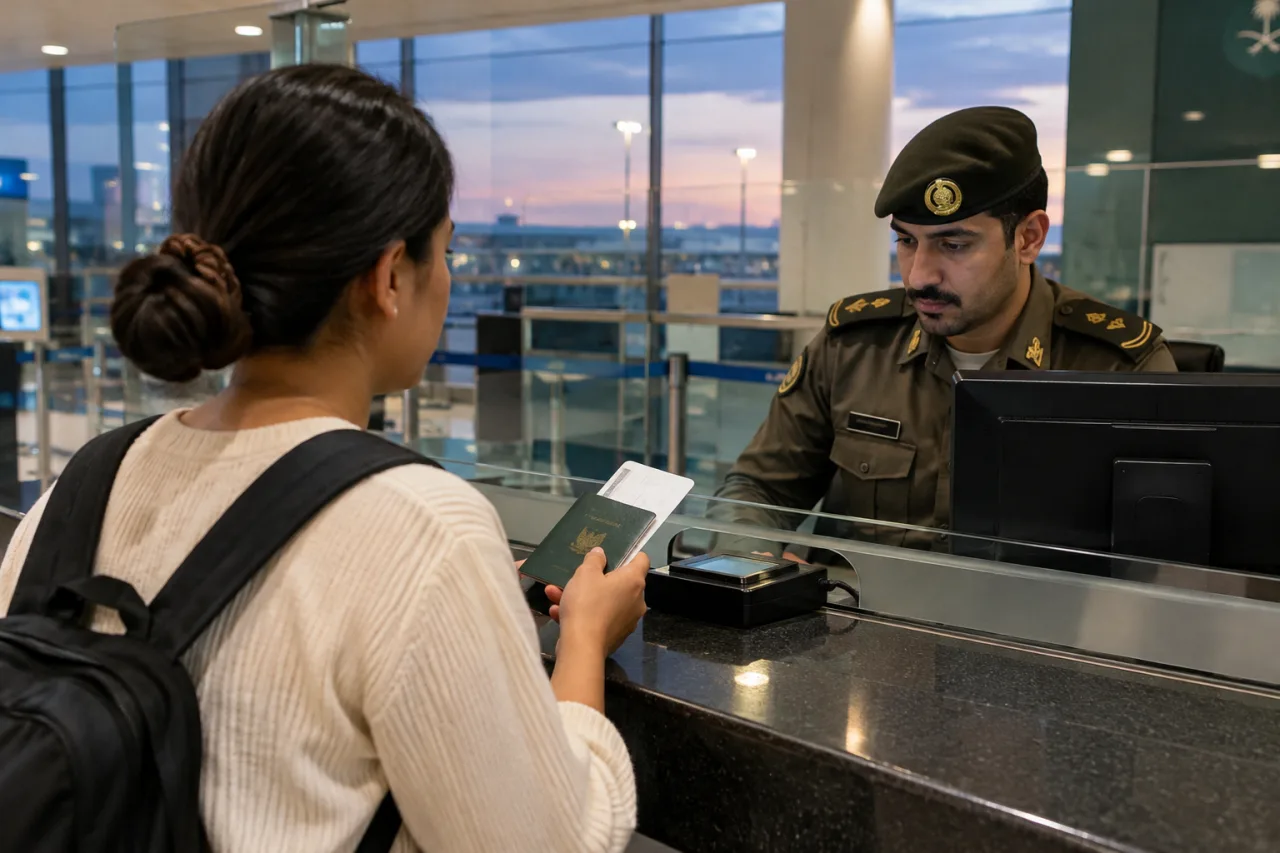
At the departure gate the visa becomes a physical event again. Saudi border officers check the visa against your passport and iqama, and a query that reads “Active” on the portal is what clears you to board; no status means a conversation, and a conversation before the flight rarely ends with the plane. The practical drill is unglamorous and effective: print the visa as well as keeping the PDF on two devices, check the status inside the Absher query window three to seven days before departure while there is still time to fix anything, and screenshot the confirmation. A traveler with matching documents, an in-window visa and a paid-up account never needs the counter to be interesting.
Extending Inside the Kingdom
Extensions processed before departure run at the standard rates and take minutes through the same platforms: the sponsor pays through SADAD, opens the visa service, adds months to the period, and confirms. For company employees the request normally flows through the employer’s Muqeem dashboard, since the establishment account manages the worker’s visa services; family members and domestic workers run through the sponsor’s Absher Individuals account instead. Two conditions still bind every in-Kingdom extension: the visa’s total period never exceeds the iqama’s validity, and any outstanding fines or dues get settled before the system accepts the request. Extensions are the cheapest insurance in the whole schedule, which is why the rule of thumb is simple: extend early, extend at home, extend once rather than three times.
The Return Lane: What Breaks and What Doesn’t
Three failure patterns account for most airport-counter griefs. First, the expired-window return: the visa period ends while the traveler is abroad, and re-entry on that visa is finished; Jawazat’s own guidance states a reentry visa cannot even be converted into a final exit while the beneficiary is outside the Kingdom, so the fix usually costs a new issuance plus the doubled-rate extension math. Second, the cancelled-by-sponsor visa: status queries show “Cancelled” when an employer terminates it, which re-routes the traveler to the labor-dispute lane rather than the airport lane. Third, the used single: status “Used” reads exactly as it says on a multiple? No, on a single: one trip spent, travel done.
Status checks themselves take minutes: Absher Individuals under passport services (Query Exit Re-Entry Visa), or the Muqeem portal for employer-side queries, both listed among the five online check methods the 2026 manuals document. The manual’s timing advice is the part worth copying: verify three to seven days before travel, not the night before, and keep both a printed and a digital copy of the visa.
For the Filipino Household: the Playbook
- Buy the type from the trip, not the price. One planned trip: single. A year with two or more returns (school breaks, emergencies, family events): the multiple at SAR 500 base almost always wins on arithmetic.
- Extend before flying out whenever possible. The same extra month costs half at home: SAR 100 versus SAR 200 on singles, SAR 200 versus SAR 400 on multiples. The doubling is the single most expensive timing mistake in the schedule.
- Check the iqama headroom first. Everything sits inside the residency’s validity; if the iqama expires soon, renewal (per our and the paperwork habits around it, like keeping SSS claims current while abroad) comes before any visa purchase.
- The license rule applies to documents the same way: an OFW driving on a Saudi license carries the same home-validity logic we mapped in the driver’s license renewal guide: renew before the border crossing, not after the return.
- Keep the receipt trail. SADAD payments through Jawazat are the employer’s obligation for workers; receipts are the proof when the deduction fight starts.
FAQ
How much is an exit reentry visa in Saudi Arabia?
A single exit reentry visa costs SAR 200 for up to two months, plus SAR 100 per extra month (SAR 600 at six months, SAR 1,200 at twelve). A multiple exit reentry visa costs SAR 500 for up to three months, plus SAR 200 per extra month (SAR 2,300 at twelve). Each extra month requested from abroad costs double.
How do I extend my exit reentry visa while outside Saudi Arabia?
Use the Absher overseas extension service line, pay the doubled monthly rate (SAR 200 single, SAR 400 multiple per extra month) through SADAD, and confirm the amount shown in the portal before paying. The extension cannot push the visa past your iqama’s validity.
What happens if my exit reentry visa expires while I’m abroad?
The visa is spent and re-entry on it is finished; you need a new issuance process before returning, and Jawazat’s guidance says a reentry visa cannot be converted into a final exit while the beneficiary is outside the Kingdom. Contact your employer immediately, since the sponsor manages the fix.
Who pays for the exit reentry visa, the employer or the worker?
For a worker, Article 40 of the Saudi Labor Law puts the exit reentry visa cost on the employer, along with iqama and work-permit fees. Family dependents need individual visas paid by the sponsoring resident.
Can I use a single exit reentry visa for two trips?
No: a single visa covers one exit and one return, and after that trip its status reads “Used”. Two trips inside the same period require a multiple exit reentry visa, which permits unlimited exits and returns within its validity.
How early should I apply for an exit reentry visa before travel?
Processing averages one to two days, but the smarter margin comes from the check-window habit: apply a week ahead, verify the status three to seven days before departure, and leave room for a correction such as unpaid dues or a passport nearing its 90-day minimum. The status query is free and takes minutes.
Can I get an exit reentry visa for a family member or domestic worker?
Yes: each dependent needs an individual visa, issued through the sponsor’s Absher Individuals account after the fee is paid through SADAD under Jawazat services. Domestic workers are sponsored the same way, and every visa’s period stays inside that person’s own iqama validity.
What is the difference between an exit reentry visa and a final exit visa?
The exit reentry visa is temporary and preserves your residency for return; the final exit ends the residency permanently when you leave. They cannot be interchanged from abroad, per Jawazat’s statement, so the choice has to be made with the sponsor before departure.
The Bottom Line
The exit reentry visa is arithmetic before it is paperwork: pick the type from your trip pattern, buy the extension before the plane, and keep every receipt against the day the employer’s obligation gets tested. The regulator’s platforms do the checking in minutes online, the fee ladder is public and linear, and the doubles only bite travelers who leave their timing to the airport. Two million eight hundred thousand trips a year run on this document; the ones that fail ran on assumptions instead of the table.
- hasebio.com/guides/exit-reentry-visa-fees — Hasebio’s October 2026 fee guide
- saudilifeguide.com/exit-re-entry-visa — the check-your-status manual’s
- bashammakh.sa/en/service-complete-data/711 — re-verify the visa on demand
- saudipress.com/jawazat-reentry-visa-cant-convert-into-final-exi
External sources linked in this article, in order of first mention. Spotted an error or a broken link? Tell us.
Cite this pagePublished Nov 25, 2026
Agron, E. (2026, November 25). Saudi Exit Reentry Visa: the Types, Fees and Extension Rules OFWs Hit. WorldNgayon. https://worldngayon.com/exit-reentry-visa/
Agron, Edmon. “Saudi Exit Reentry Visa: the Types, Fees and Extension Rules OFWs Hit.” WorldNgayon, 25 Nov. 2026, worldngayon.com/exit-reentry-visa/.
Agron, Edmon. “Saudi Exit Reentry Visa: the Types, Fees and Extension Rules OFWs Hit.” WorldNgayon, November 25, 2026. https://worldngayon.com/exit-reentry-visa/.
Agron, E. (2026) ‘Saudi Exit Reentry Visa: the Types, Fees and Extension Rules OFWs Hit’, WorldNgayon, 25 November. Available at: https://worldngayon.com/exit-reentry-visa/.
E. Agron, “Saudi Exit Reentry Visa: the Types, Fees and Extension Rules OFWs Hit,” WorldNgayon, Nov. 25, 2026. [Online]. Available: https://worldngayon.com/exit-reentry-visa/
@online{agron2026exitreentry,
  author       = {Agron, Edmon},
  title        = {{Saudi Exit Reentry Visa: the Types, Fees and Extension Rules OFWs Hit}},
  year         = {2026},
  date         = {2026-11-25},
  organization = {WorldNgayon},
  url          = {https://worldngayon.com/exit-reentry-visa/},
  urldate      = {}
}TY - ELEC AU - Agron, Edmon TI - Saudi Exit Reentry Visa: the Types, Fees and Extension Rules OFWs Hit T2 - WorldNgayon PY - 2026 DA - 2026/11/25/ UR - https://worldngayon.com/exit-reentry-visa/ Y2 - ER -
Cite the version you read; the page may be updated. Zotero and Mendeley can also import this page directly.